Image source: wikiart.org
Introduction
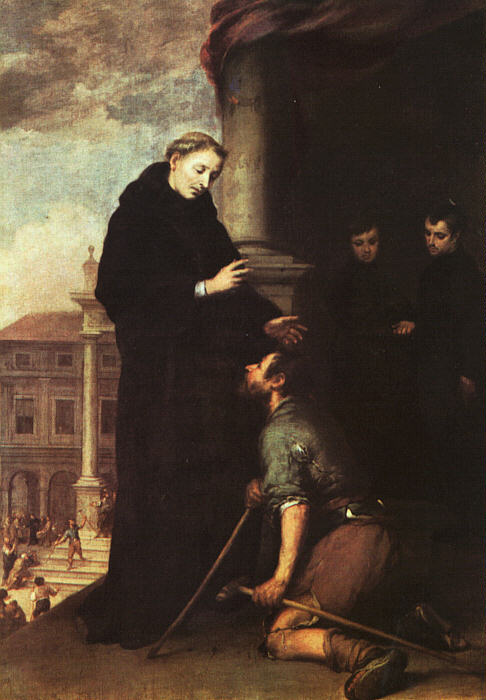
“St. Thomas of Villanueva Distributing Alms” by Bartolome Esteban Murillo is a moving meditation on charity, humility, and the dignity of the poor. Painted in 1668, it shows the Augustinian friar and Archbishop of Valencia in the act that made him famous during his lifetime, giving alms to those who needed it most. Murillo transforms what could have been a dry hagiographic scene into a deeply human encounter between two men, one cloaked in ecclesiastical authority and the other crippled and destitute, yet both equally tenderly observed.
At first glance the painting is dominated by the tall, black robed figure of St Thomas standing near a monumental column. He leans slightly forward as a beggar kneels at his feet, clutching a crutch and raising his face toward the saint with a mixture of hope and desperation. Behind them, two friars look on, and in the distance a square teems with other figures, echoing the wider social implications of the act of charity taking place in the foreground. Through light, color, and careful staging, Murillo presents St Thomas not simply as a dispenser of material aid, but as a living channel of divine mercy.
Historical and Religious Context
St Thomas of Villanueva (1488–1555) was widely venerated in Spain for his radical generosity. As Archbishop of Valencia he used church revenues to establish hospitals, orphanages, and relief for the poor, and he was said to give away his own clothing and food. In the seventeenth century, when Spanish society struggled with poverty and social inequality, he became an exemplary model of Christian charity in action.
Murillo worked in Seville, a city acutely aware of poverty. Epidemics, economic decline, and the presence of large numbers of orphans and beggars shaped its streets. Religious orders ran hospitals and confraternities of charity, and art often served as visual encouragement to these efforts. Murillo’s cycle of paintings on charity, including this canvas, was likely intended for a religious institution that helped the poor. In that context, “St. Thomas of Villanueva Distributing Alms” became both devotional image and moral exhortation.
By 1668 Murillo had perfected his mature style, characterized by warm light, soft modeling, and a gentle, compassionate approach to religious themes. Instead of focusing on dramatic miracles, he preferred scenes where saints work quietly in the world, mirroring Christ’s care for the least and the lost. This painting fits that vision perfectly, presenting charity not as grand spectacle, but as an intimate, everyday act.
Composition and First Impression
Murillo organizes the composition vertically, emphasizing the height of the saint and the steps that connect the architectural background to the street. St Thomas occupies the left half of the painting, his black habit a striking dark mass against the lighter stone architecture and the sky. His body forms a calm, stable axis, contrasted with the twisted posture of the kneeling beggar who leans on his crutch and tilts his head upward.
The kneeling figure is placed diagonally at the bottom, creating a dynamic line that leads the viewer’s gaze from his bare, dusty feet up to his imploring face, then to the hand of St Thomas extended in blessing. Behind the saint, the column and the slight curve of the arch frame his head, creating an almost halo-like architectural nimbus. On the right side, two young friars stand slightly in shadow, their faces attentive, witnesses to the saint’s action.
In the background a square is visible. Tiny figures gather under an arcade, and to the left a group of people moves toward the steps. This distant scene expands the narrative beyond a private meeting, suggesting that the work of charity continues on a larger scale and that countless others also depend on such acts of generosity.
Overall the composition balances solidity and movement. The saint and the column provide vertical stability, while the diagonal of the beggar’s body and crutch, and the horizontal lines of the steps and architecture, animate the space. Murillo thus anchors the divine virtue of charity in a realistic, lived environment.
The Figure of St Thomas of Villanueva
Murillo portrays St Thomas in a simple black habit, rather than in the elaborate episcopal vestments that might have emphasized his rank as archbishop. This choice immediately suggests humility and inner spiritual greatness rather than worldly status. The saint’s posture is gentle and slightly inclined. His right hand is lifted in a gesture that is both blessing and acceptance. His left holds a small purse, the visible sign that he is ready to give material help.
The saint’s face is one of the most striking elements of the painting. Murillo gives him a youthful appearance, with soft features, a high forehead, and pale hair. His expression is serious but compassionate. He does not look beyond the scene or toward the viewer. Instead his gaze rests on the kneeling man before him, fully attentive to the individual in need. That psychological focus is crucial. It reminds the viewer that charity begins not from abstract principles, but from seeing and responding to the concrete person who stands in front of us.
The black habit and the architectural column behind him form a frame that sets him apart, yet he is not distant. His feet stand on the same steps as the beggar. His hand hovers close to the man’s head, ready to touch him. Murillo thus negotiates a subtle balance between the saint’s elevated spiritual role and his solidarity with the poor.
The Beggar and the Theme of Charity
The kneeling beggar is rendered with the same attention to detail and dignity as the saint. He wears worn clothing, his sleeves rolled up, his legs bare. Muscles, veins, and dirt are carefully modeled. His right knee rests on the step, while his left leg stretches behind, almost stumbling, suggesting the physical weakness that forces him to rely on crutches.
His face is turned upward, eyes fixed on St Thomas. Murillo paints him with a mix of hope and vulnerability. The parted lips, the furrowed brow, and the clasped hands pressed to his chest convey both petition and gratitude. He is not anonymous. He is an individual whose suffering and story we can imagine. This humanization of the poor is one of Murillo’s hallmarks. He often gave the poor the same careful characterization he reserved for saints and nobles.
In the beggar’s hands, the crutches are not mere props. They symbolize human frailty and the burdens that weigh on the marginalized. By reaching toward the saint’s hand, the beggar reaches not only toward financial help, but toward recognition and compassion. The encounter suggests that charity is not a one sided transaction, but a meeting where both giver and receiver are transformed.
Architecture, Setting, and the Public Stage
The scene takes place on the steps of an imposing building, likely representing a church or episcopal residence. The heavy column beside St Thomas and the grand façade in the background emphasize the institutional dimension of charity. This is not simply the personal kindness of one man. It is the duty and privilege of the Church and of society as a whole.
Murillo paints the architecture with soft clarity, yet avoids excessive detail. The light stone contrasts with the saint’s dark habit, and the arch frames the main figures. To the left, other buildings and arcades open onto a large square. Tiny figures move about, suggesting a bustling city filled with daily business and human drama. That distant crowd reminds the viewer that poverty is widespread, and that the beggar at the saint’s feet represents many unseen others.
By positioning the meeting on the steps, Murillo marks a threshold between private interior and public exterior. Charity happens at this threshold. St Thomas, who comes from within the institution, steps outward to meet those who live on the margins. The beggar, in turn, moves upward toward the door of the Church. It is a visual metaphor for spiritual and social inclusion.
Light, Color, and Atmosphere
Murillo’s handling of light gives the painting its emotional warmth. A soft, golden illumination enters from the left, bathing the faces of both saint and beggar. Their meeting becomes the brightest area of the composition. In contrast, the background architecture and the figures of the friars remain partially in shadow. The effect is like a focused spotlight, but rendered in gentle, naturalistic tones.
The color scheme is restrained, dominated by earth tones, black, and warm browns, enlivened by small accents. The saint’s black robe anchors the palette, while the beggar’s muted clothing merges with the stone steps. The sky and distant square are painted in cool blue grays, creating depth. The only strong color accent lies in the red curtain that hangs from above, partially framing the scene and hinting at the presence of an interior space behind the column.
This warm, unifying light creates a sense of calm and reverence rather than theatrical drama. It suggests that divine grace is quietly present in acts of mercy. Murillo avoids harsh contrasts that might turn the scene into a moralistic lesson. Instead, the viewer is invited into a contemplative mood, drawn by the tender glow that surrounds the central encounter.
Murillo’s Naturalism and Emotional Appeal
One of Murillo’s strengths is his blend of naturalism and idealization. In this painting the figures are convincingly real, yet softened by a gentle idealizing touch. The anatomy of the beggar is accurate; his muscles, rough beard, and grime are carefully rendered. Yet his features retain a noble dignity. Likewise, St Thomas, though depicted as a canonized saint, has the approachable look of a real Sevillian friar.
Murillo’s brushwork is loose in certain areas, especially in the background, where figures and architecture dissolve into broad strokes of color. This keeps the viewer’s eye from getting lost in detail and directs attention toward the main narrative. In the faces and hands, however, the modeling becomes more precise. Expressions are carefully modulated. The saint’s modest, almost hesitant gesture and the beggar’s intense gaze produce a powerful emotional connection without resorting to melodrama.
This emotional appeal was crucial to Counter Reformation art, which sought to move the faithful to devotion through affective images. Murillo achieves this through empathy rather than fear. The painting does not threaten the viewer with punishment for neglecting the poor. Instead it offers the example of a saint whose compassion is attractive and imitable.
Symbolism and Theological Meaning
Although the scene appears simple, it is rich in symbolic meaning. The act of almsgiving is, in Christian theology, both a corporal and spiritual work of mercy. By extending his hand, St Thomas serves as Christ’s representative, healing not only physical need but spiritual loneliness. The column behind him may symbolize the firmness of faith and the Church’s support.
The beggar’s crutches signal human weakness, including the spiritual poverty that afflicts all people. His kneeling posture evokes penitence and hope in divine mercy. In some interpretations, the beggar can be seen as an image of Christ himself, for in Matthew’s Gospel Christ identifies himself with “the least of these.” If so, the painting suggests a profound reversal: the saint, in giving alms to the poor, encounters Christ in disguise.
The presence of the two friars introduces a communal dimension. They represent the religious community that witnesses and perhaps continues the saint’s mission. Their slightly shadowed place implies that sanctity shines most clearly in acts of self giving love, which they are called to imitate.
In the background square many other smaller figures can be seen. Some appear engaged in trade or conversation. Their presence hints that charity must extend beyond a single episode to address systemic needs. Yet Murillo does not turn the painting into a social critique. His focus remains spiritual and moral: the inner disposition of generosity that transforms the giver and honors the receiver.
Place within Murillo’s Oeuvre and Baroque Art
“St. Thomas of Villanueva Distributing Alms” belongs to a wider group of works by Murillo that highlight charity and compassion. Paintings such as “St Elizabeth of Hungary Giving Alms to the Poor” and his scenes of beggar children show a similar sensitivity to the plight of the marginalized. Unlike some Baroque artists who favored heroic martyrdom or spectacular miracles, Murillo’s saints are often portrayed in everyday acts of kindness.
Stylistically the painting demonstrates the soft, luminous manner that made Murillo so influential in Spain and abroad. His handling of light and color anticipates elements of later Rococo tenderness, yet remains grounded in Baroque realism. Compared with the energetic dynamism of Italian Baroque, Murillo offers a more intimate, contemplative vision. Movement is present, but subordinated to mood.
Thematically the painting reflects Counter Reformation priorities. The Council of Trent encouraged art that was clear, instructive, and emotionally persuasive. By choosing a contemporary Spanish saint known for charity, Murillo provided viewers with a concrete, local model rather than a remote ancient figure. In doing so he connected spiritual ideals to real social issues, such as poverty in seventeenth century Seville.
What This Painting Communicates Today
For a modern viewer, “St. Thomas of Villanueva Distributing Alms” still speaks powerfully. The contrast between the saint’s dark, simple habit and the beggar’s rough clothing evokes perennial questions about inequality and responsibility. Who are the “St Thomases” of our age, and how do we respond to those whose lives are broken by illness or economic hardship
The painting invites us to see the poor not as anonymous masses, but as individuals with faces and stories. Murillo’s tender treatment of the beggar encourages empathy rather than judgment. At the same time, the beauty of the saint’s interior peace suggests that charity enriches the giver as much as the receiver.
The architectural setting and the presence of other figures in the background remind us that acts of mercy have a communal dimension. They are not only private choices but shape the ethos of cities, institutions, and societies. Murillo’s work gently challenges viewers to imagine a world in which the powerful and the vulnerable meet on the steps of shared humanity.
Ultimately, this painting stands as a visual homily on the transformative power of compassion. Through subtle gestures, harmonious composition, and luminous light, Murillo shows that holiness is not an abstract ideal but a way of relating to others. The saint, the beggar, and even the quiet friars in the background become mirrors in which viewers can recognize their own call to give, to receive, and to see one another with the eyes of mercy.