Image source: wikiart.org
Introduction
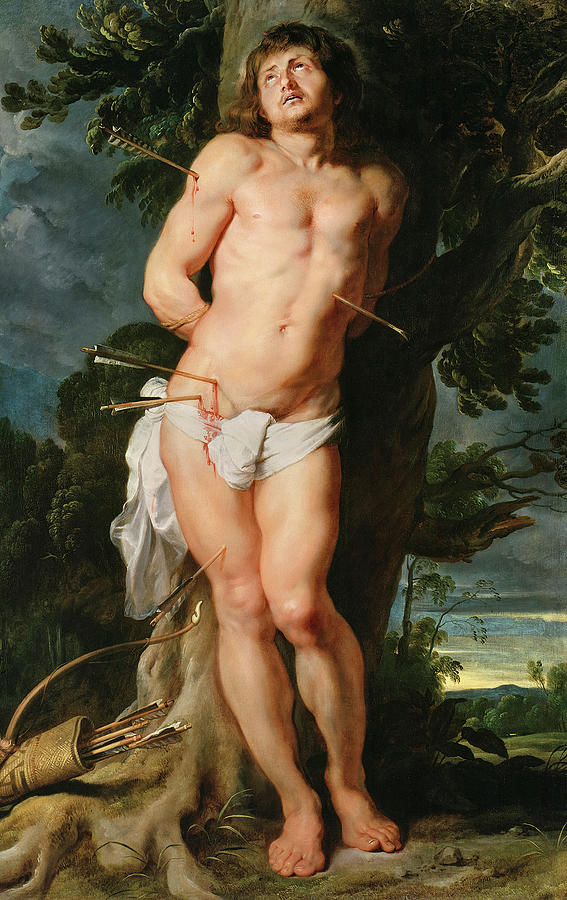
Peter Paul Rubens’s “St. Sebastian” of 1614 is one of the most arresting male nudes of the early Baroque. The martyr stands bound to a gnarled tree, his body punctured by arrows that track across the flesh like vectors of fate. Storm clouds coil behind him, a river valley opens to distant light, and a quiver lies toppled at his feet like a spent instrument. With astonishing tactility—the weight of muscle, the satin cling of a small white cloth, the bead of blood about to fall—Rubens turns a martyrdom into a meditation on grace under pressure, devotion in the face of pain, and the precarious beauty of living flesh. The canvas fuses classical anatomy with Counter-Reformation feeling, producing an image that is at once heroic, vulnerable, and profoundly human.
The Legend Behind the Image
Sebastian, a Roman officer in the reign of Diocletian, was condemned for his Christian faith and shot with arrows by his own soldiers. Left for dead, he was nursed back to health by Irene of Rome and ultimately beaten to death after confronting the emperor. Baroque painters favored the first episode because it permits a solitary figure, a clear emblem of steadfast faith, and a powerful vehicle for the male nude. Rubens distills the tale to a single, charged moment after the volley: the rope is taut, the arrows are still vibrating in the air, and the saint’s face turns upward, not toward the archers but toward a source of light that reads as divine attention. The legend’s didactic core—constancy amid persecution—arrives through anatomy, light, and gesture rather than narrative clutter.
The Baroque Body as Theology
Rubens builds Sebastian’s body as a theological argument. The torso is modeled with a sculptor’s eye, the pectorals and abdomen swelled by breath rather than flexed by exertion. A gentle contrapposto sets the right hip forward and the left shoulder back, forming a supple S-curve that registers life, not rigidity. This serpentinata is the physical sign of an interior poise: though pierced and bound, Sebastian is not broken. The neck’s extension and the parted lips give the sense of prayer in the moment between exhalation and speech. Rubens’s flesh is famously alive; here it becomes the medium of martyrdom and miracle. In a Catholic visual culture that insisted grace is embodied—in sacraments, relics, and living devotion—Sebastian’s breathing, bleeding presence is itself an argument for faith.
Classical Memory and Contemporary Urgency
Rubens had studied antique sculpture and Michelangelo in Italy. In “St. Sebastian,” echoes of the Belvedere Torso and the Farnese Hercules shape the monumental trunk and powerful thighs. Yet the image refuses to fossilize into a quotation. Where classical marbles freeze an ideal, Rubens’s paint loosens it into life: the skin flushes at the arrow wounds, fine hairs catch light on the forearm, and the toes flex against the tree’s rough bark. The classical past supplies a grammar; the Baroque present animates it into speech. That synthesis explains why the figure reads at once timeless, like a hero rescued from antiquity, and immediate, like a living man whose next breath we can almost hear.
Choreography of Arrows
The arrows are more than props. They choreograph the way a viewer reads the painting. One enters at the left where a shaft pricks the skin below the clavicle and exits diagonally toward the right flank; another dashes across the abdomen; yet another pierces the thigh, angling back toward the quiver on the ground. These lines draw counter-movements across the figure’s organic S-curve, generating a cross-rhythm of pain against poise. The few drops of blood are carefully rationed, each a small red punctuation mark that clarifies the paths of penetration. Rubens keeps the gore minimal so that empathy does not become nausea; the focus stays on the man’s spiritual orientation rather than his bodily ruination.
The Tree as Second Body
The saint is lashed to an oak whose twisted trunk and thick bark function as a second body. The swell at the base of the tree echoes Sebastian’s thigh; the knotty hollows mirror the shadowed pauses along his ribcage and hip. This correspondence has been noted in depictions of Sebastian since the Renaissance, but Rubens intensifies it. The tree is a patient witness, older than the empire that ordered the execution and older than the church that will later venerate the martyr. It is also a visual foreshadowing of another execution carried out on wood: the Crucifixion. Without a painted cross, Rubens invokes the Cross through arboreal rhyme.
The Space Between Storm and Clearing
The sky is a narrative. Immediately behind the saint, dark clouds churn in thick, bluish masses, their edges enunciated by flashes of cooler light. To the right, across a river valley, the atmosphere brightens into a silvery afternoon. Rubens does not paint a single weather; he paints a weather front, a turning. The saint’s upturned face catches a glimmer that belongs to the clearing rather than the storm, quietly aligning his hope with the meteorology of salvation. The distant landscape is calm, as if somewhere beyond this hillside the ordinary world goes on. That juxtaposition—an intimate catastrophe and the serene persistence of nature—deepens the pathos without resorting to spectacle.
The Language of Light
Rubens uses light as rhetoric. It falls from the right and arranges the figure into zones of meaning. The forehead, cheekbones, and the plane of the chest glow as if warmed by an unseen presence, while the left side—the arm near the tree—contracts into soft shadow. The white loincloth holds the brightest whites, staging a chaste triangle of attention that separates the saint’s exposed body from voyeurism. Such luminosity is not only descriptive but interpretive: it argues for the saint’s interior light by bathing his exterior in a sympathetic glow. The skin’s sheen is constructed with translucent glazes over a warm ground, then pricked by opaque highlights that flicker like breath across the surface.
Intimacy of Wounds
Rubens is attentive to the physiology of pain without indulging in horror. The wound at the upper chest puckers slightly where the shaft enters; the blood threads down the torso in a thin, precise line; the abdomen tightens into a reflexive half-spasm; the left thigh registers a deeper penetration with a fuller bloom of red. Each mark is personalized, as if the body were telling us exactly how it receives the world. This intimacy of wounds makes the saint’s serenity all the more persuasive. He is not anesthetized; he is attentive to pain and attentive beyond it.
Erotic Tension and Devotional Aim
Sebastian has long served as a locus of erotic tension in Christian art because the iconography grants a nearly nude male figure to sacred painting. Rubens neither suppresses nor exploits that tension. The flesh is undeniably sumptuous, the pose open, the gaze soft. Yet everything in the painting directs desire beyond possession toward compassion. The viewer’s attraction is translated into fellow-feeling; the beauty of the body becomes the ground for the beauty of self-offering. This delicate conversion—from eros to agape—is one of the image’s ethical achievements and helps explain why the saint became an intercessor against plague: the wounded body calls forth healing love.
Counter-Reformation Context
Antwerp in the 1610s was a Catholic stronghold energized by new altarpieces, processions, and devotional images. Rubens, returned from Italy and newly established with a bustling studio, supplied the visual language of that renewal. “St. Sebastian” fits this climate perfectly. It is clear, legible, and affective, capable of speaking to unlettered devotion and learned taste alike. While it could have served in a private chapel, it also functions as a portable sermon on steadfastness. In a city acquainted with epidemics, Sebastian—the plague saint—would have carried special urgency. The arrows that pierce him had long been likened to the “arrows” of pestilence; his endurance promised protection.
The Grounded Foreground
At the base of the composition, Rubens orchestrates a small still life that quietly anchors the drama. A quiver and several spent arrows lie near the roots of the tree; grasses bend underfoot; a strip of broken bark tilts toward the viewer. These low objects push the saint forward into our space, making the encounter immediate. Their textures are varied with loving accuracy: the quiver’s leather absorbs light; the arrow shafts gleam along their varnished grain; the grasses catch tiny highlights like dew. This attentiveness to the humble foreground refuses to let the painting float away into allegory. The martyrdom happens on the ground we share.
The Discipline of Color
Rubens restricts his palette to a disciplined harmony. The flesh ranges from warm rose to honeyed tan, cooled by slate shadows and enlivened by the sharp accents of arterial red. The loincloth contributes a clean, matt white that calibrates the entire value scale; the tree’s sap greens and brown-ochres supply the earth register; the sky offers ever-shifting blues and grays. Because the chroma is measured rather than flamboyant, the eye never tires. Instead, small passages—the pink around an arrow wound, the blue reflected light just under the ribcage—keep refreshing the sensation of proximity.
Brushwork and Material Presence
Rubens’s surface rewards close viewing. Long, elastic strokes model the rounded thigh; small, feathery touches describe down on the torso; a loaded brush draws the crisp edge of the loincloth; the tree’s bark is scumbled with dry pigment to mimic roughness. Glazes deepen the shadows without opacity, allowing the warm ground to glow through and generate an inner light. These procedures are practical, but they also bear metaphorical weight: the painting is about the vulnerability and resilience of flesh, and the surface itself becomes an enactment of that theme—thin veils layered over strength, transparency and density held in tension.
Time Suspended
One of the picture’s most striking effects is the way it suspends time. The arrow shafts still hum with their flight; the ropes still hold their last tightening; the saint’s eyes are not closed in death but lifted in an unfinished address. Everything is on the cusp. Rubens achieves this with careful control of diagonals. The arrows are quick slashes that promise movement; the vertical tree is a stern halt; the S-curve of the body negotiates between the two, sustaining a poised present. The viewer senses both the past—the volley just delivered—and the future—companions approaching to cut him down or soldiers returning to verify execution—without either being painted.
Landscape and the World Beyond Suffering
The open valley at the right edge conducts a quiet counter-argument to the immediate pain. Fields glow, a watercourse threads to a far horizon, and a strip of sky breaks to a pale, benedictive light. This is not mere backdrop. It says that the world is larger than the scene of suffering and that creation itself participates in consolation. In many Baroque devotional works, the landscape serves as an emblem of divine order. Here it is an atmospheric theology: humidity, light, and distance compose a soft promise held just beyond the saint’s reach.
Devotional Use and Viewer Response
The painting is calibrated for prolonged, private contemplation. The scale of the figure creates a one-to-one encounter; the gaze angled heavenward invites the viewer to occupy the saint’s line of sight; the moderate pathos allows one to dwell in empathy rather than recoil from horror. In a chapel or domestic oratory, such an image would support prayers for courage, protection, and fidelity. The emotional range is broad enough to receive many petitions. The saint’s body is both shield and mirror: one can stand behind it as under protection, or one can see oneself in it—wounded yet upright.
Rubens and the Ethics of Beauty
A frequent modern anxiety about Sebastian pictures is whether beauty trivializes suffering. Rubens answers by having beauty carry ethical weight. The splendor of the body does not cancel the pain; it dignifies the person enduring it. The saint’s loveliness is not a passive spectacle but an active testimony that human form, even under assault, remains a vessel of meaning. The painting thus works as a defense of embodiment against any doctrine that would denigrate flesh as merely corrupt. In a culture where plague, war, and famine were common, such an image of radiant endurance was more than aesthetic—it was moral medicine.
Iconographic Economy
The picture’s economy is masterly. There are no onlookers, no archers, no angels collecting arrows. A single tree, a single man, a handful of shafts, a pocket of landscape: these suffice. The restraint gives each element symbolic density. The tree becomes a scaffold, a cross, a witness. The rope becomes both instrument of capture and line of connection to the divine (for his arms are raised by it). The loincloth becomes a banner of chastity. The arrows become the world’s afflictions—disease, persecution, calumny—without which the saint’s love would lack occasion to prove itself.
From Studio to World
By 1614 Rubens presided over a thriving Antwerp workshop, but the touch in this painting feels intimately his. Assistants may have laid in parts of the landscape or ground, yet the body’s articulation and the crucial passages of light announce the master’s hand. The painting also reflects his experience as a diplomat of images, someone who could reconcile classical taste, ecclesiastical demands, and popular devotion. That diplomatic competence is visible here: the work speaks to scholars and sailors, canon lawyers and widows, without dilution.
Enduring Relevance
Contemporary viewers, whether or not they share the theology, often find “St. Sebastian” disarmingly modern. Its questions are perennial. How does one remain open when wounded. How does one hold integrity under constraint. How can beauty and pain coexist without canceling each other. The painting does not answer by argument but by presence. It shows a man receiving the world’s violence without surrendering the clarity of his gaze. In that posture, many recognize not only a saint but a pattern of resilience applicable to their own lives.
Conclusion
“St. Sebastian” is a compact epic. In one figure and a tight slice of landscape, Rubens stages a drama of faith, eros, storm, and light. Classical memory animates a modern urgency; painterly flesh bears spiritual meaning; the world’s cruelty leaves marks that do not erase serenity. Few paintings hold such a poised balance between pathos and poise, distance and touch. To stand before it is to feel how the Baroque could harness beauty to moral seriousness, and how painting can still, centuries later, tutor the gaze in courage.
