Image source: wikiart.org
Introducing Francisco de Zurbaran’s “St. Rufina of Seville”
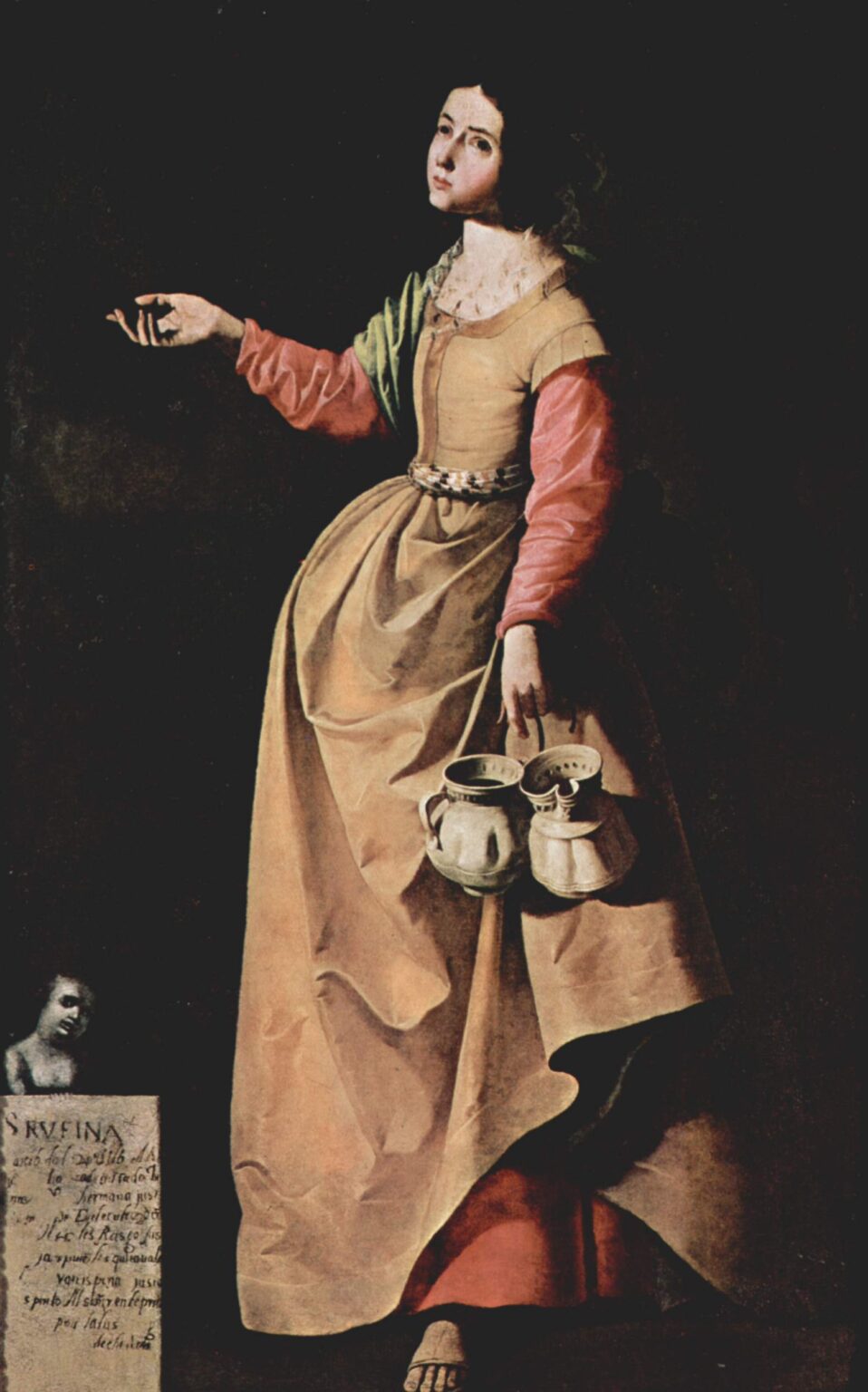
Francisco de Zurbaran’s “St. Rufina of Seville,” painted around 1640, is a luminous celebration of a local saint who was deeply loved in Baroque Spain. The work presents St Rufina alone, nearly life size, standing against a dark and undefined background. She looks out toward the viewer with a gentle, thoughtful expression, while in her right hand she holds a trio of earthenware jugs, the symbol most closely associated with her legend.
Zurbaran’s painting belongs to a series of female saints painted for Sevillian churches and convents. Each figure is shown full length, elegantly dressed, and isolated against a dark ground. Yet Rufina has a special resonance because she was one of the patron saints of Seville, a martyr who according to tradition was a potter’s daughter from the city’s famous ceramic quarter of Triana. By setting her in sumptuous clothing and giving intense attention to the jugs in her hand, Zurbaran connects her spiritual heroism to the everyday world of Sevillian artisans and merchants.
The painting demonstrates Zurbaran’s mastery of portraitlike saintly images, where psychological presence, carefully rendered fabrics, and symbolic objects work together to create an image that feels at once intimate and monumental.
The Legend of St Rufina and Her Sevillian Roots
St Rufina, together with her sister St Justa, was said to be the daughter of potters in Seville during the time of Roman persecution. They earned their living by selling ceramic vessels. When a pagan festival demanded that they provide idols or offerings, the sisters refused. One legend recounts that they smashed a statue of a goddess that had been placed in their stall, an act of defiance that led to their imprisonment and martyrdom.
Because of this story, Rufina and Justa became guardians of potters and artisans and ultimately protectors of the entire city, especially during earthquakes and other catastrophes. In Seville, whose wealth relied heavily on trade and crafts, their cult was very strong. Devotional images of the two sisters often include the jugs and pots of their trade, transforming everyday objects into emblems of faithfulness under pressure.
Zurbaran painted both saints in separate canvases, giving each her own space. In “St. Rufina of Seville,” he focuses on her as an individual, highlighting her quiet courage. The jugs she holds recall the world of Triana’s kilns and workshops, connecting the lofty idea of martyrdom with the lived experience of Sevillian viewers.
Composition and the Graceful Standing Figure
The composition is straightforward yet full of subtle movement. Rufina stands slightly off center, her weight resting on one leg while the other steps forward. This contrapposto stance gives her a natural elegance. The long, tawny dress flows nearly to the floor, broken by a glimpse of red underskirt and the simple sandal on her foot.
Her torso twists gently as she extends her left arm outward, palm facing upward, as if offering something invisible or addressing an unseen presence. Her right arm hangs downward, fingers curling around the handles of three ceramic jugs that cluster near her hip. The diagonal line created by her left arm, paired with the vertical column of her body, sets up a dynamic but balanced rhythm.
The background is a deep, velvety darkness that contains no architecture or landscape. The only interruption is the small stone plaque in the lower left corner, inscribed with text and topped by a small sculptural bust. This device anchors the saint in a specific identity. It functions like the label on a statue, announcing that this is St Rufina, virgin and martyr. Yet because the text remains unobtrusive, the viewer’s main encounter is with the living figure rather than with inscriptions.
Zurbaran’s Use of Light and Shadow
Light enters the scene from the left, bathing Rufina’s face, neck, and upper torso. It glides down her dress and catches on the metallic rims of the pots, leaving the right side of her body and the background in deep shadow. This controlled chiaroscuro is typical of Zurbaran. Rather than an aggressive spotlight, the illumination is gentle and focused, lending the scene a contemplative atmosphere.
The light has a sculptural effect on the figure. It models the planes of her face with subtle transitions, emphasizing her youth and seriousness. On the fabrics, the light creates complex patterns of highlights and soft shadows, suggesting the thickness and weight of the cloth. The jugs gleam with small reflections that affirm their solid, clay material.
The darkness enveloping her has a double significance. It simplifies the visual field, ensuring that nothing distracts from the saint, and it also evokes the spiritual idea of the world’s confusion or persecution surrounding a believer who stands in the light of truth. Rufina literally emerges from darkness, carving out a space of clarity and quiet conviction.
Costume, Color, and Social Identity
Rufina’s dress is one of the painting’s most striking features. Zurbaran clothes her not in simple peasant garb but in attire more befitting a well to do young woman of seventeenth century Seville. This reflects a recurring pattern in his female saints, many of whom are portrayed as elegant Spanish ladies, even when their historical circumstances were more humble.
Her main gown is a warm beige or ocher tone, cinched at the waist by a decorative belt and gathered in soft folds across the skirt. Underneath, a red garment appears at the sleeves and hem, providing a vivid accent. Draped over her shoulders is a light greenish shawl that falls down her back, creating a diagonal band of cooler color that contrasts with the earthy tones of the dress.
The colors have both aesthetic and symbolic resonance. The red hints at martyrdom and love, the green at hope and renewal, and the neutral beige at humility and earthiness, appropriate for a potter’s daughter. The harmony of these tones, subdued yet rich, reinforces the sense of an interiorly balanced personality.
By presenting Rufina as a dignified young woman in fine dress, Zurbaran acknowledges that sainthood is compatible with social refinement. In the context of Sevillian convents and lay confraternities, this image would have offered an attractive model of pious femininity for women of similar background.
The Ceramic Jugs as Emblems of Vocation and Martyrdom
The three jugs Rufina carries are crucial to the painting’s meaning. They are not casual props but carefully rendered objects that speak directly to her story. Their slightly varied forms suggest real examples of Sevillian pottery, likely familiar to viewers of the time. Zurbaran treats them with the same seriousness and attention he gives to sacred objects in other works.
On a literal level, the jugs refer to her occupation and that of her family. They remind us that her sanctity emerged within the ordinary routine of making and selling pots. On a symbolic level, they suggest generosity and service, since vessels hold water, oil, or food that can be shared with others.
Within the legend, the sisters’ refusal to supply objects for pagan rituals marked their break with idolatry. One might see the jugs here as purified versions of that earlier trade, no longer associated with false worship but with Christian charity. In Rufina’s hand they become trophies of faithfulness, not merely tools of commerce.
Their weight also matters visually. The way her right arm hangs and her hand grips the handles suggests that the jugs have substance. They pull slightly downward, counterbalancing the upward and outward gesture of her left arm. This physical tension between the two sides of her body echoes the spiritual tension between earthly responsibilities and heavenly calling.
Facial Expression and the Inner Life of the Saint
Rufina’s face is luminous and introspective. She is shown in three quarter view, with her head gently inclined and her eyes gazing slightly upward. Her lips are closed, the corners neither lifted nor heavily pulled down. There is a hint of softness in her mouth and a subtle longing in her eyes, which might suggest prayer or quiet resilience.
Unlike dramatic martyrdom scenes, this image focuses on the moral decision preceding suffering rather than on the suffering itself. Rufina does not display visible wounds or instruments of torture. Instead, her expression conveys readiness, as though she has already chosen her path and is now calmly awaiting whatever consequences may come.
Zurbaran avoids excessive idealization. Her nose is slightly prominent, her cheeks delicately rounded, and small irregularities in skin tone contribute to a sense of realism. These details make her more approachable, a figure with whom viewers might identify rather than a remote celestial vision.
The Inscribed Plaque and the Bust
In the lower left corner, a stone tablet bears an inscription and supports a small sculpted head. This element grounds the image historically and iconographically. The head likely represents the pagan idol that Rufina and Justa shattered, an act that triggered their persecution. Its placement beneath her feet and to the side signals the defeat of idolatry.
The inscription identifies the saint and perhaps summarizes aspects of her life and martyrdom. In the context of a church or convent, such text would help viewers learn about her, especially if they were less familiar with her story. Yet Zurbaran keeps it relatively small and unobtrusive, so that the reading of words does not overshadow the visual encounter with the figure herself.
The combination of painting and sculptural motif also creates an interesting interplay between living presence and carved stone. The bust, lifeless and white, contrasts with Rufina’s warm skin and flowing garments. It underscores that the old gods were mere stone, while true faith is embodied in a living person.
Zurbaran’s Female Saint Series and the Ideal of Charity
“St. Rufina of Seville” should be seen alongside Zurbaran’s other full length female saints, such as St Casilda, St Apollonia, and St Agnes. These works form a kind of spiritual gallery of Christian womanhood as understood in seventeenth century Spain. Each saint embodies a particular virtue. Casilda exemplifies mercy to prisoners, Agnes purity, Apollonia constancy in suffering, and Rufina steadfastness in faith joined with humble labor.
For convents and pious households, such paintings functioned as mirrors of identity. Women could see models of holiness wearing clothing similar to their own and standing in dignified poses. The message was that sanctity could grow within their own social roles, whether as nobles, merchants’ daughters, or artisans.
Rufina in particular speaks to the value of work and trade. Her jugs point not to renunciation of the world but to its transformation. The same hands that shaped clay and handled money become hands that witness to the Gospel. Zurbaran’s image invites contemplation of how ordinary tasks can become acts of faith.
Emotional and Spiritual Resonance Today
For modern viewers, “St. Rufina of Seville” retains a surprising freshness. The painting’s restrained drama and focus on a single figure make it easy to approach. One does not need detailed knowledge of the legend to feel the quiet strength in her stance and the tenderness in her face.
The combination of practical object and spiritual meaning also speaks to contemporary concerns. In a world where daily work can feel disconnected from deeper values, Rufina’s jugs remind us that vocational tasks, however humble, can be places of moral choice and generosity. Her calm gaze encourages reflection on how we use our professions and skills in service to others rather than to selfish ends.
Additionally, the painting offers a nuanced image of feminine strength. Rufina is neither passive nor aggressively defiant. Her firmness is expressed through steadiness, not spectacle. She represents a form of resilience grounded in conscience and compassion, a quality still deeply admired today.
Conclusion
Francisco de Zurbaran’s “St. Rufina of Seville” is far more than a decorative portrait of a beautiful young woman. It is a carefully constructed meditation on vocation, courage and charity rooted in the everyday world of Sevillian artisans. Through subdued yet rich color, masterful use of light and shadow, and thoughtful attention to gesture and expression, Zurbaran gives Rufina a presence that is at once regal and approachable.
The ceramic jugs she carries recall both her humble origins and her courageous stand against idolatry. The inscribed plaque and small bust connect her to specific historical and legendary details, while the dark background and luminous face lift the image into the realm of contemplation.
Standing quietly in her simple sandals, poised between light and darkness, between work and worship, St Rufina becomes a timeless symbol of faith lived out in the midst of ordinary life. Zurbaran’s painting continues to invite viewers into the same posture of readiness and generosity, calling them to consider how their own daily tasks might become vessels of grace.