Image source: wikiart.org
Introduction
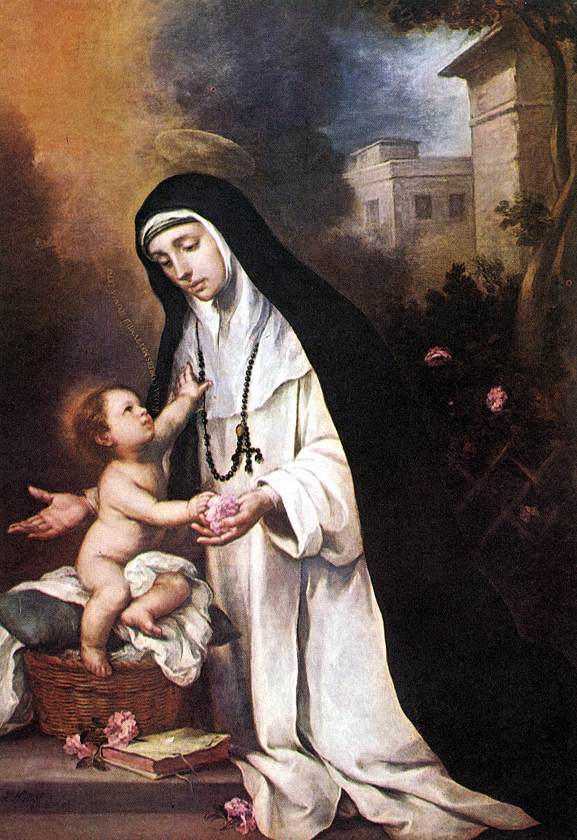
“St. Rose of Lima” by Bartolome Esteban Murillo, painted around 1670, is a tender vision of mystic intimacy between a Dominican nun and the Christ Child. The painting shows Rose in the full habit of her order, bending lovingly toward the infant Jesus who sits on a basket at her side. In his small hands he offers her roses, the symbol that became inseparable from her identity, while a cascade of flowers surrounds them at their feet. The scene glows with a gentle light that wraps both figures in warmth, transforming an everyday courtyard into a place of revelation.
At first glance the work radiates sweetness. A closer look reveals a sophisticated meditation on sanctity, sacrifice and spiritual beauty. Murillo uses soft color, delicate modeling and carefully chosen symbols to communicate Rose’s inner life. Rather than presenting a remote and austere saint, he portrays a young woman whose love for Christ is immediate and personal. The viewer is invited to experience this affection and to feel the serenity that flows from it.
Historical and Spiritual Context of St Rose of Lima
St Rose of Lima, born Isabel Flores de Oliva in Peru in 1586, was the first canonized saint of the Americas. She joined the Dominican Third Order and lived a life of intense penance, prayer and charity. Known for her devotion to the poor and her mystical experiences, she became a powerful symbol of holiness in the New World and a figure of pride for Spain’s overseas empire.
By the time Murillo painted this image in Seville, Rose had been canonized for only a few years. Devotion to her spread rapidly through Spanish territories. For artists, she offered an opportunity to depict a contemporary saint whose life combined familiar convent practices with exotic associations of distant Lima. Murillo’s painting reflects this enthusiasm. He brings Rose into a European looking garden, yet the idea that she belongs to the wider Spanish world would have been clear to his contemporaries.
Her spirituality focused on union with Christ through suffering and love. Images of her often include the crown of thorns, a crucifix or a vision of the child Jesus. In Murillo’s version the emphasis falls less on suffering and more on tender relationship. The Christ Child does not present thorns but roses. The emphasis is on the reward of love rather than the severity of penance.
Murillo and the Counter Reformation Imagination
Murillo worked during the height of the Counter Reformation when the Catholic Church used art as a means to inspire devotion and clarify doctrine. Painters were encouraged to make religious scenes emotionally compelling and easily understood so that even the uneducated could grasp spiritual truths through images.
Murillo answered this call with a style that combined soft light, graceful figures and approachable emotion. His Virgins and saints appear gentle and human rather than distant and hieratic. “St. Rose of Lima” is a textbook example of this approach. The painting is not crowded with complex theological detail. Instead it focuses on a moment of mutual affection between the saint and Christ, allowing the viewer to sense the joy of intimate friendship with God.
In doing so Murillo bridges two worlds. He respects the demands of post Tridentine religious art for clarity and orthodoxy, while simultaneously giving free rein to his own lyrical sensibility. The result is a work that is both doctrinally sound and deeply poetic.
First Impressions of the Composition
The composition is vertical, encouraging the eye to move upward from the earthbound roses and books to the faces of Rose and the Child and finally to the luminous sky that opens above them. St Rose occupies the center of the canvas, her white habit an expanse of light that stands out against the darker background. Her black veil creates a strong frame around her pale, contemplative face.
To her left, the Christ Child sits on a wicker basket filled with fabric. His body is turned slightly toward her, one hand holding a rose and the other reaching toward her face. The diagonal created by his reaching arm and her lowered gaze forms the emotional axis of the painting. Everything else is secondary to this exchange.
Around them, the scene is framed by a garden. A tree leans from the right, its foliage partially silhouetted against a dramatic sky in which clouds part to reveal a subtle glow. In the middle distance, pale architectural forms suggest a convent or urban building. These structures anchor the heavenly event in a recognizable earthly setting.
Murillo arranges all elements to direct attention toward the spiritual bond between the two figures. Lines of sight, gestures and folds of fabric converge to emphasize their relationship. The painting feels both intimate and monumental, as if a private moment of prayer had expanded to cosmic significance.
The Figures of St Rose and the Christ Child
St Rose is shown as a young woman with delicate features. Her eyes are lowered, lashes casting soft shadows on her cheeks. The expression on her face combines humility and quiet joy. She does not look dramatically ecstatic. Instead she appears absorbed, fully present to the child before her.
Her hands are eloquent. One hand, open and slightly turned outward, manifests readiness to receive. The other gently cradles the rose offered by Christ. This subtle gesture embodies her spiritual life. She accepts the graces he gives with gratitude but without possessiveness. Her posture, slightly bent, signals reverence.
The Christ Child is robust and full of life. Murillo paints his skin with warm tones, making him glow against the darker basket and cloth. His curly hair has a soft halo effect. He is not solemn. His gaze meets Rose’s lowered eyes, and his extended hand touches her face with affectionate insistence. This touch expresses divine initiative. He is the one who bridges the distance between heaven and the soul.
By giving the Child such lively immediacy, Murillo underlines the doctrine of the Incarnation. God appears here as an infant who can reach out, smile and play with a rose. At the same time his gestures carry symbolic weight. The roses he offers recall the traditional link between Rose’s name, her virtues and the reward of heavenly joy.
Light, Color and Atmosphere
Light is one of Murillo’s most powerful tools in this painting. A warm illumination falls diagonally from the upper left, bathing St Rose and the Child in a golden glow. Their faces and hands catch the brightest highlights, while the folds of her habit and the subtle roundness of his limbs are modeled by gentle transitions from light to shadow.
This glow contrasts with the cooler, darker tones of the background. The sky is streaked with stormy blues and grays, with a break of pale yellow near the top that hints at divine presence. Trees and architecture recede into bluish shadows. This contrast gives the main figures an almost sculptural clarity. They appear to step forward from an otherwise dim world.
Murillo’s palette is largely restrained. The dominant colors are the black and white of the habit, the warm flesh tones and the muted browns of basket and book. Against this restrained background, the roses stand out as vibrant accents in shades of pink. These small bursts of color draw the eye and symbolize grace blossoming in the midst of simplicity.
The overall atmosphere is one of quiet radiance. There is no harsh contrast or dramatic spotlight. Instead the light feels enveloping and steady, suggesting the calm, persistent presence of God in the life of the saint. It is an interior, contemplative kind of light translated into paint.
The Symbolism of Roses and the Basket
Roses are central to the iconography of St Rose of Lima and Murillo uses them with thoughtful intention. One rose lies in the Christ Child’s hand, another rests in Rose’s own. More blossoms are scattered at their feet and entwined near the basket. The flowers carry multiple meanings at once.
On a basic level they play with the saint’s name. She is literally surrounded by roses. But the symbolism goes deeper. In Christian art roses often represent charity, joy and the beauty of the soul in grace. Their fragrance and delicate petals evoke heavenly sweetness. Yet they also have thorns which can symbolize suffering. In many images of Rose of Lima, she wears a crown of thorns hidden under roses to express her hidden penances.
Murillo downplays the thorns and focuses on the flowers themselves. This choice highlights the spiritual fruit of her sacrifices rather than the pain. The Christ Child, source of grace, offers her the rose as a sign of approval and love. Accepting it, she receives not only consolation but a share in divine beauty.
The basket in which the child sits invites further reflection. A basket is an object of domestic labor, used to carry bread, laundry or goods to market. By placing Jesus in such a humble container, Murillo suggests his willingness to be present in everyday life. The clothes within the basket soften his seat, emphasizing maternal care. They may also hint at the linens used to wrap the infant at Bethlehem or the shroud of Christ, gently connecting Incarnation and Passion.
The Book, the Rosary and the Habit
At the bottom left of the painting lies a book, partly covered by roses. Its presence identifies Rose as a woman of study and meditation. Dominican spirituality has always emphasized theological reflection. A book here can refer to Scripture, the Divine Office or spiritual writings. The fact that roses rest upon it suggests that learning and love go together in her path to holiness.
Around Rose’s neck hangs a rosary that falls in a graceful curve across her chest. The beads catch highlights of light and serve as a visual reminder of contemplative prayer. For seventeenth century viewers, the rosary was a powerful symbol of Marian devotion and meditative repetition. It connects Rose to the broader Dominican and Marian tradition. The line of beads also leads the viewer’s gaze downward from her face to her hands and the rose she holds, knitting together the various symbols of the composition.
Her habit deserves close attention. Murillo renders the white tunic and scapular with soft folds and subtle shadows. The cloth looks heavy yet supple, conveying both purity and discipline. The black veil frames her head like an architectural arch. This contrast between black and white has symbolic significance. White represents innocence and truth, black humility and renunciation of worldly things. Together they form a visual shorthand for consecrated life.
By painting the habit with such care, Murillo honors the Dominican order and also underscores Rose’s identity as a consecrated woman. She became holy not by fleeing the structures of religious life but by living them intensely.
The Setting and its Silent Architecture
Behind the figures, Murillo paints a small section of architecture. It appears to be a solid building with rectangular windows, probably representing a convent or city structure. Its pale walls catch a faint light, while the roofs and corners fall into shadow. This background is not detailed enough to identify a specific location in Lima or Seville. Instead it serves as a generic reminder that Rose lived her sanctity within an urban Christian community.
To the right rises a tree whose twisting trunk and foliage break the straight lines of the architecture. The natural world and human construction thus coexist in the background, suggesting that grace touches all aspects of creation. The garden setting hints at the cloistered patios of many Spanish and colonial convents where flowers and plants offered a small oasis of beauty.
The sky above is particularly evocative. Darker stormy clouds gather at the edges while a central passage opens into gentle light. This visual contrast mirrors the interior drama of Rose’s life. She endured spiritual trials and physical austerities yet remained filled with inner peace. The heavens appear to acknowledge her sacrifice by allowing a glimpse of calm radiance beyond the turbulent clouds.
Emotion, Gesture and the Language of Devotion
Murillo excels at capturing emotion through small, understated gestures. In “St. Rose of Lima” there is no theatrical ecstasy or dramatic swoon. Instead he presents a quiet intimacy that feels psychologically believable.
The tilt of Rose’s head conveys modesty and deep attention. She is not looking outward toward the viewer but inward toward the Child. This focus invites us to adopt her viewpoint rather than observe from a distance. Her lips are gently closed, suggesting silent prayer rather than spoken words.
The Christ Child’s gesture is equally expressive. With one hand he offers the rose, while with the other he touches her face, as if blessing her or drawing her even closer. It is a gesture of both affection and claim. He is saying, in body language, that she belongs to him and that their relationship is personal.
Even the placement of their bodies enhances the emotional message. Rose stands firmly yet bends toward the Child, indicating both stability and tenderness. He, in turn, leans toward her amid the soft linens of the basket, embodying vulnerability and trust. Together they form a subtle embrace of gazes and open hands.
These gestures communicate a theology of devotion centered on love rather than fear. The viewer is encouraged to see sanctity as an intimate response to the invitation of Christ.
Painterly Technique and Surface
On the technical level, Murillo displays his characteristic mastery of oil paint. The flesh of the Christ Child is built up with delicate layers of translucent color that allow inner warmth to shine through. Soft transitions between light and shadow create the illusion of roundness and softness.
St Rose’s face is painted with equal care. Murillo uses a limited range of tones to model her features, focusing on the subtle gradation of shadows under the eyes, nose and chin. The result is a face that feels very real yet slightly idealized. It is the face of a woman who has spent long hours in prayer, serene and free of harsh lines.
The fabrics are handled with a combination of broad and precise strokes. Large areas of the habit are suggested with sweeping brushwork, while key folds are emphasized with sharper highlights. This allows the garment to read clearly from a distance while remaining interesting up close.
The background is looser. Trees, architecture and sky are blended with freer brushwork that avoids hard edges. This softness keeps attention on the figures and contributes to the dreamy atmosphere. Murillo’s transitions are so smooth that the painting acquires a velvety surface, inviting contemplation rather than analysis.
Theological Themes and Inner Meaning
Beyond its visual appeal, “St. Rose of Lima” communicates several theological themes. Foremost among them is the idea of union with Christ. The entire composition revolves around the encounter between the saint and the Child. Their shared roses, gentle touch and mutual orientation suggest a relationship where love flows freely in both directions.
Another theme is the dignity of female sanctity. Rose is not shown as passive or overshadowed. She participates actively in the exchange of grace. Her open palms and calm posture signify consent. Within the Church she stands as a model that holiness is accessible not only to clergy and theologians but also to lay women who respond wholeheartedly to divine love.
The painting also expresses the harmony between contemplation and action. The book and rosary reference prayer and study. The basket, simple setting and flowers suggest daily work and care. Rose’s sanctity embraces both. She is rooted in prayer yet present in the ordinary world.
Finally, the work can be read as a statement about the universality of the Church. A Peruvian saint, painted by a Spanish artist and venerated throughout the Catholic world, appears in a setting that could belong to either side of the Atlantic. Murillo visually weaves together Old World and New World into one spiritual narrative.
Legacy and Continuing Resonance
Over time, images like Murillo’s helped solidify the popular image of St Rose of Lima. Viewers came to associate her with roses, the Dominican habit and a mystical relationship with the Christ Child. Generations of believers would have meditated on this painting or similar ones in churches and convents, drawing inspiration for their own spiritual lives.
Today the painting continues to appeal, even to viewers whose religious background is different or distant. The tenderness between woman and child, the calm harmony of color and light, and the sense of quiet sanctuary remain compelling. In a world often marked by noise and distraction, the painting offers a vision of stillness and focused love.
From an art historical perspective, it stands as an important example of Murillo’s mature religious style. It illustrates how he could merge the soft luminosity associated with his Sevillian school with the doctrinal clarity demanded by the Church. The work also demonstrates how Baroque art could be emotionally rich without relying on overwhelming drama.
Conclusion
“St. Rose of Lima” by Bartolome Esteban Murillo is a serene yet powerful celebration of mystic intimacy. Through carefully orchestrated composition, warm light and subtle symbolism, the painter invites viewers into a private moment between the saint and the Christ Child. The roses, basket, book and rosary all play their part in revealing Rose’s identity as a woman of love, study and sacrifice whose life was wholly oriented toward Christ.
Murillo’s skillful handling of color and form creates an atmosphere where heaven and earth seem to meet. The saint stands firmly on the ground, surrounded by simple objects, yet her gaze and gestures reveal a heart already turned toward eternity. In this harmonious balance between the ordinary and the divine lies the painting’s enduring beauty.
Centuries after its creation, the work continues to speak about the possibility of a loving relationship with God, about the dignity of consecrated life and about the quiet joy that can flourish even within the walls of a cloister. Murillo has transformed paint and canvas into a space of contemplation where viewers can still sense the fragrance of roses and the gentle presence of the Christ Child.