Image source: wikiart.org
Introduction to “St. Romanus and St. Barulas of Antioch”
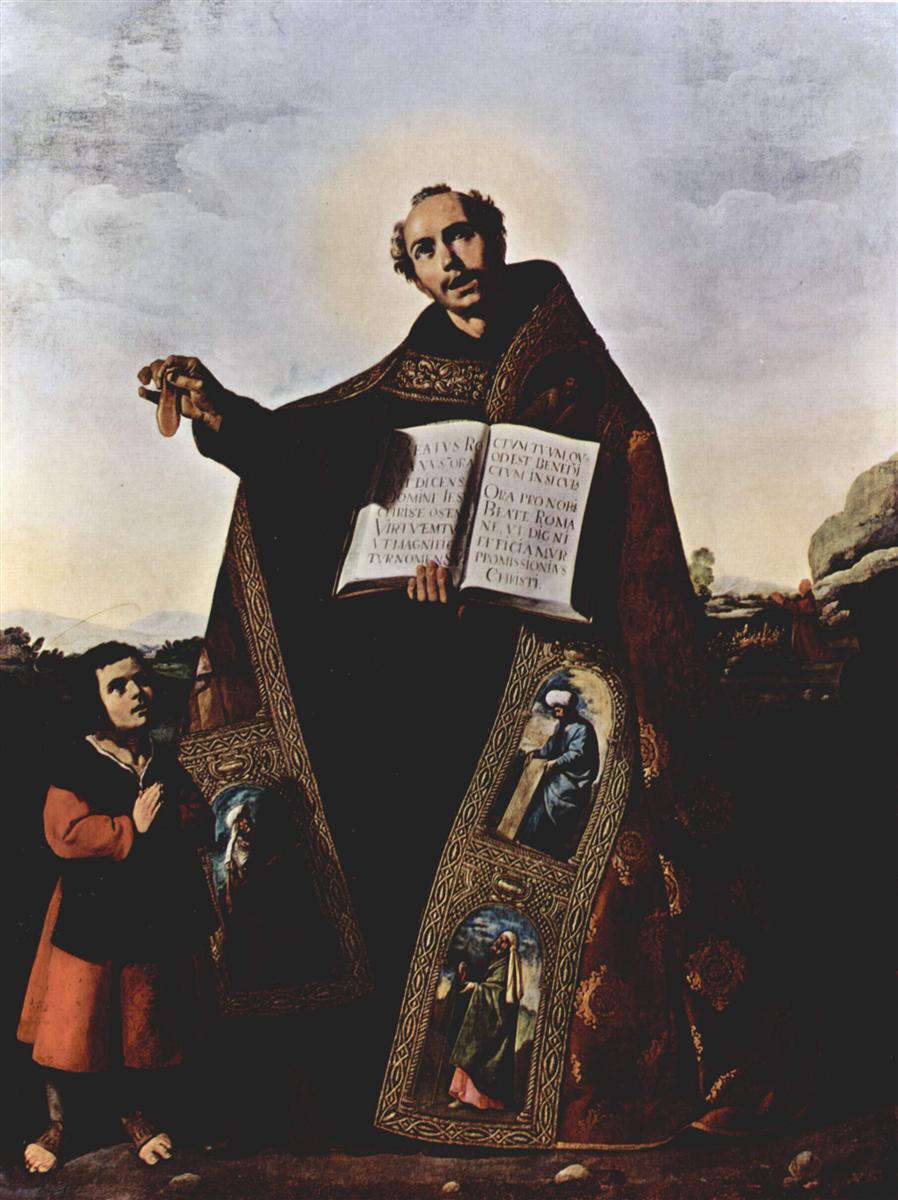
Francisco de Zurbaran’s “St. Romanus and St. Barulas of Antioch,” painted in 1638, is a striking vision of martyrdom, preaching and childlike faith. The enormous figure of St Romanus dominates the canvas, wrapped in an embroidered cope that falls like an architectural curtain to the ground. In his left hand he holds an open book with large Latin script, while his right hand raises a small object that appears to be his severed tongue, the instrument of his testimony. At his feet stands a young boy, St Barulas, gazing upward with hands folded in devotion.
Behind these two figures stretches a quiet landscape of hills, distant town and pale sky. The space is open and lyrical, yet the monumentality of Romanus fills it, transforming the countryside into a vast pulpit. Zurbaran turns the story of two early martyrs from Antioch into a powerful meditation on the power of speech, the cost of fidelity and the transmission of faith between generations.
Historical and Devotional Context
Romanus of Antioch was a deacon and preacher martyred during the persecutions under Diocletian. He was known for his bold defense of Christians and for publicly exhorting others to remain steadfast. According to tradition, when he was condemned the authorities cut out his tongue, hoping to silence him, yet he miraculously continued to speak and praise Christ. Eventually he was strangled and his body thrown aside as a warning.
Barulas, sometimes called Barlaam, was a young boy who witnessed Romanus’s courage. Questioned by the authorities, he professed his own faith in Christ and refused to renounce it. For this confession he too was executed. Their stories were recorded in the early martyrologies and became popular examples of courageous witness, especially in periods when preachers and confessors were under pressure for their beliefs.
Seventeenth century Spain saw a renewed interest in such figures. The Counter Reformation church admired martyrs as models of uncompromising fidelity and as intercessors for those facing persecution or temptation. A painting of Romanus and Barulas would have spoken directly to preachers, confessors and parents concerned with the religious formation of children. Zurbaran, who often painted saints for monastic communities, here presents the two Antiochene martyrs as towering symbols of steadfast faith rooted in Scripture and passed on to the next generation.
Composition and Monumental Scale
The first impression of the painting is one of scale. St Romanus is rendered far larger than life. His head nears the upper border of the canvas and his cope extends to the bottom, creating a column of dark fabric that dominates the space. By contrast, the child Barulas is much smaller, placed at Romanus’s left side and only reaching to about knee level. This disproportion is deliberate. It transforms Romanus into a monumental presence, almost like a living church façade, while Barulas appears as a child sheltered at the base of a towering edifice.
The saint stands in three quarter view, with his body turned slightly toward the viewer’s right. The enormous cope flows out from his shoulders and spreads in an angular shape across the lower half of the canvas, framing the child and enclosing several painted scenes worked into its embroidered borders. The open book he holds at chest level forms the compositional center, drawing the viewer’s eye before it travels up to his face and down again to the miniatures on his vestment.
The background landscape is relatively low and unobtrusive. Low hills and distant buildings stretch horizontally across the middle ground, while the sky occupies the upper third of the painting. The subdued tones of earth and sky provide a calm setting against which the dark, richly patterned cope and the illuminated face of Romanus stand out. The composition therefore balances monumentality with serenity, grandeur with simplicity.
The Figure of St Romanus
Zurbaran presents St Romanus as a middle aged man with receding hair, high forehead and intense gaze. His features are individualized rather than idealized, giving him the presence of a real preacher who might have lived in Zurbaran’s own time. A faint halo surrounds his head, subtly distinguishing him as holy without breaking the naturalism of the scene.
His expression is one of earnestness and slightly raised wonder. The open mouth suggests speech or the immediate aftermath of speech. The eyes look beyond the viewer, perhaps toward the heavenly judge who heard his confession. There is a sense that he is in the act of explaining the meaning of the book he holds and the sacrifice he made.
Romanus’s cope is a marvel of painted textile. Deep reddish brown in its main field, it is edged with wide golden bands filled with geometric designs and inset panels. The weight of this garment is palpable. It wraps him like a mantle of authority, signifying his office as deacon and preacher. The elaborate embroidery hints at the richness of the church’s tradition which he proclaims, while the dark base color underscores his readiness to suffer.
The open book he holds is inscribed with clear Latin text in large letters, reminiscent of the liturgical books used in chanting. The very size of the script announces that this is not private reading but proclamation. The pages stand between Romanus and the viewer, mediating his testimony and inviting us to read with him.
In his right hand the saint holds a small, tongue shaped object, delicately pinched between two fingers. For contemporary viewers familiar with his legend, this would have been a powerful and somewhat shocking symbol. It recalls the mutilation he endured and the miracle that followed. Here, however, it is presented without grotesque detail. The tongue becomes a kind of relic, almost like a host elevated in a liturgical gesture, a sign that the word of God cannot be silenced by violence.
The Child Martyr St Barulas
At the lower left stands the smaller figure of Barulas, dressed in a simple red and dark tunic. Barefoot on the rocky ground, he looks up toward Romanus with an expression of awe and devotion. One hand is raised to his chest, echoing the prayerful gesture of many saints. His other hand is hidden within his cloak, suggesting modesty and a slight sense of vulnerability.
Barulas’s youthful face, framed by dark hair, contrasts strongly with the more mature, intellectual features of Romanus. He represents innocence rather than learned preaching. Yet by placing him in such close proximity to the towering saint, Zurbaran implies that the same courage inhabits both. The child is not overshadowed in meaning, only in physical size.
For seventeenth century viewers, Barulas would have served as a model of childlike faith. His willingness to confess Christ in the face of death spoke to parents, teachers and confessors who sought to instruct children in a robust piety. In the painting, his upward gaze also guides the viewer’s eye toward Romanus and the open book. It is as if he is learning to read the faith through the example and teaching of the older martyr.
The Cope as Painted Relic
One of the most fascinating aspects of the painting is the rich decoration of Romanus’s cope. Along its vertical borders are inset small painted scenes framed like miniature altarpieces. These images depict other saints, possibly prophets or martyrs, standing within arched niches. At least two such scenes are clearly visible along the front of the garment, while others may be suggested by the patterning.
These miniature figures have a dual function. On the one hand, they indicate that Romanus is clothed in the memory of earlier witnesses. He does not stand alone but wrapped in a garment populated with holy predecessors. On the other hand, they allow Zurbaran to display his skill at painting different scales and textures within a single work. Each small scene is carefully modeled, with its own color harmonies and sense of depth, yet all are unified by the gold framework of the embroidery.
The cope thus becomes a kind of portable gallery of saints, a visual reminder that martyrdom is part of a long tradition. For a congregation standing before this painting, the garment would act almost like a reliquary, housing images of holiness just as real vestments sometimes housed relics in their orphreys.
Light, Color and Landscape
The palette of “St. Romanus and St. Barulas of Antioch” is restrained yet rich. The sky is a cool gray, with patches of light cloud that indicate a calm day. The landscape is rendered in soft greens and browns, with low hills and distant trees. These natural tones create a peaceful backdrop that throws the darker, warmer colors of the figures into relief.
The main chromatic focus is the deep reddish brown of the cope, the golden trims and the red of Barulas’s garment. These warm hues are balanced by the neutral black of Romanus’s cassock and the pale flesh tones of the faces and hands. The interplay of gold and brown in the embroidery gives the cope a sense of weight and luxury, appropriate for a liturgical vestment.
Light falls mainly from the left, illuminating Romanus’s face, the open book and the upper sections of his cope. The child receives some of this light on his forehead and hands, while the lower parts of the painting sink into deeper shadow. The halo around Romanus’s head is subtle yet effective, a soft ring of light that blends with the sky and suggests sanctity without using strong outlines.
The landscape is not simply decorative. Its modest scale and calm mood highlight the interior drama of the martyrs. There are no storms or dramatic cliffs, only a gentle world that continues to exist as witness to their testimony. A small figure or group in the distance, perhaps engaged in conversation or prayer, hints at the wider Christian community that remembers the martyrs’ story.
Symbolism of the Book and the Tongue
The two objects Romanus holds embody the central themes of the painting. The book stands for the word of God, the Gospel he preached, and the teaching of the church. It represents reasoned proclamation, doctrinal clarity and the intellectual dimension of faith. The careful Latin script, arranged in neat columns, evokes the solemnity of liturgical texts.
The tongue represents the physical instrument of that proclamation, the organ that formed words and bore witness under persecution. By holding his own tongue as if it were a sacred object, Romanus underscores the idea that speech can itself be a sacrifice. He gave up his ability to speak rather than betray the message he carried.
Together, book and tongue suggest a union of word and body, doctrine and suffering. The message is not abstract. It costs something to speak it. The painting thus offers a powerful meditation on the vocation of preachers, confessors and anyone whose public speech may be contested or threatened. It implies that true proclamation may entail real risk, yet God honors that risk by transforming even mutilation into a sign of glory.
Emotional and Spiritual Meaning
Despite the emphasis on martyrdom, the mood of the painting is not grim. Romanus’s face, though serious, carries a hint of quiet joy. He seems to be in the act of explaining his own story to the viewer, almost inviting us into a contemplative conversation. The child Barulas looks up with trust rather than terror. The landscape breathes calm, and the soft halo around the saint’s head suggests radiant peace.
This combination of monumental seriousness and gentle tranquility reflects Zurbaran’s approach to sanctity. For him, saints are not theatrical heroes but solid, grounded people whose holiness manifests in interior composure. Romanus and Barulas stand in the same world as the viewer, yet their attitudes show that they belong to another city as well.
Spiritually, the painting celebrates the power of mentorship in faith. The tall figure of Romanus and the small boy at his side form a kind of spiritual family. The older martyr teaches through word and example, the younger imitates and eventually shares in the same crown. In a broader sense, the painting speaks of how each generation of believers receives the Gospel through the testimony of those who came before.
Zurbaran’s Style and the Spanish Baroque
“St. Romanus and St. Barulas of Antioch” exemplifies many traits of Zurbaran’s mature style. His figures are solid, sculptural and clearly delineated. He favors simple compositions in which a few elements are arranged with great clarity. The use of a dark monumental garment against a relatively plain background is typical of his portraits of monks and bishops.
At the same time, the painting shows his sensitivity to psychological nuance. Romanus is not an abstract symbol but a person with a particular face and inward intensity. Barulas has his own distinct personality, shy yet ardent. The small scenes on the cope reveal Zurbaran’s delight in narrative detail and in the interplay between large and small scales.
Within the broader Baroque context, the painting is restrained. There are no swirling clouds or explosive gestures. Instead, Zurbaran emphasizes stillness, gravity and contemplative depth. This suits the subject of two martyrs whose heroism lies not in physical action but in steadfast confession.
Conclusion
Francisco de Zurbaran’s “St. Romanus and St. Barulas of Antioch” is a powerful visual homily on the courage to speak and the cost of faithful witness. Through the monumental figure of Romanus, the trusting gaze of Barulas, the richly embroidered cope and the symbolic pairing of book and tongue, Zurbaran creates a work that is at once doctrinal, devotional and deeply human.
The painting invites viewers to stand before these Antiochene martyrs and consider their own use of speech, their readiness to defend truth and their responsibility to hand on faith to younger generations. In the calm landscape and luminous sky, the towering saint and small child stand as enduring reminders that the word of God cannot be silenced, even when tongues are torn from mouths, because it continues to speak through the lives of those who dare to confess it.