Image source: wikiart.org
Introduction to “St. Rodriguez”
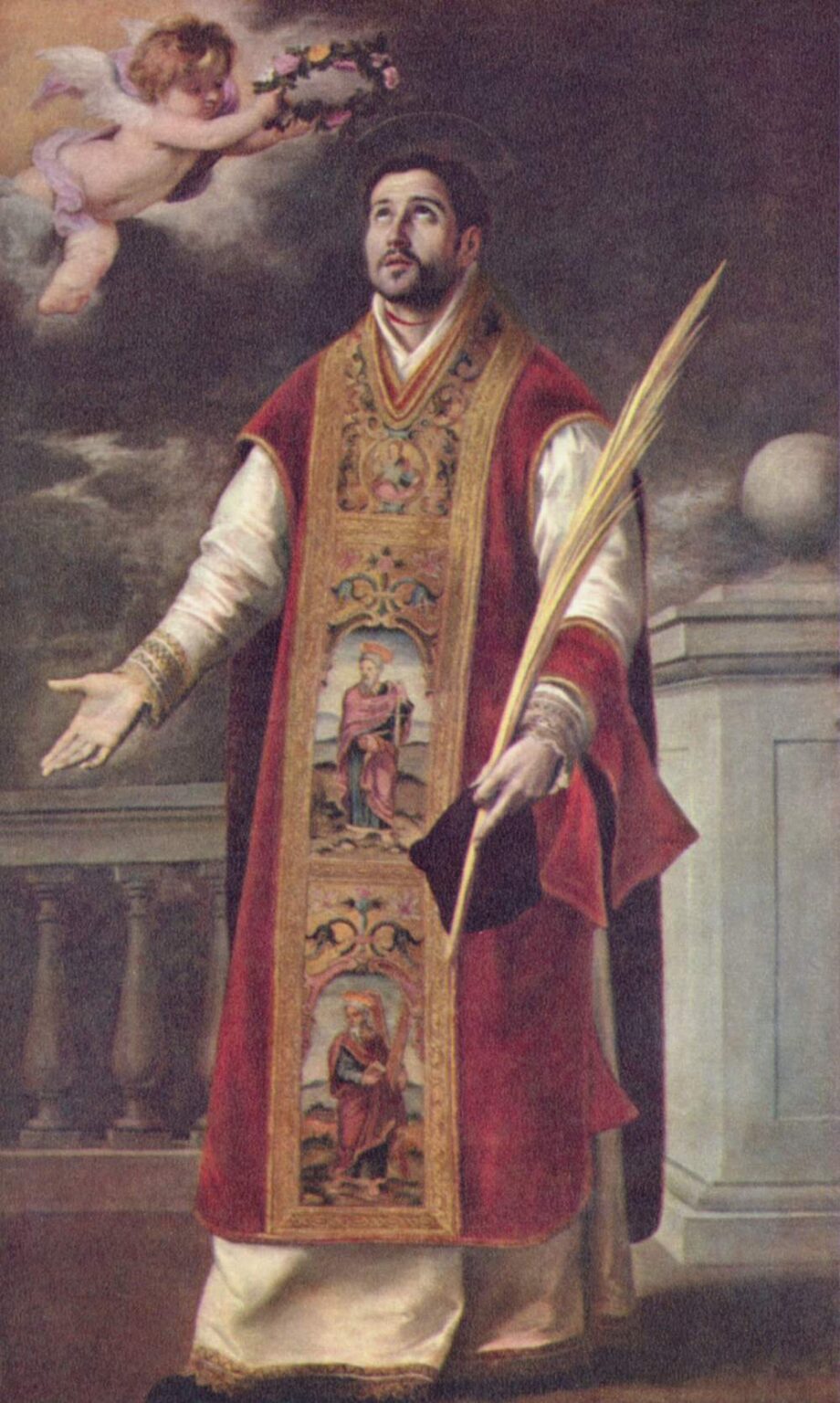
“St. Rodriguez,” painted by Bartolome Esteban Murillo around 1655, presents a Spanish martyr priest at the moment of mystical recognition. The saint is shown full length, dressed in rich liturgical vestments, holding the palm of martyrdom while an angel descends from the clouds with a wreath of flowers. Murillo arranges this vision in an elegant architectural setting that mixes the solidity of stone with the vaporous softness of sky and cloud.
The painting reflects Murillo’s mature Sevillian style, in which gentle naturalism, warm color and a compassionate reading of religious subjects come together. Here he avoids violent scenes of martyrdom and instead offers a vision of spiritual triumph. St. Rodriguez does not appear wounded or tormented. He stands upright, eyes raised in quiet wonder as heavenly reward approaches, inviting viewers to contemplate the grace that crowns faithfulness rather than the cruelty that precedes it.
The Historical Figure Behind the Image
The title “St. Rodriguez” refers to a Spanish priest martyr whose story was well known in seventeenth century devotional literature. Venerated for his steadfast confession of faith, he became a symbol of perseverance under persecution. For a city like Seville, proud of its Christian history, such local or national saints provided models of courage and loyalty to the church.
Murillo does not narrate the details of Rodriguez’s death. Instead, he concentrates on the spiritual meaning of martyrdom as understood by his contemporaries. In the Counter Reformation world of Spain, martyr saints were celebrated not primarily as victims but as witnesses. Their suffering was interpreted as a path toward union with God and participation in the victory of Christ. The painting expresses this theology by focusing on reward rather than violence, on the saint’s inner gaze rather than his physical struggle.
Composition and Overall Design
Murillo builds the composition around the upright figure of the saint. St. Rodriguez stands slightly left of center, occupying most of the vertical space. His red chasuble with its embroidered panels creates a strong column of color that anchors the painting. One arm extends outward with open palm, the other holds the palm frond that crosses diagonally over his body.
To the left, above the saint, a cherub or small angel emerges from the clouds, flying toward him with a wreath of roses. This movement from upper left toward the saint’s head introduces a sweeping diagonal that balances the verticality of the figure. The saint’s uplifted gaze meets the angel’s descent, creating a visual conversation between earth and heaven.
On the right, a massive stone balustrade and pedestal provide counterweight to the lightness of the clouds and angel. These classical architectural forms frame the scene and remind the viewer that the vision unfolds within a solid world. The interplay of verticals, diagonals and horizontals produces a stable yet lively design characteristic of Baroque composition.
The Saint’s Pose and Expression
St. Rodriguez’s pose is both ceremonial and deeply personal. He stands firmly planted, feet hidden beneath the white alb that peeks out from under the red chasuble. His shoulders are straight, and his head is tilted upward, eyes fixed on the approaching wreath. The mouth is slightly parted, as if in quiet prayer or astonished breath.
His left hand opens outward in a gesture of offering or acceptance. This open palm suggests readiness to receive whatever God sends, whether suffering or glory. His right hand grasps the palm of martyrdom, but not tightly. The frond slopes gently, leading the eye down toward the lower part of the painting and then back up along the line of his arm. The combination of open hand and held palm expresses both the cost and the reward of witness.
Murillo imbues the face with a distinctive personality. Rodriguez appears young or in early middle age, with neatly trimmed beard and dark hair. His features are not idealized to the point of anonymity. Instead, they show a specific individual touched by inward fervor. The soft illumination on his forehead and cheeks, together with the reflective gaze, communicates interior prayer and trust.
Vestments, Color, and Symbolic Detail
One of the most striking aspects of the painting is the saint’s vestment, a rich red chasuble decorated with vertical panels of gold embroidery and small narrative images. Murillo lavishes attention on this garment. The red signifies charity and the blood of martyrdom, while the gold embroideries suggest the glory that crowns sacrificial love.
The central embroidered panel contains miniature scenes of saints or evangelists, each framed by ornate borders. These tiny figures echo Rodriguez’s own role as a priest inserted into the long line of witnesses and teachers of the church. They also demonstrate Murillo’s skill in handling different scales within a single composition, from the large full length figure to these delicate details.
Under the chasuble, the white alb and sleeves are visible. The alb’s whiteness stands for purity and baptismal grace. Murillo paints the fabric with soft folds and careful highlights that convey its weight and smooth texture. The contrast between the glowing red of the chasuble and the luminous white of the alb produces a rhythm of color that leads the eye up and down the figure.
The saint holds a long palm frond, the traditional sign of martyrdom in Christian art. Murillo renders it with subtle strokes of yellow and green. It catches the light just enough to draw attention without competing with the vestments. By placing the palm across the body, the artist integrates symbol and figure, so that the idea of martyrdom is woven directly into the saint’s stance.
The Angelic Vision and Crown of Flowers
The celestial element in the painting is provided by the flying cherub at upper left. This small winged figure bursts from the clouds with dynamic energy, arms extended as it holds a wreath of flowers. The cherub’s body twists gracefully, and the fluttering drapery around its waist reinforces the sensation of movement.
The wreath itself is composed of roses and other blossoms, painted with delicate colors. In Christian symbolism, a floral crown often represents both victory and heavenly joy. When placed on a martyr, it becomes a sign that earthly suffering has given way to eternal reward. By choosing flowers instead of a more rigid laurel or metal crown, Murillo imbues the reward with tenderness and sweetness.
The interaction between cherub and saint is purely visual. There is no spoken dialogue or written inscription. The communication occurs through gaze and gesture. The angel leans toward Rodriguez, while Rodriguez lifts his eyes and opens his hands. This silent exchange expresses a theology of grace that is received rather than seized, gifted rather than earned by force.
Architectural Setting and Baroque Space
While the central drama occurs between saint and angel, the architectural background gives the scene stability and context. On the left, behind Rodriguez, we see a stone balustrade that suggests an elevated terrace or church balcony. The repeating verticals of the balusters echo the upright lines of the saint, reinforcing his presence.
To the right, a large pedestal or block of masonry fills the space. Its sharp edges and heavy volume contrast with the soft forms of clouds and flesh. Murillo uses these solid structures to ground the composition in earthly reality. The saint stands not in an undefined celestial space but on a literal floor, near tangible stone. This realism makes his mystical vision more accessible to viewers, who inhabit similar architectural surroundings in their own churches and cloisters.
The background recedes into a cloudy sky with patches of light. The transition from stone to cloud is gradual, so that the space feels continuous rather than divided. This blending of physical and spiritual realms is a key feature of Baroque religious painting, aiming to show that heavenly encounters can occur in the midst of everyday settings.
Light, Atmosphere, and Murillo’s Technique
Murillo’s use of light in “St. Rodriguez” is subtle yet powerful. The primary illumination seems to come from the left, bathing the saint’s face, chest, and the front of his vestments. This light also touches the palm frond and the cherub’s figure. The result is a warm, unifying glow that envelops the main actors of the scene.
Shadows are soft rather than harsh. The folds of the chasuble are modeled by gentle transitions from light to dark, giving the fabric volume without making it rigid. The architecture in the background receives less light and thus stays subordinate to the figure. In the sky, patches of brightness break through the clouds, suggesting the presence of divine radiance beyond the visible.
Murillo’s brushwork, although controlled, is not tight or mechanical. In the vestments he uses fine strokes to convey embroidery and texture. In the clouds and skin tones he allows softer blending and more open handling. This combination of precision and looseness gives the painting both clarity and life. Nothing feels static. Even the heavy stone seems to breathe in the surrounding light.
Spiritual Themes of Martyrdom and Reward
Beyond its visual richness, the painting communicates key spiritual themes central to seventeenth century Spanish devotion. The first theme is martyrdom understood as witness. The palm in Rodriguez’s hand signals that he has confessed the faith to the point of death. Yet Murillo chooses not to depict the struggle. Instead, he shows the moment of peaceful acceptance, when the saint looks upward and opens his hands to receive the crown.
This emphasis shifts the viewer’s focus from fear of suffering to hope in divine reward. The wreath of flowers symbolizes not only victory but also the joy of union with God. Rodriguez’s expression expresses a mixture of humility and longing. He does not grasp at the crown. He waits for it, aware that it comes from God’s generous initiative.
A second theme is the dignity of priestly service. The elaborate vestments remind viewers that Rodriguez is not only a martyr but also a celebrant of the liturgy. His ministry at the altar prepared him for the ultimate offering of his life. This connection would have been particularly meaningful for clergy viewing the painting, who were invited to see in him a model of faithful exercise of their vocation.
Finally, the painting suggests the closeness of heaven to earth. The cherub descends almost into the saint’s personal space, bridging the gap between sky and terrace. Murillo portrays the supernatural not as remote but as intimately involved with the believer’s story. It is a vision designed to encourage trust and perseverance amid the trials of daily life.
Murillo’s Sevillian Context and Patronage
When Murillo created “St. Rodriguez,” Seville was a major artistic and religious center. Confraternities, monasteries, and churches commissioned images that would adorn chapels, sacristies, and cloister walls. Many of these works focused on local saints or themes that highlighted Spain’s Catholic identity.
A canvas like this one may have been part of a series of martyr saints commissioned for a religious community. The vertical full length format, balanced composition and clear iconography made it suitable for placement in a side chapel or corridor where viewers would encounter it regularly. The image would serve as both decoration and spiritual exhortation, reminding members of the community to imitate Rodriguez’s courage and love.
Murillo’s reputation rested largely on his ability to humanize sacred subjects while preserving their dignity. In “St. Rodriguez” he maintains that balance. The saint appears approachable in his youthful face and expressive hands, yet the grandeur of vestments and architecture affirms the seriousness of his role. This combination of familiarity and elevation explains why Murillo’s religious paintings became beloved in Spain and later throughout Europe.
Emotional Impact and Lasting Legacy
Even today, “St. Rodriguez” can move viewers who may know little about the historical details of the saint’s life. The painting offers a universal story of fidelity rewarded. The upward gaze, the open hands, and the descending crown speak to experiences of hope amid difficulty. There is a quiet drama in the moment Murillo chooses to depict, one that resonates beyond its specific religious context.
For admirers of Baroque art, the canvas also showcases Murillo’s mastery of color and composition. The deep red chasuble, flecked with gold, draws attention like a flame against the muted stone and sky. The graceful interaction between saint and angel demonstrates the dynamic yet orderly movement typical of the period.
As part of Murillo’s wider body of work, “St. Rodriguez” adds to our understanding of how he portrayed male saints. While his images of the Virgin and child often receive more attention, his portraits of priests and bishops reveal another side of his artistry, one that emphasizes intellectual and spiritual strength. Rodriguez stands alongside other clerical saints in Murillo’s oeuvre as a figure of noble restraint, illuminated not by bodily ecstasy but by steadfast vision.
Conclusion
“St. Rodriguez” by Bartolome Esteban Murillo is a richly layered portrayal of a martyr priest, uniting historical memory, liturgical symbolism, and personal devotion. Through the saint’s upright pose, radiant vestments, and gentle interaction with the cherub bearing a floral crown, Murillo conveys the essence of martyrdom as loving witness that leads to joy. The architectural setting grounds the scene in the tangible world, while the clouds and light open a window onto the heavenly realm.
In this painting, viewers are invited to contemplate not only the life of one saint but the broader call to fidelity and hope. Murillo’s warm palette, nuanced light and psychological insight transform a doctrinal theme into a compelling human story. More than three centuries after its creation, the image continues to communicate a sense of serene courage and the promise of divine reward.