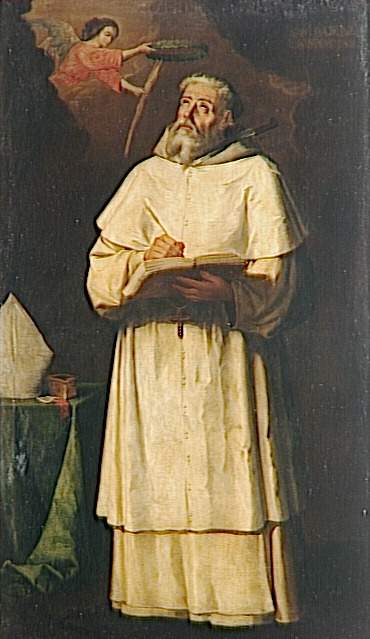
Image source: wikiart.org
Introducing “St. Pierre Pascal, Bishop of Jaen”
Francisco de Zurbaran’s painting “St. Pierre Pascal, Bishop of Jaen,” completed around 1630, presents a quiet yet powerful portrait of a scholar bishop caught in a moment of inspiration. The saint stands in a luminous white habit, pen in hand, gazing upward as if listening to a voice that comes from beyond the visible world. At the upper left, an angel hovers in a warm cloud, extending a wreath or crown toward him. To the lower left, a table draped in green holds a bishop’s mitre and liturgical objects, discreet reminders of his ecclesiastical rank.
The composition is vertically oriented, giving the solitary figure of the bishop a commanding presence. The surrounding background is dark and indistinct, which emphasizes the saint’s white robe and the quiet drama of the vision taking place above him. In this painting, Zurbaran unites two complementary aspects of sanctity: the contemplative scholar who writes and prays, and the public shepherd who guides his flock as a bishop and martyr.
Historical and Religious Context
The subject of the painting, often known in Spanish as San Pedro Pascual, served as bishop of Jaen and belonged to the Order of Mercy, the Mercedarians. This order, founded by St. Peter Nolasco in the thirteenth century, was dedicated to the ransom of Christian captives in Muslim territories. Many of its members risked their lives traveling across the Mediterranean to negotiate the release of prisoners. Some, like Peter Pascual, ended their lives in captivity and martyrdom.
By the early seventeenth century, when Zurbaran was active in Seville, Spain was deeply engaged in reaffirming Catholic faith and identity. Religious orders commissioned cycles of paintings that celebrated their founders, patrons, and martyrs. These works were intended not only as decoration but also as a visual catechism for the monks and the faithful who prayed before them.
Within this context, “St. Pierre Pascal, Bishop of Jaen” presents the bishop as a model of learning, pastoral care, and sacrificial love for Christ. The painting likely formed part of a larger ensemble that illustrated the history of the Mercedarian order. By depicting a bishop rooted in study and guided by heavenly inspiration, Zurbaran offered Mercedarian communities an image of how intellectual labor and ecclesiastical office can be united in holiness.
Composition and the Standing Figure
Zurbaran organizes the composition around the upright figure of the saint, who occupies almost the full height of the narrow canvas. The bishop is seen standing slightly turned to the viewer’s right, his head tilted upward toward the angel in the clouds. His hands hold a book and quill at chest level, suggesting that we are catching him at the very moment when he interrupts his writing to receive divine guidance.
The composition is structured on a diagonal line that runs from the lower right, where the saint’s feet rest, to the upper left, where the angel appears. This diagonal guides the viewer’s eye along the same route as the saint’s gaze. At the same time, the vertical axis formed by his body and habit anchors the scene, creating a sense of stability and calm.
To the left, a simple table draped with a green cloth introduces a counterweight to the figure. On it rests the white bishop’s mitre, shaped like a modest mountain peak, along with a small container or chalice. These elements broaden the space slightly, but Zurbaran keeps the background largely undefined, allowing the saint to stand out sharply against a warm, dark ground.
The simplicity of the setting underscores the interior nature of the event. Rather than placing the bishop in a cathedral or elaborate architectural space, Zurbaran situates him in what feels like a study or monastic cell, a place of quiet reflection where the most important drama is spiritual rather than external.
Light, Shadow, and the Atmosphere of Contemplation
As in many of his works, Zurbaran uses a restrained form of tenebrism to model the figure. A focused, soft light falls from the upper left, bathing the saint’s face and habit while leaving much of the background in shadow. This light gently grazes the folds of his white robe, creating subtle transitions between brightness and shadow that give the garment a sculptural solidity.
The play of light on the habit is one of the most striking aspects of the painting. The heavy cloth breaks into broad planes and delicate creases, which Zurbaran renders with a muted palette of creams and soft yellows. This careful modeling makes the figure appear almost tangible, as if he occupies a real space just beyond the picture frame.
The angel in the upper left is enveloped in a warmer, more diffuse light, surrounded by a soft cloud. This heavenly glow contrasts with the more directional light on the saint, suggesting that the illumination of his mind and heart comes from a supernatural source.
The overall effect is one of contemplative stillness. There are no violent contrasts or sharp flashes of light. Instead the tones are harmonized in a way that supports introspection. The painting invites the viewer to enter into the same meditative silence that surrounds the bishop, to share in the moment when the soul listens attentively for God’s voice.
The White Habit and the Symbol of Purity
The saint’s white habit, which dominates the lower part of the picture, is a central feature of Zurbaran’s design. It is rendered with extraordinary attention to texture and weight. The garment falls in long, vertical folds from the shoulders to the floor, broken only by the belt and the hood that drapes over his back.
White in Christian iconography often symbolizes purity, charity, and the light of grace. In this painting, the radiant habit suggests a life given wholly to God. Although Peter Pascual held the office of bishop, the habit reminds viewers that he was first and foremost a religious, committed to poverty and service.
Zurbaran was famous for painting monks and friars in white robes, particularly Carthusians and Mercedarians. Here again he uses the habit to express spiritual character. Its simplicity contrasts with the ornate vestments often worn by bishops in liturgical settings. By showing the bishop in a monastic garment rather than ceremonial robes, Zurbaran emphasizes humility and inner holiness over external splendor.
The Book and the Act of Writing
In the bishop’s hands lies an open book, and between his fingers he holds a quill. These objects identify him as a man of letters, someone engaged in study, preaching, or theological writing. The pages of the book are faintly suggested, their edges highlighted by the light.
The pose is carefully chosen. Rather than looking down at his writing, the saint lifts his eyes upward, as if pausing mid sentence to receive inspiration. The quill is poised above the page, ready to record whatever insight the vision provides. This moment captures the dynamic between human effort and divine grace in the work of theology. The bishop writes, but he writes as one who listens.
For viewers in a monastic setting, the image would have been an encouraging model. It suggests that intellectual work is not a purely human enterprise but a collaboration with God. Study, meditation, and writing are shown as forms of prayer.
Episcopal Authority and the Objects on the Table
While the figure’s habit underscores his religious humility, the table at the left reminds us of his role as bishop. The most prominent object is the mitre, the distinctive pointed headgear worn by bishops. It stands upright on the table, its white surface catching a soft light. Nearby, a small vessel or chalice suggests liturgical service at the altar.
These objects are placed off to the side rather than directly associated with the saint’s body. He does not wear the mitre, nor does he hold the crozier that might usually signify his authority. Instead, ecclesiastical power is represented as something set aside, secondary to the present task of contemplation and writing.
The green cloth that covers the table introduces a complementary color to the dominance of white and warm brown. Green traditionally symbolizes hope and life. Draped beneath the mitre, it can be read as a sign that bishop’s office, when exercised in the spirit of charity and sacrifice, becomes a source of life for the Christian community.
The Angel and the Heavenly Crown
In the upper left corner, half veiled by clouds, an angel leans forward, offering a wreath or crown toward the bishop. The angel is robed in warm tones, and its wings unfurl behind it. Although relatively small in scale, this figure is essential to the painting’s meaning.
The crown held by the angel likely represents the crown of martyrdom or heavenly reward. According to tradition, Peter Pascual was captured and eventually executed for his faith while seeking to ransom captives. The painting may therefore depict a prophetic moment in which heaven promises him the glory that will follow his suffering.
The angel’s gesture also provides a visual link between the unseen realm and the bishop’s earthly activity. The saint’s gaze follows the diagonal upward to the angel, who in turn bends down toward him. The space between them hums with unspoken dialogue. The crown seems almost ready to descend, yet remains suspended, suggesting that the reward is assured but not yet fully realized.
This interplay between the angel and the bishop encapsulates the theme of hope. The bishop’s life of study, service, and eventual sacrifice is framed within the certainty of God’s promise. For the monastic community that commissioned the work, this promise would have been a powerful encouragement in their own trials.
Emotional Tone and Psychological Depth
Although the painting is formally composed and outwardly calm, it carries a quiet emotional intensity. The saint’s face, with its gray beard and furrowed brow, reveals a man who has known labor and responsibility. Yet his features are softened by a gentle light that emphasizes his eyes and slightly parted lips. There is a sense of attentive listening, of a heart open to instruction.
Zurbaran avoids dramatic gestures or exaggerated expressions. Instead he conveys interior life through small details: the tilt of the head, the tension in the hand holding the quill, the thoughtful line of the mouth. The bishop appears absorbed in a conversation that is not audible but is very real.
This subtle psychological depth is characteristic of Zurbaran’s religious figures. He does not treat them as distant icons, nor does he turn them into theatrical actors. They are portrayed as real persons whose sanctity is revealed in quiet fidelity. The viewer is invited not to admire heroics but to imitate steady faithfulness in one’s own state of life.
Zurbaran’s Style and the Spanish Golden Age
“St. Pierre Pascal, Bishop of Jaen” fits seamlessly into Zurbaran’s broader body of work and into the artistic culture of Spain’s Golden Age. Like many of his contemporaries, Zurbaran favored strong contrasts of light and dark, simplified backgrounds, and a focus on single figures that seem to step into the viewer’s space.
His particular contribution lies in the seriousness and dignity with which he treats religious subjects. Monks, nuns, and saints are shown with realistic bodies and faces, yet they are bathed in an atmosphere of reverence. The result is a union of naturalism and mysticism. In this painting, the anatomy of the saint, the texture of his habit, and the materiality of the book and mitre are all carefully observed, yet the overall tone is contemplative and spiritual.
For modern viewers, the painting also offers insight into how early modern Spain imagined the ideal bishop. Not as a worldly prince draped in gold, but as a man clothed in simplicity, dedicated to study, and attentive to the voice of God.
Spiritual Meaning and Contemporary Relevance
Beyond its historical context, “St. Pierre Pascal, Bishop of Jaen” speaks to enduring spiritual questions. The painting emphasizes the harmonious relationship between contemplation and action. The bishop is shown engaged in writing, a form of active work, yet his body language reveals deep prayer. His episcopal authority is present but subdued, placed at the side rather than on display. The crown of martyrdom promised by the angel indicates that his life will culminate in an ultimate act of witness.
For viewers today, the image can inspire reflection on how to integrate professional responsibilities, intellectual pursuits, and spiritual life. It suggests that authentic leadership flows from listening to a higher call. It also reminds us that true wisdom is not only the result of study but also of openness to inspiration and grace.
The solemn, concentrated mood of the painting encourages quiet contemplation. As we look at the saint, we may feel drawn into the silence that surrounds him, invited to consider our own capacity to hear God’s voice amid daily tasks. The angel’s crown reminds us that faithfulness in small things can lead to great holiness, even if the world does not recognize it.
Conclusion
Francisco de Zurbaran’s “St. Pierre Pascal, Bishop of Jaen” is a profound meditation on vocation, learning, and sanctity. Through a restrained yet eloquent composition, the artist presents a bishop who is at once a humble monk, a scholar at his desk, and a future martyr crowned by heaven. The luminous white habit, the open book and poised quill, the mitre resting quietly on the side table, and the angel offering a crown all work together to convey a rich story in a single image.
The painting reflects the values of seventeenth century Spanish Catholicism, where religious orders sought visual models of virtuous leadership and self giving service. At the same time, it transcends its period by revealing a timeless psychology of prayerful attention. The saint’s upward gaze and listening posture mirror the longing of any believer who wishes to act in harmony with divine will.
In this serene yet powerful work, Zurbaran shows how a simple vertical figure in a plain interior can embody an entire spiritual journey. “St. Pierre Pascal, Bishop of Jaen” stands as a lasting testament to the artist’s ability to unite realism and mysticism, and to portray sanctity not as distant spectacle but as quiet, faithful, and deeply human.