Image source: wikiart.org
Introduction to Francisco de Zurbaran’s “St. Lawrence”
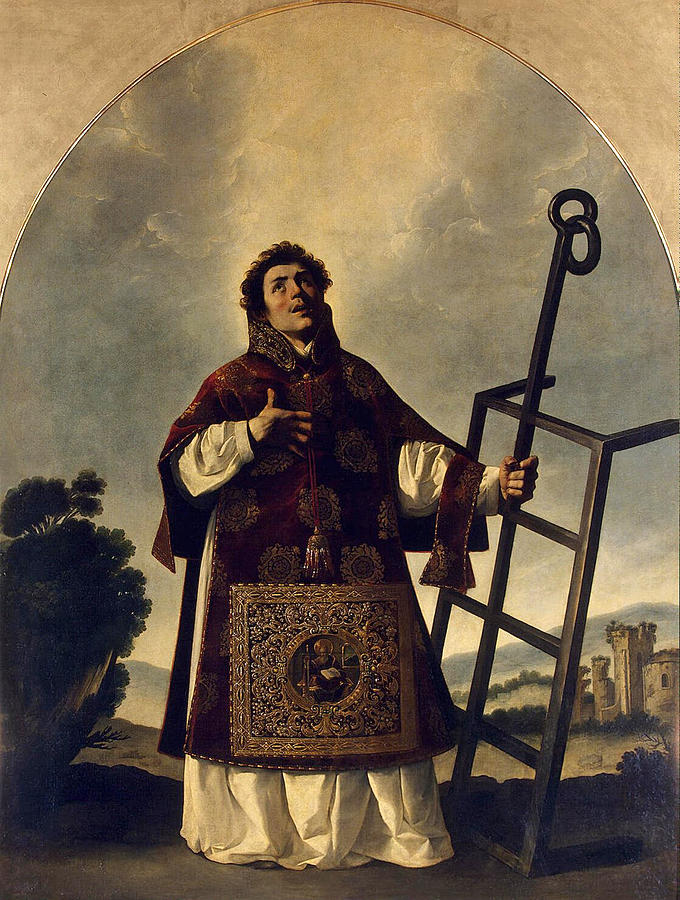
“St. Lawrence” by Francisco de Zurbaran is a majestic Spanish Baroque painting that transforms a third century martyr into a towering spiritual presence. The saint stands full length against a luminous sky, dressed in richly embroidered vestments and holding the instrument of his martyrdom, the gridiron. Zurbaran removes all distracting detail and creates a solemn, iconic image that is at once deeply human and liturgically grand.
This painting belongs to Zurbaran’s celebrated series of single standing saints, often commissioned for monastic and ecclesiastical interiors in seventeenth century Spain. In “St. Lawrence” he unites his technical mastery of fabric, his dramatic use of light, and his contemplative sense of spirituality. The result is an image that has the stillness of an icon yet the vivid realism of a living person, inviting viewers to meditate on courage, charity, and faithfulness to the Church.
The Story And Symbolism Of St. Lawrence
St. Lawrence was a deacon of the early Church in Rome, known especially for his care for the poor and his bold defense of the Church’s treasures. According to tradition, when Roman authorities demanded that he hand over the wealth of the Church, Lawrence presented the poor and the sick, declaring that they were the true treasures of Christ. For his defiance he was condemned to death and martyred on a gridiron over a fire.
Zurbaran incorporates the key symbols of this story in the painting. The gridiron stands upright beside the saint, transformed from an instrument of torture into a kind of heraldic emblem. St. Lawrence steadies it with one hand, not as a victim but as someone who has accepted his fate and conquered fear. His other hand rests over his heart, suggesting inner commitment and burning charity.
The sumptuous vestments underscore his role as deacon. In the Catholic liturgy, deacons wear the dalmatic, a wide sleeved outer garment, often richly decorated. Zurbaran paints this garment with elaborate gold embroidery and a square appareled panel featuring a religious medallion. These details evoke Lawrence’s liturgical service at the altar and his closeness to the Eucharist, connecting his martyrdom to Christ’s own sacrifice.
Composition And Monumental Presence
The composition is deceptively simple. St. Lawrence stands centrally framed within an architectural arch that echoes the shape of a chapel niche. This arch subtly separates the saint from the viewer’s space, marking him as a holy figure, yet the realism of his face and garments makes him feel close and approachable.
Behind the saint stretches a broad landscape with gentle hills, a tree to the left, and a distant fortress or city to the right. The horizon lies low, which allows the figure to rise powerfully into the sky. The gridiron leans diagonally across the right side, its angular form contrasting with the soft curves of the dalmatic.
The saint’s gaze is lifted upward toward the heavens. His head tilts slightly back, and his expression combines awe, longing, and a touch of quiet exaltation. This upward focus intensifies the vertical thrust of the composition. The viewer’s eye travels from the small plants at the saint’s feet, over the folds of white alb and red dalmatic, along the shaft of the gridiron, and finally into the open sky where Lawrence seems to find his true home.
The result is a monumental presence. St. Lawrence stands not as a narrative character but as a timeless figure who embodies virtue. The composition encourages the viewer to look up with him, sharing in his vision of the divine.
Light, Atmosphere, And Spiritual Drama
Zurbaran’s treatment of light is crucial to the painting’s mood. The sky behind St. Lawrence is luminous, filled with pale clouds and soft gradations of blue and gray. This gentle atmospheric light contrasts with the stronger, directional light that falls on the saint himself.
From the left, a clear light illuminates his face and the front of his body, making the gold details on the dalmatic shimmer. Shadows form in the folds of the fabric and under the arms, but they never plunge into deep darkness. Unlike some of Zurbaran’s more intensely tenebrist works, this painting uses a more open, airy light that suits the outdoor setting.
The interaction between light and vestment creates a spiritual drama. The white alb at the base of the figure reflects brightness outward, giving a sense of purity and holiness. The rich red of the dalmatic absorbs light more deeply, creating warm, resonant tones that suggest love and sacrifice. Gold embroidery catches highlights in a way that alludes to heavenly glory.
The sky itself contributes to the contemplative atmosphere. There is no violent storm or radiant vision, only a calm expanse that seems to open endlessly. It suggests that Lawrence is already oriented toward eternity, his earthly surroundings fading into the background as his attention focuses on God.
Vestments, Textures, And Zurbaran’s Craftsmanship
One of the most remarkable aspects of “St. Lawrence” is Zurbaran’s exquisite depiction of textiles. He was famed for his ability to render fabrics with almost tactile realism, and this painting showcases that skill.
The dalmatic is a deep crimson, adorned with intricate gold designs that resemble woven brocade. Zurbaran carefully models each motif, yet he avoids excessive fussiness by subordinating detail to the larger plays of light and shadow. The square appareled panel at the front features a central medallion, possibly depicting a sacred image such as a Madonna and Child, framed by ornate filigree. Its surface gleams like rich embroidery or gold thread.
Beneath the dalmatic hangs the white alb, whose crisp folds fall straight to the ground. The contrast between the heavy, decorated upper garment and the simple white lower garment heightens the illusion of weight and movement. The sleeves billow slightly where they emerge from under the red fabric, catching light on their rounded forms.
The saint’s hands and face are also rendered with great care. The skin shows subtle modeling, rosiness in the cheeks, and the play of light along the nose and brow. His curly hair frames his head like a natural crown, and the expression of his eyes and lips conveys both youthfulness and seriousness. Through such details, Zurbaran combines sumptuous materiality with psychological depth.
The Gridiron And The Theology Of Martyrdom
The gridiron is more than a prop. In Christian iconography, the instruments of a martyr’s death often become symbols of their triumph. Zurbaran paints the gridiron as a solid, metal frame that leans diagonally, anchored firmly on the ground. Its dark iron bars contrast with the light sky and the soft textures of clothing, giving it a stark, unyielding character.
St. Lawrence’s right hand grips the gridiron with calm strength. There is no sign of horror or revulsion. Instead, he seems to accept it as part of his vocation. The diagonal position of the gridiron introduces energy into the composition, slicing across the verticals of the figure and the horizon of the landscape. This dynamic angle hints at violence without showing it directly.
Theologically, the gridiron can be understood as a personal cross. Just as Christ redeemed the world through the wood of the cross, Lawrence achieves sanctity through his faithful endurance of suffering. By standing beside the gridiron with uplifted gaze, he proclaims that martyrdom is not defeat but a passage to glory. Zurbaran’s painting thus becomes a meditation on how human instruments of pain can be transformed into symbols of victory when embraced in faith.
Landscape, Architecture, And The World Beyond
Although the figure dominates the canvas, Zurbaran includes a landscape that adds narrative and symbolic depth. On the left, a tree and low hill suggest the natural world. On the right, distant walls and towers evoke the city, perhaps Rome, where Lawrence served as deacon and met his death.
These elements are painted with broad, atmospheric strokes rather than meticulous detail. Their function is not to tell a specific story but to situate the saint in a larger world. He stands between nature and civilization, between solitude and the community he served.
The castle almost disappears into the hazy distance, reminding the viewer that earthly powers and political structures are fleeting. In contrast, the saint, bathed in light and framed by the arch, remains solid and enduring. This juxtaposition reinforces the idea that holiness outlasts worldly might.
Counter Reformation Spirituality And Zurbaran’s Vision
“St. Lawrence” was created in a Spain shaped by Counter Reformation ideals. Religious art was expected to be clear in meaning, doctrinally orthodox, and capable of inspiring devotion. Zurbaran responds to these demands with remarkable clarity.
The identity of the figure is unmistakable. The gridiron, the dalmatic, and the upward gaze all signal St. Lawrence. At the same time, the painting is more than a visual label. It invites viewers to reflect on the virtues associated with the saint: courage, love for the poor, loyalty to the Church, and joyful acceptance of martyrdom.
Zurbaran’s particular contribution is his combination of austerity and richness. The composition is simple, and the pose is calm, yet the textures and colors are opulent. This balance mirrors the spiritual ideal of a heart detached from worldly luxury yet willing to use beautiful things in the service of God and worship.
Devotional Function And Viewer Experience
For its original viewers, perhaps monks, clerics, or lay patrons, “St. Lawrence” would have served as an object of devotion within a church or monastery. The full length scale allows the saint to appear almost life sized, creating the sense of a personal encounter. Standing before the painting, one might feel as though St. Lawrence stands in the same space, interceding and offering a model of discipleship.
The upward tilt of his gaze guides the viewer’s eyes toward heaven. The hand on the heart suggests an invitation to examine one’s own interior motives. The gridiron reminds the viewer that following Christ may involve sacrifice, whether literal or spiritual.
Because the background is relatively uncluttered, viewers can focus on these gestures and symbols in quiet contemplation. The painting encourages not momentary excitement but sustained meditation. It is easy to imagine someone praying before this image before Mass, asking for the courage to live out their vocation with the same generosity Lawrence displayed.
Modern Appreciation And Lasting Significance
Today, “St. Lawrence” continues to speak beyond its original religious context. From an art historical perspective, it stands as a prime example of Zurbaran’s mastery in combining portraitlike presence with symbolic richness. Students and admirers of art can study it to understand Baroque use of light, color, and fabric, as well as strategies for creating monumental figures within simple setups.
On a more personal level, the painting offers a reflection on integrity and service. St. Lawrence’s fidelity to the poor and to his conscience, even to the point of martyrdom, resonates with contemporary concerns about justice and the use of power. The image challenges viewers to consider what treasures they value most and what they are willing to sacrifice for them.
The calm dignity of the saint, standing between earth and sky, suggests that courage can coexist with serenity. It is not noisy heroism but quiet, steadfast commitment that defines sanctity. Zurbaran’s painting captures this message with a visual eloquence that remains compelling centuries after it was created.
Conclusion
Francisco de Zurbaran’s “St. Lawrence” is a powerful synthesis of Spanish Baroque artistry and Catholic spirituality. Through a carefully balanced composition, luminous sky, richly rendered vestments, and the stark symbol of the gridiron, he transforms the deacon martyr into an enduring icon of faith.
The saint’s upward gaze, hand on heart, and firm grasp on the instrument of his death express a profound acceptance of God’s will. The painting conveys not only the historical story of a third century martyr but also the timeless call to charity, courage, and fidelity.
Whether viewed in a church, museum, or reproduction, “St. Lawrence” continues to invite contemplation. It reminds viewers that true treasure lies not in material wealth or worldly power but in a heart freely given. In the quiet strength of this solitary figure, Zurbaran reveals how art can make visible the hidden drama of holiness and offer a model of steadfast hope for every age.