Image source: wikiart.org
Introduction to St. Lawrence by Francisco de Zurbaran
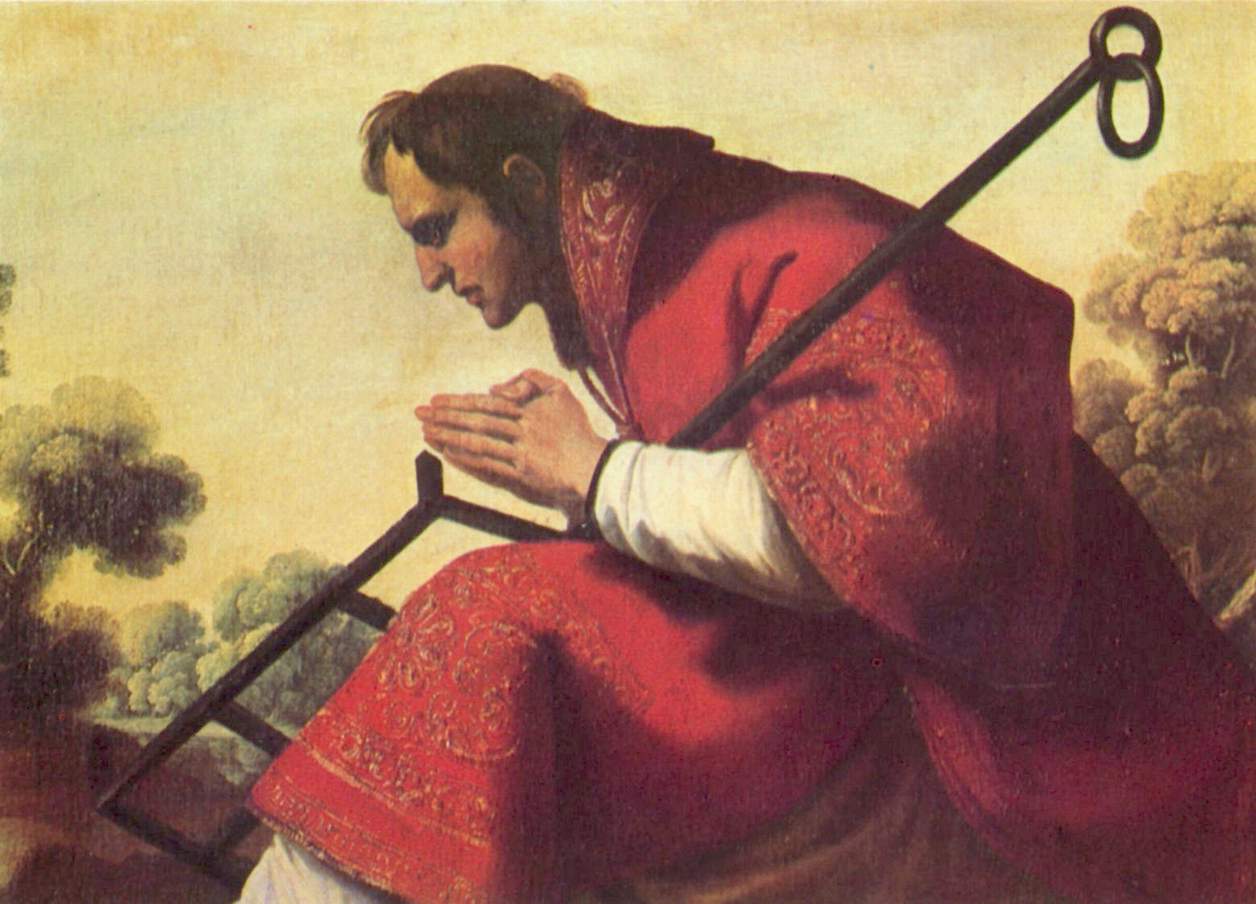
Francisco de Zurbaran’s painting “St. Lawrence,” completed around 1639, captures a moment of profound interior prayer just before martyrdom. The saint appears in profile, dressed in a richly embroidered red dalmatic that glows against a softly lit landscape. In his hands he joins his fingers in prayer, while over his shoulder leans the unmistakable attribute of his martyrdom, the iron gridiron on which he was burned alive. Rather than presenting the brutal drama of his death, Zurbaran freezes time at a contemplative instant, when Lawrence turns entirely toward God, accepting his fate with humility and courage.
This painting offers a compelling example of Zurbaran’s unique ability to combine quiet introspection with vivid physical presence. The simplicity of the composition, the restrained palette, and the highly focused emotion make “St. Lawrence” a deeply moving work that invites prolonged meditation on sacrifice, service and trust in divine justice.
The Historical and Spiritual Figure of St. Lawrence
St. Lawrence was a third century deacon of the Church in Rome, serving under Pope Sixtus II during the persecutions of Emperor Valerian. Tradition recounts that Lawrence was responsible for the distribution of alms and the care of the poor. When imperial authorities demanded that he hand over the treasures of the Church, he famously presented the poor, the sick and the marginalized as its true riches. This bold gesture led to a cruel sentence of death on a gridiron over burning coals.
From the Middle Ages onward, Lawrence became one of the most popular martyrs in Christian art. Artists often depicted him in the act of distributing alms or standing beside the gridiron, sometimes in scenes that emphasized the physical horror of his execution. Zurbaran, however, chooses a different path. He shows Lawrence not in the midst of torture, but in a recollected moment, as if the saint has stepped away from the bustle of Rome into a quiet countryside to prepare his soul. This contemplative approach mirrors Spanish Counter Reformation spirituality, which encouraged believers to meditate on the interior disposition of the saints rather than simply on the external spectacle of martyrdom.
Composition and the Power of the Profile
The composition of “St. Lawrence” is remarkable for its simplicity and focus. The saint’s body fills most of the horizontal canvas, leaning forward from right to left in a diagonal arc. He is shown in strict profile, his face turned downward, his hands folded at chest level. This reliance on the profile view recalls classical reliefs and Renaissance medal portraits, giving the figure a timeless dignity.
The diagonal created by Lawrence’s body is echoed and reinforced by the long handle of the gridiron that stretches across his back. This strong line stabilizes the entire composition, tying together the saint, his instrument of martyrdom and the surrounding space. The gridiron’s shape forms a stark geometric pattern that contrasts with the organic forms of the saint’s body and the soft, rolling landscape in the background.
There are no distracting secondary figures, no elaborate architectural structures, only a few trees and a pale, open sky. The simplicity of the scene allows the viewer to concentrate entirely on Lawrence’s posture and expression. The painting feels almost like a single sustained breath, held at the edge between calm and impending suffering.
Gesture, Expression and Inner Prayer
Zurbaran communicates the saint’s spiritual state primarily through gesture and subtle facial expression. Lawrence’s hands are clasped in a firm but gentle prayer, fingers touching, thumbs aligned. This gesture is not tense or desperate but composed, suggesting a steady, trusting conversation with God. The forearms, wrapped in white sleeves that emerge from beneath the red vestment, lead the viewer’s eye back toward the heart, emphasizing the interior source of his courage.
The profile of the face is sharply drawn. Lawrence’s brow tilts slightly downward, his eyes almost closed, his lips pressed together in quiet concentration. There is no hint of bitterness or fear, but neither is there sentimental sweetness. The expression suggests a man fully awake to the gravity of what awaits him, yet surrendering himself to a will greater than his own. The inclination of his head evokes both humility and determination, as if he bends toward martyrdom in an act of obedience.
The saint’s entire body participates in this movement of prayer. The lean forward, the slight hunch of the shoulders, and the firm grip of his arms all communicate a focused energy directed not outward toward the viewer, but inward toward God. The viewer becomes a respectful observer of this intimate exchange rather than a participant in a dramatic narrative.
The Red Dalmatic and the Language of Fabric
One of the most striking elements in the painting is the sumptuous red dalmatic that Lawrence wears. As a deacon, he would have been vested in such a liturgical garment, a tunic-like outer vestment with wide sleeves. Zurbaran, famous for his mastery of painting fabric, renders the dalmatic with extraordinary richness. The cloth appears thick and weighty, its folds catching the light in deep waves. Gold embroidery traces intricate patterns along the edges, glimmering softly without sliding into ostentation.
The color red carries multiple meanings. It is the color of blood and therefore an obvious symbol of martyrdom. It also signifies love and charity, virtues that defined Lawrence’s service to the poor. In the context of liturgy, red is worn on feasts of the Holy Spirit and martyrs, connecting the outpouring of the Spirit’s fire with the sacrificial blood of witnesses to the faith. The dalmatic thus becomes a visual synthesis of Lawrence’s identity: servant of the Church, lover of the poor, and martyr consumed by the fire of divine love.
Beneath the red garment, the white sleeves and under tunic peek out, offering a contrast that points to purity and innocence. The juxtaposition of red and white suggests that Lawrence’s coming death, though violent, will be a passage into spotless glory.
Light, Color and the Tranquil Landscape
Zurbaran bathes the figure and landscape in a soft, evenly distributed light. Unlike his darker, tenebrist interiors, this painting unfolds outdoors under a calm sky. The light is gentle, diffused, and warm, as if it were late afternoon. It illuminates the folds of the dalmatic, the curve of Lawrence’s profile and the subtle forms of the trees in the distance.
The landscape itself is understated but important. Soft green foliage, rounded tree crowns and distant hills provide a serene backdrop. The color palette of the background leans toward muted greens and browns, which set off the vibrant red of the garment without competing with it. The atmosphere feels peaceful, not stormy or ominous, which heightens the sense that Lawrence’s martyrdom is not a chaotic tragedy, but a serene offering.
This choice of setting is significant. Instead of situating the saint in a crowded Roman street or near the instruments of torture, Zurbaran places him in nature, as though creation itself silently accompanies his prayer. The landscape can be interpreted as a symbol of the soul’s inner garden, where the martyr’s consent to God’s will blossoms in quiet beauty.
The Gridiron as Attribute and Cross
The gridiron that rests upon Lawrence’s back is one of the clearest visual identifiers of the saint in Western art. Here, Zurbaran incorporates it in a particularly elegant way. Rather than isolating it as a separate emblem at his side or feet, he uses it structurally in the composition. Its dark, simple lines cross the saint’s back and extend beyond his head, creating a visual echo of the cross of Christ.
This connection between gridiron and cross is more than formal. The gridiron represents the method of Lawrence’s execution, but, in Christian understanding, every martyrdom participates in the one sacrifice of Christ on the cross. By letting the handle of the gridiron rise diagonally behind the praying figure, Zurbaran hints that Lawrence is spiritually leaning against the cross, drawing strength from it. The intersection of suffering and salvation is thus embodied in a single, understated object.
The gridiron’s dark hue and angular geometry contrast with the organic curves of Lawrence’s body and the soft foliage beyond. It introduces a note of severity into an otherwise gentle scene, reminding the viewer of the harsh reality that underlies the saint’s serene prayer.
Emotional Tone and Contemplative Spirituality
The emotional tone of “St. Lawrence” is decidedly contemplative rather than sensational. Many Baroque images of martyrs relish in dramatic gestures, contorted faces and violent diagonals. In contrast, Zurbaran offers a calm, collected figure, caught in a moment of interior decision. The drama here is not in visible struggle, but in the silent yes that Lawrence offers in his heart.
This approach aligns closely with Spanish spiritual authors of the period, who encouraged meditative engagement with the mysteries of the faith. Instead of overwhelming the senses, the painting invites a slower gaze. Viewers are drawn to imagine Lawrence’s thoughts, his memories of serving the poor, his love for the Church, and his hope for what lies beyond death. The humility of his posture encourages the viewer to adopt a similar attitude of reverence and self offering.
The calm landscape, the absence of spectators, and the limited palette all collaborate to create a space of quiet. Even the red of the dalmatic, while intense, is controlled and harmonious. The overall effect is one of solemn peace, suggesting that true heroism may often be hidden in interior fidelity rather than outward spectacle.
Zurbaran’s Style and the Spanish Baroque
“St. Lawrence” reflects many characteristic features of Francisco de Zurbaran’s mature style. His love for simple, monumental compositions is evident in the clear profile of the saint and the dominance of a single figure against a restrained background. His skill with textiles shines in the treatment of the dalmatic. His tendency to emphasize spiritual concentration over physical agitation shapes the entire mood of the work.
Within the broader context of the Spanish Baroque, Zurbaran stands out for his combination of realism and mysticism. While contemporaries like Velazquez explored court portraiture and complex spatial constructions, Zurbaran focused largely on religious subjects, often connected to monastic patrons. His saints frequently possess a stillness that feels almost sculptural. In “St. Lawrence,” this stillness is imbued with psychological depth, transforming the saint into a contemplative presence that transcends time.
The painting also reflects the Counter Reformation emphasis on clear iconography. The attribute of the gridiron, the red vestment of the deacon, and the posture of prayer all communicate the identity of the saint without ambiguity. At the same time, Zurbaran avoids overly literal storytelling, allowing space for the viewer’s imagination and reflection.
Comparison with Other Depictions of St. Lawrence
When compared to other historical depictions of St. Lawrence, Zurbaran’s interpretation appears both traditional and innovative. Many artists, particularly in Italy, portrayed the saint in the midst of his martyrdom, lying on the gridiron surrounded by executioners and onlookers, his body arched in pain while angels descend with crowns of glory. These scenes emphasize the drama of physical suffering and the triumph of faith at the moment of death.
Zurbaran chooses a quieter narrative moment. His Lawrence is neither preaching nor being tortured. Instead, he prays. This shift of focus from external action to internal state highlights the spiritual foundation of martyrdom. It suggests that the decisive battle happens in the soul, in the free choice to remain faithful, before the first blow of persecution lands.
Other portraits show Lawrence standing, holding the gridiron like a badge. Zurbaran’s choice to bend him forward, almost in a bow, lends the figure humility and motion. It implies that Lawrence is on the way, not yet at the place of execution, but walking toward it in a spirit of obedience. The painting thus captures a moment of transition, a threshold between security and sacrifice.
Legacy and Contemporary Resonance
Today, “St. Lawrence” continues to speak to modern viewers, even those far removed from seventeenth century Spanish Catholic culture. The figure of a person quietly accepting a difficult path resonates with anyone who has had to face suffering or make costly choices. The painting suggests that true strength may look like gentle perseverance rather than outward dominance.
The restrained elegance of the composition appeals to contemporary tastes that value minimalism and psychological insight. The calm landscape and clear profile invite contemplation in a world often flooded with images and noise. For those who approach it from a faith perspective, the painting offers a visual meditation on self giving service, courage rooted in prayer and the belief that death is not the end.
From an art historical standpoint, “St. Lawrence” illustrates Zurbaran’s contribution to the development of religious portraiture. It demonstrates how a single figure, simply posed and sparsely surrounded, can carry a rich narrative and profound emotional weight. It also showcases the painter’s mastery of color, especially in the challenging task of rendering red cloth with depth and subtlety.
Conclusion
Francisco de Zurbaran’s “St. Lawrence,” painted in 1639, is a remarkable blend of simplicity and depth. Through a restrained composition, a powerful profile, and the luminous red of a deacon’s dalmatic, the artist portrays the saint at a crucial spiritual moment, poised between life and martyrdom. The gridiron resting on Lawrence’s back, the quiet landscape, and the prayerful gesture all work together to express a theology of loving sacrifice and steadfast faith.
Rather than dwelling on the physical brutality of his execution, Zurbaran invites viewers into the interior world of the saint, where a courageous yes is whispered in the silence of prayer. The painting stands as a testament to the power of contemplative art within the Spanish Baroque, and it continues to offer a compelling image of humble heroism for viewers today.