Image source: wikiart.org
Introduction
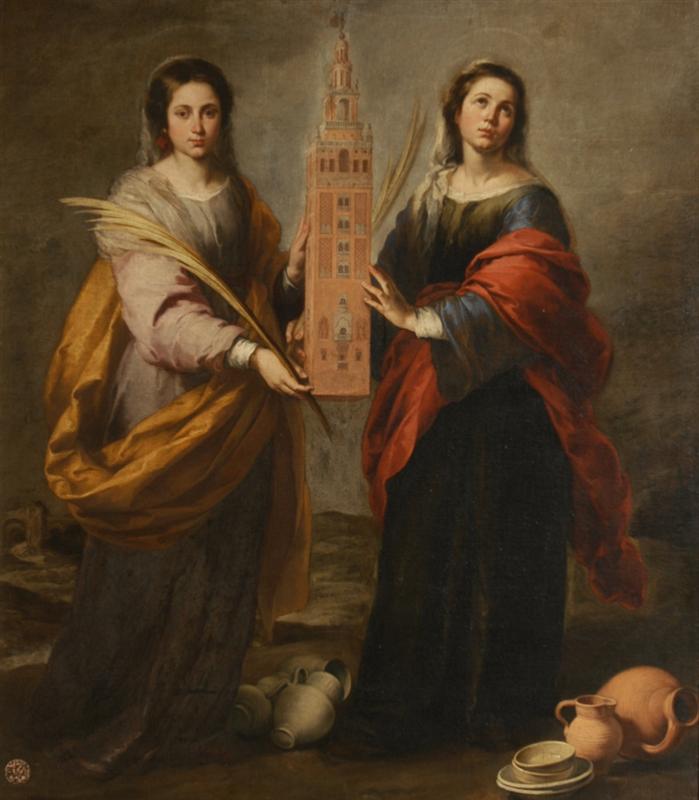
“St. Justina and St. Rufina” by Bartolome Esteban Murillo, painted around 1675, is a solemn and luminous vision of two young women who became the spiritual protectors of Seville. Standing side by side, they hold between them a detailed model of the Giralda, the famous bell tower of Seville Cathedral. At their feet lie broken and intact earthenware vessels, while each saint grasps a palm branch, the traditional symbol of martyrdom. The setting is simple and almost barren, yet the painting feels monumental. Murillo transforms a quiet devotional image into a grand statement about faith, civic identity and sacred memory.
At first glance the composition appears straightforward. Two figures, similar in age and appearance, face the viewer in almost frontal poses. Their robes fall in rich folds of color, golds, reds and blues, that glow against a subdued earth toned background. Yet the more you look the more complex the painting becomes. The careful balance between the saints, the central tower and the scattered pottery creates a symbolic architecture that tells their story without a single written word. Murillo’s gentle light and humanized expressions invite the viewer to draw near and contemplate the meaning of their sacrifice.
Historical and Devotional Context
Justina and Rufina were young sisters from Seville in the third century. According to tradition they were potters or sellers of earthenware who refused to take part in pagan worship during a local festival. When they destroyed an idol of Venus that had been placed on their market stall, the enraged crowd retaliated by smashing their pottery and handing them over to the authorities. Tortured and eventually killed for their refusal to renounce Christianity, they became venerated as virgin martyrs.
Their cult took on a special importance in Seville. In later centuries they were credited with miraculously protecting the city and the cathedral tower during earthquakes. For this reason they are often depicted flanking a model of the Giralda. By the seventeenth century, when Murillo painted them, they were firmly established as local patron saints. Their images could reassure the faithful of Seville that heaven watched over their city and its most iconic monument.
This civic dimension shaped the way Murillo approached the subject. He was not simply painting two martyrs for a generic devotion. He was presenting Seville’s own guardians, figures who linked the early Christian past to the Baroque present. The Giralda in their hands reminds viewers that the saints continue to intercede for the city, uniting history, architecture and faith in a single visual symbol.
The Saints as Twin Figures
One of the most striking features of the painting is the near symmetry of the two saints. They are similar in height, age and facial type, and they stand close together, their bodies forming a gentle V shape that cradles the model of the tower. Murillo emphasizes their sisterly bond through this mirror like arrangement. Yet he also gives each saint distinct characteristics that prevent them from becoming interchangeable.
The figure on the left, often identified as Justina, wears a muted lavender gown with a golden ocher mantle that wraps around her shoulders and flows in large folds. Her dark hair falls loosely, and her expression is calm, slightly serious, her eyes directed toward the viewer. She holds her palm branch low across her body, the reed like leaf echoing the curve of her mantle.
Rufina, on the right, is dressed in deep blue with a striking red mantle that sweeps diagonally across her body. Her gaze is lifted upward, as if in prayer or visionary contemplation. Light touches her cheekbones and forehead, giving her face a slightly more animated look. Her palm is held higher, near the tower, as if she is presenting the sign of martyrdom in conjunction with the symbol of Seville.
This subtle differentiation enriches the composition. Justina appears more grounded and engaged with the viewer, while Rufina is oriented toward heaven. Together they represent both the earthly and the spiritual response to martyrdom: steadfast endurance and transcendent hope.
Composition and Structural Balance
The painting’s composition is tightly structured. The vertical axis of the Giralda model divides the canvas into two equal halves, yet the slight turn of the saints’ bodies prevents the image from feeling rigid. Murillo uses the tower as an anchoring element that unites and separates the sisters at the same time. Their hands, gently touching the base of the model, create a visual link that draws the viewer’s eye to this central symbol.
The triangular arrangement of forms adds stability. The base of the triangle is formed by the scattered jugs and dishes at their feet, while the apex rises to the top of the tower. The saints’ heads and shoulders lie along the sides of this triangle, creating a harmonious flow from their grounded stance to the lofty spire. This geometric structure supports the spiritual message: the humble realities of daily work and pottery at the base, the martyr saints in the middle, and the tower reaching toward the sky above.
Murillo keeps the background plain, almost barren, with only hints of rocky ground and a neutral sky. This emptiness enhances the monumental presence of the figures and the tower. There are no distracting architectural details except for the earthenware fragments, which belong to the saints’ story. The overall result is an image that feels both simple and grand, grounded and elevated.
Light, Color and Atmosphere
Murillo was renowned for his warm, gentle light, and “St. Justina and St. Rufina” is a beautiful example of this quality. The illumination seems to fall from the upper left, touching the saints’ faces, hands and the front of the Giralda model. This light is not harsh. It pools softly on surfaces, creating gradual transitions between brightness and shadow. The effect is an atmosphere of calm radiance that suits the contemplative mood of the painting.
The color palette balances rich, saturated hues with more subdued earth tones. Justina’s golden mantle brings a sunny warmth to the left side of the canvas, while Rufina’s deep red mantle adds a powerful note on the right. The blue of her dress sets off the red, creating a classical pairing reminiscent of colors often used for the Virgin Mary. These vivid tones stand out against the neutral gray brown ground and sky, making the saints visually dominate the scene.
The Giralda model is painted in a delicate brick red with touches of light pink and white. This color echoes the surrounding earthenware and harmonizes with the reds and golds of the robes. Murillo thus integrates the architectural symbol into the broader color scheme. The scattered jugs and dishes at the bottom right are in cream and terracotta tones that complement the warm palette without competing for attention.
The overall atmosphere is serene and devotional. The light seems almost spiritual, revealing the figures not just as historical characters but as living presences in the sacred imagination of Seville.
Drapery and Textural Detail
Murillo’s treatment of drapery is central to the painting’s visual impact. The heavy folds of the saints’ garments create a sense of volume and movement. Every curve of cloth is modeled by light and shadow so that the viewer can almost feel the weight of the fabric.
Justina’s golden mantle swirls around her body in broad, looping folds. It wraps her left arm and falls diagonally across her front, pooling near her feet. This mantle catches the light, producing a range of tones from bright yellow to deep ocher. The drapery gives her figure a statuesque presence, reminiscent of classical sculpture.
Rufina’s red mantle is more angular and dynamic. It crosses her torso and hangs down in thick folds that gather near her knees. The rich red glaze of the paint suggests a heavy, velvety texture. The interplay of blue dress, red mantle and pale linen at her neckline creates a complex harmony of materials.
Murillo contrasts these rich textiles with the smooth surfaces of the earthenware vessels and the carefully detailed brickwork of the Giralda. The different textures are all carefully rendered, yet none of them are fussy. He uses painterly strokes to suggest material reality without losing the simplicity appropriate to a devotional image.
Symbolism of the Giralda Tower
The Giralda that the saints hold is more than a simple architectural model. It is a condensed symbol of Seville itself. Originally a minaret from the city’s Islamic past, later transformed into the bell tower of the cathedral, the Giralda embodies the layered history of the city. In Murillo’s time it was already an emblem recognized far beyond Spain.
By placing the model in the hands of St. Justina and St. Rufina, Murillo gives visual form to their role as protectors of Seville. According to legend, during an earthquake the tower was in danger of collapsing, but the saints interceded to keep it standing. The painting therefore celebrates not only their ancient martyrdom but also their continuing guardianship.
The precise depiction of the tower reveals Murillo’s attention to local pride. The recognisable tiers, windows and belfry let viewers immediately identify the structure. Yet the scale is reduced enough to be cradled between the saints, transforming the monumental tower into a devotional object. It almost becomes a reliquary or a small shrine, suggesting how the earthly city is entrusted to the spiritual care of its patron saints.
The fact that each saint places one hand at the base of the model implies shared responsibility. They support the city together, just as they faced persecution together. This dual guardianship echoes their sisterhood and reinforces the theme of unity.
Earthenware, Work and Martyrdom
Scattered at the bottom of the painting are jugs, dishes and broken pottery. These objects anchor the scene in the saints’ earthly occupation. As sellers of earthenware, Justina and Rufina earned their living in the marketplace, handling vessels very much like those depicted here. The presence of these pots reminds viewers that their martyrdom grew out of ordinary work. They were not noblewomen or scholars but artisans of humble social status.
The broken pieces allude directly to the moment when the angry crowd destroyed their goods in revenge for the smashing of the pagan idol. The shards on the ground speak of loss and violence, yet Murillo does not dramatize this episode. The pots lie rather quietly, integrated into the composition, as if the memory of suffering has been absorbed into the calm dignity of sainthood.
At the same time, the intact jugs and bowls suggest continuity and provision. Earthenware holds water, oil and food, all basic necessities of life. By including both broken and whole vessels, Murillo hints at the paradox of martyrdom: apparent destruction that leads to spiritual abundance. The saints may have lost their property and lives, but they gained a lasting place in the spiritual memory of the city.
The Palm Branches and Signs of Victory
Each saint holds a palm branch, the traditional emblem of Christian martyrs. In early Christian symbolism the palm signified victory over death, drawing on associations with triumph and paradise. Here the long, slender leaves of the palms echo the vertical thrust of the Giralda and the upright posture of the saints.
Justina’s palm is held diagonally across her body, almost like a staff. Rufina’s is positioned behind the tower, its tip rising upward. The placement of the palms suggests both personal and communal triumph. Individually, they mark the saints’ own victory over persecution. Collectively, in combination with the tower, they indicate the spiritual triumph of Christianity in Seville.
Murillo paints the palms in a subdued yellow green, less vibrant than the garments but still clearly visible. This restrained color keeps the symbol prominent without competing with the rich drapery. The palms quietly proclaim the deeper meaning of the scene: not merely two women with a tower, but martyrs crowned in glory.
Expressions and Inner Life
Although the painting has a certain formal symmetry, the emotional expressions of the saints add depth and nuance. Justina’s face is calm, almost introspective. Her eyes meet the viewer’s gaze with a steady look that conveys quiet strength. Her lips are relaxed, neither smiling nor frowning, suggesting a balanced and composed character.
Rufina’s expression is more animated. Her head tilts slightly, and her eyes look upward, as if listening to a distant voice. The light on her face and the slight parting of her lips give her a more visionary presence. She seems aware of the divine realm just beyond the visible world.
These contrasting expressions may reflect different spiritual attitudes: contemplation and aspiration. Together they present a holistic picture of sanctity. The saint is both grounded in inner peace and drawn toward heavenly communion. Murillo’s subtle modeling of their features avoids melodrama. Instead he offers a believable, humanized image of holiness that viewers can relate to.
Murillo’s Baroque Devotional Style
“St. Justina and St. Rufina” exemplifies Murillo’s mature Baroque style in religious painting. The hallmarks of this style include warm light, soft transitions, naturalistic figures and an emphasis on tender emotion rather than intense drama. Unlike some Baroque works that overflow with movement and complex spatial effects, this painting opts for serenity and clarity.
Murillo’s saints are idealized enough to inspire devotion yet remain recognizably human. Their slightly rounded faces, soft skin tones and modest yet rich clothing give them a relatable presence. This humanization of holy figures was central to Counter Reformation art, which sought to make saints approachable models for believers.
At the same time, Murillo’s use of composition and symbolism is sophisticated. The careful arrangement of the saints and Giralda, the subtle theology embedded in the pottery and palms, and the play of light across fabrics all reveal an artist who thoughtfully integrates doctrine and aesthetics. The painting functions both as an object of prayer and as a work of high artistic achievement.
Legacy and Continuing Significance
For the people of Seville, images of St. Justina and St. Rufina have long been a visual affirmation of divine protection. Murillo’s version became one of the most influential, shaping how later generations envisioned the two sisters. His balanced composition, gentle light and civic symbolism encapsulate the city’s devotion in a single memorable image.
Today, viewers can appreciate the painting on multiple levels. It is a document of Baroque religious culture, a portrait of local pride and identity, and a testament to Murillo’s skill in capturing both grandeur and intimacy. The combination of towering architecture and simple pottery, of richly robed martyrs and humble work, continues to resonate with contemporary audiences who seek meaning in the overlap of daily life and spiritual aspiration.
The painting also speaks to questions of gender and sanctity. Justina and Rufina are not passive figures hidden in the background. They stand tall, centrally placed, bearing symbols of civic importance. Their image affirms the role of women in the spiritual history of Seville and the broader Catholic world.
Conclusion
“St. Justina and St. Rufina” by Bartolome Esteban Murillo is a deeply layered work that unites faith, history and artistic beauty. Through the symmetrical yet varied portrayal of the sister martyrs, the central symbol of the Giralda tower, and the humble pottery scattered at their feet, the painting narrates their story without need for words. Murillo’s warm light, rich color and soft modeling give the saints a gentle but commanding presence, simultaneously approachable and exalted.
The painting celebrates Seville itself, presenting its iconic tower as entrusted to the hands of its patron saints. At the same time, it honors the courage of two young women whose refusal to compromise their beliefs led them to martyrdom. Murillo transforms their memory into a visual anchor of hope for his contemporaries and for viewers today.
Standing before this canvas, one senses not only the historical weight of Seville’s devotion but also the enduring power of art to embody spiritual truths. “St. Justina and St. Rufina” remains a moving testimony to the way painting can weave together city, saints and story into a single radiant image.