Image source: wikiart.org
A contemplative vision of St. John the Evangelist
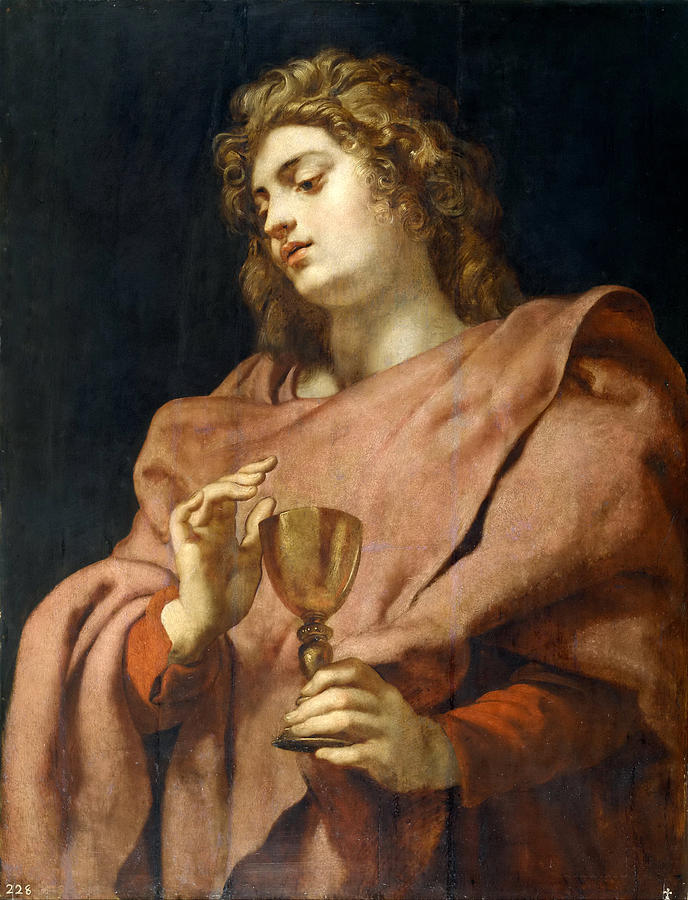
In “St. John the Evangelist,” Peter Paul Rubens turns one of Christianity’s most important figures into an intimate, quietly radiant presence. The painting shows the apostle half length against a deep, dark background, his youthful face turned slightly downward as he studies a golden chalice in his hands. Draped in a voluminous pink cloak over a warmer red garment, St. John emerges from the shadow with a soft glow, his expression absorbed and inward looking.
Rubens was famous for dramatic altarpieces filled with action, clouds, angels, and intense diagonals, yet here he chooses restraint. The composition is simple, almost austere. There is no crowded narrative, no complex architecture, no landscape. Instead, the viewer encounters a single figure suspended in silence. This narrow focus allows Rubens to explore the apostle’s psychology and spiritual meaning through posture, gesture, and light.
The painting belongs to a long Christian tradition of representing John as the beloved disciple and author of the fourth Gospel. In earlier art he often appears beside the Virgin at the Crucifixion or sitting at the Last Supper. Rubens isolates him from those episodes so that his identity and symbolism are distilled into a contemplative image. The result is a portrait that feels both devout and deeply human.
St. John and his traditional iconography
In Christian iconography, St. John the Evangelist is usually shown as the youngest of the apostles. Artists gave him smooth features, abundant hair, and a somewhat androgynous beauty that suggests spiritual purity rather than rugged experience. Rubens follows this convention. John’s face is oval and unlined, his lips soft, his gaze gentle.
One of John’s enduring symbols is the chalice. According to legend, enemies of the saint attempted to poison him, but the venom left the cup in the form of a serpent when John blessed the drink. Many paintings show a snake writhing from the rim. In Rubens’s version, the chalice is plain and empty, held delicately but firmly in both hands. The absence of the serpent creates ambiguity. The cup can still recall the miracle of the poison, but it also evokes the Eucharist, the Last Supper, and the sacrificial blood of Christ.
By removing any overt narrative detail, Rubens invites the viewer to reflect on the chalice as a symbol of mystery and faith rather than a specific episode. John’s attentive gaze and poised fingers suggest that he is meditating on the significance of what the cup represents. It becomes a visual focus for prayer.
Composition and the power of simplicity
Rubens constructs the composition from a small number of large shapes. The dark background forms a nearly solid field that pushes the figure forward. John’s pink cloak creates a sweeping diagonal from the upper right shoulder down to the lower left corner. This cloak, with its heavy folds and warm tones, occupies much of the canvas, giving the saint a monumental presence.
Within this broad arrangement, Rubens orchestrates a more delicate rhythm through John’s hands and the chalice. The left hand, seen in three quarter view, holds the base of the cup. The right hand, raised just above the rim, appears about to bless the drink or test its contents. The slightly curved fingers create a subtle arc that echoes the roundness of the chalice. These small gestures focus the eye on a tight central triangle formed by the two hands and the cup.
The tilt of John’s head leans into this triangular zone. His features are oriented toward the chalice, not toward the viewer. This inward orientation reinforces the sense of private meditation. Although we can see his face clearly, he does not look at us or address us. Instead, we witness him in a moment of interior prayer. This compositional choice turns the painting into a window onto devotion rather than a direct confrontation.
Light and color as instruments of spirituality
Light plays a central role in the emotional impact of “St. John the Evangelist.” The background is nearly black, which makes the illuminated areas of skin and fabric stand out with striking clarity. The light seems to fall from above and slightly to the left, bathing John’s forehead, nose, and cheek in a soft glow. It then slides down his neck and catches the top surfaces of his hands and the lip of the chalice.
This carefully directed lighting does several things at once. It gives the figure volume, separating him from the dark ground. It guides the viewer’s eye from face to hands to cup. It also suggests a spiritual source beyond the visible world. The way John turns his head allows the light to strike him as if it were a divine presence, an invisible grace that illuminates his contemplation.
Rubens’s color choices enhance this sense of warmth and interiority. The pink of the cloak is not a cold pastel but a rich, earthy rose imbued with browns and ochres. The red of the undergarment peeks out at the sleeves, intensifying the warmth. Against the deep background, these colors feel like banked embers, gently glowing rather than burning hot.
The golden chalice echoes the warm tones of the garments. Rubens paints it with subtle highlights that suggest polished metal without turning it into a flashy object. Its modest shimmer feels appropriate for an item used in sacred ritual. The harmonies of pink, red, and gold create a quiet unity that supports the painting’s meditative mood.
The expressive power of John’s face
Rubens was a master of facial expression, and in this painting he achieves a delicate balance between calm and emotion. John’s eyes are half closed, the lashes casting small shadows. The mouth is slightly parted, suggesting that he may be whispering a prayer or breathing out a gentle sigh. There is no trace of strain or dramatic anguish. Instead, the features convey an absorbed tenderness.
The angle of the head, with the chin raised slightly and the neck exposed, introduces a note of vulnerability. This posture can recall traditional depictions of martyrs who offer themselves to God. Yet here the effect is more introspective than heroic. John’s upward tilt seems to release him from earthly distraction, allowing his thoughts to rise toward the mystery symbolized by the chalice.
Rubens also emphasizes the saint’s youth and softness through his treatment of hair and skin. The curls are painted with fluid strokes that catch the light in strands of gold and brown. They frame the face like a natural halo, reinforcing the aura of sanctity. The skin is smooth and luminous, with gentle transitions between light and shadow. This careful modeling avoids harsh contrasts, which contributes to the serene atmosphere.
Gesture, touch, and the sacred object
The handling of the hands is one of the painting’s most beautiful aspects. Rubens gives them elongated fingers and a subtle, almost musical rhythm of movement. The right hand’s fingers hover above the chalice with a sensitivity that suggests both reverence and caution. The slightest extension of the index finger could turn the gesture into a sign of blessing.
Hands in religious art often function as the visible expression of inner states. In this case, they embody the delicate balance between faith and the possibility of danger, recalling the story of the poisoned cup. The way John touches the chalice lightly while studying it closely hints at his trust in divine protection. At the same time, the measured, almost hesitant movement acknowledges the reality of human fear.
Rubens’s attention to anatomy ensures that these hands feel convincingly alive. Tendons and knuckles are registered with soft accents. The thumb that supports the base of the chalice presses firmly, creating a sense of weight. By making the physical interaction between saint and object so tangible, Rubens deepens the viewer’s connection to the scene. We can almost feel the cool metal of the cup and the warmth of the living fingers that hold it.
Drapery and the body beneath
The vast cloak that wraps St. John is more than a decorative element. It both conceals and reveals the body underneath, creating an interplay of mass and movement. Rubens excels at painting drapery, and here he arranges it in large, sculptural folds that catch the light along their ridges. The fabric gathers around the shoulders, falls diagonally across the chest, and bunches again at the waist.
These folds suggest the structure of the torso without fully describing it. The broad upper mass hints at strong shoulders, while the narrowing toward the bottom of the canvas implies a slender waist. The cloak thus transforms John’s body into a series of flowing surfaces. This approach corresponds to his spiritual status: he is a human being, yet his physicality is wrapped in the mantle of grace.
The contrast between the thick, weighty cloth and the delicate hands and face also heightens our awareness of his sensitivity. It is as if his inner life is emerging from a heavy world of matter. Rubens unites these elements through color, letting the pink cloak reflect warm tones onto the skin, so that body and garment share the same luminous atmosphere.
Rubens’s interpretation of saintly beauty
Throughout his career Rubens painted many saints and biblical figures. Some are muscular and energetic, others aged and rugged. In St. John he chooses an ideal of gentle, almost poetic beauty. The combination of youthful features, abundant hair, and calm gaze gives the apostle a near angelic presence.
This choice reflects both theological and artistic concerns. Theologically, John was associated with spiritual insight and mystical vision, especially through the prologue to his Gospel and his authorship of Revelation. Artists often highlighted his contemplative nature by giving him a softer appearance than the more robust apostles. Rubens follows this model, emphasizing qualities of sensitivity and receptivity rather than physical strength.
Artistically, the idealized beauty allows Rubens to display his mastery of harmony and proportion. The oval face, the graceful neck, and the balanced arrangement of features recall classical sculpture, which the artist studied intensely in Italy. At the same time, the fresh brushwork and warm palette root the figure in the Baroque present. The painting thus unites classical ideals with Baroque immediacy.
Devotion, introspection, and the viewer’s role
One of the most striking aspects of the painting is how it positions the viewer in relation to the saint. Because John does not meet our eyes, we are not directly addressed or summoned. Instead, we become discreet observers of his devotion. This creates a mirror effect. His inward turning posture invites us to consider our own inner life.
The dark background plays a crucial role here. It removes any sense of specific location, whether church, landscape, or interior room. The setting becomes a spiritual space, defined solely by the interaction between saint, chalice, and light. As viewers, we are drawn into this space and encouraged to share in its stillness. The painting functions almost like a visual aid for meditation.
At the same time, the physicality of the figure keeps the experience grounded. The softness of the skin, the texture of the cloak, and the weight of the cup remind us that spiritual life unfolds within a human body. Rubens articulates this dual reality with great sensitivity. St. John appears both earthly and transfigured, engaged in an action that belongs to daily ritual and timeless mystery.
“St. John the Evangelist” within Rubens’s wider work
Although this painting is quieter than many of Rubens’s grand altarpieces, it shares important features with them. The rich, warm color scheme, the careful modeling of flesh, and the theatrical use of light all bear his unmistakable signature. What differs is the scale of the drama. Here, the intensity is turned inward rather than outward.
In other works Rubens often depicted crowded scenes of martyrdom or triumph. Those compositions display his command of complex groupings and energetic movement. “St. John the Evangelist” reveals another side of his talent, his capacity to focus on a single figure and convey an entire spiritual world through posture and gaze.
The painting may have been intended for private devotion, perhaps for a chapel or a collector’s cabinet. Its intimate size and meditative atmosphere support this possibility. Whatever its original home, the image invites personal encounter rather than public spectacle. In this sense, it anticipates later Baroque and even Rococo religious images that emphasize emotional closeness between saint and viewer.
A timeless invitation to contemplation
Seen today, Rubens’s “St. John the Evangelist” continues to speak across centuries. The painting does not depend on an elaborate storyline or theological treatise. Instead, it presents a simple visual fact: a young man holds a chalice and ponders its meaning. Through the artist’s handling of light, color, expression, and gesture, this fact becomes a profound meditation on faith, vulnerability, and divine presence.
The work invites viewers of any background to pause and share its silence. One does not need to know the legend of the poisoned cup to feel the tension between caution and trust in the way John’s fingers hover above the rim. One does not need to read the Gospel of John to sense a longing for understanding in his lowered eyes. The image communicates through universal human experiences of reflection and reverence.
Yet for those familiar with Christian symbolism, the painting offers deeper layers. The chalice can recall the Eucharist, the sacrifice of Christ, and the mystery of salvation. John’s youthful beauty can evoke the renewal promised by faith. The dark background can suggest the darkness of the world into which divine light shines. Rubens succeeds in binding these meanings together without forcing them. They arise naturally from the way he paints.
“St. John the Evangelist” therefore stands as a masterful example of how Baroque art can be both emotionally immediate and spiritually rich. Rubens, with his keen understanding of human expression and his love of luminous color, creates an image that continues to draw viewers into quiet contemplation. The painting is not loud yet it lingers in the mind, like a whispered prayer repeated in the heart.