Image source: wikiart.org
Introduction to St. John the Baptist as a Child
“St. John the Baptist as a Child,” painted around 1665 by Bartolome Esteban Murillo, is a tender and luminous vision of the future prophet during his youth. Rather than presenting John as the ascetic adult in camel skin on the banks of the Jordan, Murillo focuses on a moment of contemplative childhood.
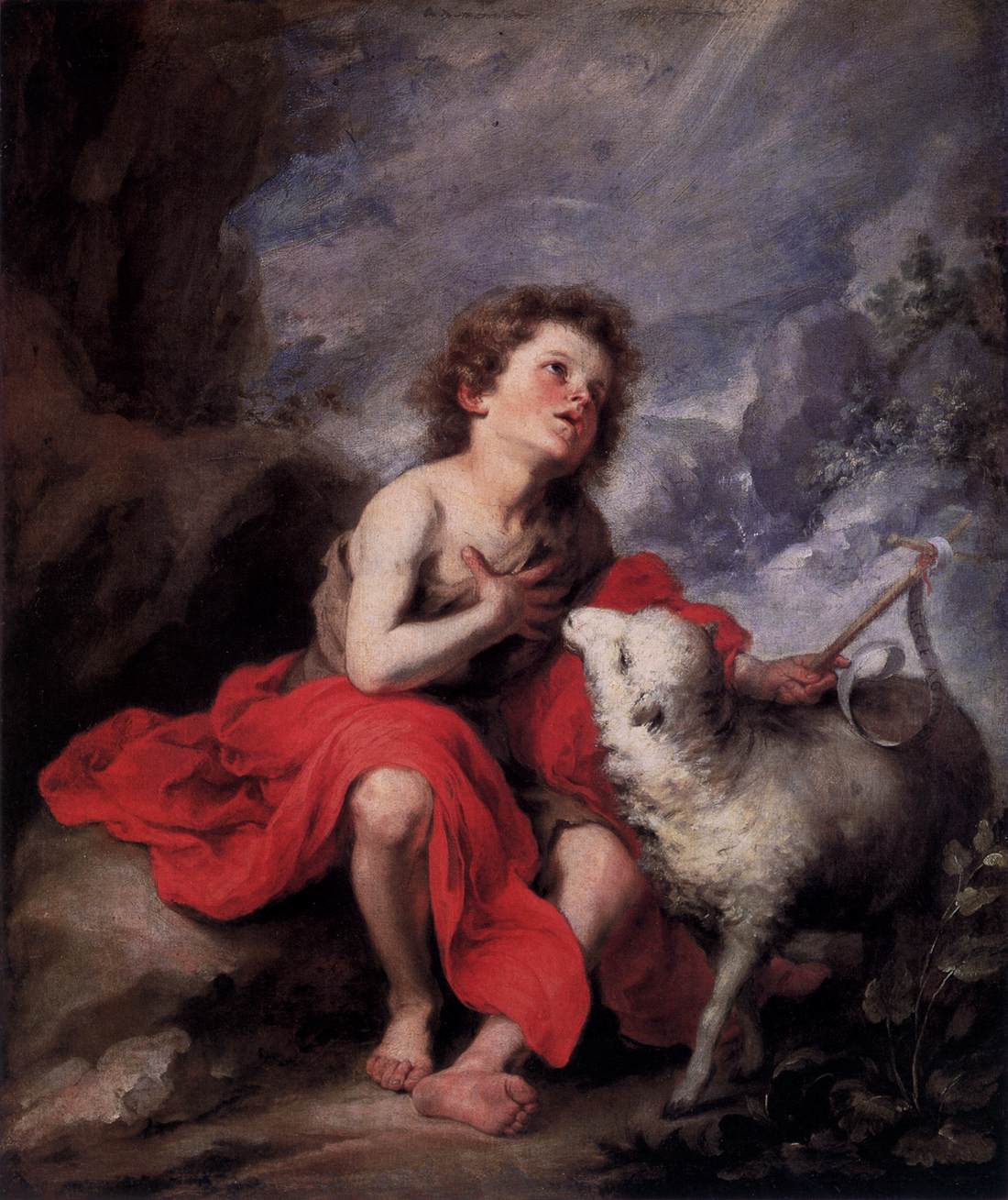
The boy sits on a rocky ground, draped in a vivid red cloak that spills around his bare legs and feet. One hand presses to his chest, the other rests on the woolly back of a lamb that gazes up at him. John’s eyes are lifted toward a celestial light that enters from the upper right, and the surrounding landscape dissolves into soft clouds and rocky forms.
This painting belongs to Murillo’s mature Sevillian period, when he had become famous for his glowing depictions of sacred childhood and his ability to combine realism with a gentle poetic spirit. Here he turns a formidable biblical figure into an approachable child while still hinting at his future mission as the herald of Christ. It is a work that invites both contemplation and affection, fusing theology with deep human feeling.
Historical and Religious Context
In seventeenth century Spain, images of child saints were enormously popular. Counter Reformation spirituality encouraged a more intimate and emotional relationship with holy figures, and painters responded with tender visions of the Christ Child, the Virgin as a girl, and youthful versions of saints. These images made doctrine tangible for ordinary believers and helped fill churches, convents and private homes with visual aids for prayer.
John the Baptist held a special place in this devotional landscape. As the forerunner of Christ, he symbolized conversion, penance and preparation for salvation. The Gospel passages about his childhood are sparse, but tradition imagined him growing up in the wilderness, already prefiguring the prophet he would become. Artists had considerable freedom to imagine these early years.
Murillo, working in devout Seville, returned to the subject several times. This version from about 1665 reflects his matured style and the taste of patrons who wanted religious art that moved the heart as much as it instructed the mind. John is recognizably a child from Murillo’s own world, yet the symbolic elements – the lamb, the cross staff, the wilderness setting and the heavenly light – clearly identify him with his future role as the one who points to Christ, the Lamb of God.
The painting likely served as a devotional image, perhaps for a private chapel or a religious community. Viewers would have recognized in it both the innocence of childhood and the seriousness of vocation. The soft naturalism made the saint approachable, while the symbolic clues invited meditation on his prophetic mission.
Composition and Focal Points
Murillo’s composition is deceptively simple but carefully orchestrated. John is placed slightly left of center, seated on the ground with his body forming a gentle diagonal that leads from the lower left toward the upper right. The lamb occupies the lower right, its head raised, forming a visual echo of John’s own upward glance.
The red cloak spreads across the base of the composition, creating a strong area of color that anchors the scene. Above this vibrant field of red, the boy’s pale torso and face emerge, catching the light. Surrounding these warm tones is a cooler landscape of grays, violets and muted greens that recede into the distance.
The viewer’s eye is naturally drawn first to John’s face. His lifted gaze and slightly parted lips direct attention toward the invisible source of light in the sky. From there, the diagonal sweep of the composition carries the eye down his arm to the lamb, then back along the curve of the cloak and up again. This circular flow reinforces the connection between the child, the sacrificial animal and the divine presence overhead.
Murillo creates a sense of intimate closeness by cropping the composition tightly around the figures. There is no crowd, no elaborate narrative detail. Only the essential participants in this quiet revelation are present: the boy, the lamb and the surrounding wilderness under a vast sky. This simplicity gives the painting an almost timeless quality and encourages focused contemplation.
Light, Color, and Atmosphere
The play of light in “St. John the Baptist as a Child” is central to its emotional power. A soft but clear illumination enters from the upper right, bathing John’s face, chest and the upper back of the lamb. This light is not harsh; it glides across the forms, creating gentle highlights and subtle shadows. It has the quality of a spiritual visitation, suggesting the moment when the child senses a call from beyond himself.
The color scheme balances warm and cool tones with remarkable harmony. John’s cloak is a deep, almost crimson red, rich and saturated. This color speaks of passion, sacrifice and fervent love. In contrast, the sky and distant rocks are painted in cool grays and bluish violets, creating a misty background that recedes and enhances the sense of space.
The earthy browns of the rock on the left frame the scene and provide a neutral contrast to the cloak. John’s skin is rendered with delicate pinks that give him a living, breathing presence. The lamb’s white fleece takes on hints of cream and gray, catching the light in soft tufts.
Murillo’s brushwork is loose and painterly, especially in the background. The clouds and rocks seem to dissolve into one another, as if reflecting the fluid boundary between the natural world and the realm of grace. In contrast, the boy’s features and the lamb’s head are more precisely defined, keeping the focus on the key symbolic figures. The overall atmosphere is one of gentle radiance, as if the air itself has been touched by the divine.
The Child Saint and the Lamb
The relationship between John and the lamb is the heart of the painting’s symbolism. According to Christian theology, John would later proclaim Jesus as the “Lamb of God who takes away the sins of the world.” In this image Murillo anticipates that role by placing the animal at the child’s side, already his companion in the wilderness.
The lamb leans toward John, its muzzle almost touching his arm. Its expression is calm and trusting. It seems to participate in the moment of revelation, raising its head as if also sensing the heavenly presence above. This closeness suggests not only John’s future witness to Christ but also a relationship of affection and care.
The small wooden staff with a curved top, resting against the lamb, is another hint of John’s adult iconography, when he is often shown with a reed cross. Here it is still a simple shepherd’s tool, connecting the child to the pastoral imagery that surrounds Christ as Good Shepherd. The sling or strap hanging from it may recall the water gourd associated with his desert life.
By presenting the lamb as an actual animal rather than a purely symbolic icon, Murillo bridges the gap between theology and daily life. Viewers could recognize the texture of the fleece, the delicate legs, the curious tilt of the head. Yet they would also read these details as signs pointing to the deeper mystery of Christ’s sacrifice, which John will one day announce.
Gesture, Expression, and Inner Life
Murillo’s genius often lies in his ability to express interior states through subtle gestures. In this painting John’s left hand rests over his bare chest, fingers splayed in a gesture that suggests both self awareness and emotional intensity. It can be read as a response to an inner stirring, perhaps the first awareness of his calling.
His head tilts slightly back, and his eyes look upward toward the light. The expression on his face is a mixture of wonder, longing and almost aching devotion. There is none of the stern severity often associated with the adult Baptist. Instead, we see a child moved to the core by an experience of God, vulnerable and open.
The slightly parted lips and flushed cheeks enhance the sense of immediacy. It is as though he has just encountered a vision and is struggling to absorb it. Murillo does not show angels or a visible apparition; the viewer is left to imagine what John sees. This decision focuses attention on the psychological reaction rather than the external event.
The positioning of the legs reinforces his emotional state. One knee is raised, supporting his body, while the other leg extends forward, bare foot resting on the ground. The pose is spontaneous rather than formal, more like a boy who has suddenly paused in mid movement because something has captured his attention. The open posture communicates receptivity rather than rigidity.
Murillo’s Handling of Childhood and Sanctity
Murillo was renowned for his depictions of children, both sacred and secular. In “St. John the Baptist as a Child” he applies this gift to create a figure who is convincingly young yet clearly marked by holiness.
Unlike some earlier depictions of child saints that emphasize idealized beauty alone, Murillo gives John small imperfections that make him believable. His hair is slightly tousled, his knees and feet show a hint of roughness from outdoor life, and his features, while attractive, retain the softness of youth. He appears like a real child who might have wandered into the Sevillian countryside.
At the same time, the reverent posture, the lamb and the heavenly light elevate him beyond ordinary childhood. Murillo does not place a halo over his head, yet the surrounding radiance and his spiritual gaze function as a kind of invisible aureole. Sanctity is suggested through atmosphere and attitude rather than through overt decorative symbols.
This approach reflects the devotional aesthetics of Murillo’s time, which sought to bring holy figures close to the faithful. By making John relatable and human, the painter encourages viewers to see sanctity as something that can grow within ordinary human life, even from an early age. Children and adults alike could find a model of prayerful openness in this young saint.
Landscape and Wilderness Symbolism
The setting of the painting is a simplified wilderness that serves both narrative and symbolic purposes. On the left, a dark rocky outcrop anchors the composition and suggests a cave or crag where the child might have sheltered. On the right, the land falls away into a misty distance where rocks and foliage are barely discernible. Above, the sky dominates, filled with soft clouds and a subtle path of light.
According to Gospel tradition, John would later dwell in the desert, living an austere life of solitude and prayer. Murillo anticipates that vocation by placing him in a landscape that is more wild than cultivated. There are no buildings or signs of human society. The child and the lamb appear alone with God and nature.
The wilderness also symbolizes the inner path of conversion. In spiritual writings of the period, the desert was seen as a place where distractions fall away and the soul encounters God more directly. By situating the boy in such a space, Murillo suggests that even in childhood John has begun this journey of inward purification.
The rocks and clouds are painted with a certain vagueness, as if they belong partly to the realm of vision. This ambiguity allows them to serve as both real environment and metaphor for the soul’s terrain. The light that cuts through the sky can be interpreted as divine grace breaking into this solitary landscape, illuminating the path John will follow.
Emotional Impact and Devotional Use
For seventeenth century viewers the painting would have offered a powerful aid to personal devotion. The tender humanity of the child invites affectionate contemplation, while the symbolic elements stimulate deeper reflection. A viewer might meditate on John’s readiness to listen to God, his humility as he kneels barefoot on the ground, and his closeness to the Lamb who prefigures Christ.
The emotional tone of the painting is gentle yet intense. There is no drama of martyrdom or confrontation here, only the quiet drama of a heart being awakened. This makes the image especially suitable for private prayer focused on inner conversion and openness to divine calling.
Today the painting retains its impact even for viewers who may not share the original theological framework. The scene can be read as a universal moment of childhood wonder, when a young person senses the immensity of the world and their place within it. The combination of innocence, vulnerability and budding vocation speaks to anyone who has felt a call to something larger than themselves.
Murillo’s soft light, warm colors and tender modeling create an atmosphere of hope. The wilderness is not threatening but protective, an almost intimate chapel under the open sky. The lamb’s presence adds a note of comfort and companionship, balancing the seriousness of John’s expression. Together these elements make the painting a lasting visual meditation on how spiritual awareness can begin in the simplest of circumstances.
Conclusion
“St. John the Baptist as a Child” is a masterpiece of Murillo’s mature religious art, combining technical brilliance with deep spiritual insight. By focusing on the young John in a moment of contemplative encounter, the painter offers a fresh view of a familiar biblical figure.
The carefully arranged composition, the glowing interplay of warm and cool tones, and the richly symbolic relationship between the child and the lamb all work together to convey a sense of divine calling entering the ordinary world. Murillo’s sensitive portrayal of childhood, his atmospheric landscape and his subtle suggestion of heavenly light make the painting both accessible and profound.
More than a simple illustration, this work invites viewers into a quiet conversation about vocation, innocence and the gentle ways in which grace can touch a human heart. Whether seen in a church, a museum or in reproduction, “St. John the Baptist as a Child” continues to inspire contemplation through its blend of humanity and holiness, reminding us that even the greatest prophets once sat barefoot on the ground, listening to a voice that called them from beyond the visible sky.