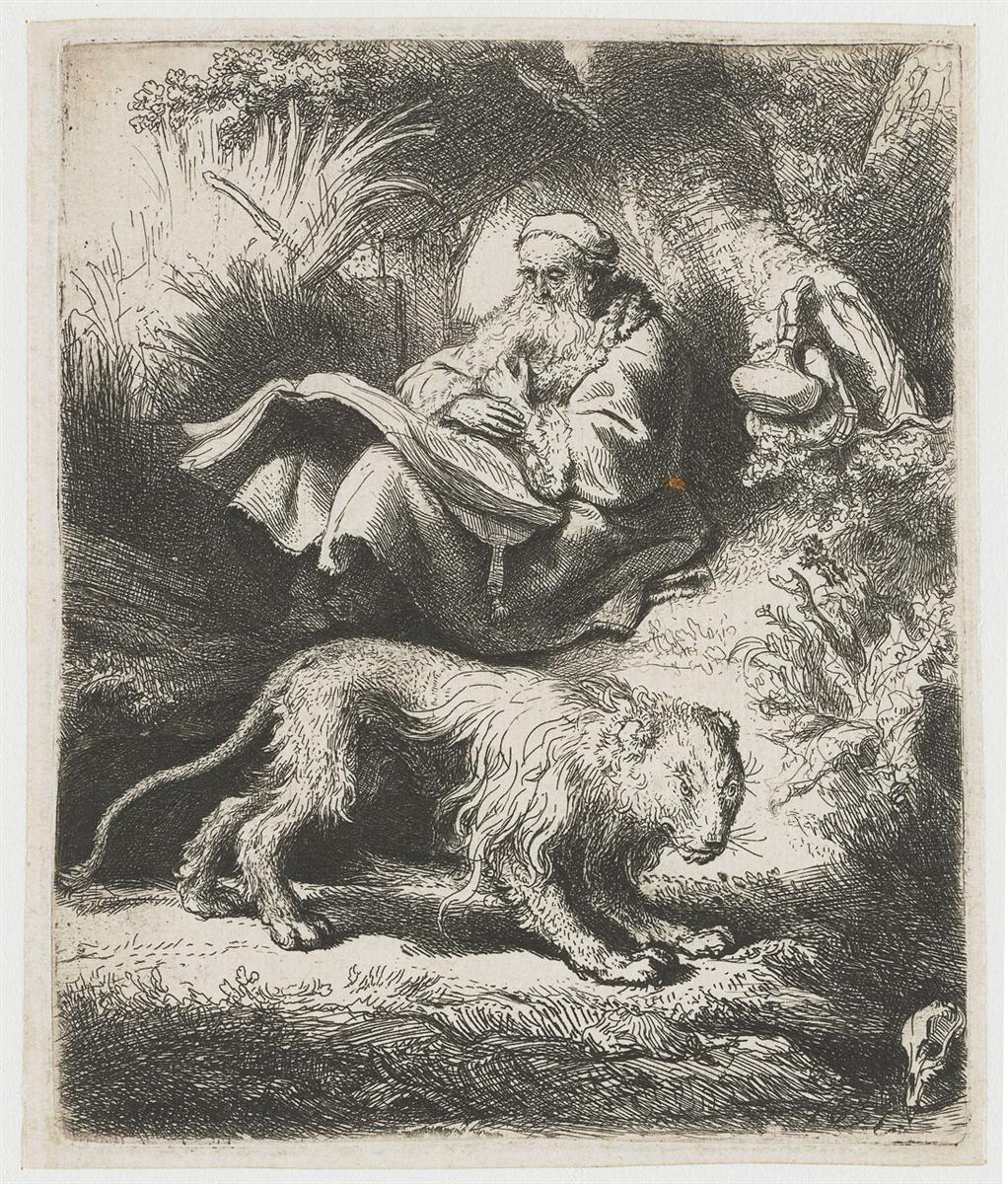
Image source: wikiart.org
Introduction
“St. Jerome Reading” (1634) is a concentrated jewel from Rembrandt’s early Amsterdam years, made not with oil paint but with the quick, incisive vocabulary of etching. On a small copperplate the artist stages a vast interior life: the scholar-saint sits in a shaded hollow beneath a tree, absorbed in a large folio that spills across his knees. A lion—Jerome’s traditional companion—pads alertly across the foreground, its paw lifted as though registering the same hush that binds the scene. Around them Rembrandt knits a dense wilderness of grasses, fronds, and rough bark, creating a hermitage where thought can thicken into prayer. The result is an image that feels at once intimate and monumental, a private moment given the gravity of history through the pressure of line and the choreography of light.
Subject, Legend, and the Image of Scholarship
Jerome, the fourth-century biblical translator and church father, was revered for his erudition and his penitential retreat to the desert. Artists across Europe portrayed him either as a scholar in his study or as a hermit in the wilderness, often accompanied by a lion whose paw he famously healed by removing a thorn. Rembrandt chooses the hermit-scholar synthesis. The saint wears a warm, fur-trimmed robe more suited to Northern weather than to Syrian heat, a choice that domesticates the figure for Dutch viewers and signals practical, living comfort rather than theatrical deprivation. A gourd-shaped water flask and satchel hang at the right, simple tools of a traveler turned anchorite. The lion, neither menacing nor docile, feels like a thinking animal, a quiet witness to the saint’s stillness. Scholarship here is not a prideful display of books but a way of life set inside the grain of creation.
Composition as a Theater of Attention
The plate is organized like a small stage where every element points toward the act of reading. Jerome sits slightly off-center, snug in a shallow niche formed by the embracing trunk and a bank of shadowed foliage. The open folio angles toward the light, its flared pages acting as reflectors that throw illumination back onto hands and beard. The lion traverses the foreground on a diagonal that keeps the eye moving and anchors the lower edge of the composition like a footlight. Behind, a fan of large leaves erupts, echoing the fan of pages, so that vegetation and book become analogues: one a text of nature, the other a text of revelation. The framing tree is not merely background; it behaves like a proscenium arch that hushes the scene. The entire arrangement is a machine for attention, built so that the viewer falls into the same contemplative mode the saint inhabits.
Light Drawn with Silence
In etching, light is the paper left untouched, and Rembrandt makes the white ground active. The brightest reserves live in the open book, the saint’s forehead and beard, and scattered highlights along the lion’s back. Around these islands, line accumulates into pools of shadow—deep hatching under the saint, cross-hatching within the tree’s hollow, dense textures in the grasses. The transition from white to dark is never abrupt; it is graded like breath, which is why the figures feel wrapped in air rather than pasted onto the sheet. The light arriving from the left reads as morning clarity: it is cool enough to keep the page crisp and the fur shivery, but warm enough to graze skin with softness. Because the elders of shadow are drawn, not washed, the darkness retains grain and therefore life. This balance—white paper as glow, lines as shade—creates the quiet weather of contemplation.
Etching Technique and the Intelligence of Line
The plate is a showcase of Rembrandt’s early graphic powers. He varies line weight with musical precision: long, taut strokes for the book’s edges; short, wiry flicks for beard and fur; tight, parallel hatchings on robe and rock that curve with form; looser, windblown marks for grasses; and thicker cross-hatching to anchor the deepest recesses. The lion’s mane is written in an entirely different hand than the saint’s garment, and yet the two coexist in the same tonal world. You can reconstruct the maker’s tempo—the quickness of a strand of hair, the slow pressure of a shadow laid in. Even the white highlights inside the book are “drawn” by omission, set up by surrounding hatches that calibrate their brightness. The craft is self-effacing, always subordinated to the sensation of living space.
The Lion as Character and Counterpart
Jerome’s lion is no mere emblem inserted to fulfill iconographic duty. Its body is low and sinuous, its paw lifted mid-step, its head turned downward with a concentration that mirrors the saint’s. The mane is ragged, almost wet-looking where lines pile up; the flanks are described with ripples of hatching that suggest thinness rather than bulk. This lion feels aged and companionable, a creature who has chosen, as Jerome has, to leave the roar of cities for the grammar of leaves and silence. In the lower right, a small skull peeks from the shadow—a traditional memento mori. Between lion and skull stretches the path of earthly life, an arc the saint contemplates with book in hand. The animal’s presence keeps the meditation embodied and wild, resisting any drift toward decorative piety.
The Book as Engine of Light and Thought
The opened folio is the brightest form on the plate and the compositional hinge. Rembrandt insists on its weight and size—thick leaves, visible binding, the slight sag of paper where it rests on the lap. The book does more than identify the scholar; it orchestrates illumination. Its angled planes catch light differently, sending soft reflections upward to the face and downward to the robe’s folds. In doing so, the book becomes an active participant in the saint’s transformation: it feeds him light as well as meaning. This is a profoundly Rembrandtian move, granting physical books sacramental roles without overstatement.
Nature as Cloister
The hermitage is rendered not as exotic wilderness but as a Northern thicket—large leaves that curl and fan, bracken and grasses, a tree trunk riddled with bark textures. The density is deliberately uneven: at left, the foliage thins into a luminous haze where the white paper breathes through; at right, the textures compress into nearly black passages. That asymmetry pulls the saint toward light and gives the composition torque. Nothing in the setting is neutral. Plants lean in, shadows knit, small clearings appear like thought’s brightings. Rembrandt transforms landscape into a living cloister that answers the saint’s inwardness with outward shelter.
Gesture, Posture, and Psychological Weather
Jerome’s pose—one hand tucked beneath the folio, the other cradling the page—communicates ease without slackness. The head bends slightly forward, eyes narrowed and intent, the long beard cascading like a second robe. The robe’s fur lining is tactile but modest; the cuffs and hem break into small, convincing shadows where the fabric turns. Most telling is the way the body anchors at the ground: the tucked legs and weighted seat bind the saint to earth even as his attention travels elsewhere. The psychology is concrete. This is not ecstasy; it is concentration, a weather of mind sustained by habit and environment.
Time, Mortality, and the Quiet Emblems
Alongside the skull, the hanging flask and bag contribute to the meditation on time. They imply travel now concluded, daily needs managed with simplicity, a life stripped to essentials so that thought may thicken. The skull is small and peripheral, hardly dramatized, because the saint’s focus is not on death as spectacle but on wisdom as practice. Even the lion’s slow step reads as a timepiece: seconds are marked by paws, not clocks. Rembrandt’s ability to load such unobtrusive objects with resonance gives the etching its aftertaste of long thought.
Theology without Rhetoric
Rembrandt’s saints rarely thunder. Here, theology is woven into the physics of light and the honesty of materials. Jerome’s sanctity is not announced by a halo but inferred from attention and from the way the world answers that attention: the book glows, the air clears around the head, the wilderness hushes. The lion’s domesticated wildness and the skull’s quiet presence thread humility through the image. It is a spirituality of dailiness, where reading is prayer and the page is a surface on which divine light falls as naturally as sunlight on leaves.
Relationship to the 1630s Etching Campaign
“St. Jerome Reading” belongs to Rembrandt’s feverish etching campaign of the early 1630s, when he tested copper’s ability to behave like paint—soft, atmospheric, capable of deep shadow and sudden brilliance. Compared with his flamboyant self-portraits in exotic costume from the same year, this plate reveals the other half of his temperament: inward, slow, and capacious. The saint’s face could almost be a projection of the artist’s own, imagining a vocation where making and reading become intertwined disciplines. This suite of experiments honed the tonal orchestration that would later define his large religious canvases.
The Experience of Scale
Encountered in a portfolio, this print asks for closeness. You lean in, and the paper’s texture enters your peripheral vision like another landscape. The tiniest touches—the notch that indicates the lion’s nostril, the minuscule highlights on the page, the twined grasses at lower left—become legible only at intimate range. That forced intimacy is part of the work’s meaning. Reading is a near act; so is the viewing of this etching. The object world cooperates to create a mirror of the saint’s practice.
Material Truth and Credibility
The believability of Rembrandt’s art rests upon how well materials behave. Fur looks warm because lines feather and overlap; paper looks crisp because edges are clean and shadows remain thin and cool; bark looks rough because strokes catch and break; earth looks tamped because cross-hatching is weighted, pressing downward. This fidelity to behavior convinces the eye and frees the mind to attend to the scene’s inwardness. The viewer does not constantly translate; everything makes sense at the level of touch, so attention can settle where the artist wants it—on the silence around a reader.
Legacy and Continuing Appeal
Later artists mined Rembrandt’s Jeromes for their fusion of landscape, portraiture, and devotional mood. Printmakers admired the plate’s range—from hairline whites to near-black pools—achieved without sacrificing clarity. Readers across centuries recognize themselves in the saint’s posture: a body made quiet so the mind can speak. In an age of noise, the print’s hush has only grown more persuasive. It models an ecology of attention in which the world’s textures are not distractions but companions to thought.
Conclusion
“St. Jerome Reading” is a small masterclass in how etching can carry inner life. Rembrandt builds a hermitage from lines, then pours light into it by protecting patches of paper. He gives the scholar a lion, a skull, a flask, and a wilderness—not as stage props, but as partners in contemplation. Every mark respects the feel of things, which is why the image never floats into symbol; it remains grounded, tactile, habitable. The saint’s reading becomes a form of seeing, and we, leaning over the print, repeat the gesture. In 1634, with copper and acid, Rembrandt forged a spiritual space where knowledge and humility meet—the page glowing like a small hearth, the lion stepping softly across the threshold of thought, and a human face lit by the kind of attention that makes the world itself more legible.