Image source: wikiart.org
Introduction
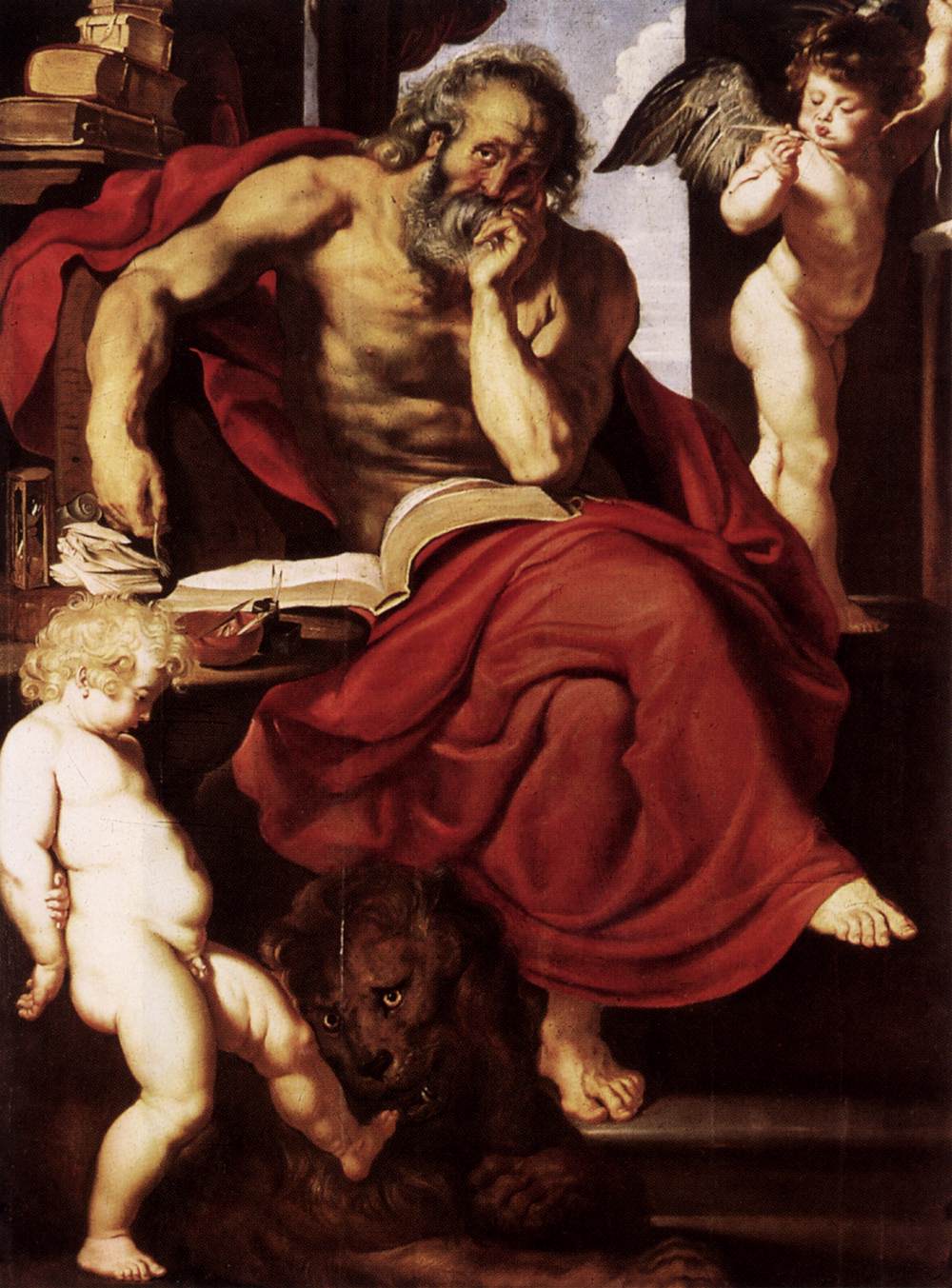
Peter Paul Rubens’s “St. Jerome in His Hermitage” (1609) stages the most bookish of the Latin Fathers as a monumental presence who dominates a dark, columned interior while light pours over muscle, parchment, and scarlet cloth. It is both a study in the grandeur of thought and a virtuoso display of Baroque painting. The scene is familiar in Christian art—Jerome the translator of the Vulgate, the hermit-scholar with lion, books, and symbols of mortality—yet Rubens infuses the subject with theatrical life. The aged saint’s body is tense, the brow furrowed, the hand at the beard mid-thought; cherubs bustle at the margins; the lion crouches domesticated but watchful at his feet. The picture compresses prayer, scholarship, and vision into one charged instant. What follows is a close reading of its iconography, composition, color, and historical meaning, showing how Rubens, newly returned to Antwerp from Italy, reimagined an emblem of learning for the Catholic Counter-Reformation while announcing the full powers of his mature style.
Historical Moment and Rubens’s Return to Antwerp
The year 1609 is pivotal for Rubens. He had just returned to the Southern Netherlands after nearly a decade in Italy, where he studied antiquity, absorbed the Venetian colorists, and engaged the Roman revival led by the Carracci. Politically, the Twelve Years’ Truce began in 1609, offering Antwerp a measure of calm after the religious and economic convulsions of the previous decades. In this atmosphere of renewed civic and religious confidence, Rubens quickly became the preeminent painter of the city, receiving commissions that asked him to make doctrine radiant and persuasive. “St. Jerome in His Hermitage” belongs to this moment of consolidation. It synthesizes Italian lessons—monumental anatomy reminiscent of Michelangelo, the warm breadth of Titian’s color, the dynamic figuration of the Carracci—into a Flemish idiom of tactile realism, minute still-life detail, and devotional intensity. The painting thus marks a hinge between Rubens’s Italian apprenticeship and the great Antwerp altarpieces of the 1610s.
The Iconography of Jerome and the Baroque Recasting
Jerome’s attributes make immediate sense of the scene. The open book is the Vulgate itself, the official Latin Bible whose translation and commentary established Jerome as the Church’s scholar-saint. The scarlet mantle recalls the cardinal’s robe he is traditionally given, even though historically the office postdates him; iconography uses it to assert ecclesial authority. The lion at his feet refers to the legend of Jerome removing a thorn from a lion’s paw, after which the animal remained his faithful companion. On the table we see papers, a writing knife and quills, an inkwell, and an hourglass—emblems of study and of time’s passage. Putti, one winged and one not, animate the upper and lower margins like embodiments of heavenly assistance and innocent curiosity. Everything is legible, but the Baroque twist is how these symbols become actors. The lion is not a token; it nudges against the foot of a child and turns a worried eye outward. The hourglass is not a static memento mori; it tilts as if just set down, reinforcing the sensation of interrupted time while thought gathers in the saint’s furrowing gaze.
A Theatre of Thought: Gesture and Psychology
Rubens’s genius lies in making mental life visible. Jerome’s head turns and dips into shadow; a hand props his jaw as if physically supporting a burden of ideas. The eyes look not at the open volume but into a middle distance beyond the picture’s edge, a classic Baroque device to suggest revelation arriving from outside the frame. The other hand dangles loosely toward the writing instruments, ready to seize them once the right phrase crystallizes. The mouth is compressed, the breath paused, the ribcage taut. Rubens uses a body honed like a classical athlete to embody the exertion of intellect. This is not a passive scholar but a titan who wrestles with language, theology, and time.
Composition as Drama
The composition pivots on a sweeping diagonal from the upper left, where stacked books press into the shadows, down across the saint’s torso and red drapery to the lion and the child in the lower left. A counter-diagonal rises from those feet toward the winged putto on the right, who seems to announce or measure the arrival of inspiration. The intersecting diagonals create a vortex around the saint’s head, the focal knot where thought condenses. Columns open a bright portal of sky behind the figures; the square of blue establishes depth and frames Jerome’s profile like a halo of air. Rubens softens the architectural geometry with the cascade of the mantle, which billows and gathers in great folds that ripple like a tide across the canvas. The drapery’s curves are not merely decorative; they conduct the eye, guide rhythm, and break the frame’s rectangle into pulses of movement.
Light, Shadow, and the Carving of Form
Chiaroscuro in this painting is assertive but not tenebrist. The light is warm, as though arriving from a window at right, falling across the saint’s shoulder and chest, the cheek of the winged putto, the belly of the child, and the pages of the book. Shadows are deep and elastic, pooling under the drapery and the lion’s muzzle and climbing the fluted column. The effect is sculptural: muscles are chiseled, veins feather across the hands, and the leonine fur breaks into tufts and curls. Rubens learned from Titian how to bathe flesh in a luminous glaze; here he inflects that Venetian glow with robust Flemish modeling. The balance of glowing skin and weighty shadow creates the painting’s mood of concentrated quiet pierced by revelation.
The Scarlet Mantle and the Language of Color
The painting’s coloristic structure orbits a single dominant note: the cardinal red mantle. Its saturation anchors the composition, but its significance is double. On the symbolic level it proclaims Jerome’s status and the Church’s authority; on the painterly level it provides the great field against which flesh tones can bloom. Rubens modulates the reds—crimson folds near the knee, cooler vermilion by the book, warmer lakes in the shadows—so that the cloth behaves like a living organism, swelling where it catches light and thinning at the turn of a fold. The chromatic counterpoints are carefully placed. Warm, tawny browns in the lion and table steady the center of gravity. Pale, pearly skin of the putti and the luminous paper introduce high values that sparkle against the mantle’s mass. A cool blue in the distant sky ventilates the palette, preventing the harmony from overheating. The result is a controlled symphony of reds, ochres, ivories, and blues that sustains the painting’s sense of depth and air.
The Lion as Companion and Mirror
Rubens gives the lion a complex role. Its posture is low and close to Jerome’s foot, signaling domestication, yet the expression is vividly sentient—a wide, almost human gaze that meets the spectator’s. That look performs a bridge function, drawing the viewer into the saint’s sphere. But it also mirrors Jerome’s interior life: the lion’s watchfulness externalizes the vigilance of the mind. The legend of the thorn is latent here—no blood, no paw extended—because Rubens wants the animal’s presence to be psychological, not anecdotal. The creature’s heavy paw, claws tucked in, rests like a punctuation mark at the lower edge, fixing the painting to the ground. Fur is rendered with quick, loaded strokes that bristle where light strikes and dissolve into shadow at the nape, a masterclass in economy and texture.
The Putti and the Theatre of Inspiration
The winged putto at the right delicately handles a feather, an image of the quill with which Jerome will resume writing. His lips purse as though he is about to blow across the feather’s vane, a fragile act that turns breath into a visible ripple—an apt metaphor for inspiration, the “in-breathing” of spirit. The other child, at left, tests the lion’s proximity with that unafraid curiosity that Baroque painters loved to choreograph. These children animate the periphery like small breezes around a storm center. They keep the scene from solemnity by reminding the viewer that grace can be playful, that the work of a learned old man is still under the supervision of heaven’s most lightfooted messengers. Their pale, cool flesh provides chromatic relief from the mantle’s heat and creates a living scale: from cherubic softness, to the lion’s rough hide, to Jerome’s hardened anatomy.
Still-Life Intelligence: Books, Tools, and Time
The array of tools is small but telling. A writing knife and quills lie beside folded sheets; an inkwell glints; an hourglass leans; bound volumes stack precariously on the shelf. Rubens paints each object with keen attention to material—the shine on ink, the rough nap of paper, the leather spines—and choreographs them to echo the drama of thought. The hourglass is the admonition that time is running out, but the open book is the counter-image of endurance: Scripture persists as sand falls. The knife, used to trim quills and scrape errors from parchment, belongs to the hard labor of textual correction; it stands for the discipline that makes inspiration tractable. In a painting devoted to the union of prayer and study, these humble props articulate a theology of craft.
Body and Sanctity in Tension
Rubens does something bold with Jerome’s physique. The saint is elderly, but the torso is heroic, the deltoids pronounced, the abdomen still segmented. This is not a literal portrait but a theological anatomy. Rubens draws on classical prototypes to propose that sanctity does not cancel the body; instead, the body becomes the instrument and image of virtue. The tension in the muscles corresponds to the tension of faith and reason, desire and discipline. The aged skin with its slight sag at the flank and the bluish tone at the knee locates the figure in time; the monumental build lifts him toward the timeless. The result is a paradox central to Baroque spirituality: the more fully human the saint appears, the more credible his access to the divine.
Space, Architecture, and the Window of Heaven
The setting combines architectural gravity with an opening to the natural world. Columns and entablature ground the saint in the Church’s enduring structure. Yet the square of sky behind his head breaks that enclosure, pouring airy light into a space otherwise thick with books and cloth. This “window” is not decorative; it constructs a visual analogy for the movement from study to contemplation. Jerome’s gaze aligns with that rectangular patch of blue, suggesting that thought, when properly disciplined by tradition, receives its consummation as illumination. The play between enclosure and opening is quintessentially Baroque, where the material frame is constantly being exceeded by grace.
Brushwork, Glaze, and the Craft of Persuasion
Rubens’s technique here is both sumptuous and economical. Flesh is built with warm underlayers and translucent glazes that allow light to seem as though it emanates from within. In passages like the saint’s forearm or the putto’s shoulder, you can sense wet-in-wet handling that blends halftones while preserving the sparkle of highlights placed with a final, loaded touch. Drapery edges are dragged to create hairline transitions against shadow; the lion’s fur is laid with swift, directional strokes that follow the turn of the musculature. The open book’s pages are a marvel of calligraphic brevity: a few ochre lines suggest script, a thicker ribbon marks the binding, a thin white scumble catches the light along the page’s deckle. Everything serves persuasion. The viewer does not merely decode symbols; the eye delights, and delight becomes assent.
Dialogue with Tradition
Jerome had been painted for centuries before Rubens, from early devotional panels to Northern Renaissance studies of the scholar in his study—think of Dürer’s engravings or the fastidious interiors of Marinus van Reymerswaele. Those pictures often emphasize the austerity of learning, the skull on the desk, the narrow cell of discipline. Rubens shifts emphasis from dour renunciation to heroic contemplation. Without discarding the memento mori implicit in the hourglass, he amplifies vitality. The saint is not hunched over a lectern but enthroned on stone, swathed in imperial red, body alive with thought. Italian models hover—the musculature recalls Michelangelo’s sibyls; the flowing red evokes Titian’s grandest draperies—but Rubens’s Flemish eye for texture and anecdote keeps the picture intimate. This dialogue with tradition situates the work between continuity and innovation, respectful of iconographic habit yet energized by new theatrical aims.
Counter-Reformation Rhetoric and the Authority of the Text
In the early seventeenth century, the Catholic Church emphasized the authority of the Vulgate and the Church Fathers against Protestant appeals to private interpretation. A painting that dramatizes Jerome’s authorship and sanctity is thus more than biography; it is rhetoric. The scarlet mantle, the Roman architecture, the obedient lion, the angelic attendance, and the massive book collectively legitimize the text and the institution that guards it. At the same time, the tenderness of the putti and the contemplative hush invite personal devotion. Rubens fuses the public argument for tradition with the private appeal to the heart. The effect is not polemical aggression but confident splendor: the Church as generous custodian of beauty and truth.
Time, Mortality, and the Urgency of Writing
While the painting radiates vitality, it is haunted by time. The hourglass is the most explicit sign, but subtler notes sound: the slackness at the saint’s abdomen, the worn edges of the books, the lion’s tired, soulful eyes. Even the sky’s pale square feels like afternoon light, the day slipping. Jerome’s pause—hand to beard, eyes narrowed—reads as the most precious and precarious of intervals, the moment before thought becomes script. That urgency gives the painting its speed. The mantle seems freshly arranged; the penknife lies open; the putto’s feather quivers. Rubens captures not a timeless icon but a moving instant in which eternity presses on a mortal scholar’s next sentence.
The Viewer’s Place in the Scene
Rubens seats the spectator just below the saint, within reach of the lion and the child. This low vantage intensifies the monumentality of Jerome’s body and draws us into the circle of light around the book. The lion’s frontal glance checks our approach and then, by conceding it, admits us. The cherubs ignore us; they are absorbed in their tasks, underscoring that grace is not staged for our benefit but proceeds regardless. Yet the painting’s persuasive rhetoric pulls the viewer into complicity: we become silent witnesses to the birth of a phrase that will be copied, preached, and believed. It is a subtle devotional strategy, more effective than overt exhortation, because it lets the work of revelation unfold while the viewer simply looks.
Rubens’s Early Mastery and Future Directions
“St. Jerome in His Hermitage” already contains the hallmarks of the great Rubens: muscular figuration, torrents of drapery, glowing flesh, a humane sense of animals, and the fusion of classical grandeur with domestic tactility. In coming years he would expand these elements into vast altarpieces—Martyrdoms, Assumptions, Adorations—crowded with bodies and angels in swirling clouds. Yet the Jerome shows the artist in an intimate key. The cast is small; the drama is intellectual rather than martial. It demonstrates that Rubens could command quiet as effectively as tumult and that his powers of characterization did not depend on large ensembles. The painting is therefore both a summary of his Italian education and a promise of the Antwerp decade to come.
Material Presence and the Haptic Pleasures of the Paint Surface
Part of the painting’s enduring appeal is tactile. The saint’s beard is crowded with wiry strokes that you can almost feel on your fingers; the red mantle has the weight of velvet; the lion’s mane is a coarse rug of paint. Rubens’s surfaces do not merely depict matter; they reenact it. This haptic seduction serves a spiritual end: it anchors invisible grace in the visible world. Theological meaning travels through pigment. The viewer’s desire to touch becomes a desire to remain, to contemplate, to take in the lesson of the scene. In this way the painting embodies a sacramental aesthetic in which material forms mediate spiritual realities.
Legacy and the Humanist Saint
Rubens gives us not a desert ascetic but a humanist saint: a man of books, languages, and bodily vigor whose solitude is intensified by study rather than by deprivation. This vision resonated with the cultured patrons of Antwerp, a mercantile city proud of its libraries and presses. It also offers a persuasive model for devotion in an age that valued eloquence: holiness is compatible with learning; indeed, it requires it. The lion’s docility, the children’s joy, the architectonic calm, and the brilliant cloth all conspire to make the life of the mind look attractive. That is no small rhetorical feat, and it explains why Rubens’s Jerome continues to feel alive in rooms crowded with louder miracles.
Conclusion
“St. Jerome in His Hermitage” presents a saint at the summit of thought, his body sharpened by discipline, his tools arrayed for work, his companions earthly and angelic, his time measured in falling sand. Rubens binds these elements into a single pulse of life through coloristic splendor, sculptural light, and a choreography of diagonal energies that converge at the saint’s thinking head. The result is a portrait of intellect as vocation, saturated with grace and urgency. In this early Antwerp masterpiece, Rubens proves that a scholar seated with a book can command as much drama as a martyr on a pyre or a general on a battlefield. The painting leaves the viewer at the threshold between page and revelation, where the next written word might tilt the world.