Image source: wikiart.org
Introduction to St. Francis by Francisco de Zurbaran
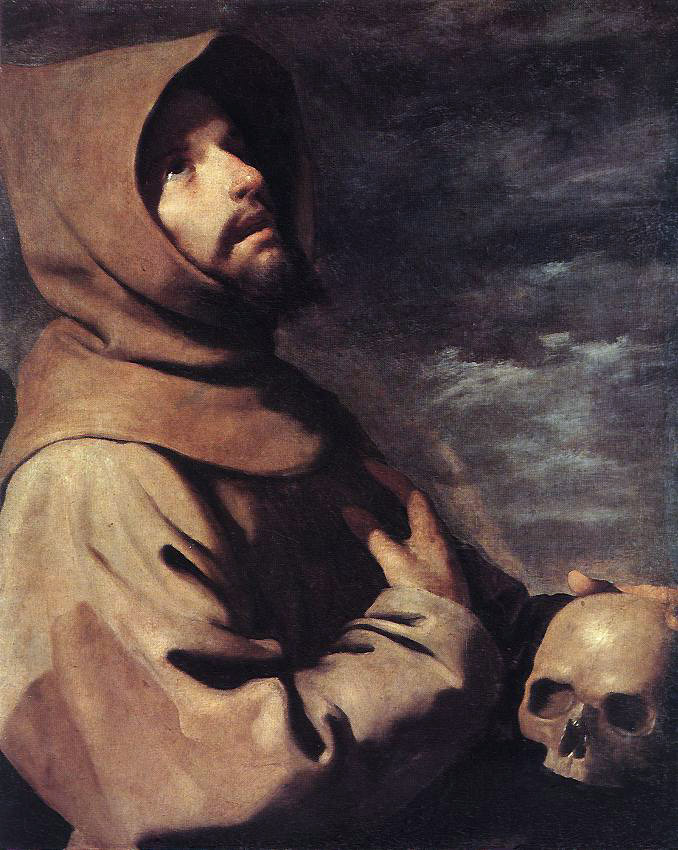
Francisco de Zurbaran’s “St. Francis,” painted around 1660, is one of the most intimate and moving images of the saint in Spanish Baroque art. The painting shows the friar in half length, wrapped in his simple habit with the hood pulled up, one hand pressed to his chest and the other resting on a skull. His head is turned toward a source of light outside the frame, eyes lifted with an expression that mixes awe, humility and longing. Behind him stretches a dark, unsettled sky.
At first glance the composition appears very simple. There is no elaborate architecture, no crowd of angels, no dramatic narrative action. Yet this very simplicity heightens the emotional and spiritual impact of the work. Zurbaran reduces the story of St. Francis to a single moment of contemplation. Through the play of light and shadow on cloth, skin and bone he invites viewers into the inner world of the saint and, by extension, into their own.
Historical and Spiritual Context
St. Francis of Assisi was a central figure in Catholic devotion of the seventeenth century. His radical embrace of poverty and his burning love for Christ spoke directly to the Counter Reformation emphasis on personal conversion and interior renewal. In Spain, Franciscan monasteries and convents commissioned many images of their founder to adorn chapels, refectories and cloisters. These paintings were meant to inspire monks and laypeople to imitate his humility and faith.
Zurbaran, active mainly in Seville and later at the Spanish court, became one of the most sought after painters of religious subjects. He painted St. Francis many times, exploring different aspects of the saint’s life: receiving the stigmata, meditating in solitude, or simply standing as a model of contemplative poverty. The 1660 “St. Francis” belongs to this group of works and may have been created toward the end of the artist’s career, when his style had become especially refined and meditative.
The image reflects a spirituality focused on personal encounter with God. Instead of illustrating a specific miracle or event, Zurbaran presents Francis at prayer, pondering the mystery of death and eternity. This contemplative emphasis suited monastic practice, which encouraged brothers to meditate on death not as something morbid but as a gateway to union with God.
Composition and Pose
The composition is tightly framed around the figure. St. Francis is placed slightly to the left, leaving room for the dark sky on the right and the skull at the lower edge. The framing cuts off his body just below the waist. This half length format brings the viewer close to the saint and emphasizes his face and hands, the parts of the body most expressive of emotion and intention.
The pose is carefully constructed. Francis’s torso turns slightly toward the right, while his head tilts back toward the light. This gentle twist creates a dynamic diagonal line that runs from his left shoulder up through his face to the unseen source above. His right hand touches his chest, fingers spread, as if he is silently affirming his love and surrender to God. His left hand supports the skull, with the bones resting against the dark surface at the bottom of the canvas.
The asymmetry of the pose prevents the painting from feeling static. The diagonal of the head and shoulders contrasts with the more stable vertical of the body. The placement of the skull at the lower right forms a visual counterweight to the illuminated face at the upper left. The viewer’s eye moves in a gentle circuit between these two focal points, following the silent conversation between life and death that the painting dramatizes.
Light, Shadow and the Baroque Atmosphere
Light in this painting is both natural and symbolic. A strong but controlled illumination comes from the upper left, falling on Francis’s face, the upper part of his habit and the front of the skull. The rest of the figure and the surrounding space remain in deep shadow. This handling of light and dark is characteristic of Baroque tenebrism, yet Zurbaran uses it not simply for theatrical effect but to express spiritual truth.
The light appears to be external, perhaps the glow of a hidden sun breaking through clouds, yet it also suggests an interior illumination, the grace of God shining on the soul. Francis lifts his eyes toward this light, acknowledging it as the source of his hope. His face and hand glow against the darker habit, while the skull, though strongly lit, remains pale and dull by comparison. In visual terms, the warmth and vitality of the living saint surpass the cold clarity of death.
The background sky contributes to the atmosphere. It is not a bright blue day but a troubled expanse of gray and muted tones, with patches of lighter cloud suggesting changeable weather. This restless sky mirrors the spiritual battle between fear and trust that every believer experiences. Yet the light that touches Francis’s face assures the viewer that divine presence is stronger than the dark.
The Face of St. Francis and Inner Psychology
Zurbaran’s rendering of the face is one of the great achievements of the painting. Francis appears between youth and middle age, with a short beard and mustache, high cheekbones and a slightly pointed nose. His features are not idealized. They retain a certain roughness that hints at the ascetic life he leads. Yet the expression is remarkably gentle.
The eyes are wide and moist, turned upward. They do not simply stare into space. They seem to be fixed on something beyond the frame, something that inspires both awe and tender affection. The slightly parted lips suggest that he might be whispering a prayer or quietly breathing the name of Christ. The brow is relaxed rather than furrowed. There is a hint of vulnerability in the way the light touches his cheek and illuminates the edge of the hood.
This psychology is subtle but profound. St. Francis is not presented as a stern ascetic or a dramatic ecstatic. He is depicted as a man deeply moved by love, conscious of his own fragility and mortality yet trusting in mercy. Viewers can easily identify with this expression of humble longing. It is not reserved for monks alone but speaks to anyone who has looked up from the troubles of life in search of consolation.
The Habit and the Symbolism of Poverty
The brown habit that envelops Francis is more than clothing. It is a visual shorthand for his vocation of poverty and simplicity. Zurbaran paints the cloth with great attention. The material looks thick and heavy, perhaps coarse wool. The hood covers most of the head, leaving only the face visible. The shoulders swell with folds that catch the light, while the chest and arms are modeled with broad, simple planes.
The color of the habit is a warm earthy brown, which links the saint to the soil and to the poor. Unlike the rich fabrics in some of Zurbaran’s paintings of female saints, here there is no ornament, no embroidery, no jewelry. The only luxury is the painter’s skill in describing the play of light over rough cloth. This emphasis on texture can be read as a meditation in itself. The habit becomes a visible sign of the saint’s decision to strip away worldly status in order to belong entirely to God.
Yet Zurbaran avoids any suggestion that poverty is ugly or degrading. The folds of the habit are beautiful in their severity. The way the light slides over them suggests dignity and quiet grandeur. In this way the painting communicates a central Franciscan insight: that true beauty is found not in glittering wealth but in loving simplicity.
The Skull as Memento Mori
The skull that Francis holds is one of the key symbols of the painting. It rests in his left hand at the lower right corner of the canvas, tilted slightly toward the viewer. The eye sockets are dark and empty. The bone surface glows under the same light that illuminates the saint’s face. There is no horror or blood. The skull is presented calmly, almost as an object of study.
In Christian iconography the skull serves as a memento mori, a reminder of death. Monks and nuns often used such images in their meditation to keep the fleeting nature of earthly life before their eyes. For St. Francis, who called death “sister,” the skull is not an enemy to be feared but a companion that points beyond itself to eternal life. By holding it rather than recoiling from it, he expresses his acceptance of mortality.
Zurbaran’s placement of the skull is significant. It is visually linked to the saint’s hand on his chest. The line of his arm leads from his heart to the skull and then back to his face. This triangular relationship suggests that awareness of death does not lead to despair, but to a deeper love and a more intense turning toward God. The skull becomes an instrument of conversion rather than a symbol of doom.
The Sky and the Sense of Place
Unlike some of Zurbaran’s earlier monastic images, which surround their subjects with impenetrable darkness, this painting includes a suggestion of outdoor space. The upper right portion of the canvas shows a cloudy sky, painted with loose, atmospheric strokes. The horizon is not visible, and no landscape details are included, yet the presence of clouds hints that Francis might be praying in the open air, perhaps on a hillside or in a remote field.
This open sky expands the space of the painting and aligns the saint with nature, a key element in Franciscan spirituality. St. Francis loved to pray outdoors, addressing the sun, moon, wind and animals as brothers and sisters. Though Zurbaran does not include such details explicitly, the cloudy background evokes that world of creation that surrounds and witnesses his prayer.
The sky also sets a mood. The mix of dark and lighter clouds suggests a storm that is passing or about to gather. Against this restless backdrop, the steady upward gaze of Francis stands out as a calm response. The painting thus becomes a subtle drama between the turbulence of the world and the interior peace found in trust.
Comparison With Other Depictions of St. Francis by Zurbaran
Zurbaran painted St. Francis many times, yet each version explores a slightly different nuance of the saint’s character. In some paintings Francis stands full length in an empty, black background, his figure almost statue like. In others he kneels in meditation, cradling a skull or a crucifix. Compared to these, the 1660 “St. Francis” feels particularly intimate.
The half length format brings the viewer closer to the face. The inclusion of the sky introduces a more open and atmospheric setting. The mood is softer and more reflective than in some earlier works, where the contrasts of light and dark are more extreme. This suggests that the painting may belong to the later phase of Zurbaran’s career, when his style became somewhat gentler and more lyrical.
Despite these differences, certain elements remain constant. The simple habit, the use of tenebrism, the focus on solitary contemplation and the presence of symbols like the skull are hallmarks of Zurbaran’s Franciscan imagery. Together they create a recognizable visual language that seventeenth century viewers would have associated with the ideals of humility, penance and loving union with God.
Baroque Spirituality and the Viewer’s Experience
In the context of Baroque spirituality, this painting functions as more than a depiction of a historical figure. It is a tool for meditation. Devout viewers would stand before the canvas and try to place themselves in Francis’s position, imitating his gestures and interior attitudes. The closeness of the figure, the direct yet gentle gaze and the stark confrontation with the skull all contribute to this effect.
The painting invites the viewer to ask personal questions. How do I face my own mortality? Where do I look for light in the midst of darkness? What habits or attachments keep me from embracing simplicity and trust? The silent image does not provide verbal answers. Instead, it creates a space where such questions can be pondered in God’s presence.
At the same time, the painting comforts. The light on Francis’s face, the softness of his expression and the calm way he cradles the skull suggest that grace is available to anyone who turns toward it in sincerity. The saint is not distant or terrifying. He is a companion who has walked the path of conversion and now intercedes for those who still journey.
Legacy and Contemporary Relevance
Today, Zurbaran’s “St. Francis” continues to speak to viewers across cultures and beliefs. Even outside a strictly religious framework, the painting addresses universal themes: the fragility of life, the search for meaning, the tension between fear and trust. The honest portrayal of a human face faced with mortality can resonate with anyone who has confronted loss or uncertainty.
From an art historical standpoint, the work stands as a prime example of Spanish Baroque painting at its most distilled. It demonstrates how mastery of light, color and form can be harnessed to express inner realities rather than simply outer appearances. The painting’s economy of means and emotional depth have inspired many later artists interested in the power of reduction and silence.
For viewers who share the Christian faith, the image retains its original devotional function. It offers a visual doorway into contemplation of the mysteries of death and resurrection, poverty and grace, fear and love. In a world often distracted by noise and spectacle, Zurbaran’s quiet, focused “St. Francis” feels strikingly contemporary in its call to interiority.
Conclusion
Francisco de Zurbaran’s “St. Francis” from around 1660 is a masterpiece of concentrated spiritual portraiture. With only a hooded friar, a skull and a cloudy sky, the painter evokes an entire world of faith, struggle and hope. The warm light on Francis’s face, the rough folds of his habit, the pale bone of the skull and the troubled yet spacious sky all work together to create a meditation on mortality illuminated by grace.
The painting exemplifies Zurbaran’s ability to combine Baroque drama with monastic sobriety, resulting in an image that is both powerful and profoundly peaceful. Whether viewed as a religious icon, a psychological study or a work of pure visual artistry, this “St. Francis” continues to invite viewers into the same upward gaze that transforms fear of death into trust in the God of life.