Image source: wikiart.org
Introduction to St. Eulalia
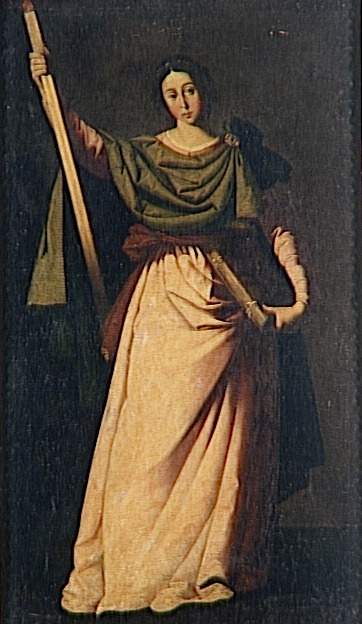
Francisco de Zurbaran’s “St. Eulalia,” painted around 1650, is a quiet yet powerful image of one of Spain’s most beloved virgin martyrs. The painting shows a young woman standing alone against a dark background, dressed in a pale robe and a green mantle, her waist cinched with a reddish sash. In her hands she holds the instruments of her martyrdom, pieces of a large wooden cross that frame her body on a diagonal. Her face is serene and contemplative, her gaze directed gently toward the viewer.
At first glance the composition looks simple. There is no crowd of executioners, no dramatic landscape, no violent scene. Yet in this apparent simplicity Zurbaran achieves an intense psychological and spiritual depth. The saint’s steady posture, the muted colors, and the stark contrast between her luminous figure and the surrounding darkness combine to present St. Eulalia as a timeless symbol of courage, purity, and steadfast faith.
Historical Background and the Cult of St. Eulalia
St. Eulalia is associated with early Christian martyrdom in Roman Hispania. Tradition speaks of a young girl, twelve or thirteen years old, who defied imperial edicts that demanded sacrifice to pagan gods. Refusing to renounce her faith, she openly confessed herself a Christian and was tortured and killed. There are two principal versions of her story, one centered in Merida and the other in Barcelona, but both emphasize her youth, her bravery and her resolute confession of faith.
By the seventeenth century, when Zurbaran worked in Seville, devotion to virgin martyrs like Eulalia was deeply ingrained in Spanish Catholic culture. They embodied ideals of chastity, courage and loyalty to Christ which Counter Reformation spirituality prized. Their relics and stories were linked to specific cities, giving local communities heavenly protectors. Paintings of these saints were commissioned for churches, convents and private chapels as aids to prayer and as visual affirmations of Catholic identity.
Zurbaran, renowned for his images of saints, monks and martyrs, was frequently asked to depict such figures. His “St. Eulalia” belongs to a group of female martyr paintings in which he unites intense spiritual focus with a restrained, almost sculptural sense of form.
Composition and Spatial Structure
The composition of “St. Eulalia” is vertically oriented and deliberately spare. The saint occupies almost the entire height of the canvas. She stands on a simple patch of ground, barely differentiated from the dark background. There is no visible horizon line, no architectural frame, no landscape. This lack of context isolates the figure, making her appear both monumental and accessible.
Eulalia’s body forms a subtle S-curve. Her weight rests on one foot while the other steps slightly forward, causing her long pale skirt to fold and billow gently. The diagonal formed by the wooden crosspiece in her right hand echoes this gentle movement and leads the viewer’s eye across the figure from lower right to upper left. The long vertical plank in her left hand anchors the composition, balancing the diagonal with a strong upright line.
The overall effect is one of stability and grace. The diagonals suggest dynamism and sacrifice, while the vertical emphasizes moral firmness. Zurbaran uses these visual rhythms to communicate the inner character of the saint: a young woman whose life was interrupted by violence yet who stands before us calm, composed and unshaken.
The Figure of St. Eulalia
Zurbaran’s Eulalia is youthful but dignified. Her face is oval, with delicate features and large dark eyes. Her lips are closed, and her expression is thoughtful rather than ecstatic. She does not display the dramatic anguish or intense emotion often seen in Baroque martyr images. Instead, she appears self possessed, almost introspective, as if she has already accepted her fate and now contemplates it with peaceful resolve.
Her dark hair is parted in the middle and drawn back, giving her a modest appearance. There is no heavy jewelry or elaborate hairstyle. This simplicity underscores her virginity and humble status, even as her composed posture and fine clothing reveal noble qualities.
Although standing, she evokes a sense of inward recollection. Her head is slightly inclined, and her gaze seems to meet the viewer’s without aggression. The painting invites us to approach her not as a tragic spectacle but as a spiritual companion, someone who gently encourages courage and fidelity.
Costume, Drapery and Color
The saint’s costume combines elegance with modesty. She wears a long, soft pink gown that reaches the floor. The fabric falls in ample folds, particularly around the lower half of the body, where it catches the light and creates subtle patterns of shadow. The color is neither bright nor dull. It is a warm, flesh toned pink that suggests youth and purity, harmonizing with the gentle tones of her skin.
Over the gown Eulalia wears a green mantle that drapes across her shoulders and upper torso, held in place by a rich reddish sash wrapped around her waist. The mantle’s green adds a cool counterpoint to the warm pink of the dress and dark background. Green has long been associated with hope and new life, fitting symbols for a martyr whose death is believed to lead to eternal life.
The sash functions both structurally and symbolically. Visually it defines the waist and introduces a horizontal band of color that stabilizes the composition. Symbolically the deep reddish tone hints at the blood of martyrdom. It ties together the themes of virginity, sacrifice and spiritual victory.
Zurbaran’s treatment of fabric reveals his characteristic mastery. The folds of the gown and mantle are rendered with an economy of brushwork that suggests weight and texture without overwhelming detail. The light glides over the cloth, picking out edges and soft creases, giving the impression that these garments belong to a real person, not a theatrical costume.
Symbols of Martyrdom: The Wooden Cross
The most important iconographic elements in the painting are the pieces of wood that Eulalia holds. In her left hand she grasps a tall upright beam that almost reaches the top of the canvas. In her right she holds a shorter crosspiece, creating a partial cross. These wooden elements recall the instruments of her torture and the structure on which she was exposed or crucified according to some versions of her legend.
Zurbaran does not present the cross as a completed Latin symbol. Instead, by showing the components separately, he emphasizes the human role in constructing the instrument of suffering while also allowing the saint to handle them with a certain authority. She is not a passive victim pinned to the cross. She holds its parts as if acknowledging what was done to her yet standing free and victorious.
The diagonals formed by the beams also create a visual connection to the cross of Christ. For devout viewers, St. Eulalia’s martyrdom is not an isolated event but a participation in Christ’s sacrifice. The wood’s rough texture and muted color contrast with the smoothness and gentle tones of her clothing, underlining the harsh reality of persecution amid the beauty of holiness.
Light, Shadow and the Dramatic Background
Light in this painting is concentrated on the figure of Eulalia. A gentle illumination from the left falls across her face, upper body and gown, while the background remains a nearly uniform dark tone. This tenebrist approach, inspired by Caravaggist tendencies, is central to Zurbaran’s style. It gives the figure sculptural presence and focuses the viewer’s attention on her features and gestures.
The darkness enveloping Eulalia can be read symbolically as the world of pagan hostility or sin in which she bore witness to Christ. Against this gloom her pale figure stands out as a beacon of purity. The boundary between light and dark along the edges of her body is sharp in some places and softer in others, creating a subtle halo effect without the use of a literal halo.
The limited tonal range also contributes to the contemplative mood. Rather than using dramatic, high contrast lighting to depict violent action, Zurbaran uses shadow to create silence and depth. The void behind Eulalia feels solemn and timeless, like the interior of a chapel. It allows viewers to meet the saint in an intimate, almost private space suited to prayerful meditation.
Gesture, Movement and Inner Life
Although St. Eulalia stands still, her gestures convey nuanced meaning. Her left arm lifts the tall beam with ease. Her hand grips it firmly but without strain. This suggests spiritual strength and acceptance of the cross. Her right arm curves downward, holding the crosspiece at an angle across her body. This position connects the cross with her heart, implying that martyrdom is not simply imposed from outside but embraced from within as an act of love.
The slight shift of her hips and the twist of her shoulders impart gentle movement, preventing the figure from appearing rigid. These subtle gestures embody a narrative moment. It is as if she has just taken up the cross that recalls her suffering and now presents herself to us as one who has passed through trial and found peace.
Zurbaran refrains from including explicit wounds or graphic details of torture. The focus is instead on the interior attitude of the saint. Her calm gestures tell us that she has forgiven her persecutors and surrendered her life into God’s hands. This emphasis on interior transformation rather than outward violence reflects the spiritual values of his monastic patrons and the larger Catholic reform.
Zurbaran’s Style and the Spanish Baroque Context
“St. Eulalia” reveals many aspects of Zurbaran’s mature style. He was celebrated for his ability to render saints as life sized, solid presences with minimal external distraction. In contrast to the exuberant dynamism of some Italian and Flemish Baroque painters, Zurbaran favors stillness, clear contours and strong, quiet light.
His approach suited the tastes of Spanish religious communities that valued sobriety, discipline and focused meditation. Paintings like “St. Eulalia” were often placed in convents or churches where nuns or monks would contemplate them during prayer. The simplified background and solitary figure allowed viewers to project their own spiritual struggles onto the saint and to feel personally addressed by her gaze.
At the same time, the painting reflects broader Baroque tendencies through its dramatic lighting and subtle emotional intensity. The contrast between dark and light, the diagonal elements of the cross, and the interplay of warm and cool colors all create an underlying drama. Yet this drama is interiorized, distilled into a single standing figure rather than dispersed through complex narrative scenes.
Devotional Function and Message
For seventeenth century viewers, the image of St. Eulalia would have carried several layers of meaning. It honored a specific local saint whose relics and legends linked the community to the heroic age of the early Church. It provided a model of youthful courage and chastity, especially for young women in religious life who might see in Eulalia an image of their own commitment. It also served as a reminder that true Christian discipleship sometimes requires confrontation with powerful cultural forces.
The painting’s message is not one of bitter resistance but of peaceful steadfastness. Eulalia stands in silence, her expression gentle, her posture unaggressive. She holds the cross not as a weapon but as a testimony. This attitude expresses a theological view of martyrdom as loving witness rather than mere defiance. The saint does not hate her enemies. She simply refuses to deny the truth she knows.
Contemporary viewers can still find inspiration in this portrayal. In a world where pressure to conform can take many forms, the image of a young person calmly holding fast to inner conviction remains powerful. The painting suggests that true strength may look like quiet fidelity rather than loud aggression.
Conclusion
Francisco de Zurbaran’s “St. Eulalia” is a masterful synthesis of simplicity and depth. Through a solitary standing figure, a few carefully chosen symbols and a controlled palette of light and shadow, he evokes the entire story of a young martyr who chose fidelity to Christ over safety and social approval. Her pale gown, green mantle and red sash, together with the wooden cross pieces she holds, create a rich visual language of purity, hope and sacrificial love.
The painting demonstrates how Zurbaran could transform hagiography into an intimate encounter. Viewers are not overwhelmed by spectacle. Instead, they are invited into a quiet space where the saint’s calm gaze and gentle gestures speak directly to the heart. “St. Eulalia” continues to stand as a testament to the enduring allure of courage grounded in faith and to the unique spiritual power of Spanish Baroque painting.