Image source: wikiart.org
A compassionate scene from Golden Age Seville
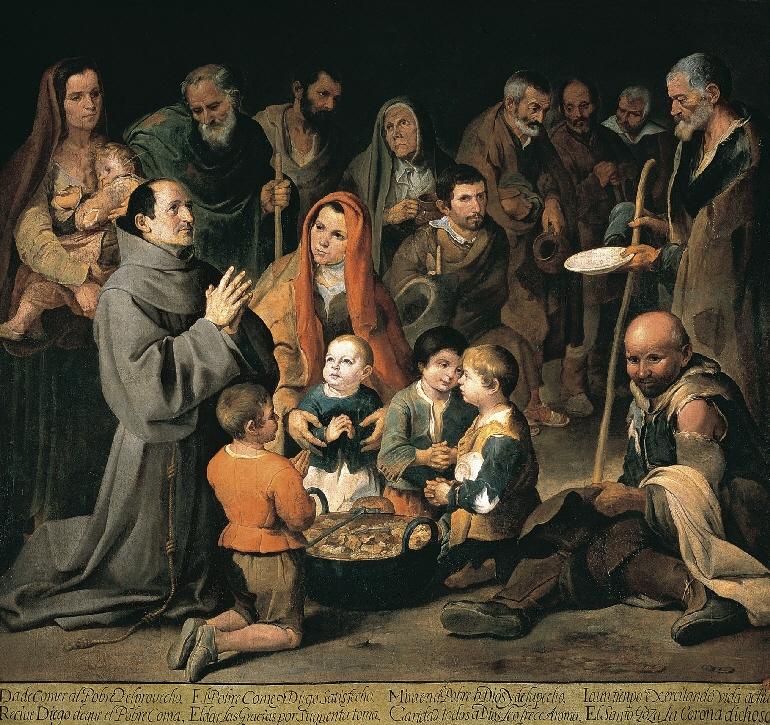
“St. Diego Giving Alms,” painted by Bartolome Esteban Murillo in 1646, presents a deeply human vision of charity in action. The canvas gathers a crowd of poor men, women and children around the humble figure of a Franciscan friar. At the center, a large pot of food sits on the ground, around which children cluster with trusting, eager faces. Behind them, adults wait patiently with staffs, crutches and empty bowls in hand.
Murillo stages this episode not as a distant miracle but as a very real scene that could unfold in the streets and convent courtyards of Seville. The saint is fully immersed within the group of beggars, his gestures directed toward them rather than toward any heavenly apparition. The painting invites viewers to see sanctity in simple acts of feeding the hungry and to recognize the suffering poor as the privileged recipients of divine care.
St. Diego of Alcalá and the Franciscan ideal
The central religious figure is St. Diego of Alcalá, a humble Franciscan lay brother known for his service to the sick and destitute. Born in the fourteenth century, he became famous for his work in hospices and for miraculous multiplications of food and bread. By Murillo’s time, devotion to St. Diego was especially strong in Spain, where he was celebrated as a protector of the poor.
Murillo portrays Diego in the simple gray habit of the Franciscans, rope belt tied around his waist, head uncovered, and features modest rather than heroic. He kneels or stands slightly apart from the crowd, hands together in prayer, eyes lifted toward heaven. His posture suggests that his charitable work is rooted in prayer and dependence on God. He appears to intercede both for the poor who surround him and for the viewer who observes the scene.
By choosing a lay brother rather than a high ranking cleric as his subject, Murillo emphasizes the Franciscan ideal of humble service. Holiness in this painting is not about ecclesiastical power or scholarly learning. It is about practical love that fills empty bowls and comforts hungry children.
Composition organized around the pot of food
The composition of “St. Diego Giving Alms” is carefully structured to draw the viewer’s attention toward the central act of charity. At the bottom center of the painting sits a large pot, filled with what appears to be stew or cooked food. Around it, several children kneel or stand, their small bodies forming a semicircle. Their bright garments and lively faces immediately catch the eye.
From this focal point the composition radiates outward. St. Diego kneels on the left, slightly forward, creating a diagonal line between his praying hands and the pot. On the right, an older man with a ladle and plate leans toward the group. He is likely another member of the religious community, actively serving the food that Diego’s prayer has blessed or multiplied.
Behind this foreground group stands a semicircle of adults. Some hold staffs, one cradles a baby, another clutches a hat ready to receive coins or bread. Their heads create a rhythmic arc that frames the central action and prevents the viewer’s gaze from wandering out of the picture. The dark background behind them keeps attention on the figures themselves.
Murillo also includes a painted inscription along the lower edge, like a carved frieze at the base of an altar. This band of text anchors the composition and reminds the viewer that the scene is not only a genre image but also a sacred narrative.
The faces of the poor and Murillo’s humanism
One of Murillo’s great gifts is his ability to individualize faces. In this painting, every figure, from the small child to the stooped old woman, has a distinct expression and personality. There is no anonymous mass of poverty. Instead, the poor are presented as a community of unique persons, each deserving attention.
At the far left, a woman holds a baby on her hip, her tired face partly shadowed but turned toward the center with quiet hope. Nearby, an older man with a staff leans forward, brows furrowed. In the middle distance, a woman in a headscarf looks at the saint with a mixture of gratitude and curiosity. To the right, a man with a crooked back and worn clothing sits on the ground, his bald head gleaming in the light, his face brightened by a faint, humble smile.
The children in front are especially vivid. One boy in an orange shirt kneels with his back to us, body twisting as he looks up at the saint. Two others, dressed in greenish and yellowish garments, face each other in conversation, sharing delight in the food and the attention they are receiving. A younger child sits on the lap of a woman in red, gaze directed outward, chubby hands placed trustingly on the pot.
Through these varied expressions Murillo communicates a wide range of emotions: hunger, hope, gratitude, shyness, curiosity, joy. The painting becomes a visual catalogue of human response to mercy and generosity.
The figure of St. Diego as mediator
St. Diego’s pose is both humble and central. He does not stand above the poor, dispensing charity from a distance. Instead, he is on almost the same level, his brown habit blending with the earth tones of their clothing. His face is turned upward, but his body leans slightly toward the children at his feet.
His clasped hands form a vertical axis that connects earth and heaven. He prays for God’s blessing on the food and for the well being of those who will receive it. At the same time, his presence reassures the crowd. The calm expression on his face suggests trust in divine providence. Even the youngest child seems at ease in his company.
Murillo thus presents Diego as a mediator between God and the poor, but also as a model for the viewer. The saint’s attitude of prayerful service offers a pattern of how to relate to those in need: with humility, compassion and reliance on grace rather than self glory.
Light and color directing moral attention
Murillo uses light and color with great skill to highlight key elements of the story. The overall palette is warm and subdued, dominated by earthy browns, soft greens and muted reds. Against this background, faces and hands glow with a gentle luminosity.
A soft light falls from the left, illuminating St. Diego’s habit, the children, and the pot of food. This creates a triangular zone of brightness in the lower center of the painting. The light then diffuses upward onto the faces of the adults, gradually fading into the darker upper background.
The woman in the center with a red cloak and orange hood forms a strong color accent, drawing the eye toward the heart of the group. The child on her lap, dressed in blue, adds a complementary note. The boy in the orange shirt near the pot further intensifies this warm focus.
Through these chromatic choices Murillo gently guides the viewer’s attention toward the interaction between saint, mother and children. This is where charity becomes most tangible. The older mendicants in the background are important but less brightly lit, suggesting that the immediate beneficiaries of Diego’s miracle are the little ones and their caregivers.
Everyday detail and the realism of charity
Although the painting has a clear religious theme, Murillo grounds it firmly in the reality of seventeenth century Seville. The clothing of the poor is patched and worn, with visible tears and frayed edges. Simple sandals, bare feet and rough cloaks indicate the harshness of their lives. A wooden crutch, a gourd water flask and an empty clay dish appear as practical objects, not symbolic props.
The pot of food is painted with particular attention. Its metal surface reflects the surrounding colors, and the food inside appears thick and substantial, more stew than delicate delicacy. This detail captures the concrete nature of charity. Feeding the hungry involves real bread and real labor, not only spiritual sentiment.
Murillo’s careful observation of everyday life reflects his broader interest in genre scenes. Throughout his career he painted street children, peddlers and humble workers with sympathy and enjoyment. In “St. Diego Giving Alms,” that same realism serves a religious purpose. By making the poor so convincingly real, he reminds viewers that the works of mercy are not abstract ideals but pressing needs.
The role of the helper at the right
The man at the far right with a ladle and plate plays a crucial supporting role. While Diego prays, this figure actively serves. His sleeves are rolled up, revealing muscular forearms ready for work. His posture leans forward, eyes directed toward the gathered poor, as if he is about to scoop another portion from the pot.
This helper may be a fellow friar or lay brother. His presence illustrates the practical cooperation required for charitable endeavors. Miracles and saintly intercession are important, but so are organized efforts and human collaboration. Together, Diego and this unnamed assistant embody both the spiritual and practical dimensions of Christian love.
His placement at the edge of the canvas also echoes the position of the viewer. Like him, we stand slightly apart from the main action yet are drawn into it. The painting thus challenges us to move from passive observation to active participation in acts of mercy.
Spiritual symbolism and the works of mercy
Beyond its documentary realism, the painting carries rich spiritual symbolism. Feeding the hungry is one of the corporal works of mercy emphasized in Catholic teaching. By depicting this act in such detail, Murillo aligns the painting with broader Counter Reformation efforts to encourage practical charity.
The children at the center recall Christ’s words about welcoming the little ones. The mother in the red cloak can evoke the figure of Mary as protector of the poor. St. Diego’s prayerful posture suggests that all effective charity flows from union with God.
The crowd of beggars, gathered in a semicircle around the pot, can be seen as a visual echo of biblical scenes such as the multiplication of loaves or the manna in the desert. Yet Murillo’s composition avoids grandiose spectacle. Instead, he shows the miracle present in humble daily routines. The true wonder is that no one leaves hungry and that kindness transforms a shabby courtyard into a place of grace.
Murillo’s Seville and the culture of charity
Seville in the seventeenth century was a city of stark contrasts. It enjoyed considerable wealth from trade with the Americas, yet it also suffered from plague, economic decline and widespread poverty. Religious orders played a major role in providing relief to the poor through hospitals, soup kitchens and almsgiving.
Murillo lived within this context and collaborated with several charitable confraternities. His art often supported their mission by depicting saints engaged in acts of mercy. “St. Diego Giving Alms” can be seen as part of this broader effort to inspire generosity among wealthy patrons and ordinary believers alike.
By choosing to show St. Diego among a crowd of local poor rather than in an abstract heavenly setting, Murillo grounds the saint’s example in the present needs of Seville. Viewers were encouraged not only to venerate Diego but to imitate his compassion toward the very beggars they saw in their own streets.
The viewer’s emotional and moral response
Murillo’s careful arrangement of figures invites a layered response from viewers. At first, one is drawn by the touching realism of the children and the gentle dignity of the saint. The scene elicits empathy and perhaps admiration.
As the eye moves through the crowd, noticing the diversity of age, ailment and need, the viewer may feel a deeper sense of responsibility. These are not faceless poor; they are individuals whose hunger, illness and vulnerability are palpable. The painting becomes a mirror in which viewers can examine their own willingness to share resources and time.
At the same time, the warmth of the composition offers hope. Smiles and grateful glances are scattered throughout the group. The atmosphere, though marked by hardship, is not one of despair but of communal support. Murillo suggests that charity benefits both giver and receiver, creating bonds of human solidarity that reflect divine love.
Conclusion: a timeless image of mercy
“St. Diego Giving Alms” stands as one of Murillo’s most compelling early religious works. It combines vivid observation of daily life with deep spiritual meaning, presenting charity not as an abstract virtue but as a living, breathing encounter between saint and poor.
Through compositional focus on the pot of food, subtle use of light and color, and tender characterization of every figure, Murillo invites viewers into the heart of the scene. We witness the miracle of generosity transforming hunger into shared nourishment and loneliness into community.
Even centuries after its creation, the painting speaks with undiminished relevance. In a world still marked by inequality and need, Murillo’s vision challenges and consoles. It reminds us that holiness can be found in the act of giving bread to a hungry child and that the true measure of faith is love expressed in concrete deeds.