Image source: wikiart.org
Introduction to Peter Paul Rubens’s “St. Cecilia”
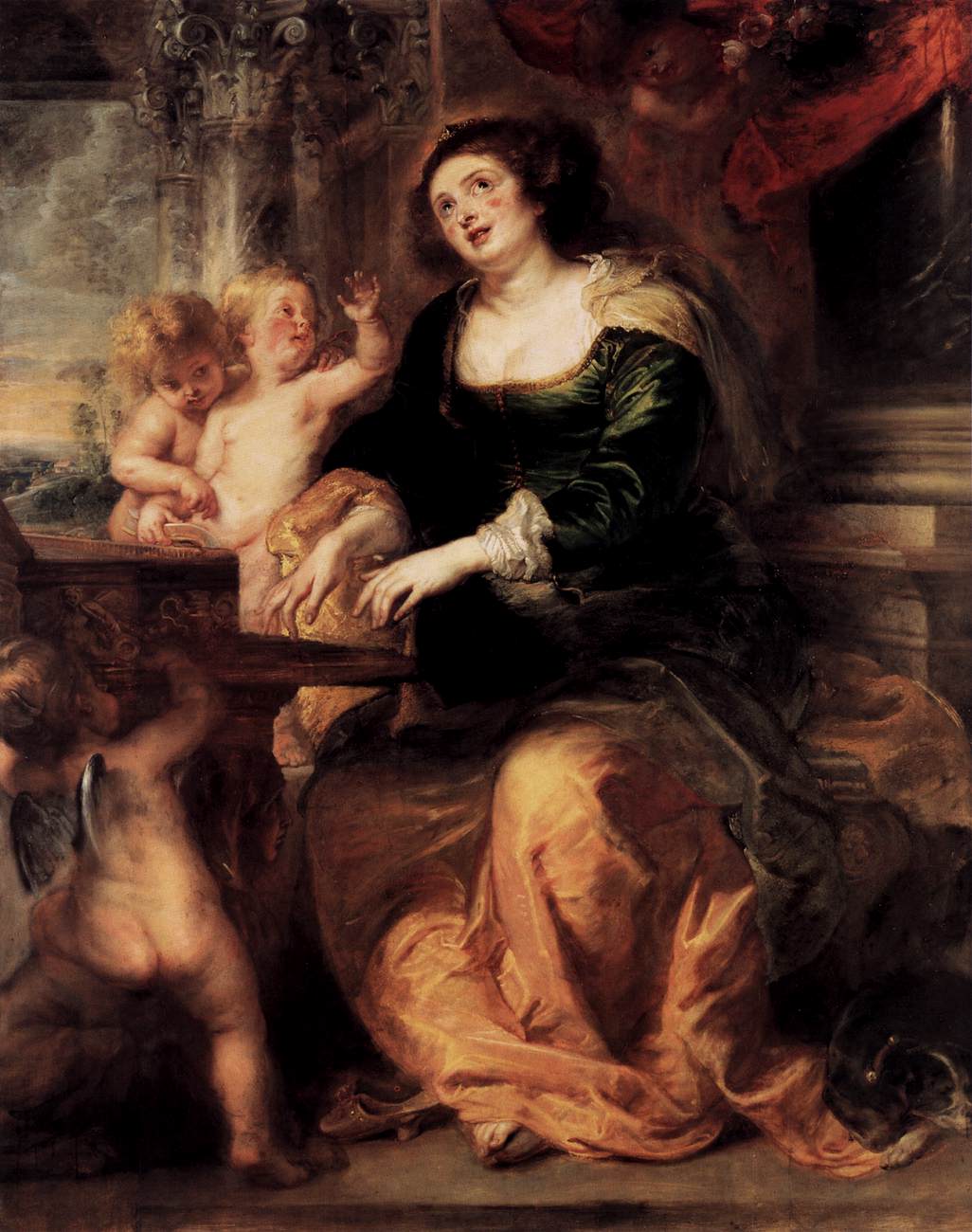
“St. Cecilia,” painted by Peter Paul Rubens around 1640, is a luminous and emotionally charged meditation on music, devotion, and divine inspiration. The painting presents the early Christian martyr Cecilia, patron saint of music, seated before an organ with cherubic putti clustered around her. Draped in sumptuous green and golden fabrics, she lifts her eyes heavenward with an expression that hovers between rapture and awe. Putti tug at musical instruments, lean over the organ, and flutter among the architectural columns and crimson drapery that frame the scene.
This late work gathers together many hallmarks of Rubens’s mature style: the warm, glowing color palette; the robust figures; the swirling drapery; and the dynamic interaction between earth and heaven. Yet it is also unusually intimate. Rather than staging a dramatic martyrdom, Rubens depicts Cecilia at the moment when earthly music gives way to celestial song, when the saint’s senses are flooded by a melody that only she fully hears.
St. Cecilia and the Idea of Sacred Music
To understand the power of Rubens’s painting, it helps to grasp Cecilia’s role in Christian tradition. According to legend, Cecilia was a Roman noblewoman who vowed her virginity to God and, during her wedding feast, sang to the Lord in her heart while musicians played. Later, after her refusal to abandon the faith, she was martyred. Over the centuries she became the patron saint of music, often pictured with an organ, harp, or other instruments.
Artists and theologians alike saw Cecilia as a symbol of the soul harmonized with God. Her outward music represented an inner hymn of love. In Baroque imagery she often embodies the ideal of sacred music that lifts the mind beyond earthly concerns toward contemplation of the divine. Rubens, deeply immersed in Counter-Reformation spirituality, taps into this tradition while emphasizing the emotional and sensuous dimension of Cecilia’s encounter with heavenly song.
Composition and Spatial Drama
Rubens organizes “St. Cecilia” as a richly layered vertical composition. Cecilia sits slightly off center, turned three-quarters toward the viewer, occupying the lower right quadrant. The organ and putti cluster to her left, while above her head, red drapery and architectural columns frame an opening that suggests a higher, unseen realm. A putto leans out of this upper space, pushing aside the fabric and spilling light downward, as if drawing the celestial world closer to Cecilia.
The interplay of diagonals energizes the scene. Cecilia’s tilted head and lifted gaze form a diagonal line that rises from the organ toward the upper right, guiding the viewer from the earthly instruments to the imagined source of the heavenly music. Her right arm extends outward in a gentle arc, hand relaxed, as if keeping time with an invisible rhythm. The putti create their own diagonal movements: one climbs up from below, another stretches across the organ, others swirl around the upper drapery.
This composition creates a sense of upward movement and spiritual ascent. The viewer’s eye is drawn constantly upward along lines of sight, flowing garments, and architectural elements, echoing the saint’s own inner movement from earthly sound to divine inspiration.
The Figure of St. Cecilia: Devotion and Human Warmth
Cecilia’s figure dominates the painting emotionally. Rubens presents her as a young woman with soft features, full lips, and luminous skin. Her face is turned upward, eyes wide and slightly moist, mouth gently parted. The expression suggests wonder and gratitude more than ecstatic frenzy. It is as though she has suddenly heard a choir of angels and is letting their music wash over her.
Her clothing balances modesty and richness. She wears a deep green velvet bodice, laced at the front, over which a delicate white chemise peeks at the neckline and cuffs. A golden-orange skirt cascades in heavy folds across her lap and onto the floor, catching the light in undulating waves. A translucent shawl or veil drapes over her shoulders, softening the silhouette and linking her visually to the illuminated atmosphere around her.
Rubens’s handling of Cecilia’s body conveys both physical presence and spiritual receptivity. She is solidly grounded—knees bent, feet planted, torso slightly leaning—but her upper body and face seem drawn upward by an invisible force. The gentle twist of her pose, combined with the flowing drapery, suggests movement without disrupting the sense of poised stillness appropriate to contemplation.
Putti and Musical Symbolism
The painting’s cherubs play a crucial role in expressing the theme of music and divine joy. Two putti crowd around the organ at Cecilia’s side. One stands behind, leaning forward with a playful yet reverent expression, while the other stretches upward, arm lifted as if beating time or reaching toward the unseen choir. Their golden curls, rosy cheeks, and soft bodies echo Cecilia’s warmth and vitality. They are embodiments of the music itself: childlike, pure, and overflowing with energy.
In the lower left corner, a winged putto strains to push or support the organ, his back turned to the viewer. This figure adds a note of humor and physicality, reminding us that instruments require effort and collaboration to sound. At the upper right, another cherub appears amid swirling red drapery, holding a garland or bouquet. This elevated figure, half hidden in shadow, hints at celestial musicians beyond the frame, those whose melodies Cecilia hears interiorly.
The organ is the chief instrument in the scene, symbolic of Church music and liturgical grandeur. Rubens paints it as a richly carved wooden structure with gilded details, placed diagonally so that its top recedes into space. While Cecilia’s hands are not actively pressing keys, her proximity and the attention of the putti imply that music is either about to begin or has just reached a transcendent climax. The focus is less on the mechanics of performance and more on the spiritual effect of the music.
Architectural and Decorative Setting
Rubens situates the scene within an opulent architectural environment that mixes earthly church interior and imagined heavenly palace. Behind Cecilia rise ornate columns with carved capitals and arches, rendered in soft greys and warm stone tones. Beyond a gap in the architecture, a glimpse of landscape and sky opens toward the horizon, adding depth and a sense of the wider world outside the sacred space.
The upper right is dominated by a heavy red curtain, drawn back to reveal the cherub above. In Baroque painting, such curtains often signify the unveiling of a spiritual reality, as if the mundane world were being pulled aside to show the heavenly realm beyond. Here the rich crimson fabric, with its deep folds and shadows, forms a dramatic contrast with the lighter tones around Cecilia’s face and bodice, emphasizing the point of divine encounter.
The combination of carved stone, luxurious textiles, and golden organ pipes creates an atmosphere of solemn splendor. It reinforces the idea that sacred music operates within the liturgical life of the Church while simultaneously opening a window onto eternity. Rubens’s setting is less a specific church than an idealized, theatrical space where the earthly and the heavenly converge.
Light, Color, and Baroque Atmosphere
Light in “St. Cecilia” is both natural and symbolic. A warm, golden illumination falls across Cecilia’s face, chest, and hands, as well as the bodies of the putti. This light appears to come from the left and above, perhaps from a window or an unseen heavenly source. In contrast, the background architecture and lower corners of the painting recede into deeper shadow, intensifying the drama of the highlighted figures.
Rubens’s color palette is rich and harmonious. The deep emerald of Cecilia’s gown sets off the glowing orange of her skirt, while the whites of her chemise and veil add brightness and purity. The putti are painted in delicate flesh tones, with rosy pinks and soft creams, unifying them visually with the saint. Warm browns and golds in the organ and architectural details balance the cooler greys and blues in the distant landscape and stonework.
The red drapery overhead serves as a visual crescendo. Its saturated hue and bold folds draw the eye upward and echo the emotional intensity of Cecilia’s experience. The overall effect of Rubens’s color and light is to envelop the scene in a golden, vibrating atmosphere, suggesting both the acoustical resonance of music and the spiritual radiance of grace.
Emotional and Theological Interpretation
On one level, “St. Cecilia” is a straightforward depiction of the patron saint of music. On another level, it becomes a visual theology of how grace touches the human heart. Cecilia’s upward gaze and parted lips suggest the moment when earthly sound is overtaken by an inner hearing of the divine word. She is no longer simply a musician but a listener, her whole being turned toward God.
The putti around her represent different aspects of this encounter. The children at the organ evoke the joyful playfulness of music; the straining cherub below suggests the human effort required to maintain instruments and liturgy; the cherub above, half hidden in shadow, hints that true music originates in the invisible realm. Together they illustrate the idea that sacred art and worship involve cooperation between human creativity and divine inspiration.
The painting also dramatizes the Counter-Reformation conviction that the senses can be pathways to God rather than obstacles. Far from suppressing beauty and emotion, Catholic spirituality of Rubens’s time embraced them as vehicles for devotion. In this context, Cecilia’s richly colored clothing, her flushed cheeks, and the affectionate putti are not distractions but instruments of spiritual persuasion. The viewer is invited to feel, through the painting’s sensual appeal, something of the joy and elevation that sacred music can bring.
Comparison with Other Depictions of St. Cecilia and Rubens’s Late Style
Artists from Raphael to Guido Reni painted St. Cecilia, often emphasizing her as a composed, almost statuesque figure surrounded by instruments. Rubens’s version is more animated and human. His Cecilia is not aloof but emotionally engaged, physically present in a richly furnished space, interacting with lively children. The emphasis on putti and swirling drapery aligns his work with the high Baroque love of movement and theatricality.
At the same time, the painting exemplifies Rubens’s late style, which tends toward broader brushwork, warmer tones, and a deepening focus on intimate, emotionally resonant subjects. While earlier in his career he painted large political cycles and grand altarpieces, in the 1630s and 1640s he increasingly turned to scenes that explore personal devotion, family life, and mythological pleasure. “St. Cecilia” sits at the intersection of those concerns: it is an altarpiece-like image infused with the warmth of domestic affection and the sensuality of his mythological nymphs, but redirected toward sacred ends.
Compared with his more turbulent compositions, this painting has a quieter center. The diagonals and swirling forms energize the canvas, yet the overall mood remains one of contemplative joy rather than dramatic conflict. This serenity reflects Rubens’s mature confidence in his craft and in the religious ideals he served.
Viewing Experience and Lasting Impact
For a contemporary viewer, “St. Cecilia” offers several layers of engagement. On the most immediate level, the painting captivates with its color, textures, and the endearing presence of the putti. One can almost hear the music implied by the tilting heads and raised hands. The folds of Cecilia’s dress, the softness of the flesh, and the gleam of carved wood invite slow, sensuous looking.
On a deeper level, the painting prompts reflection on the role of beauty and art in spiritual life. Cecilia’s absorbed expression suggests that art can transport the soul, creating moments when the everyday world fades and a different dimension opens up. Viewers familiar with intense listening experiences—whether in church, concert hall, or alone with music—may recognize in her posture something of their own absorption.
Finally, the painting has historical significance as a testimony to how seventeenth-century Catholic Europe imagined the union of art, faith, and emotion. Rubens’s Cecilia is both patron saint and model worshiper: attentive, ardent, fully alive to bodily and spiritual experience. Through her, the painting continues to speak about the power of music and visual art to awaken longing for transcendence.
Conclusion
Peter Paul Rubens’s “St. Cecilia” is a radiant fusion of Baroque artistry and spiritual reflection. Painted around 1640, it portrays the patron saint of music surrounded by cherubic putti, seated at an organ in a richly architectural setting. Through dynamic composition, sumptuous color, and expressive light, Rubens depicts the moment when earthly music becomes a vehicle for divine encounter.
Cecilia’s upward gaze, the playful yet reverent putti, the glowing drapery, and the interplay of architecture and sky all work together to create a sense of ascending joy. The painting affirms that the senses, and especially hearing, can lead the soul toward God. It also exemplifies Rubens’s late style, with its warm palette, emotional depth, and intimate approach to sacred subjects.
More than a devotional image or a portrait of a saint, “St. Cecilia” is a meditation on art itself: how human creativity, embodied in music and painting, can open windows onto a reality beyond the visible and audible. In this glowing canvas, Rubens invites viewers to join Cecilia in listening for that higher harmony.