Image source: wikiart.org
Introducing “St. Casilda of Toledo” by Francisco de Zurbaran
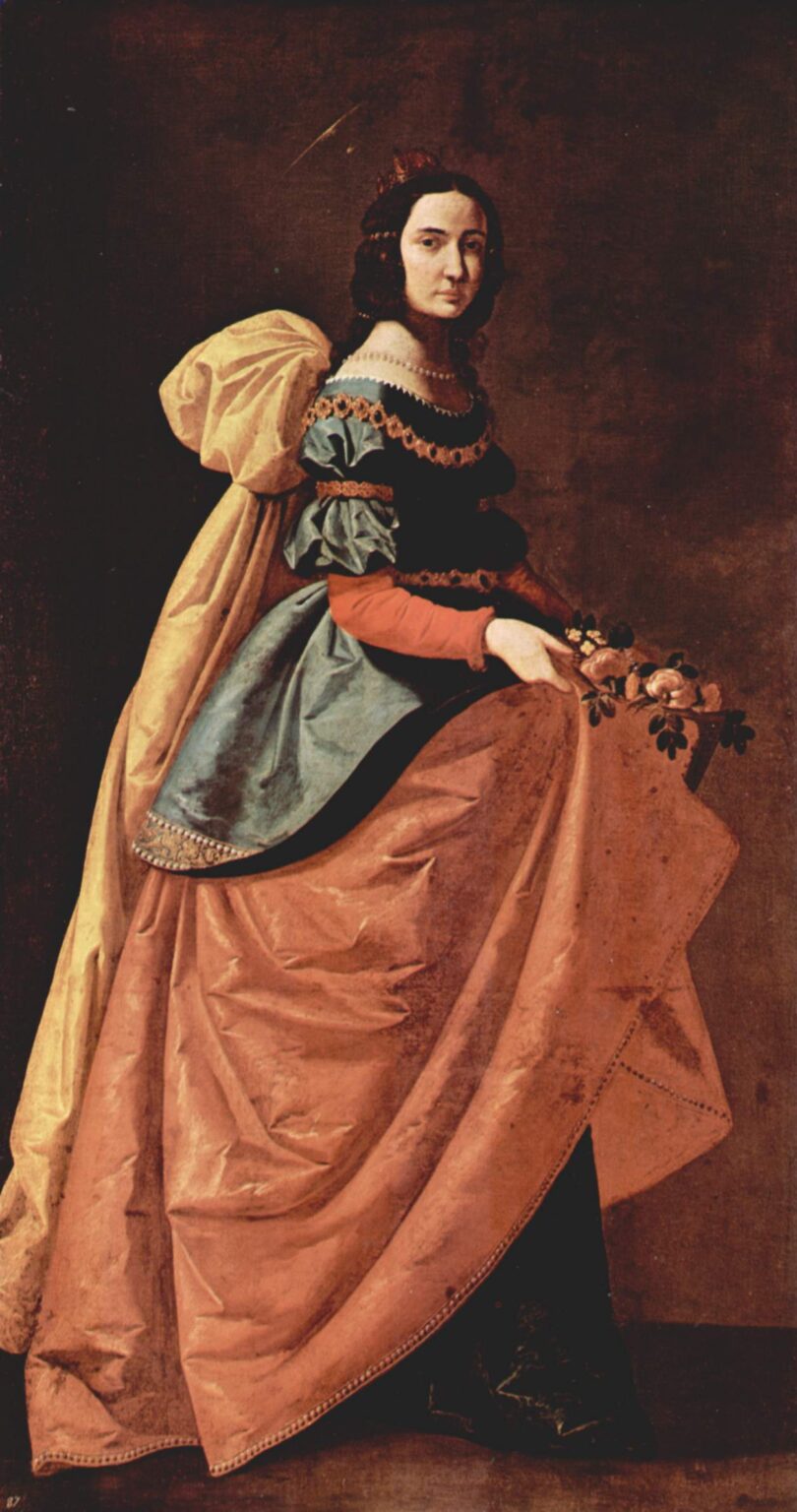
Francisco de Zurbaran’s “St. Casilda of Toledo,” painted around 1640, is one of the most striking full length female saints in Spanish Baroque art. The canvas presents a single figure, almost life size, standing against a dark and undefined background. At first glance she might be mistaken for a Spanish noblewoman posing for an official court portrait. Only after a closer look do the symbols of holiness begin to emerge.
The saint stands in a three quarter pose, her head turned toward the viewer with a composed and intelligent gaze. She wears a magnificent gown in rich tones of rose, green and gold, the fabric thick and weighty, falling in deep folds to the ground. A small crown rests on her carefully arranged dark hair. At her side she holds the heavy skirt with one hand and in the other she carries a cluster of roses, their soft petals and leaves rendered with delicate realism. Behind her, a voluminous yellow mantle billows like a banner.
Zurbaran takes the legend of St Casilda, a medieval princess who secretly helped Christian prisoners, and translates it into a quiet yet powerful image of charity, nobility and inner strength. His saint is neither ecstatic nor crushed by martyrdom. She is poised, contemplative and self possessed, a woman whose holiness is expressed through compassion and dignified resolve rather than spectacular miracles.
The Legend of St Casilda of Toledo
St Casilda is said to have been the daughter of a Muslim king or governor of Toledo during the period when much of Spain was under Islamic rule. Though raised in a non Christian court, she felt sympathy for the Christian prisoners held in her father’s dungeons. According to the legend, she visited them in secret, carrying bread hidden under her cloak. When her father confronted her and demanded to know what she was carrying, the bread miraculously transformed into roses, protecting her from punishment and revealing the purity of her intentions.
Later traditions tell that Casilda eventually converted to Christianity and lived a life of penance and prayer near Burgos, where a healing spring became associated with her name. Spanish devotion to the saint grew particularly strong in the late Middle Ages and early modern period, when she became a model for noblewomen who were called to acts of charity within a complex religious landscape.
Zurbaran’s painting focuses on the moment after the miracle. The roses in her hand allude to the transformation of bread into flowers and to the saint’s compassion for the poor and imprisoned. Unlike other depictions that show her mid action, surrounded by guards or prisoners, Zurbaran removes all narrative elements and concentrates on the solitary, timeless presence of the saint herself.
Composition and the Stately Pose
The composition of “St. Casilda of Toledo” is both simple and refined. The figure occupies nearly the entire height of the vertical canvas. She is slightly turned, with her weight resting on her back leg and her front foot just visible beneath the hem of the skirt. The pose is graceful yet stable, reminiscent of portraits of queens and princesses by court painters.
Her head is positioned near the upper left of the canvas, which gives a subtle diagonal movement from the voluminous skirt at lower right up through the torso to the face. The large expanse of fabric in the foreground serves as a visual foundation. It anchors the saint to the ground and conveys a sense of physical presence.
The dark, neutral background has no identifiable architecture or landscape. This lack of setting directs all attention toward the figure. The absence of distractions also enhances the sense that Casilda stands outside of particular time and place, representing spiritual ideals more than a specific historical moment. The faint suggestion of a halo around her head and the small crown reinforce her dual identity as both princess and saint.
Clothing, Color and the Language of Textiles
Zurbaran’s fascination with textiles is one of the painting’s most captivating features. The enormous rose colored skirt dominates the lower half of the canvas. Its surface is modeled with subtle variations of light and shadow that suggest the stiffness of heavy silk or satin. The hem is finished with a delicate border, and the folds catch the light in irregular patterns that avoid any sense of mechanical repetition.
Above the skirt, the saint wears a deep green overdress, shorter in front, that reveals the rose fabric beneath. The bodice is trimmed with intricate gold decoration, and a necklace of pearls encircles her throat. A bright red sleeve emerges from under the green garment, adding another note of color and connecting visually with the warm tones of the skirt.
Behind Casilda, a pale yellow mantle or cloak is tied in a large bow at her back, its folds puffing out like sails. This element introduces a sense of movement into the otherwise still figure. The mantle’s light color contrasts with the darker tones of the other fabrics, helping to separate the figure from the background and framing her head like a luminous halo of cloth.
The richness of the clothing might seem at odds with the idea of a saint, yet it perfectly suits the story of a princess who used her privileged position for works of mercy. In the Counter Reformation context, such luxurious garments did not simply indicate vanity. They also testified to the ability of grace to sanctify every condition of life, including the world of aristocratic courts. Zurbaran uses the language of textiles to show that holiness and beauty can coexist, provided that beauty serves love rather than pride.
The Roses and the Memory of the Miracle
Casilda’s right hand holds a small bouquet of roses, their blossoms and leaves tilted slightly forward. The flowers are modest in scale compared to the expanse of her gown, yet they carry the deepest symbolic weight. They recall the legendary moment when her hidden bread became roses under divine protection.
Zurbaran paints these roses with a careful but restrained realism. They are not overly detailed or idealized, but they are distinct enough that the viewer can almost sense their softness and fragrance. The contrast between the delicate flowers and the heavy fabric suggests the contrast between Casilda’s gentle compassion and the harsh world of imprisonment and religious conflict in which she acted.
The way she holds the roses also matters. Her grip is firm yet relaxed, as if she is both presenting them and keeping them close. This ambiguity reflects the dual nature of her charity. She gave food and comfort to others, but she also received the miracle as a personal gift that confirmed her inner vocation.
Expression and Psychological Presence
Casilda’s face is one of the most memorable aspects of the painting. She looks out toward the viewer with a calm, level gaze. Her expression is neither smiling nor stern. There is a quiet seriousness in her eyes, a mixture of gentleness and determination that suggests an inner life shaped by reflection and moral decision.
Her features are not idealized according to classical standards. She appears as a real woman with distinctive bones and slightly shadowed eyes. Zurbaran avoids the ethereal, almost porcelain quality seen in some depictions of female saints. Instead he gives her a grounded, psychologically convincing presence.
This realism supports the painting’s spiritual message. Casilda is not presented as a distant, unreachable icon, but as someone whose holiness took shape through concrete choices within a complex family and political environment. Her gaze invites the viewer not simply to admire her beauty but to consider her story and perhaps to imitate her courage and charity.
Light and the Subtle Drama of Chiaroscuro
Although “St. Casilda of Toledo” is less starkly contrasted than some of Zurbaran’s earlier tenebrist works, light still plays a vital role. A soft illumination falls from the left, touching the saint’s face, neck and hands, and sliding down the folds of her garments. The right side of her body recedes into deeper shadow, especially around the skirt and lower leg.
This controlled chiaroscuro sculpts the figure in space, giving her a solid, almost sculptural presence. It also enhances the sense of introspective mood. The light does not burst onto the scene with theatrical violence; rather, it quietly reveals the form emerging from darkness, much as grace quietly shapes a soul over time.
The dark background absorbs much of the light, which makes the saturated colors of the dress appear even more luminous. The play of light across the folds of fabric creates a gentle rhythm that guides the viewer’s eye up and down the figure, from the crown to the roses and back again to the face.
Symbolism of Nobility, Conversion and Mercy
The legend of St Casilda includes several themes that Zurbaran weaves into this portrait: noble birth, conversion, and works of mercy. Her crown and luxurious clothing proclaim her status as a princess of Toledo. Yet nothing in her expression suggests arrogance. Instead, she appears introspective and compassionate, as if her nobility has found its true purpose in serving others.
The dark background can be read as a metaphor for the spiritual darkness of a world divided by religious conflict. Casilda’s richly colored figure stands out against this gloom as a sign of reconciliation and charity that crosses boundaries. Her story of helping Christian prisoners while still living in a Muslim court resonated strongly in early modern Spain, where memories of religious coexistence and conflict were vivid.
The roses in her hand symbolize both the miracle that protected her and the love that motivated her actions. They might also hint at her eventual conversion to Christianity, since in Christian symbolism roses often represent divine love and the joys of heaven granted after trial.
Zurbaran’s Female Saints and the Ideal of Virtuous Womanhood
“St. Casilda of Toledo” belongs to a larger group of paintings in which Zurbaran portrayed female saints and martyrs, often in splendid contemporary dress and against dark backgrounds. These works were frequently commissioned for convents, where nuns would use them as aids to meditation and as models of virtuous womanhood.
Within this context, Casilda offers a distinct profile. Unlike martyr saints who hold palms and instruments of torture, she embodies the ideal of compassionate intervention, risking her comfort and safety to help the imprisoned. Her story would have been particularly inspiring in communities dedicated to charity and intercession.
Zurbaran’s decision to portray her as a dignified, self aware mujer noble also reflects broader cultural ideals. In seventeenth century Spain, noblewomen were expected to combine elegance with modesty, devotion with social responsibility. Casilda, with her regal bearing and gentle expression, perfectly incarnates this synthesis. The painting therefore speaks not only about an individual saint but also about the aspirations and self understanding of early modern Spanish women of faith.
The Timeless Appeal of “St. Casilda of Toledo”
Today, Zurbaran’s portrait of St Casilda continues to captivate viewers for its combination of visual splendor and spiritual depth. The painting appeals on a purely aesthetic level through its masterful handling of color and fabric, its balanced composition and the serene beauty of the figure. At the same time, it invites contemplation of themes that remain relevant: compassion for those in prison, the courage to act according to conscience in environments of pressure, and the possibility of personal transformation.
The saint’s steady gaze seems to ask contemporary viewers how they might use their own privileges, opportunities or talents in service of others. The roses she holds recall the hidden acts of kindness that may never be widely known yet are precious in the eyes of God. Her gorgeous garments remind us that holiness does not always appear in simple clothing or dramatic suffering; sometimes it is found in the quiet, steadfast choices of people who live inside complex social structures.
Through this single standing figure, Zurbaran offers a meditation on charity, dignity and inner strength. “St. Casilda of Toledo” stands as a testament to the power of art to preserve and reinterpret the stories of saints for new generations, inviting each viewer to step into the dimly lit space before the canvas and to meet the gaze of a princess who became a symbol of mercy.