Image source: wikiart.org
A First Encounter with “St. Bartholomew Almost in Agony”
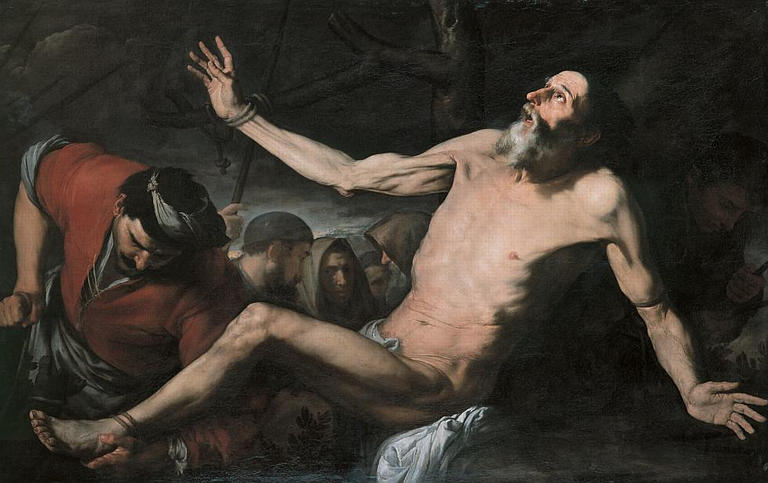
Francisco de Zurbaran’s “St. Bartholomew almost in agony,” painted in 1632, is one of the most searing depictions of martyrdom in Spanish Baroque art. The canvas presents the apostle Bartholomew at the brink of torture, his nearly naked body twisted in a powerful diagonal across the foreground. His arms are bound, his torso arched, his face lifted toward an unseen light as if appealing to heaven. Around him gather rough executioners and shadowed onlookers who press in on the scene.
From the first glance, the painting hits with raw physicality. The apostle’s muscles strain, his skin appears taut, and every tendon reads with almost anatomical accuracy. Zurbaran records the moment just before the violence erupts into its most horrifying phase, heightening the tension and emotional intensity. Rather than focusing on the gruesome act itself, he chooses the instant of psychological extremity, when the saint’s faith confronts impending agony.
The composition is dark and crowded, yet Bartholomew’s body catches a harsh, spectral light that isolates him as the moral center of the drama. The painting feels almost cinematic in its immediacy, yet beneath its visceral impact lies a carefully constructed theological meditation on suffering, grace, and steadfast faith.
Historical and Religious Context
St Bartholomew, one of the twelve apostles, was believed by tradition to have evangelized in remote regions of Asia and Armenia. Early accounts describe his martyrdom as particularly brutal. Later legend developed the haunting detail that he was flayed alive. This aspect of his story made him a powerful symbol of extreme fidelity under torture and associated him with themes of spiritual transformation, since the removal of the skin could be interpreted as stripping away the outer man to reveal the inner soul.
Seventeenth century Spain was steeped in Counter Reformation spirituality, which encouraged vivid visual meditations on the lives and deaths of the saints. Painters like Zurbaran were often commissioned by monastic orders or confraternities to create images that would stir compassion and encourage imitation of the martyrs’ courage. Rather than presenting martyrdom as abstract theology, artists translated it into bodies, gestures, and faces that believers could confront directly.
In this climate, Bartholomew’s story had particular force. His endurance of extreme suffering mirrored the Church’s ideal of total self offering. Zurbaran’s painting reflects this devotional context, yet it also shows the influence of Caravaggio and other tenebrist masters, who used strong contrasts of light and shadow to intensify emotional engagement. The result is a work that is both deeply rooted in religious culture and strikingly innovative in its dramatic realism.
Composition and the Diagonal of Martyrdom
The composition is built around a powerful diagonal formed by Bartholomew’s body. Starting at the lower left where his foot extends toward the viewer, the line rises through his bent knee, crosses his bare torso, and ends in the uplifted arm and straining head at the upper right. This diagonal creates a sense of motion and instability, as if the saint is being dragged or thrown backward.
Opposing this line are the more compact shapes of the executioners who crowd the left side of the canvas. One muscular tormentor in a red garment leans forward, busy with his work. Behind him, other figures loom in half shadow, their features less individualized and their attention directed toward the victim. The background is dark and murky, with a hint of landscape or architectural forms barely visible, giving the impression of an outdoor execution carried out at dawn or in failing light.
The diagonal of Bartholomew’s body fulfills multiple purposes. Visually, it enlivens the rectangular format, breaking the horizon and guiding the viewer’s eye from left to right. Narratively, it conveys the violence of the scene, the sense of a body forced into an unnatural pose. Spiritually, it evokes the dynamic of ascent amid suffering, since the saint’s face and outstretched arm reach upward even as his body is pulled downward.
Zurbaran carefully balances this dramatic line with areas of relative calm. The center of the composition, where two backlit figures and a veiled woman appear, forms a kind of emotional buffer between the brutality on the left and the ecstatic tension on the right. These onlookers register varying degrees of concern and detachment, suggesting the range of human responses to suffering.
The Body of St Bartholomew: Anatomy and Emotion
Zurbaran’s rendering of Bartholomew’s body is both clinically precise and deeply expressive. The saint is presented almost completely nude, covered only by a loose cloth at his waist. This near nudity serves several functions. It exposes his vulnerability, underscores the physical dimension of martyrdom, and allows the artist to explore the expressive potential of the human body.
Every muscle and tendon is carefully modeled. The chest expands as if inhaling sharply, the ribs stand out beneath stretched skin, and the abdominal muscles twist with the torque of his pose. The left leg extends almost straight, its foot foreshortened toward the viewer, while the right leg bends, adding a sense of depth and instability. The left arm flings upward, bound at the wrist, the fingers splayed in a gesture that hovers between desperation and ecstatic surrender.
The face is perhaps the most striking element. Bartholomew throws his head back, mouth slightly open, eyes directed upward into the unseen light. This upward gaze is ambiguous. It could register physical agony, a cry to God for help, or a kind of spiritual rapture in which the saint already anticipates union with Christ. The gray beard and lined features indicate maturity and experience, suggesting that this is a man who has lived and preached long before facing this final trial.
Through this intense physicality, Zurbaran communicates psychological depth. Bartholomew is not shown as a passive victim. His body language conveys resistance, struggle, and then acceptance. The tension in his muscles and the openness of his gesture convey a soul hovering on the threshold between terror and transcendent trust.
Executioners and Witnesses
The figures surrounding Bartholomew play an important role in shaping the narrative and spiritual meaning of the painting. On the left foreground, one executioner bends over the saint, his face partly hidden beneath a headband. His muscular arms and thick torso wrapped in red emphasize brute strength. He seems entirely absorbed in his task, indifferent to the humanity of the man he tortures. This executioner stands for the blind forces of violence and political authority that persecute the faith.
Behind him, two other men appear in profile, their heads turned toward the scene. Their expressions are less legible, but their presence suggests complicity. They witness the atrocity yet do not intervene. Between them and the saint, a veiled woman appears, her face marked by sorrow and concern. She might represent a sympathetic observer, perhaps a Christian disciple or an allegorical figure of compassion. Her presence introduces a note of mourning and solidarity within the hostile crowd.
These secondary figures deepen the moral tension of the canvas. The viewer is invited to consider where they would stand among them. Would they be like the executioner, hardened and unfeeling, or like the silent witnesses who watch without acting, or like the grieving woman who shares the sufferer’s pain? Zurbaran thus transforms a specific historical martyrdom into a broader reflection on human responsibility before brutal injustice.
Light, Shadow, and Tenebrist Drama
Light is one of the key agents of drama in this painting. A strong, cold illumination falls from the upper right, bathing Bartholomew’s torso and face while leaving much of the rest of the scene in shadow. This light seems almost supernatural, as if emanating from a divine source outside the picture. It sculpts the saint’s body with sharp contrasts, making his skin appear almost marble like against the darkness.
In contrast, the executioners and secondary figures are partially obscured. The man in red is lit only on his back and arms, his face plunged in shadow. The crowd behind him recedes into a murky zone that blurs individual features. The background opens onto a dim horizon, with faint hints of trees or structures enveloped in dusk.
This tenebrist staging does more than create visual suspense. It carries theological weight. The saint is literally in the light, while those who harm him dwell partially in darkness. The illumination that grips his body and face suggests the grace that sustains him. Even his impending agony is surrounded by radiance. The darkness enveloping the others symbolizes ignorance, sin, or moral blindness.
The result is a visual sermon on the paradox of martyrdom. From an earthly perspective, Bartholomew is helpless and humiliated. From a spiritual perspective, he is the only truly free and enlightened figure in the scene. Zurbaran’s handling of light invites viewers to adopt this second perspective, to see suffering in the light of faith rather than mere tragedy.
Color Palette and Textural Details
Zurbaran restricts his palette to somber, earthy tones that heighten the emotional gravity of the subject. Flesh tones dominate the right side, ranging from pale highlights to deep reddish shadows. The cloth around Bartholomew’s waist is a muted white that reflects the harsh light. On the left, the executioner’s red garment provides the strongest chromatic accent, a vivid splash that signals violence and blood.
The rest of the canvas is filled with dark greens, browns, and grays, forming a brooding environment that feels heavy and oppressive. This limited palette draws attention to the textures Zurbaran renders so carefully. The difference between rough cloth, scarred wood, and taut skin is palpable. The metal shackles around the saint’s wrists and ankles catch small glints of light, emphasizing the reality of his bondage.
These textural details enhance the sensory impact of the painting. Viewers can almost feel the roughness of the rope, the weight of the saint’s body, the chill of the surrounding air. Yet the overall effect is not one of mere physical realism. Zurbaran uses these details to anchor the spiritual drama in the tangible world, reminding us that martyrdom is not an abstract idea but an event that occurs in real flesh and blood.
Iconography of Bartholomew’s Martyrdom
Although this painting does not show the act of flaying directly, it alludes to Bartholomew’s traditional martyrdom. The saint’s near nakedness, the binding of his limbs, and the presence of executioners preparing their instruments all signal the imminence of torture. His twisted pose suggests both the force used against him and the contortions his body will soon endure.
By choosing the moment before the worst suffering begins, Zurbaran emphasizes Bartholomew’s interior decision. The saint has already accepted his fate. The raised arm and upward gaze indicate that he has handed himself over to God. The painting thus focuses not on the spectacle of violence but on the spiritual courage that precedes it.
In later art, Bartholomew is often pictured holding his own flayed skin as a symbol of his victory over torture. Zurbaran’s work belongs to an earlier, more dramatic stage in the narrative. It underscores the cost of that victory. The saint’s heroism is not yet completed but is in the process of being forged in the crucible of fear, pain, and trust.
Psychological and Spiritual Meaning
Beyond its visceral impact, “St. Bartholomew almost in agony” can be read as a meditation on the mystery of suffering. The title itself, with the phrase “almost in agony,” highlights a transitional state. Bartholomew is on the threshold, poised between relative intactness and extreme violation. This threshold becomes a space of intense spiritual significance.
The saint’s posture expresses a mixture of dread and longing. His chest thrusts forward, his mouth opens, his hand stretches upward. This may reflect the human reaction to impending pain, yet it also evokes the biblical language of offering the body as a living sacrifice. In this suspended moment, Bartholomew’s body becomes a prayer.
For believers in Zurbaran’s time, such an image would have invited empathy and imitation. They were encouraged to think of their own trials, however minor, as opportunities to unite themselves with the martyrs’ courage. The painting reassures them that God’s light surrounds those who suffer for righteousness, even when the world sees only defeat.
For modern viewers, the work can speak more broadly about resilience in the face of any hardship. The interplay of vulnerability and strength in Bartholomew’s figure reflects the human capacity to confront fear with meaning and to find dignity even in situations of extreme powerlessness.
Zurbaran’s Style and Place in Baroque Art
This painting showcases many hallmarks of Zurbaran’s style. Like other Spanish Baroque masters, he was deeply influenced by Caravaggio’s dramatic lighting and realistic figures. Yet his approach remains distinctive. Where some Italian works revel in theatrical gestures and crowded compositions, Zurbaran often focuses on a few concentrated elements, allowing the viewer to linger on the psychological and spiritual implications of a scene.
Here, he orchestrates a powerful sense of movement without resorting to chaotic action. The frame captures a single, charged moment rather than a full sequence of narrative events. The saint’s twisting body and the executioner’s bent form provide enough dynamism to make the entire scene vibrate with tension.
Zurbaran’s devotion to realism is also evident. His saints are not idealized youths but mature, sometimes weathered individuals. Bartholomew’s age and physical solidity make his martyrdom more poignant. This realism grounds the spiritual message in historical humanity.
Within Zurbaran’s oeuvre, “St. Bartholomew almost in agony” stands beside his many images of monks, apostles, and martyrs as one of his most intense explorations of the encounter between human frailty and divine grace.
Legacy and Continuing Impact
Although created for a seventeenth century religious context, the painting retains its emotional power today. Its stark depiction of a bound body confronting violence can resonate with contemporary concerns about human rights, persecution, and the dignity of the vulnerable. Viewers need not share the original theological framework to sense the gravity of what Zurbaran portrays.
At the same time, for those interested in Christian spirituality, the painting offers a profound visual meditation on how faith can transform suffering. The contrast between Bartholomew’s radiant, strained body and the shadowed crowd invites reflection on the difference between outward defeat and inward victory.
Art historians continue to study the work for its technical mastery and its contribution to the development of Baroque martyrdom imagery. The canvas demonstrates how Zurbaran could infuse a traditional subject with fresh psychological insight and dramatic force.
Conclusion
“St. Bartholomew almost in agony” is a remarkable synthesis of physical realism, emotional intensity, and spiritual depth. Francisco de Zurbaran captures the apostle at the very edge of his ordeal, turning a moment of extreme vulnerability into a testimony of unwavering faith. The diagonal thrust of the body, the harsh tenebrist light, the surrounding executioners, and the dark, unsettled background all contribute to a scene that is at once terrifying and strangely luminous.
Through this painting, martyrdom is not presented as distant legend but as a human drama that unfolds in real bodies and real time. Yet the upward gaze and radiant flesh of Bartholomew reveal that within this drama lies a mystery of grace. The saint’s almost agonized body becomes a conduit for divine light, a sign that suffering freely embraced out of love can be transformed into a path toward glory.
Viewed today, the painting continues to challenge and move its audience, inviting them to consider how they confront their own trials and what sources of meaning and courage they draw upon. Zurbaran’s powerful vision of St Bartholomew remains a compelling testament to the enduring dialogue between pain, faith, and artistic expression.