Image source: wikiart.org
Introduction to St Anthony Dispirited
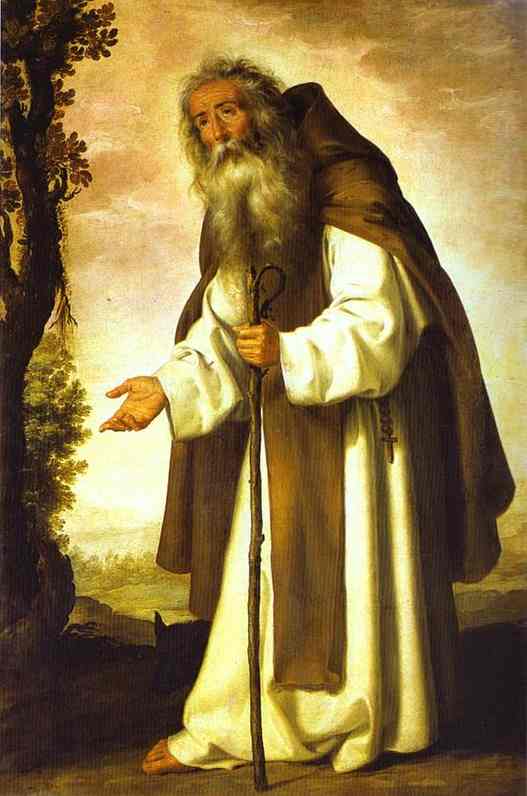
Francisco de Zurbaran’s “St Anthony Dispirited,” painted in 1640, shows one of the great desert fathers at a moment of quiet exhaustion and searching faith. The tall figure of St Anthony stands in the open air, wrapped in a white habit and brown cloak, his long beard flowing over his chest. He leans slightly on a wooden staff, one hand extended with the palm turned upward, as if asking a question or seeking help. The golden light of evening touches his garments and the distant landscape, creating an atmosphere that is both serene and melancholic.
Rather than presenting a triumphant saint, Zurbaran chooses to show Anthony in a moment of discouragement. The painting turns inward, exploring what it means for a holy man to carry doubt, fatigue, and spiritual weariness while still remaining turned toward God. In doing so, it reveals the human side of sanctity and allows viewers to recognize their own struggles within the figure of the aged hermit.
St Anthony the Hermit and the Meaning of Dispirited
St Anthony of Egypt, often called Anthony the Great, is regarded as one of the founders of Christian monasticism. He left his family and possessions in the third century in order to live a life of solitude, prayer, and fasting in the desert. His biography describes fierce temptations, long battles with demons, and periods of deep desolation followed by renewed consolation.
The word “dispirited” in the title of Zurbaran’s painting points to this darker side of the spiritual life. It suggests discouragement, heaviness of heart, and perhaps a sense of abandonment. Yet for Anthony, such experiences were seen as part of the journey, times when perseverance and trust were tested.
By choosing this aspect of the saint’s story, Zurbaran aligns the painting with the spiritual literature of his own century, which often spoke about dryness, interior trials, and the purifying value of desolation. The painting becomes not only a portrait of Anthony but also a reflection on the experience of believers who feel far from God despite their efforts.
Composition and First Impression
The composition of “St Anthony Dispirited” is deceptively simple. The saint fills most of the vertical canvas, standing in a three quarter pose turned toward the viewer’s left. His large, white habit dominates the lower two thirds of the painting, while the brown cloak forms a hood and cape around his shoulders. The background consists of a spacious landscape that recedes into soft hills and sky, with a tree rising on the left side to balance the figure.
The first impression is one of stillness. Anthony is not in the midst of action or miracle. He is simply standing, poised between step and pause. His staff anchors him to the ground, and his extended hand suggests a moment of speech, perhaps a lament or a plea. The light is warm and gentle, not dramatic, which reinforces the contemplative mood.
This simplicity allows the viewer’s attention to settle on the subtleties of posture, expression, and gesture. The painting invites a slow reading, as if one were sitting with the saint in silence, gradually discovering the depth of his interior world.
The Figure of St Anthony Gesture and Expression
St Anthony’s figure is characterized by a mix of dignity and fragility. He is tall and thin, wrapped in voluminous garments that emphasize his ascetic life. His shoulders droop slightly, and his back curves forward just enough to reveal his age and weariness. Yet he stands firmly, supported by the staff and by the quiet resolve visible in his face.
His right hand holds the staff near his chest, fingers curled around the wood with habitual familiarity. This staff is more than a practical walking stick; it is a symbol of his long journey through the wilderness and through the ups and downs of spiritual life.
His left hand is the most expressive element. With palm facing upward and fingers slightly open, it offers a gesture that can be read in several ways. It may be a sign of supplication, as if he were saying to God, “Why have you abandoned me?” It may also be an invitation to the viewer, asking for understanding or companionship. The openness of the hand suggests that, even in discouragement, Anthony remains receptive rather than closed off.
The saint’s face is deeply lined, with a large, flowing beard that frames his mouth and chin. His eyes are directed toward some distant point, slightly above the horizon, rather than meeting the viewer directly. This upward and outward gaze communicates interior searching. His brows are furrowed, and the corners of his mouth droop gently, indicating sadness and prayerful concern rather than despair. Zurbaran avoids theatrical expressions, preferring a quiet, believable weariness that resonates with human experience.
Habit, Cloak, and the Visual Language of Poverty
Zurbaran was renowned for his ability to paint fabric, and in “St Anthony Dispirited” the habit and cloak become major actors within the composition. The saint wears a long, white tunic that falls almost to the ground. Over this he has a brown cloak with a hood that covers his head and shoulders. The clothing is reminiscent of the garments of Carthusian or Cistercian monks, which would have been familiar to Zurbaran’s patrons, even though Anthony himself lived centuries earlier.
The white habit is painted with large, gentle folds that catch the light with soft gradations of cream and pale gold. It has a simple, almost sculptural quality, making the saint resemble a carved figure glowing in early morning sunlight. The brown cloak, by contrast, is heavier and darker, with deeper shadows that frame the face and shoulders.
These garments speak of poverty and simplicity. There is no ornament, no embroidery, no luxurious fabric. Their very roughness reflects Anthony’s renunciation of worldly comforts. Yet Zurbaran paints them with such dignity that they seem more noble than any courtly costume. The habit becomes a visible sign of the inner freedom achieved by letting go of material wealth.
Around Anthony’s waist a simple cord or belt can be glimpsed, and a small cross or object hangs from his side, hinting at his Christian identity. The staff he carries is twisted and irregular, a piece of natural wood rather than a decorated rod, again emphasizing his closeness to the earthy realities of desert and wilderness.
Landscape, Light, and Atmosphere
The landscape surrounding St Anthony is not harsh desert but a soft, rural setting. Rolling hills fade into a hazy distance, and a tree with sparse leaves stands to the left. The sky is a mixture of warm tones and soft clouds, suggesting evening or early morning, times traditionally associated with meditation and melancholy.
The light in the painting seems to come from the left, bathing Anthony’s habit and beard in a gentle glow. This light does not produce extreme contrasts; instead it creates subtle transitions between illuminated and shadowed areas, giving the scene a contemplative calm. The golden tone of the light helps to unify figure and background, so that Anthony appears naturally rooted in his environment rather than artificially spotlighted.
This atmospheric treatment underscores the psychological mood. The world around Anthony is quiet and empty. There are no crowds, animals, or dramatic weather events. It is a place where one could easily feel both close to God and painfully aware of solitude. The title’s reference to being dispirited fits this setting, in which the natural beauty of creation does not automatically dispel inner heaviness.
Color Palette and Textural Realism
Zurbaran relies on a relatively limited color palette in this work, dominated by warm ochres, soft whites, and earthy browns. The white habit stands out as the brightest element, while the cloak, staff, and ground anchor the composition with darker shades. The tree trunk and foliage echo the browns and greens of the lower part of the canvas, tying together figure and landscape.
This restraint in color allows the painter to concentrate on nuanced variations. The folds of the habit contain delicate shifts from creamy white to pale gray and light golden hues, suggesting the way coarse wool catches the light. The beard, too, is a marvel of textural realism, with strands of silver, white, and faint brown giving the impression of age, dryness, and softness all at once.
The ground beneath the saint’s feet is painted with rough brushstrokes that evoke rocky soil and patches of earth. This textural concreteness reminds viewers that the spiritual life is lived in real physical conditions, with tired legs, dust, and uneven paths. Zurbaran’s realism grounds the mystical subject matter in everyday experience.
Emotional and Spiritual Interpretation
“St Anthony Dispirited” is remarkable for the way it communicates a complex spiritual state without relying on overt symbols of ecstasy or miraculous events. The saint is not shown in the midst of temptation by demons or receiving dramatic visions. Instead he appears as a weary traveler who has walked a long road and now pauses, unsure and vulnerable.
The painting captures the experience of spiritual dryness described by many mystics. Anthony’s extended hand, slightly questioning gaze, and slumped shoulders express the feeling of a heart that has given much yet feels little consolation. There is no visible answer to his unspoken plea, no angel or divine light breaking through. Only the soft natural light and the wide landscape accompany him.
Yet the work is not hopeless. The saint’s posture, though tired, is not collapsing. He remains upright, his staff firmly in hand, his eyes still lifted above the ground. The open hand implies continued openness to God’s will. The gentle light that bathes him can be read as a sign that grace surrounds him even when he does not feel it strongly.
For viewers facing their own discouragements, the painting offers both solidarity and quiet encouragement. It acknowledges that even the holiest people know seasons of desolation, yet it also suggests that faith consists precisely in standing, waiting, and continuing despite such feelings.
Zurbaran’s Treatment of Age and Holiness
One of the most striking features of this painting is Zurbaran’s sensitive portrayal of age. St Anthony is depicted as an elderly man with a deeply furrowed forehead, sagging cheeks, and a beard that reaches down to his chest. His hands show veins and wrinkles, the marks of a life spent in labor and prayer.
Rather than idealizing or minimizing the signs of age, the artist emphasizes them. They become visible markers of experience and wisdom. In a culture that often associated youth with beauty, Zurbaran affirms the spiritual beauty of an aged face that has weathered the elements and endured many trials.
The harmony between age and sanctity is central here. Anthony’s physical frailty coexists with the quiet strength of his gaze. His outward weakness underlines his dependence on God and makes his perseverance all the more admirable. Zurbaran suggests that holiness does not erase human weakness but transfigures it, filling wrinkles and weariness with a new kind of light.
Comparison with Zurbaran’s Other Monastic Works
Zurbaran is well known for his numerous images of monks, hermits, and saints in contemplation. Many of these works depict figures in dark monastic cells, lit by stark beams of light. “St Anthony Dispirited” differs in its open landscape and softer atmosphere, yet it shares the artist’s characteristic focus on solitude and introspection.
Compared to his images of St Francis kneeling with a skull or St Peter of Alcantara in prayer, this painting is less dramatic and more conversational. Anthony does not present a rigid, iconic pose; he seems caught in mid step, as if he has turned toward an unseen interlocutor. This gives the work a more narrative quality, as if it were one moment in a longer conversation between the saint and God.
The consistent element across these works is Zurbaran’s respect for the monastic vocation. Even when he shows discouragement or fatigue, he does so with deep empathy. His saints are not distant supernatural beings but recognizably human figures who struggle as real monks did in the cloisters and hermitages of seventeenth century Spain.
Reception and Contemporary Relevance
While originally intended for a devout Catholic audience, “St Anthony Dispirited” speaks easily to modern viewers who may or may not share its theological background. The image of an elderly man carrying doubt and exhaustion yet continuing to walk resonates with anyone familiar with long journeys, personal loss, or emotional weariness.
In a world that prizes constant energy and positivity, the painting offers a counter image. It validates moments of discouragement and admits that they are part of any serious search for meaning. At the same time, it refuses to let despair have the final word. Anthony’s upright posture, his open hand, and the gentle light that surrounds him suggest that hope can coexist with heaviness.
For those interested in mindfulness or contemplative practice, the painting also provides a visual aid. The saint’s stillness, his engagement with the natural landscape, and his simple, grounded presence invite viewers to slow down and inhabit their own bodies and emotions with more honesty.
Conclusion The Human Side of a Desert Saint
Francisco de Zurbaran’s “St Anthony Dispirited” is a moving exploration of the inner life of a holy yet very human man. Through understated composition, sensitive treatment of age, and carefully observed gestures, the artist captures a moment when spiritual strength and emotional fatigue meet.
The painting portrays St Anthony not as an untouchable hero but as an elder who knows the weight of doubt and loneliness. His open hand and searching eyes reveal a heart that continues to reach toward God even when consolation is scarce. The quiet golden light and the wide landscape wrap this moment in a sense of gentle mystery, suggesting that grace is present even when unseen.
For viewers today, the work remains a powerful reminder that discouragement does not exclude holiness. On the contrary, perseverance in such times can be one of the most authentic forms of faith. Standing before this canvas, one feels invited to join St Anthony on his path, carrying one’s own questions and fatigue while trusting that the journey, like his, can lead toward a deeper, quieter hope.