Image source: wikiart.org
Introduction to St Agatha by Francisco de Zurbaran
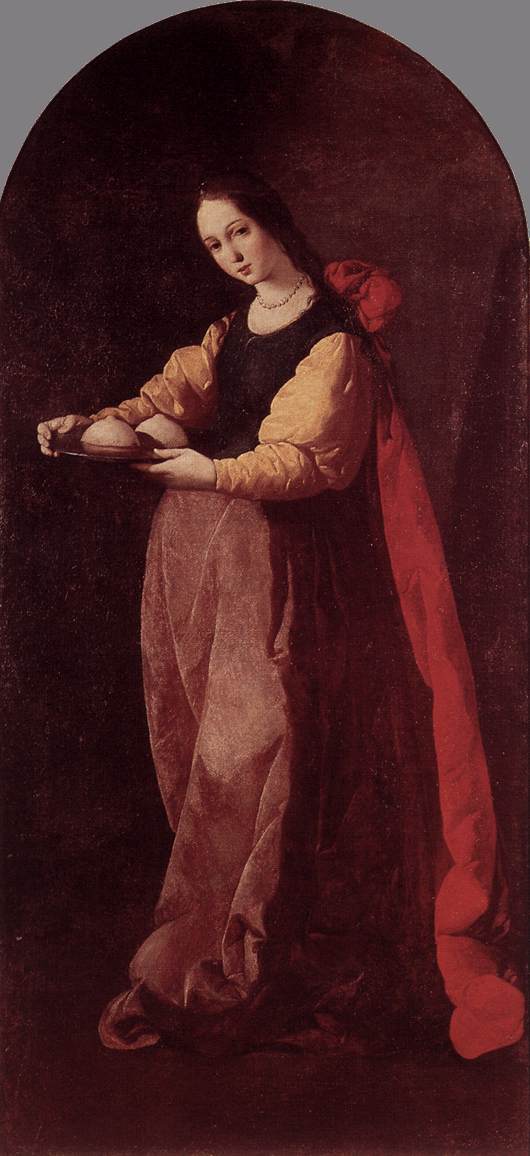
Francisco de Zurbaran’s “St Agatha,” painted in 1633, is a striking combination of quiet beauty and shocking symbolism. At first glance the viewer meets a graceful young woman who seems almost like a noblewoman from Zurbaran’s own Seville, dressed in rich fabrics and holding a silver tray. Her posture is gentle, her expression introspective, and the dark background makes her figure glow in the light. Only after a second look do we notice what rests on the tray she carries. The two rounded forms are not loaves of bread but the saint’s severed breasts, a reference to the brutal torture that made Agatha of Catania one of the most venerated martyrs in Christian tradition.
Zurbaran’s painting belongs to a series of full length female saints he created during the 1630s, many of which present holy women as elegant contemporary ladies. In “St Agatha,” he takes this approach to a powerful extreme. The refinement of her appearance contrasts sharply with the horror of her martyrdom, producing a complex emotional effect. The painting is not only a devotional image, it is also a meditation on suffering, dignity, and the strange coexistence of cruelty and grace.
The Story of St Agatha and Its Seventeenth Century Resonance
St Agatha was a third century Christian virgin martyrs from Catania in Sicily. According to the legend, a Roman official became infatuated with her and attempted to force her into abandoning her faith and marrying him. When she refused, he subjected her to humiliation and torture. The most famous episode describes how her breasts were cut off as punishment for her virginity and her allegiance to Christ. Despite this cruelty, she remained steadfast and was eventually killed, becoming a symbol of courage and purity.
By the seventeenth century her cult had spread across Europe. She was invoked as a protector of women, a guardian of chastity, and a helper in times of illness. Artists often depicted her with the instrument of torture or with her amputated breasts presented on a plate. While the subject is disturbing, it served a clear purpose within Counter Reformation spirituality. Such images reminded viewers of the seriousness of faith and of the extreme sacrifices some believers had made. They also offered an example of inner strength in the face of external violence.
In Spain, where Zurbaran worked, devotion to virgin martyrs fit well with a culture that valued both strong religious identity and strict codes of honor. Female saints who defended their faith and integrity were admired by women and men alike. Through paintings like “St Agatha,” viewers were invited to think about how spiritual commitment might demand costly fidelity even in ordinary life.
Composition and First Impressions
The composition of “St Agatha” is straightforward yet highly effective. The saint stands almost life size within a tall, arched format. Her figure slightly shifts to one side in a relaxed contrapposto, with weight mostly on her right leg. This gentle twist of the body introduces movement and grace, preventing the image from feeling stiff.
The background is deep and featureless, almost entirely consumed by darkness. There are no architectural elements, landscapes, or secondary figures. The effect is that of a stage with the spotlight focused solely on the saint. The dark ground pushes her forward into the viewer’s space, lending her presence a quiet intensity.
Agatha’s head tilts delicately to the left, and she gazes toward the viewer with a soft, almost melancholic expression. Her arms extend slightly forward, presenting the tray she carries. The diagonal formed by the tray and her forearms leads the eye from her face downward to the shocking attribute, and then back up along the sweeping folds of her dress. Zurbaran constructs a visual loop that keeps our attention circulating around the central figure, encouraging prolonged contemplation.
The Saint as a Contemporary Spanish Lady
One of the most fascinating aspects of this painting is the way Zurbaran dresses Agatha. Instead of the tunic and veil of a third century Sicilian, she appears in the garments of a seventeenth century Spanish woman. She wears a dark bodice over a pale blouse with voluminous yellow sleeves, a full skirt in muted rose, and a long crimson mantle that cascades to the floor and trails behind her. Around her neck gleams a simple pearl necklace, a detail that adds refinement and emphasizes her youth and femininity.
This anachronistic costume was deliberate. It allowed viewers to identify more closely with the saint by picturing her as someone from their own world rather than as a distant historical figure. At the same time, the fine fabrics and elegant bow at her back underline her status as a noble soul, rich in virtues even if not in material wealth. Zurbaran often used contemporary fashion to connect the sacred and the everyday. In “St Agatha,” this strategy heightens the sense that holiness can take root in any era, even in people who look like the women walking through the streets of Seville.
The combination of fashionable dress and gruesome attribute creates a tension that gives the painting its edge. Agatha resembles a young woman carrying a dish of pastries or fruit, perhaps entering a dining room. Only careful observation reveals the disturbing reality on the tray. Through this contrast, Zurbaran suggests that the horror of martyrdom does not erase the dignity or beauty of the martyr. Instead, her willingness to suffer transforms the ordinary into a sign of heroic love.
Color, Light, and the Baroque Drama of Cloth
Color plays an essential role in shaping the emotional tone of “St Agatha.” The dark background sets off the warm, rich hues of the saint’s garments. The skirt is painted in velvety tones of rose and brown. The blouse sleeves glow with a golden yellow, catching the light at the shoulders and elbows. The bodice remains dark, providing a deep central anchor. Most striking of all is the long red mantle that flows down her back and across the floor.
Red is traditionally associated with martyrdom, charity, and the Holy Spirit. In this painting, the crimson fabric acts as a kind of visual declaration of Agatha’s role as a martyr. It starts in a large bow at her shoulders and streams downward like a banner, linking her head, heart, and feet in a vertical line of color. Against the surrounding darkness, the red mantle glows with a quiet intensity, suggesting both the blood she shed and the fervor of her faith.
Zurbaran’s handling of light brings the fabrics to life. He uses a strong but controlled light source, probably from the upper left, to illuminate the front of the figure. The light touches her face, chest, and the upper folds of her skirt, then fades gradually across the lower garment. This modeling creates a sculptural effect. The folds of the skirt appear heavy and tactile, while the sleeves and mantle have lighter, more delicate highlights.
The artist’s celebrated skill in painting cloth is evident here. By carefully describing each fold and crease, he gives the viewer a sense of the physical reality of silk and wool. At the same time, the drapery serves symbolic purposes. The voluminous garments create a sense of modesty and protection around the saint’s body, even as the tray she carries reveals the violence inflicted upon her.
The Tray and the Shock of Martyrdom
At the center of the narrative meaning of the painting is the tray Agatha holds. On it lie two rounded, pale forms that resemble small loaves. In devotional imagery these forms represent the saint’s severed breasts, a discreet yet unmistakable sign of her torture. Zurbaran avoids explicit gore. There is no dripping blood or graphic detail. Instead, the forms are smoothed and simplified, almost abstract. Their pale color echoes the light on Agatha’s face and hands, creating a link between her identity and the suffering she carries.
The way she holds the tray is important. Her hands are steady and gentle. She does not clutch it with horror or cast it away. Instead, she presents it forward, almost as if offering a gift. This gesture can be read as symbolic of her consent to suffer for Christ and of her willingness to unite her pain with his sacrifice.
The tray also invites the viewer to confront the reality of martyrdom. Standing before the painting, one cannot avoid noticing these unusual objects once they are recognized. The mind oscillates between the attractiveness of the saint and the brutality of what the tray signifies. This oscillation mirrors the Christian paradox that joy and suffering are intertwined in the path of holiness.
Facial Expression and Psychological Depth
Despite the shocking attribute, Agatha’s face remains calm. She looks toward the viewer with a gentle, slightly tilted gaze. Her expression is neither ecstatically joyful nor dramatically anguished. Instead, it conveys a quiet sadness combined with inner peace. The downturned corners of her mouth and the softness of her eyes suggest that she has absorbed the reality of her suffering, yet she is not crushed by it.
Zurbaran emphasizes the oval shape of her face with subtle modeling. Light falls on her forehead, nose, and cheeks, while shadows soften the areas around her eyes and under her chin. This delicate play of light reveals the smoothness of young skin, reinforcing the sense that she died in the flower of youth.
There is a slight distance in her gaze, as though she is looking not directly at the viewer but beyond. This effect can be interpreted as a sign of her inward contemplation, her focus on a reality that transcends the physical scene. Viewers are thus encouraged to follow her gaze toward an invisible horizon of faith.
The Dark Background and Spiritual Space
The nearly black background of “St Agatha” is typical of Zurbaran’s religious paintings. It eliminates any specific setting and transforms the space into a spiritual stage. Without architectural clues, we do not know whether the saint stands in a room, a church, or an abstract void. The lack of environment sharpens the viewer’s focus on the figure and her symbolic objects.
This darkness also has theological resonance. It can be read as the world of persecution and ignorance from which Agatha’s faith sets her apart. She stands like a candle in a dark room, illuminated by an unseen source. Her garments catch the light in a way that makes them appear almost luminous against the gloom. In this sense, Zurbaran uses darkness not as absence but as a foil for the presence of grace.
The arch at the top of the composition subtly suggests an altar niche or chapel recess. It frames the saint as if she were a statue placed in a church, inviting veneration. This architectural hint situates the painting within the tradition of altarpiece imagery, even though the interior details are kept to a minimum.
St Agatha within Zurbaran’s Series of Female Saints
During the 1630s, Zurbaran produced a number of single figure paintings of female saints, often for convents and private patrons. These works share certain features. Each saint appears full length, isolated against a dark background, richly dressed in contemporary clothing, and identified by attributes such as palm branches, lamps, or specific objects linked to their legends.
“St Agatha” fits perfectly within this series yet also stands out for the boldness of its subject. Compared with other saints who carry palms or flowers, Agatha’s attribute is especially shocking. The painting thus demonstrates Zurbaran’s willingness to confront difficult aspects of martyrdom while maintaining a sense of decorum and grace.
These female saints were particularly important for women in religious communities. They served as examples of courage, chastity, and steadfast faith. A nun standing before “St Agatha” could see in her not only a distant heroine but also a sister in the same spiritual family, dressed much like the noble ladies she might have known before entering the convent.
Emotional Impact and Contemporary Relevance
For modern viewers, “St Agatha” remains compelling precisely because of its tension between elegance and violence. At a time when discussions of gender and bodily autonomy are prominent, the image of a young woman who suffers mutilation for refusing to submit to coercion has renewed resonance. The painting can be seen as a powerful statement about the integrity of the body and the courage to resist oppression.
At the same time, the work invites deeper reflection on the meaning of faith and sacrifice. Whether one approaches it from a religious or secular perspective, the calm dignity with which Agatha holds the sign of her own suffering challenges easy responses. It pushes viewers to consider how individuals today face suffering, whether chosen or imposed, and how they find meaning within it.
The painting also showcases Zurbaran’s technical brilliance and his ability to infuse simple compositions with spiritual depth. The subtle light on Agatha’s face, the heavy folds of her skirt, and the glowing red mantle create a visual experience that is both sensuous and ascetic. It reminds us that Baroque art, even when focused on painful themes, can still be profoundly beautiful.
Conclusion A Quiet Martyr with a Powerful Message
“St Agatha” by Francisco de Zurbaran is a masterful fusion of portrait like realism and symbolic intensity. Through a single standing figure and a minimal set of objects, the painter tells the story of a courageous young martyr and invites viewers into a space of contemplation. The elegant contemporary costume, the glowing colors, and the careful play of light create a sense of beauty and poise. The tray with its shocking contents, held calmly in Agatha’s hands, introduces a note of deep pathos and theological meaning.
In this painting, Zurbaran shows that martyrdom is not only an event of the past but a continuing call to integrity and faithfulness. St Agatha stands in the darkness like a quiet flame, bearing witness to a love that is stronger than violence. Her serene gaze and steady posture encourage viewers to confront suffering without losing dignity, to hold their own pain with courage, and to remember that even in the most brutal circumstances, beauty and grace can still shine.