Image source: wikiart.org
Introduction
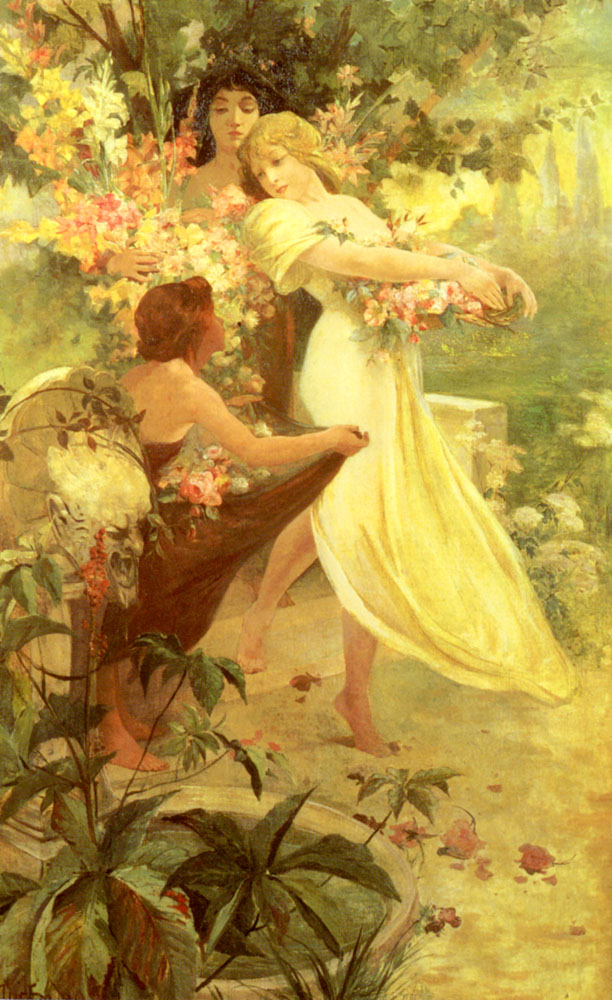
Alphonse Mucha’s “Spirit of Spring” (1894) unfurls like a warm breeze after a long winter. In a sun-bathed garden, three young women—garlanded with blossoms and enfolded by lush foliage—embody the season’s arrival. The scene is both narrative and ornamental, fusing allegory with the decorative lyricism that would soon define Art Nouveau. Everything sways: hair, drapery, vines, and garlands move in long, undulating lines, while light pours across pale skin and petals to create the honeyed glow we associate with early spring. The canvas reads at once as an idyll of renewal and as a carefully composed study in linear rhythm, color harmony, and symbolic gesture.
Historical Moment and the Artist on the Verge
The year 1894 sits at a hinge in Mucha’s career. Having trained in Moravia and Munich, and then moving to Paris, he was refining a pictorial language that merged academic figure painting with a modern taste for Japanese prints, medieval ornament, and nature’s fluent curves. Late that year a chance commission for Sarah Bernhardt’s “Gismonda” would make him famous overnight and catalyze the full flowering of Art Nouveau graphics. “Spirit of Spring,” likely painted just before that breakthrough, shows the painter already fluent in the traits that would become his signature: an idealized female type, abundant botany organized into rhythmic arabesques, and a composition that reads both as a tableau and as a decorative panel.
Allegory in Three Figures
The work personifies spring through a trio rather than a single muse, echoing the time-honored motif of the Three Graces. The blonde figure in pale yellow turns with a languid sway, her arm extended as if scattering blossoms into the air. She is the season’s warmth and generosity, a distributor of life. Behind her stands a dark-haired attendant whose serenity and frontal posture introduce calm; she supplies equilibrium to the picture’s motion. At the lower left, a figure in deeper tones—bent forward with a garland gathered in her arms—anchors the composition and suggests the season’s labor: planting, binding, and arranging. Together the trio stages a sequence of spring’s actions: awakening, balancing, and flourishing.
Composition and Spatial Design
The painting uses a tall, vertical format that lets Mucha treat the scene as a living frieze. The eye moves in an elongated S-curve from the foreground plants, up through the seated figure, into the turning blonde, and finally to the serene attendant at top center. This path, reinforced by drapery folds and flower chains, produces a gentle, perpetual motion appropriate to the subject. Architecture is reduced to a low garden wall and a suggestion of balustrade; these horizontal rests prevent the vertical sweep from tipping into restlessness. Foliage and blooms fill the upper field like a tapestry, compressing the deep space and making the garden feel sheltered and abundant.
The Language of Line
Mucha was a master of the arabesque line, and “Spirit of Spring” is a compendium of its uses. Hair curls in soft eddies; sleeves billow; flower stems bend with the weight of blossom; even the stone mask on the fountain is ringed with sinuous vegetation. These long, uninterrupted contours give the painting its musical quality—the sense that the surface is scored for the eye to read as melody. In later posters, Mucha would thicken these contours into emphatic outlines; here they remain painterly, but the linear rhythm is already the picture’s true scaffold.
Light, Atmosphere, and the Golden Key
A warm, diffuse light drenches the garden. Rather than casting strong shadows, it settles as a gentle haze that melts forms at the edges. Pale golds and creams dominate the skin and drapery; greens are softened with yellow; even the cooler passages keep a trace of sunlight. This “golden key” unifies a busy scene and enhances the allegorical tone: the world looks newly polished, as if washed by spring rain and caught during a brief lull when everything is fresh.
Color Harmony and Seasonal Palette
The palette favors tender values—ivories, pastel pinks, fresh greens—punctuated by small accents of deeper browns and reds. The blonde’s gown, nearly the color of primrose, provides the principal light. Behind her, florals run from salmon to carnation pink; leaves move between sage and sap green. These ranges are orchestrated so that no single hue overwhelms the field. It feels like a garden where all species have bloomed at once, yet the painter’s modulation keeps them in concert rather than cacophony. The selective use of darker tones around the seated figure and the fountain establishes depth without sacrificing overall radiance.
Gesture, Drapery, and the Body as Ornament
Mucha treats the human figure as both presence and pattern. The blonde’s turning pose opens the chest and throat, classical signals of vitality and ease; her lifted arm extends like a vine, and the sweep of her skirt becomes a white petal unfurling along the ground. The attendant’s upright posture stabilizes this movement, her own garland acting as a horizontal counterpoint. The seated figure’s bent knee and raised arm create a triangular brace in the lower left, anchoring the whole design. Drapery is not merely clothing but a system of flowing shapes that rhyme with leaves and petals, dissolving the boundary between human and vegetal worlds.
Nature as Decorative Architecture
The garden is as carefully designed as a building. Tall blooms mass like columns; vine clusters hang as cornices; the balustrade and fountain serve as pedestals and thresholds. The plant at the very front, with wide, glossy leaves radiating from a central stem, is placed like a heraldic device announcing the subject. Mucha’s genius lies in making this high organization feel effortless. He does not draw a grid; he arranges growth so that the eye encounters order without seeing the scaffolding that underlies it.
Symbolic Program: Renewal, Fertility, and Grace
“Spirit of Spring” is saturated with symbols the era would have understood intuitively. Flowers signify fecundity and the briefness of youth; the gathering of garlands suggests rites of May and the renewed social life of the season; the fountain implies the waters of life returning after winter’s freeze. The three women, with their differentiated coloring and positions, suggest phases of the season from first bud to full bloom. The absence of any male counterpart keeps the mood pastoral and untroubled; this is spring imagined as a self-sufficient feminine domain.
Relationship to Poster Art and the Emerging Art Nouveau
While this is a painting rather than a print, it anticipates Mucha’s soon-to-be-iconic posters. The tall format, the emphasis on contour, and the ornamental density foreshadow his lithographic panels and advertising designs. However, where the posters deploy stark outlines and flat areas of color for legibility in the street, the painting retains soft transitions and painterly modeling. “Spirit of Spring” therefore sits at a crossroads: it shows the artist translating academic fluency into a decorative language that could populate both salons and boulevards, murals and magazines.
The Female Type and Fin-de-Siècle Ideal
Mucha’s women share features that became synonymous with his name: gently oval faces, heavy eyelids, an inward, dreamy concentration, and hair treated as an ornamental pattern. In this work, the women are not eroticized; they are emblems of health and natural ease, closer to Botticelli’s Primavera than to decadent femme fatales. The era’s fascination with the feminine as a vessel for nature, style, and civic wellbeing is evident throughout. Even the act of arranging flowers becomes a metaphor for arranging society through tasteful harmony.
Spatial Depth and Decorative Flatness
One of the painting’s achievements is its balance between believable space and decorative surface. Foreground plants, middle-ground figures, and a luminous distance are present, yet the entire scene compresses into a shallow depth that lets patterns dominate. Mucha achieves this by blending background foliage into a soft tapestry and allowing the wall and fountain to block recession. As a result, the garden feels intimate, like a garden room, where one is surrounded by bloom rather than looking across it from afar.
The Masked Fountain and Nature’s Theatricality
A small but telling element sits beside the seated figure: a stone mask on the fountainhead, perhaps a theatrical or bacchic emblem. Its presence nods to the stagecraft of allegory—the idea that seasons and forces of nature wear human faces for our benefit. It also slips in a hint of antiquity, linking the scene to classical villas and the pastoral tradition. The mask is crisp and pale against dark stone and plants, a reminder that under the painting’s luxuriant spontaneity lies a long history of cultivated gardens and designed pleasure.
Movement, Music, and the Viewer’s Experience
The painting’s rhythms invite a specific tempo of looking. One senses a gentle waltz: step into the lower left, sway across the turning figure, and resolve in the soft vertical of the attendant. The garlands act like musical phrases, repeated with variation; the leaves form murmuring accompaniment; the occasional fallen flower on the ground strikes a quiet percussive note. The overall movement suggests not just the literal breeze of spring but the social season’s round of dances, promenades, and garden fêtes.
Technique, Surface, and the Sensation of Touch
Mucha’s paint handling is smooth in the lights and slightly more textured in the darks, a pragmatic way to keep the gleam where the viewer will most feel it. Flesh is rendered with thin, warm layers; hair and flowers receive slightly thicker touches that catch light. Edges blur in the sunlit haze and harden around key forms—the mask, the forward leaves, the outlines of the arms—guiding attention without overt direction. The surface becomes tactile even where the subject is purely visual; one almost senses the coolness of stone, the soft drag of petals against skin.
Comparisons and Foreshadowing
Seen alongside Mucha’s later decorative panels like “The Seasons” (1896), this work functions as a prototype. It contains the same love of seasonal allegory, the same vertical composition and rhythmic plant life, and the same belief that art can cultivate the soul through beauty. What the later panels will add is a more assertive contour and flatter color fields; what this earlier painting preserves is the warm, atmospheric envelope of plein-air light. The two modes are not contradictory but complementary, and together they explain Mucha’s dual fame as painter and designer.
Emotional Temperature and Cultural Meaning
Fin-de-siècle Paris often oscillated between anxiety about modernity and nostalgia for an idealized past. “Spirit of Spring” answers anxiety with abundance. It proposes that harmony is attainable when nature, craft, and the human figure are brought into accord. The serenity of the women’s faces is important here: they are not ecstatic or melancholic but composed. The mood is one of confident renewal—the sentiment that after winter’s privation the world sets itself right again, and that art’s role is to make this restoration visible.
Why the Painting Endures
The endurance of “Spirit of Spring” lies in its double gift. It offers immediate pleasure—flowers, warm light, graceful bodies—and it models a kind of order that feels restorative. The arabesques are not random; they are tuned. The colors are not merely pretty; they are calibrated to create balance and lift. Stand before the canvas and it becomes difficult not to breathe a little easier. The painting teaches that decoration, when done with intelligence and sensitivity, can host ideas about time, growth, and human wellbeing without ever becoming heavy.
Conclusion
“Spirit of Spring” captures Mucha on the cusp of fame, gathering the strands of Symbolist allegory, academic figuration, and modern decorative design into a single, sunlit image. Three women, a garden, and a wealth of blossoms are all he needs to stage the drama of renewal. Everything flows toward harmony: line toward melody, color toward radiance, gesture toward grace. If later posters made Mucha’s style ubiquitous on city streets, works like this reveal the poetic springs from which that style rose.