Image source: wikiart.org
First impressions and the painting’s quiet shock
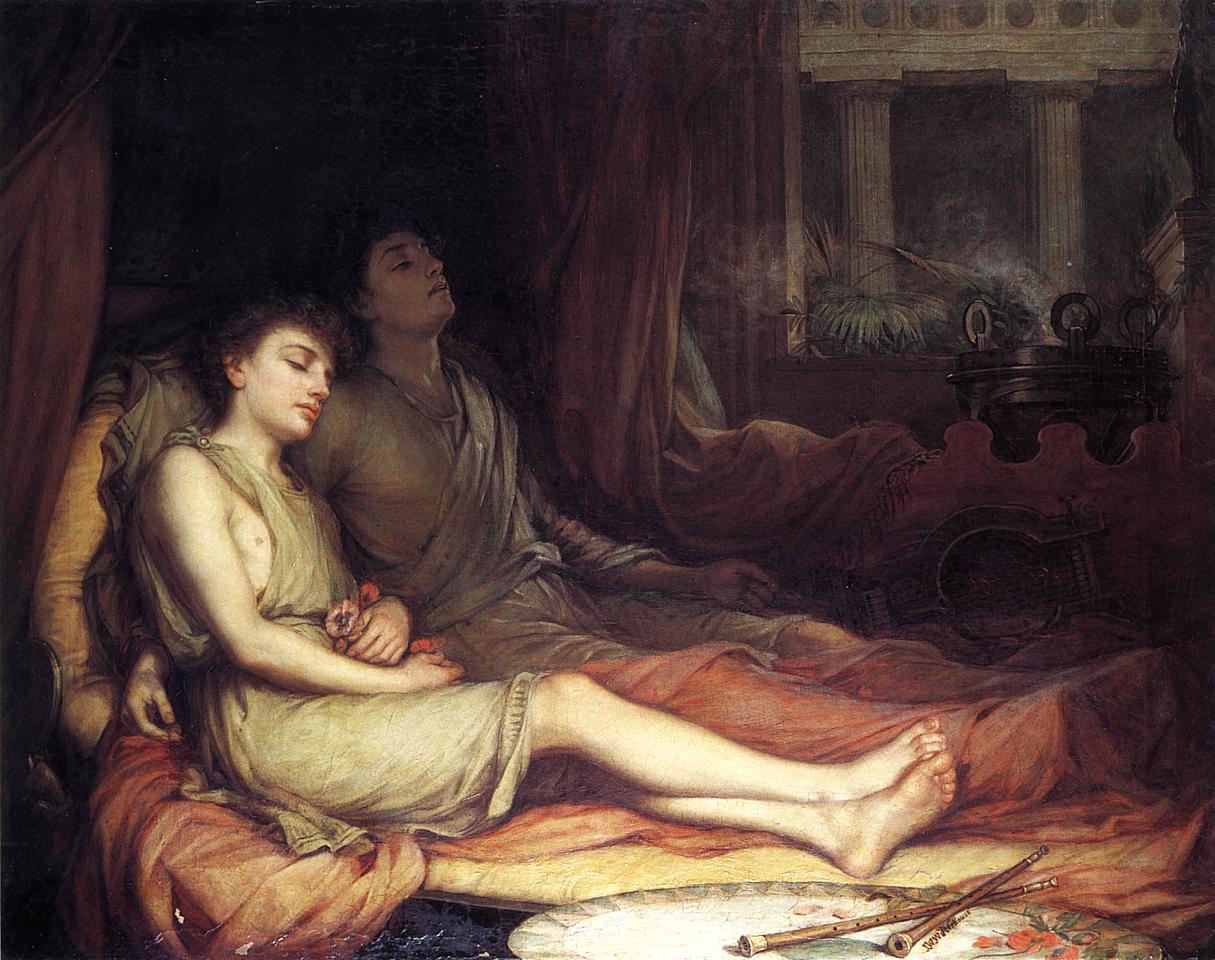
In “Sleep and His Half Brother Death” (1874), John William Waterhouse stages a scene that feels hushed, intimate, and slightly uncanny. Two figures rest on a couch or bed, wrapped in heavy drapery and warm, dim air. At first glance, it reads like a private moment of exhaustion or repose. But the title changes everything. Sleep is no longer just sleep, and rest is no longer simply comfort. The painting becomes a meditation on how close tranquility can sit beside finality, and how easily one state can resemble the other.
Waterhouse sets a mood of suspended time. Nothing “happens” in a dramatic way, yet everything feels consequential. The viewer is invited into a chamber where sound has been softened, movement slowed, and light turned into a gentle veil. That stillness is the real subject. The work asks you to look at the small differences between yielding and surrendering, between drifting off and being taken.
Waterhouse in 1874 and the appeal of classical personifications
This is an early work in Waterhouse’s career, and it already shows his attraction to classical themes and poetic narratives. Victorian audiences were deeply receptive to Greco Roman subjects, especially when artists used myth as a dignified language for emotions that were otherwise difficult to depict directly: longing, melancholy, fear, spiritual uncertainty. By choosing Sleep and Death, Waterhouse selects an idea that is ancient, universal, and instantly human.
The title refers to the classical notion of Hypnos and Thanatos as half brothers. That relationship is important because it implies kinship rather than opposition. Sleep is not Death’s enemy here, but his relative, his near twin. In visual terms, this gives Waterhouse permission to make the two states look similar. The painting becomes a study in resemblance. It suggests that what frightens people about death is partly its familiarity, the way it echoes nightly experience, only without return.
The chamber as a stage for thresholds
The setting feels like a theatrical interior, but not in a loud or decorative way. Curtains frame the figures and form a dark canopy that closes off the outside world. The architecture in the background, with its columns and shadowed surfaces, hints at antiquity, yet it also reads like a controlled studio set. This is a place designed for a single theme: the threshold between consciousness and unconsciousness.
There is also an emotional geography to the space. The deepest shadows gather above and around the heads of the figures, as if the air itself thickens where breath becomes slow and thought dissolves. The bed or couch stretches across the canvas like a shoreline, and the bodies lie at the border where waking life ends. Everything beyond them, the columns, the dim recesses, the drifting smoke, feels like the “other side” of that border: unknowable, quiet, and present.
Composition and the logic of closeness
Waterhouse builds the composition around a long diagonal that runs from the illuminated legs in the foreground to the darker upper left where the canopy of fabric swallows light. This diagonal does two things at once. It makes the reclining figure’s body the primary path for the viewer’s eye, and it turns the act of lying down into a visual “descent.” You read the painting almost as a slow slide from brightness into obscurity.
The arrangement of the two figures intensifies the theme. They are pressed close enough to feel like a single unit, yet their expressions and postures separate them. The forward figure appears fully surrendered, eyelids closed, face softened, limbs extended with natural heaviness. The rear figure, more upright, seems held in a different kind of stillness, as if not merely resting but waiting. The closeness becomes symbolic. Sleep does not lie far from Death. It lies in the same bed.
The viewer’s vantage point is also intimate. We are placed near the foot or side of the couch, close enough to notice fingers, flowers, fabric edges, and the small objects on the floor. That nearness creates a whispering tension: we are allowed into a private, vulnerable scene, but we also feel like witnesses to something solemn.
Light as a storyteller
The lighting is one of the most persuasive elements in the painting. Waterhouse lets illumination fall with a tenderness that feels almost ethical, as if the figures must be treated gently. The brightest area is the exposed skin of the foreground figure, especially along the legs and feet, where light turns flesh into a soft, luminous surface. This glow is not flashy. It is muted and warm, like lamplight or late afternoon filtered through textiles.
Crucially, light does not conquer the darkness. It coexists with it. Shadows remain thick in the upper regions, around the drapery, the back figure’s head, and the recesses of the room. The result is a visual metaphor for the subject itself: consciousness as a small island of clarity surrounded by the larger sea of the unknown. Sleep is the dimming of that island. Death is the moment the lamp does not return.
The transitions are what matter most. Waterhouse paints gradations rather than sharp contrasts, allowing light to fade slowly into shadow. That gradual fading is exactly how sleep arrives. It is not a door slammed shut, but a soft closing.
Color, fabric, and the atmosphere of warmth
The palette is dominated by deep reds, russets, browns, and smoky neutrals, with pale skin and light cloth acting as focal highlights. These colors create an atmosphere of interior heat, like a room where air has been warmed by bodies, textiles, and incense. The heavy red drapery feels protective, almost womb like, suggesting sleep as shelter. At the same time, red carries undertones of blood, mortality, and ritual, which keeps the comfort from becoming purely innocent.
The fabrics are essential to the painting’s meaning. They do not merely decorate the bed. They create a tide of folds that seem to flow under and around the figures. This flowing effect makes the bodies feel as though they are being carried, not simply lying still. In that sense, drapery becomes the medium of transition. Sleep is portrayed as a current. Death is a deeper current in the same river.
Waterhouse also uses color temperature to guide emotion. Warmer notes gather around the bed and bodies, while cooler, duller tones sit in the architectural background. This gently separates “felt life” from “impersonal space.” The bed is sensation. The background is inevitability.

The myth beneath the scene: Sleep beside Death
The classical idea that Sleep and Death are related is more than a poetic line, it is a philosophical claim. It proposes that the body’s most ordinary surrender, the nightly lapse into unconsciousness, shares a family resemblance with the final surrender. Waterhouse makes that claim visible by avoiding melodrama. There are no obvious horrors here, no violent gesture, no theatrical despair. Instead, the painting relies on resemblance and proximity.
The two figures can be read as personifications, but Waterhouse keeps them human enough that the myth remains emotionally accessible. They look like people you might find in a quiet room, not distant gods on a cloudy Olympus. That choice matters. It implies that these forces do not live “elsewhere.” They live with us, in our rooms, in our bodies, in our habits.
The title also primes you to look for hierarchy: which figure is Sleep, which is Death. Waterhouse does not make the answer simple. That ambiguity is part of the point. If you cannot immediately tell, the painting has already made its argument. Sleep and Death are hard to separate when both are rendered as stillness.
Symbols: poppies, smoke, and the language of forgetting
Several objects subtly reinforce the theme. The flowers held near the foreground figure read as poppies, traditionally associated with sleep, dreams, and oblivion. Even if you do not identify them precisely, their red warmth echoes the drapery and suggests a narcotic softness. They become a visual shorthand for drifting away.
The curling smoke near the right side of the composition contributes another layer. Smoke is a perfect symbol for altered consciousness. It blurs edges, changes the air, and makes the room feel like a place of transition. It also evokes funerary ritual, incense, and offerings. Here, smoke bridges the domestic and the sacred, turning a bedroom into a threshold chamber.
Musical instruments appear in the scene as well, including a stringed instrument resting near the bed and pipes on the floor in the foreground. Music is time made audible, and instruments imply both presence and absence. When no one plays them, they become quiet witnesses. In the context of Sleep and Death, they can suggest the lullaby, the last song, or the silence after song ends. They also connect to classical culture, reinforcing the mythic frame.
Bodies, vulnerability, and the ethics of looking
The painting asks for a careful kind of viewing. The foreground figure’s exposed skin is painted with sensitivity rather than spectacle, emphasizing fragility and the defenselessness of sleep. Sleep is the moment when the body cannot guard itself. Death is the ultimate version of that vulnerability. Waterhouse positions the viewer close enough to feel protective, yet powerless.
Notice how the foreground figure’s posture combines comfort with limpness. The arm rests without tension, the head tilts with the weight of muscles released, the legs extend with the unselfconscious logic of a body that no longer performs for anyone. This is the opposite of heroic classicism, where bodies are staged to demonstrate control. Here, the body is honest because it has stopped managing itself.
The rear figure’s more upright posture adds psychological complexity. It can be read as watchfulness, guardianship, or inevitability. If it is Death, the pose may suggest that Death does not need to rush. He can sit and wait. If it is Sleep, it may suggest that sleep is not always peaceful, that drifting off can include a strange, hovering awareness. Either way, Waterhouse makes stillness active.
Pre Raphaelite echoes and Waterhouse’s distinct tone
Waterhouse is often linked to the Pre Raphaelite orbit, and you can see related traits here: the attention to tactile detail, the seriousness of poetic subject matter, and the use of beauty as a vehicle for meaning. Yet the tone is less jewel bright than many Pre Raphaelite works. Waterhouse leans into atmosphere, smoke, shadow, and muted warmth rather than crisp, enamel like clarity. The scene feels breathed into rather than etched.
The emotional temperature is also distinct. Instead of presenting myth as pageantry, he presents it as interior experience. Sleep and Death are not distant allegories. They are felt conditions. This shift from spectacle to sensation is a hallmark of Waterhouse’s storytelling. He often turns literature and myth into moments of private intensity, where the drama is internal.
In this early painting, you can sense that direction forming. The myth is the frame, but the real subject is the human face softened by surrender, and the uneasy comfort of recognizing Death in the posture of rest.
The painting’s central idea: tenderness and terror share a bed
What makes “Sleep and His Half Brother Death” linger in the mind is its refusal to separate comfort from unease. The bed is warm, the fabrics rich, the light gentle. Yet the title insists that this softness is not purely safe. The painting suggests that the most consoling human routine, falling asleep, rehearses a kind of disappearance. That is not meant to be cruel. It can be read as a sober truth, even a strange comfort: Death is not wholly alien if it resembles something we already know.
At the same time, the work acknowledges fear. The darkness above the figures does not feel empty. It feels present. The smoke curls like a breath you cannot quite locate. The instruments lie silent. The room’s architecture stands like a reminder of permanence that outlasts bodies. Waterhouse balances tenderness and terror so carefully that the viewer experiences both at once, which is exactly the emotional logic of the theme.
The painting also invites a moral reflection. If Sleep and Death are kin, perhaps the way we treat sleep, with respect, patience, and gentleness, hints at how we might confront mortality. Not by denying it, but by recognizing its proximity, and still choosing warmth, art, music, and human closeness.
How to look longer: details that reward attention
Spending time with this painting shifts it from “a scene of two resting figures” into a web of small decisions. Look at how the folds of cloth create pathways that lead the eye back and forth, never letting you settle on a single point. Look at how the brightest highlights are saved for areas that emphasize vulnerability, like the feet and legs, rather than for jewelry or props. Look at how the background columns are present but subdued, like memory rather than immediate reality.
Also pay attention to the emotional ambiguity. The painting does not tell you whether this is peaceful or ominous. It lets you oscillate. That oscillation is the experience it offers: the mind moving between comfort and dread, between the familiar act of sleep and the unfamiliar finality of death. Waterhouse does not solve the riddle. He makes it inhabitable.