Image source: wikiart.org
First Impressions of a Voice Caught in Paint
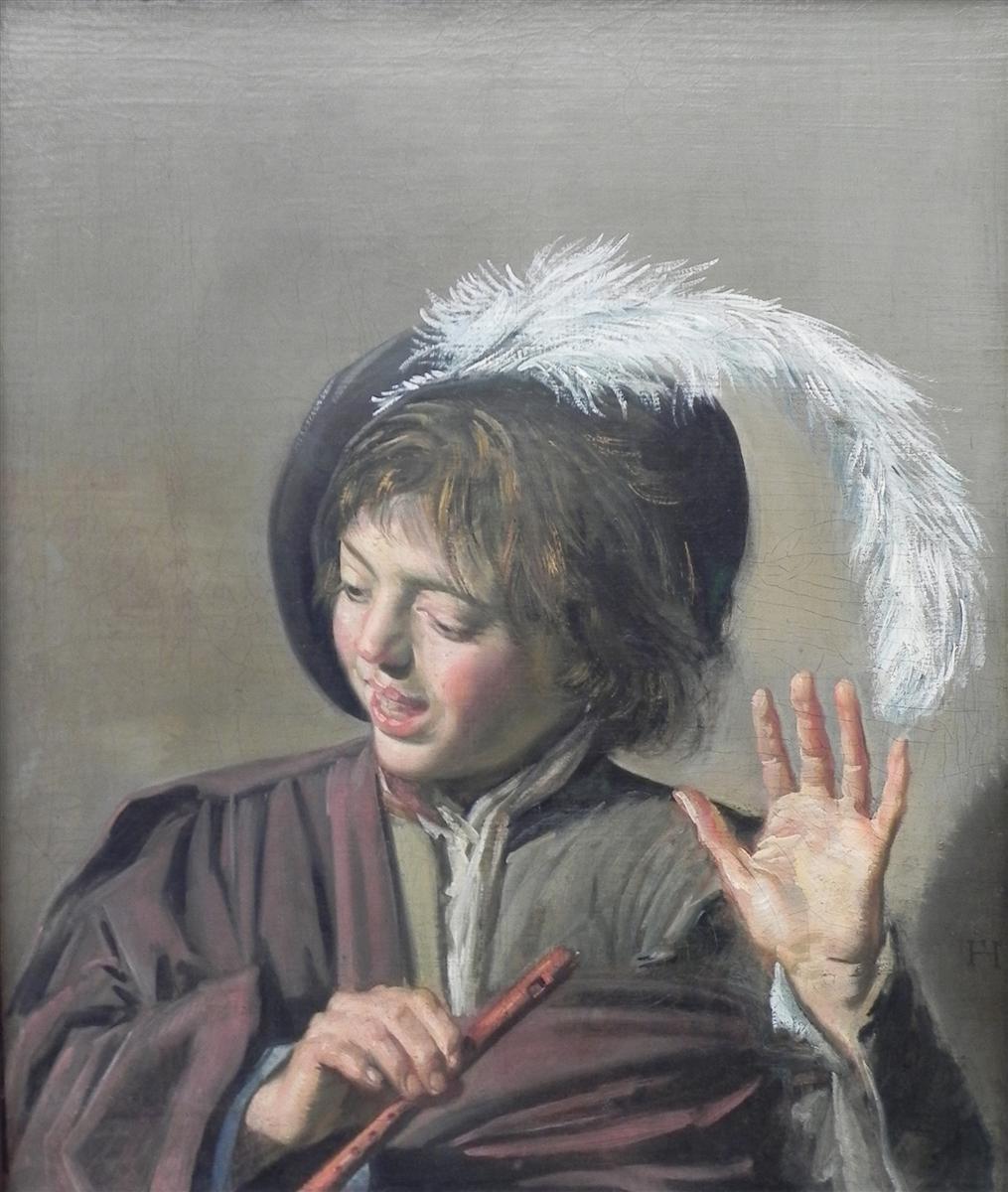
Frans Hals’ “Singing Boy with a Flute” (1623) feels like a sound made visible. The boy’s mouth is open mid-note, his cheeks flushed, his eyes half-closed in concentration or pleasure. One hand lifts with an expressive, almost theatrical gesture, while the other steadies the flute as if ready to join the singing or to punctuate it. Hals does not present a quiet child posed for a polite likeness. He presents a performer in the act, caught in the slippery instant between breath and melody.
The painting has a striking simplicity. The background is a soft, muted field with almost no distraction. There are no busy interiors, no crowd of onlookers, no elaborate props beyond the hat and the instrument. This simplicity intensifies the intimacy. The viewer is brought close to the boy’s face and hands, to the moment of performance. Hals turns a modest subject into something mesmerizing by focusing on what changes fastest: expression, gesture, and the fleeting mechanics of singing.
The Boy as Character Rather Than Formal Portrait
Although the work has the directness of portraiture, it also has the spirit of genre painting, where character types and everyday scenes come alive. The boy is not shown as a future respectable citizen in stiff clothing. Instead, he appears dressed in a loose, casual outfit with a dramatic hat topped by a large feather. This costume tilts the scene toward playacting and performance. It suggests that the boy might be participating in a festive moment, a street entertainment, or a household game of imitation.
Hals often paints figures that feel like individuals and types at the same time. This boy seems particular in his facial structure and expression, yet he also represents a familiar theme in Dutch art: music as joy, music as fleeting experience, music as a symbol of youth and spontaneity. The painting invites you to read the boy as a personality, someone with spirit and confidence, rather than as a carefully documented member of a wealthy family.
That shift matters. It changes the emotional contract. Instead of approaching the painting as a formal record, the viewer approaches it as an encounter with a moment. The boy is not “posed.” He is doing something. Hals builds the entire image around that action.
Composition and the Cropped Intimacy of the Scene
The composition is tight, focusing on the boy from the chest upward. This cropping creates immediacy. It feels as if the boy is close enough that you could hear him. Hals places the head slightly to one side, allowing the feather to arc across the upper portion of the painting like a bright, airy counterweight. The boy’s raised hand occupies the right side, fingers spread in a gesture that reads as musical emphasis, like a singer marking time or shaping a phrase.
The diagonal flow through the body is subtle but effective. The hat’s brim and feather push the eye outward, while the boy’s face pulls it back inward. The flute runs across the lower portion, creating a horizontal line that stabilizes the composition. Together these elements create a lively balance between motion and control.
The background’s emptiness is crucial. It gives the boy room to breathe, visually and psychologically. There is no spatial clutter to dilute the intensity of expression. Hals makes the simplest structure feel dynamic by letting gesture and facial movement become the architecture of the painting.
The Mouth, the Cheeks, and the Physical Truth of Singing
The most arresting detail is the boy’s mouth. Hals paints it open in a way that suggests sound rather than just a smile. The lips have a moist sheen, the mouth’s interior is carefully darkened, and the surrounding flesh seems activated by breath. This is not a generic open mouth. It is the mouth of someone actually projecting a note.
The cheeks are flushed, emphasizing effort and excitement. Singing is physical, and Hals conveys that physicality. The boy’s expression hints at the shifting sensations of performance: delight, concentration, and a slight self-consciousness. The eyes appear partly closed or lowered, as if the boy is listening to himself, feeling the rhythm, or enjoying the attention.
This attention to the mechanics of singing is one of the painting’s most modern qualities. It captures the truth that performance is a bodily act, not just an abstract talent. Hals makes the boy’s face into a map of sensation. You can almost sense the breath moving through the throat, the mouth shaping vowels, the body maintaining balance.
Gesture and the Raised Hand as Musical Conducting
The raised hand is a brilliant device. It transforms the boy from someone merely making sound into someone shaping it. The open palm, the spread fingers, the slight bend at the wrist all suggest emphasis, like a singer accenting a phrase or a conductor keeping time. It also introduces a note of theatricality. The boy’s performance is not purely inward. It is expressive, outward-facing, meant to be seen as well as heard.
This gesture invites the viewer to imagine the music’s rhythm. The hand becomes a visual metronome. It implies that the boy is not randomly singing but performing with intention. The gesture also increases the painting’s sense of immediacy. A hand raised like this feels temporary, about to move again. Hals captures it at a perfect point where it reads clearly but still feels mid-motion.
The raised hand also creates a relationship with the viewer. It could be interpreted as a greeting, a playful stop, or a flourish. That ambiguity adds charm. The boy seems aware of being watched, and he uses gesture to engage the audience, even if the audience is only the viewer centuries later.
The Flute as Prop, Instrument, and Symbol
The flute is held across the boy’s body, and its presence deepens the painting’s theme of music as lived experience. Whether the boy is about to play, has just played, or uses the flute as part of his singing act, the instrument signals a world of sound. Hals paints it as an object with weight and texture, but he does not over-detail it. The flute functions less as technical instrument and more as a sign of performance culture.
In Dutch genre imagery, musical instruments often carry symbolic meanings. They can suggest pleasure, sociability, youthful energy, and sometimes the fleeting nature of enjoyment. Hals does not force a moral lesson here, but the symbolism remains available. The boy’s youth, the casual costume, the open mouth mid-song, and the flute all suggest a moment that is beautiful because it cannot last. It exists only in the present.
At the same time, the flute helps stabilize the composition. It anchors the lower half, giving the viewer’s eye something to hold while the face and hand vibrate with implied motion. Hals uses the instrument both structurally and thematically.
Costume, Feathered Hat, and the Drama of Playacting
The feathered hat is one of the painting’s most distinctive features. Its large plume arcs across the upper right, catching light and creating a bright, airy texture against the muted background. The hat feels oversized, almost comically grand for a child, which suggests costume rather than everyday wear. This sense of costume supports the idea that the boy is playing a role, participating in a performance that is as visual as it is musical.
Feathers in portraiture and genre scenes often signal flamboyance, youth, and theatrical identity. Here the feather becomes a visual extension of the boy’s song. It has the same quality as sound: light, mobile, and expressive. Hals paints it with strokes that suggest softness and shimmer, creating a contrast with the heavier fabric of the boy’s clothing.
The clothing itself is loose and layered, painted in subdued tones that keep attention on the face and hands. The costume does not compete with expression. Instead, it frames it. Hals understands how to use costume as a tool for character without letting it overwhelm the human presence.
Light and the Quiet Radiance of the Boy’s Face
Lighting in the painting is gentle and selective. The boy’s face is the brightest area, with soft illumination on the forehead, cheeks, nose, and chin. The hat casts a shadow that adds drama without becoming harsh. The shadow suggests depth and creates a sense of realism, as if the boy is standing in a real light source rather than being evenly lit for display.
The raised hand also catches light, and Hals uses it to echo the face’s brightness. This echo creates unity. Face and hand become twin centers of expression, one vocal, one gestural. The flute sits slightly darker, a quieter object that supports the scene without stealing attention.
The background remains a muted gray, with subtle tonal variation that keeps it from feeling flat. Hals makes it a field of quiet atmosphere. It allows the boy to feel present, suspended in a space that is neither fully defined nor abstract. This ambiguity increases the painting’s intimacy. The boy seems to exist in the viewer’s immediate mental space, like a remembered sound.
Brushwork and the Illusion of Speed
Hals’ brushwork is essential to the painting’s liveliness. He uses confident strokes to suggest texture and movement. The feather is handled with lively, flickering marks that imply softness and air. The face is modeled with subtle transitions, but the paint remains visible enough to feel responsive. The clothing is handled with broader strokes, suggesting folds and weight without excessive detail.
This balance of specificity and looseness is one of Hals’ signatures. He wants the painting to feel alive, not overly polished. The slight roughness in areas like the clothing and background helps the more detailed areas, face and hand, feel even more immediate. It is as if Hals has concentrated his attention where life is most evident.
The brushwork also supports the theme of performance. Singing is fleeting. You cannot freeze it without losing it. Hals’ painterly looseness acknowledges that truth. He captures the sensation of a moment rather than turning it into a rigid document.
Youth, Music, and the Celebration of the Instant
The painting’s emotional core is its focus on youth as spontaneity. The boy’s expression is not guarded. It is open, expressive, and full of warmth. Music becomes a way of representing that openness. Singing is a public act. It involves risk, exposure, and the willingness to be heard. Hals captures the boy in that exposed state, and he does so with affection rather than mockery.
There is also an implicit contrast between the boy’s lively presence and the painting’s quiet setting. The background is still, while the boy is animated. This contrast emphasizes the boy’s vitality. It suggests that youth is a force that temporarily disrupts calm, filling space with sound and movement.
The scene can be read simply as charming, but it can also be read as subtly reflective. Music happens in time. Childhood happens in time. The painting preserves a moment that would otherwise vanish. Hals turns that vanishing into something lasting, making the boy’s song continue silently through the viewer’s imagination.
Frans Hals in 1623 and the Art of Capturing Character
By 1623, Hals had developed a powerful ability to paint expression in a way that feels immediate and unforced. “Singing Boy with a Flute” demonstrates this gift in concentrated form. With only one figure, Hals creates a full social world: the implied audience, the implied sound, the implied movement. He does not need a crowd. The boy’s face and gesture contain the event.
This painting also shows Hals’ interest in the boundary between portrait and genre. The boy is rendered with enough individuality to feel like a real person, yet the theatrical costume and performative gesture suggest a broader theme. Hals often operates in this liminal space, where a specific human being becomes a symbol of lively experience without losing their individuality.
The painting’s success lies in its economy. Hals achieves richness without overload. He uses a simple background, limited props, and a focused composition to intensify the boy’s presence. The result feels direct, intimate, and remarkably modern in its psychological clarity.
Why the Painting Still Feels So Immediate Today
“Singing Boy with a Flute” remains compelling because it captures something universally recognizable: the joy of performing, the awkward confidence of youth, the way sound can transform a moment. Even without hearing the music, the viewer senses it. Hals makes the boy’s song resonate visually through open mouth, raised hand, flushed cheeks, and lively brushwork.
The painting also invites affection without sentimentality. The boy is not idealized into an angelic figure. He is a lively child engaged in play, performance, and self-expression. The feathered hat adds humor and theatrical charm, suggesting that the boy is trying on an identity as much as singing a tune. Hals captures that mixture of seriousness and play that defines much of childhood.
Ultimately, the painting endures because it is an encounter. The boy feels present, close, and animated. Hals has transformed a brief act of singing into a lasting image of human vitality.