Image source: wikiart.org
Introduction
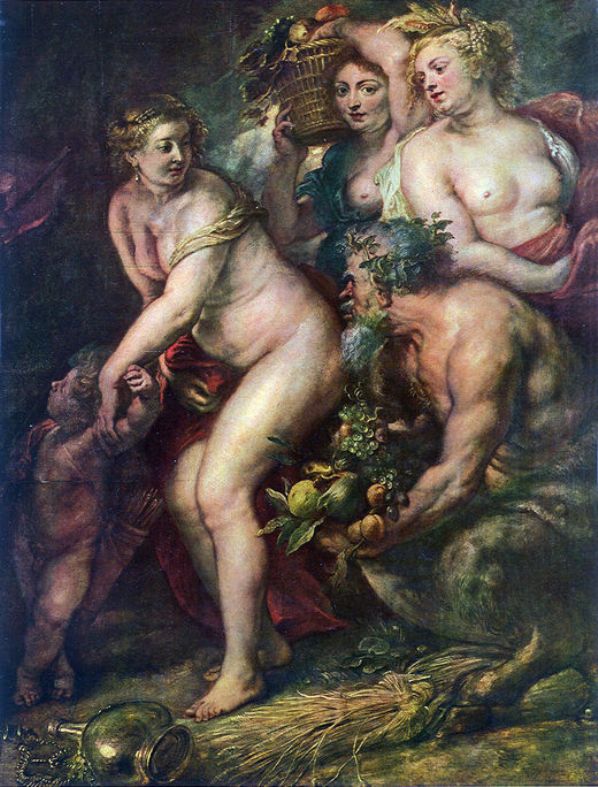
Peter Paul Rubens’s “Sine Cerere et Baccho friget Venus” (1613) is a sumptuous allegory that turns a well-loved Latin proverb into living flesh, fruit, and movement. The saying—“Without Ceres and Bacchus, Venus grows cold”—means that love needs food and wine to thrive. Rubens does not inscribe the motto on a scroll; he paints its proof. The canvas throngs with bodies and harvest: a robust Venus, flanked by companions, steps forward while a horned Bacchic figure kneels, heaping her path with grapes, pomegranates, figs, and vines. Behind them a basket-bearer in blue peers out, face bright with mischief; to the left a small Cupid tugs at Venus’s hand, hurrying her toward delight. At their feet lie a golden sheaf of wheat and a toppled amphora, glinting in the dim light like relics of a feast. The scene compresses the Roman gods into a laughing Flemish harvest dance, a compact celebration of appetite, conviviality, and the civic wealth that nourishes both.
A Living Proverb
Rubens translates the proverb into a chain of offerings. Ceres—the grain goddess—is evoked by the wheat sheaf, by the basket brimming with orchard fruit, and by the matronly presence of the woman at the right crowned with stalks. Bacchus appears in the satyr-like male figure, wreathed with vine leaves, whose arms overbrim with grapes and gourds; his muscular back and hairy legs mark him as a woodland celebrant, a companion of the god of wine. Venus, nude and rosy, is the recipient and conductor of this bounty; Cupid guarantees that the erotic principle is present, hand in hand with his mother. In the proverb’s logic, bread and wine quicken love. Rubens shows that quickening through gesture and color rather than text, building a circuit of gifts that flows from earth and vine to body and heart.
A Spiral Composition of Abundance
The painting is built on a strong ascending spiral. The curve begins at the amphora and wheat in the lower left, moves into Cupid’s tugging arm, flows up Venus’s torso and turning head, then climbs over the shoulders of the two women behind her to the crown of fruit at the top. From there the spiral drops down through the crouching satyr with his horn of plenty, returning to the foreground still-life. This compositional corkscrew keeps the eye circulating around the figures like dancers in a ring, a visual echo of feast-day processions. Rubens tucks no empty spaces between forms; hips, elbows, baskets, and vines overlap in a packed but breathable crowd. The result is neither chaotic nor static; it is a controlled whirl of offerings, with Venus as axis and appetite as engine.
The Choreography of Hands
Hands do most of the talking. Cupid’s small fist clutches the goddess’s index finger, pulling her toward pleasure with childlike insistence. Venus’s left hand, placed behind her on the scarlet drapery, steadies her forward step while her right hand twists slightly inward, half resisting, half consenting—a mirroring of love’s playful hesitations. The satyr’s hands cradle fruit not as a hoard but as a proffer; his fingers wedge grapes and pomegranates forward, bridging the gap between earth’s plenty and Venus’s warmth. The two women behind Venus handle their basket with practiced ease: one braces it against her lifted arm, the other touches it as though checking the ripeness of the scene itself. The choreography is open-palmed and hospitable. Nothing is snatched; everything is shared.
Flesh, Fabric, and the Truth of Surfaces
Rubens’s spare palette—coppery flesh, deep vineyard greens, the rich scarlet of Venus’s cloak, the straw-gold of wheat, and the burnished brass of the amphora—serves tactile conviction. Venus’s skin carries cool lights and warm half-tones that make the thigh and belly breathe; delicate pearls of highlight glint on shoulder and hip. The satyr’s body is modeled more ruggedly, with darker, ruddy notes under the skin and hair that drinks light rather than reflecting it; he belongs to shadow and vine. The women behind Venus are painted with a creamier impasto, the better to make their faces pop from the murk. The draperies are thick and present—scarlet satin, pale rose, and a seawater blue—each catching light at its crests and sinking into plum around folds. The overturned vessel on the ground shines with a lacquered glaze; the wheat reads as dry and scratchy, almost audible. The convincing world of surfaces anchors the allegory in lived experience: these bodies could be touched; these grapes could stain a lip.
Light as Warmth and Invitation
Light enters obliquely, washing Venus and the right-hand attendant while leaving the left ground and upper background in a mossy dusk. This uneven light functions like a stove: it heats the center where harvest and body meet, and it leaves the edges cool, so the viewer feels drawn to the warmth. Highlights flicker on fruit and on the satyr’s bunched forearm; a faint sheen rides the amphora’s rim. This is not the violent spotlight of tragedy but the invitational glow of a hearth or banquet. The motto says love grows cold without bread and wine; Rubens translates that into a literal temperature difference across the canvas.
Allegory of City and Season
Commissioned or collected by urban elites, such harvest allegories were also civic self-portraits. Antwerp, Rubens’s home, was a mercantile city whose prosperity depended on the dependable movement of grain and casks of wine. In this painting, the abundance is not abstract; it is logistics turned myth. The wheat sheaf references trade flows from field to granary to table; the amphora evokes Mediterranean commerce. Even the basket—a practical, woven device—becomes a crown, setting work at the same level as beauty. The season is late summer drifting into autumn: fruits swollen, grapes heavy, bodies at their fullest. The message is that love, community, and the very heat of social life are seasonal and economic phenomena as much as private feelings.
Venus as Receiver and Radiator
Venus is central not because of a flaming act but because she radiates. Her body is turned in a three-quarter twist that shows the whole vocabulary of the Rubensian nude—curve of back, downward flow of thigh, small of the back just above the swell of hip, rounded shoulder leaning into space. She glances back at Cupid with a smile that mingles amusement and consent; her mouth is slightly parted, as if the promise of taste and talk had already warmed her. She is not passive; she steps. The goddess of love here is a social power, a principle that animates convivial gatherings and brings them to golden weather.
Bacchus and the Earthy Counterweight
The Bacchic figure—half-man, half-satyr by attitude—is the earthy counterweight to this radiance. Kneeling, he anchors the whirl with muscular mass and rustic beard. Vines crawl along his wrist, grapes dangle from his palm, and a ridge of fruit piles up against his thigh. His role is technical: he transforms raw fruit into ferment, time into elixir, caution into laughter. Rubens paints him not as a drunken caricature but as a craftsman of the feast, a strong-armed patron whose gift enables the mood that Venus will foster. Without him, the warmth slackens; with him, it blooms.
Ceres and the Basket-Bearers
Ceres, or at least a Ceres-figure, sits at the right like a gentle overseer. She is crowned with gleanings, breast unveiled, cheeks flushed, the motherly answer to Bacchic virility. One might read her as the patron of kitchens and fields, less goddess than matron—Rubens loved to mingle myth with Flemish domesticity. The woman behind her, in cool blue, tips the balance from ideal to real as she peeks out—a face that could belong to Antwerp’s streets, amused to find itself at Olympus. Their basket is crowded with orchard treasure—apples, pears, plums—painted with a still-life painter’s relish. The allegory thus moves through levels: cosmic, civic, household.
The Putto as Tempo Setter
Cupid is the tempo setter, the metronome of desire. His fat, dimpled legs and concentrated frown convey the seriousness with which pleasure often arrives in Rubens: not giggling, but intent. He pulls at Venus’s hand, shortening the distance between love and feast. The motto would seem dour without him; his tug translates words into motion and warms the painting with play.
Still-Life Foundations
The amphora and wheat at the lower edge deserve their own attention. Set at a diagonal, the vessel emits a cool gleam, its metallic skin catching the very last light. A trail of wine may have dribbled from its mouth—Rubens leaves that to the imagination—but the juxtaposition with wheat makes the proverb literal. Bread and wine lie underfoot like foundation stones, supporting the upward whirl of bodies and basket. They are also painterly toys: surfaces whose depiction allows Rubens to show virtuosity in texture, reflection, and edge.
The Eye’s Journey
Rubens guides looking with conspicuous care. The eye begins at the reflective amphora, leaps to Cupid’s pink hand, glides up Venus’s leg to the turning head, crosses to the high, laughing faces in the back, drops with their basket toward the satyr’s armful of fruit, and then returns through the wheat to the vessel. This circular tour rehearses the social truth the picture expounds: feasting is circular; gifts return to givers; love passes from one face to another and back again. No single element monopolizes attention; everything sings in chorus.
Color as Edible Logic
The palette reads like a table. Reds and rosés for wine and the heat of bodies; greens and olives for vine and leaf; golds for wheat and brass; milky whites for flesh and the inner light of fruit. The dominant scarlet drapery at Venus’s hip radiates warmth into nearby tones; the blue cloak in the back cools and deepens space, preventing the harmony from overheating. Flesh tones travel from the rose of youth to the ruddier notes of the satyr and the matronly pink of Ceres, giving allegorical characters their own gastronomic temperatures.
The Ethics of Appetite
This painting is often filed under sensuality, but its ethical claim is sober and generous. Appetite is not treated as vice; it is a social good when ordered toward hospitality. The line from grain and vine to love passes through labor, storage, and skill. Rubens thus rescues pleasure from mere indulgence. Venus does not grow warm because she is flattered; she grows warm because a community has prepared abundance. The scene is morally serious in its own festive register: work makes feast, feast makes friendship, and friendship makes life humane.
Dialogue with Rubens’s Other Harvest Allegories
Rubens returned repeatedly to the proverb, sometimes staging a calmer symposium of the four deities, sometimes a riotous bacchanal. This version is distinguished by its compact, vertical format and its bustling, processional energy. Instead of forming a quiet semicircle around Venus, the figures here seem to be moving somewhere—perhaps to a banquet just offstage. The sensation of advance fits the proverb’s practical energy: bread and wine do not merely decorate love; they propel it.
Material Technique and Workshop Rhythm
Painted early in the second Antwerp period, the work shows Rubens’s studio in full stride. A warm brown ground shows through around leaves and vessels, unifying the color world. Flesh is built with translucent layers that preserve bounce and circulation; draperies are laid with wider, more decisive strokes; fruits are touched with small, wet lights. In places the brushwork is deliciously loose—the wheat is almost abstract, more scratch than depiction—while the faces gather focus where it counts. This alternation of finish keeps the picture breathing: clarity at the core, speed at the edges, like a musician keeping time with one hand while riffing with the other.
The Soundscape and the Smell of Plenty
Though silent, the image invites senses beyond sight. One can almost hear the rustle of the wheat, the basket’s wicker creak, the soft bump of grapes in the satyr’s arms, the tinkle of an amphora set down too quickly. The air smells of yeast, bruised fruit, warm skin, and leaf. Rubens’s genius lies partly in eliciting such multisensory recall; the proverb becomes a festival the viewer attends.
Civic and Devotional Uses
Allegories like this one adorned elite houses and small halls, where they reinforced a culture of conviviality anchored in charity. The painting’s message works in two registers at once: privately, it blesses the pleasures of the table and the marriage bed; publicly, it praises the productive city that supplies them. In an era when moralists often suspicioned pleasure, Rubens’s canvas offers a confident counter-argument on behalf of incarnate joy.
A Northern Olympus
Although the subject is classical, these bodies are frankly Northern. Rubens paints women with strength and breadth, not as brittle nymphs but as companions of the table. Venus’s hips could carry a basket; Ceres’s arms could knead dough. This is Olympus translated into Antwerp dialect, where divinities mingle with bakers and vintners. The theological stakes are low but not trivial: creation is good, flesh is honored, and abundance is a sign that human work and nature’s gifts conspire toward well-being.
The Final Turn: Warmth Achieved
The proverb ends with an image of coldness, but Rubens’s painting ends in warmth. The light collects on skin and fruit; the basket rises like a portable cornucopia; the satyr’s offering overflows. Cupid’s tug promises that all this bounty will be put to use—conversation, celebration, and the quieting of the day’s labor in shared delight. If one asked the canvas what love needs, it would answer with a table and friends, a loaf and a cup, and a willingness to be warmed by what others have gathered.
Conclusion
“Sine Cerere et Baccho friget Venus” is a manifesto of embodied happiness. Rather than preach or inscribe, Rubens demonstrates: the wheat and vine at the viewer’s feet, the cup about to be righted, the basket hoisted high, the satyr’s arms full, Cupid’s urgent pull, and Venus’s answering step. Composition, color, and gesture collaborate to make the proverb visible and convincing. The painting dignifies appetite, honors labor, and presents love as a social heat source nourished by shared goods. In Rubens’s hands, allegory becomes theater; myth becomes market-day; and the old Latin line becomes the most human of truths—that love, like a hearth, burns bright when bread and wine are near.
