Image source: wikiart.org
Introduction
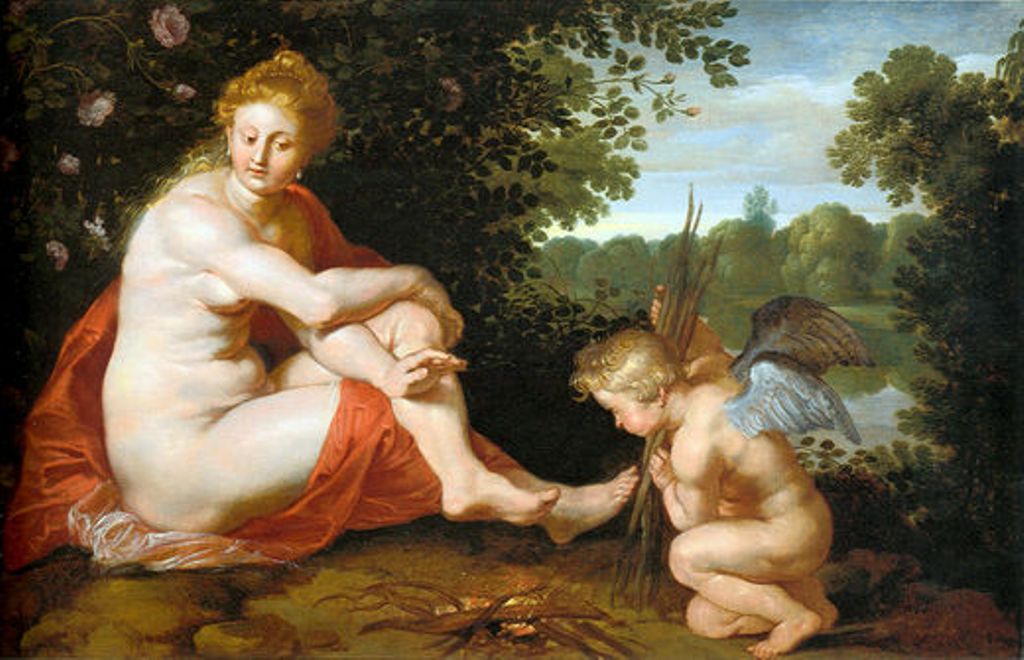
Peter Paul Rubens’s “Sine Cerere et Baccho friget Venus” (1614) is a sensuous allegory in which myth, landscape, and everyday warmth converge around a tiny campfire. The Latin maxim translates as “Without Ceres and Bacchus, Venus grows cold.” In other words: without food and wine—nourishment and conviviality—love itself loses heat. Rubens stages this proverb as an intimate scene on a riverbank. Venus, luminous and monumental, rests beneath a bower of leaves and roses. At her side Cupid crouches, wings folded, feeding a small fire with a bundle of arrows. The painting is witty, tender, and learned, yet it is delivered in the homey language of comfort: flesh catching firelight, a foot extended toward warmth, a child intent on kindling. Few works explain a humanist idea with more immediate, tactile persuasion.
The Humanist Proverb Behind the Picture
The motto “Sine Cerere et Baccho friget Venus” circulated widely in Renaissance and early Baroque Europe, appearing on emblems, prints, and tapestries. Ceres represents grain and the plenty of agriculture; Bacchus stands for wine, celebration, and the social bond. Venus symbolizes desire, beauty, marriage, and generative love. Rubens translates the sentence into theater. Cupid’s arrows—normally instruments that ignite passion—are literally being used as kindling. If love lacks sustenance and festivity, even its weapons become mere sticks for a fire. The sly inversion makes the proverb visible and memorable, fusing erudition with a household truth recognizable to any viewer.
Composition as a Circle of Warmth
Rubens organizes the composition around an invisible circle anchored by the glowing ember at lower center. Venus’s body turns back upon itself, her left arm wrapping her shin and her right hand raised in a gentle, regulating gesture. Cupid crouches opposite, completing a compact loop that keeps our attention close to the coals. Branches arch overhead to form a natural canopy, while the river and distance open to the right, providing airy counterbalance. The circular choreography gathers heat; we feel the warmth swirl between mother and child, body and fire, myth and proverb.
Light, Fire, and the Color of Skin
Light in this painting is triune: the cool day of the distant landscape, the mottled shade under foliage, and the warm irradiation of the fire. Rubens blends them masterfully. Venus’s skin receives a cool sky-reflection along the shoulders and flanks; rosy modulations concentrate where firelight licks calves, knees, and feet; soft green reflections from the surrounding leaves ride the edges of shadow. Cupid’s chubby hands glow amber as he tends the flame, and his wings register subtle, smokey violets. Against the cool greens of the bower, the carmine drapery pooled beneath Venus burns like a fallen ember, a chromatic proxy for the heat of desire that the proverb says must be fed.
Venus Between Monument and Tenderness
Rubens presents a classic Venus—ample, marble-smooth, and architecturally seated—yet humanizes the goddess by giving her a protective, almost maternal attention to Cupid. The tilt of her head, the half-smile that is more watchfulness than display, and the relaxed crossing of her limbs domesticate divinity. She is neither aloof statue nor coquettish nymph. She is a body that feels the chill of shade and the comfort of flame, a goddess who participates in the ordinary physics of warmth. The allegory becomes persuasive because Venus is believable as a person with a circulatory system, not merely an emblem.
Cupid’s Arrows as Kindling
Few visual puns in Rubens are more delicious than the sight of Cupid feeding his own arrows to the fire. It is as if the artist says, “If there is no grain and wine—no daily feast and communal joy—then love’s instruments have no use. Better to warm our feet.” The bundle slants toward the coals in a diagonal that energizes the right half of the picture. The gesture also performs a modest moral: when social bonds are neglected, eros becomes self-consuming. In Rubens’s Antwerp, a commercial and civic powerhouse, the message would have sounded like a hymn to hospitality and abundance.
Roses, River, and the Grammar of Setting
The rose brier blooming behind Venus signals her domain. Rubens paints blossoms at various stages—bud, full flower, and pale decay—suggesting the cyclic temporality of seasons and desire. The river beyond curves languidly past stands of trees, a pastoral world of steady provision. The clearing in which Venus rests reads like an outdoor hearth. By setting the scene in a thriving landscape rather than a mythic palace, Rubens fuses allegory with the everyday countryside known to his viewers, reinforcing the proverb’s practical wisdom.
The Red Drapery as a Thermal and Theological Device
The robe beneath Venus is no mere accessory. Chromatically it provides the painting’s hottest zone of color, echoing the flame and stabilizing the cool greens of the bower. Formally it supports her body like a throne of cloth, lifting her figure so line and light can travel under and around her. Symbolically the scarlet evokes love’s ardor and, in Christian-inflected readings familiar to a seventeenth-century audience, charity. If charity—love active in the world—requires nurture, then the robe’s warmth becomes a theology stitched in silk.
Brushwork that Breathes
Rubens’s handling is a tutorial in material translation. Skin is knitted with long, creamy strokes softened at the transitions, creating a bloom that appears to exhale light. Foliage is busier, composed of broken touches and quick commas that suggest leaves without enumerating them. The fire’s glow is a scumble of orange and umber rubbed into the ground so that it seems to radiate rather than sit on top. Feathers receive fine hatches and glazes that separate the soft down near Cupid’s shoulders from the firmer flight feathers at the tips. The fan of techniques keeps each texture legible and the whole ensemble alive.
The Northern Landscape and Italian Figure
Rubens combines a Flemish love for wet air and dense greenery with the idealized body he studied in Italy. The forms of Venus and Cupid have Roman confidence—their volumes turn like sculpture in light—but the space they inhabit is recognizably Northern. Moisture hangs over the river; leafy silhouettes cut crisply against the sky; the earth near the fire is a brown-green loam rather than a Mediterranean dust. This hybrid registers Rubens’s larger project: to infuse the humanist ambitions of Italy with the climate, commerce, and piety of Antwerp.
The Psychology of Warmth
The painting is animated by a quiet psychology. Venus extends a foot to the heat and raises a palm in a small, regulating gesture, as if to gauge the temperature. Cupid is absorbed, his forehead knitted in practical concentration. There is no erotic urgency or divine pronouncement. The goddess and her child simply collaborate in comfort, and in this domestic collaboration the proverb’s wisdom takes root. Love thrives where people take care to make warmth together.
Allegory Without Pretense
One of Rubens’s great gifts is to keep allegory from hardening into emblematic stiffness. “Sine Cerere et Baccho friget Venus” advances its argument through plausible action, not heraldic attributes alone. There is no carved wheat sheaf for Ceres, no ivy crown for Bacchus. Instead: a small fire; a bundle of wooden shafts; a body that, like ours, is susceptible to chill. The ordinary details transform a Latin maxim into lived truth. Viewers do not merely recognize a proverb; they nod with bodily assent.
Color Harmony and the Logic of Complementaries
The coloristic structure is built on reciprocal pairs. The dominant green of foliage finds its complement in the red drapery. Warm oranges of fire answer the cool blues of distant sky and Cupid’s gray-blue wings. Flesh carries both families of color—cool half-tones and warm lights—making the figures the chromatic bridge between nature and flame. This orchestration ensures that the painting never feels garish; instead it hums with a balanced warmth, as if heated from within.
The Body as Landscape
Rubens often treats the human body as a kind of landscape, with valleys of shadow and sunlit slopes. Venus’s torso is a rolling terrain: the round of the shoulder leads to the hollow at the clavicle, then down a long, luminous thigh to a calf warmed by firelight. Highlights ride these curves like weather. Cupid’s body echoes the terrain in miniature—pudgy knees, a chubby shoulder, a belly pushing softly against his thigh as he crouches. The analogy helps the eye move naturally between figure and setting, converting the viewer’s gaze into a leisurely walk through a summer garden.
A Painting for Dining Rooms and Wedding Chambers
Given its proverb and tender mood, the painting would have been at home in a domestic interior where eating, drinking, and kinship were celebrated. In Antwerp, prosperous households collected allegories that turned humanist learning into household ethics. Hung above a sideboard or near a fireplace, Rubens’s Venus would have smiled upon meals and gatherings, reminding hosts to keep the table generous and the conversation warm. The lesson is gentle but persuasive: feed love—literally and socially—and love will keep you.
The Subtle Erotics of Restraint
The nude is frank but unaggressive. Venus’s pose is closed rather than exhibitionistic; her limbs cross, and her torso twists away from us. The erotic charge resides less in exposure than in the heat that glows where skin approaches flame and where the red cloth touches thigh. Rubens’s restraint is strategic: he keeps the viewer’s attention on the allegory rather than on voyeurism, allowing desire to be understood as a cultivated, social energy rather than a private appetite alone.
Time, Season, and the Promise of Harvest
The roses and lush foliage suggest late spring or early summer, the season when Ceres’s gifts ripen. The river meanders toward fields bathed in afternoon light, promising plenty downstream. By setting the scene at this moment of seasonal promise, Rubens quietly links the warmth of the fire to the larger warmth of climate and community. Love is not an isolated flame; it participates in the rhythms of sowing and reaping, of festival and rest.
The Fire as a Microcosm of Civilization
Even the little blaze is meaningful. It is a domestic fire, not a mythic conflagration. Tinder, twigs, and arrows form its manageable fuel. In emblem books, fire often stands for charity or friendship—heat that comforts rather than destroys. Here, Cupid’s practical tending of the flame becomes a parable of how communities maintain affection: by small, repeated, thoughtful acts. Rubens thus compresses a civic lesson into a child’s chore.
Voice of Antwerp: Prosperity with Purpose
The painting speaks in the accents of its city. Antwerp’s prosperity depended on trade in grain and wine; feasting and hospitality fueled social bonds across guilds and families. A picture that united Ceres, Bacchus, and Venus under the sign of warmth would have resonated as a civic ideal. Rubens, at the heart of this culture, delivers an image that flatters abundance while moralizing it. Plenty is not mere luxury; it is the condition under which love keeps its radiance.
Technique, Ground, and Glaze
The surface reveals Rubens working over a warm ground that supplies a subtle undertone to flesh and foliage. He models forms with opaque passages, then enriches shadow with translucent glazes—browns deepened with tiny touches of blue near the cooler edges, red lakes amplifying heat at knees and cheeks. The fire’s core shows scrapes and scumbles where the brush dragged nearly dry, letting the ground’s warmth sparkle through like embers. Across the bower he softens edges, breathing moist air into the leaves. Technique doesn’t merely describe warmth; it enacts it.
Conclusion
“Sine Cerere et Baccho friget Venus” is a small miracle of Baroque persuasiveness. It compresses a classical proverb into a gentle tableau where a goddess and her child share a flicker of heat. In the glow of that fire Rubens braids humanist learning, domestic tenderness, civic pride, and painterly delight. The lesson feels less like doctrine than like hospitality: keep the table set, pour the wine, tend the flame, and love will not grow cold. Four centuries on, the painting still warms the room in which it hangs—and the viewer who lingers before it.