Image source: wikiart.org
Introduction
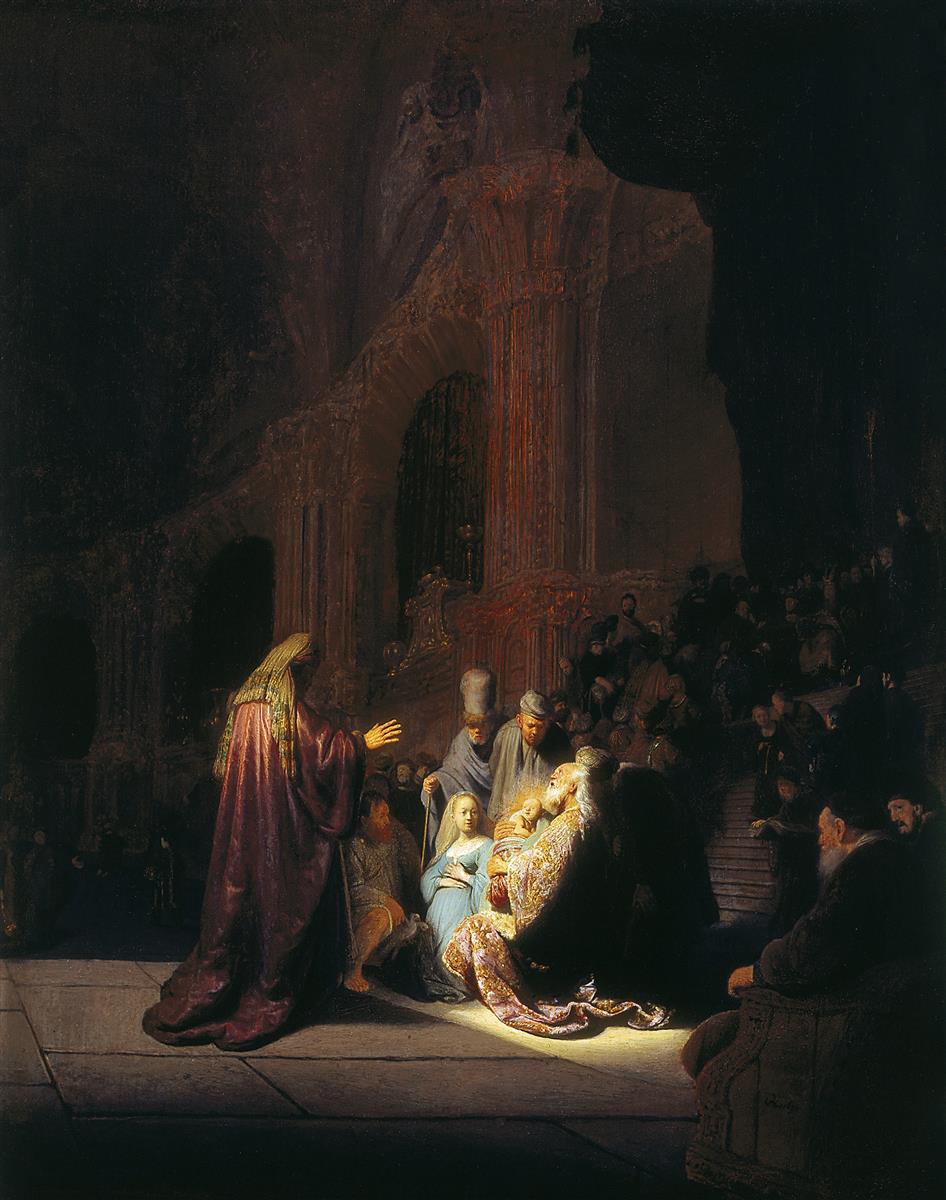
Rembrandt’s “Simeon’s Song of Praise” (1631) is an early masterwork that condenses narrative, theology, and stagecraft into a single beam of light. In a vast, dim interior—part temple, part theater—a circle of figures gathers around a child. At the center, the aged Simeon cradles the infant Jesus and, in words from the Gospel of Luke, blesses God that his eyes have seen salvation. Everything that matters is choreographed by illumination: the baby’s face, Simeon’s parted lips, the astonished tenderness of Mary, and the attentive gravity of those who witness the scene. The surrounding darkness is not emptiness; it is a resonant chamber that turns light into music.
The Biblical Moment And Its Human Scale
Luke’s narrative is brief: Mary and Joseph bring Jesus to the Temple; the devout Simeon, promised by the Spirit that he would not die before seeing the Messiah, recognizes the child and sings his “Nunc Dimittis”—“Lord, now lettest thou thy servant depart in peace.” Rembrandt chooses the instant when gratitude becomes speech. Simeon kneels, body bent by age yet buoyed by revelation; the infant lies secure in his arms; Mary and Joseph lean in close. No angels appear. There is no gilded inscription. The miracle is intimate and human, unfolding in the space of a family circle that happens, by grace, to be the world’s hinge.
Composition As A Theater Of Light
The painting’s architecture is a masterclass in staging. The immense temple rises like a carved cliff of pillars and galleries, all dissolved into dusk. Against this, the figures gather at lower left on a plane of stone slabs, their semicircle drawn by light as by a compass. The eye travels from Simeon’s luminous profile to the baby’s small face, to Mary’s blue presence, to the priest behind her, and then spirals outward through ranks of spectators ascending steps into shadow. A standing figure at left, arm extended in blessing or wonder, counterbalances the kneeling group and guides our gaze back toward the radiant center. The compositional flow is musical: a solo voice supported by choir and architecture.
Chiaroscuro As Theology
Rembrandt’s early chiaroscuro is bold yet nuanced. A strong, directional light falls from high left, striking the baby’s linen and Simeon’s forehead before pooling on the stone and climbing the folds of Mary’s dress. This light does more than describe surfaces; it interprets the story. It reads as grace made visible—selective, clarifying, and generous. The surrounding darkness is equally eloquent. It holds the city, the temple’s bureaucracy, and the anonymous watchers in a murmur of half-tones, acknowledging a world larger than the event but momentarily secondary to it. Light, in other words, is meaning.
The Faces: Speech, Attention, and Wonder
Simeon’s head is the painting’s emotional engine. Creased brow, parted mouth, and wet, gleaming eyes register not the shock of the unexpected but the relief of a promise kept. His expression is less ecstasy than fulfilled patience. Mary’s response is quieter: she leans forward with a sober attentiveness, as if tracing Simeon’s words across her child’s face. Joseph, half-shadowed, is protective and listening. The priestly figures behind them display a spectrum of reactions—curiosity, caution, calculation—so that the scene reads as a public event with private significance. Rembrandt does not crowd the foreground with faces; he leaves space between heads so that each thought can breathe.
Fabric, Metal, and the Physics of Presence
The material world anchors the vision. Simeon’s robe, heavy with brocade, is painted with a luxuriant mosaic of reds and golds that catch light like scales, then dissolve into shadow where the fabric turns. Mary’s garment, by contrast, holds a cooler, quieter blue that acts as a tonal refuge amidst the warm theater. The stone pavement at their feet reflects light upward, giving the figures a gentle underglow and setting their bodies solidly in space. Rembrandt’s handling of these textures is expressive rather than descriptive: material truth is never an end in itself but a means to make the holy legible as touch and weight.
The Temple As Moral Atmosphere
While the building’s details fall away into shadow, Rembrandt gives just enough architecture to make scale palpable: a colossal pier, a high arch, a distant organ grill, and winding steps crowded with onlookers. This vastness shrinks the humans at its base, underscoring the audacity of Simeon’s claim. Yet the light ignores grandeur and selects humility. The temple becomes almost geological—a cavern of human custom and time—within which a single beam announces the event that will reorder history. Architecture here is character; it embodies the old covenant’s solemn mass as it bears witness to the new.
The Crowd: Choruses Of Witness
One hallmark of Rembrandt’s narrative painting is his treatment of bystanders. They are not filler; they are readers inside the image who teach us how to look. On the steps, clusters of men lean forward, whisper, crane their necks, or turn to neighbors. Some appear skeptical; others are caught in the magnetism of light. In near shadow at the right margin, a seated figure—perhaps a scholar or elder—pauses in thoughtful distance, a self-portrait of contemplation. This spectrum of witness prevents the scene from collapsing into devotional cliché; the painting includes doubt, curiosity, and routine alongside revelation.
Time Staged As Light
Rembrandt implies time not with clocks but with the movement of light across bodies. The glow that climbs Simeon’s brow and cheek suggests speech unfolding; the infant’s face, fully lit, is a present tense that will soon pass; the light on Mary’s lap is slower, as if prophecy were gradually being received. Even the stone’s reflective pool feels temporal, as if the moment will fade back into gray once the song is complete. This staging of temporality through illumination is a signature Rembrandt invention: a way to make narrative happen without gesture.
Color And Temperature: Warm Mercy, Cool Faith
The palette balances warm and cool with theological intelligence. Simeon’s robe and the gilded architecture behind him vibrate with red-brown warmth; Mary’s blue gathers the scene’s cooler half-tones into a quiet, trustworthy center. Joseph’s olive and the priests’ muted grays mediate between them. The baby’s linens, pearly and bright, read as the color of promise rather than of display. These relationships feel inevitable: mercy warms, faith steadies, and the child binds both without strain.
Brushwork: From Jewel To Whisper
On close viewing the surface reveals a dazzling range of touch. Rembrandt stacks small, impasto highlights on Simeon’s embroidered sleeve and the pendant on his chest so they catch actual light. Faces are knit with soft, fused strokes that preserve the subtlety of skin under changing radiance. Distant architecture is laid in with scumbles and dry drag, allowing the weave of the canvas to flicker through like dust in a shaft of sun. This symphony of handling keeps the eye constantly recalibrating, as if moving from jewel to breath to stone within a single gaze.
The Ethics Of Scale
“Simeon’s Song of Praise” is not huge, yet it feels monumental because scale is achieved by contrast. The tiny baby anchors a vortex of attention. The temple’s mass is implied rather than cataloged, so the imagination expands it. The crowd reads as countless because Rembrandt paints only types and silhouettes where specificity would deaden the effect. Most importantly, the light is scaled: pinpoint bright at the child, broader across Simeon and Mary, and then dissipating into the room. This ethical scaling ensures that the miracle is not drowned in spectacle.
Dialogue With Early Rembrandt
The painting stands among Rembrandt’s earliest large religious works, kin to the 1631 “Presentation in the Temple” variants and to the quiet domestic visions from the same year. It already displays traits that will define his mature storytelling: the centrality of light as interpretation, the dignity of age, the sympathy for bystanders, and the refusal of theatrical angels. Compared with his Leiden history pieces, this work is less crowded, more architectural, and far more psychologically economical. The young painter has learned to subtract.
Simeon’s Gesture And The Shape Of Blessing
The gesture language is minimal and powerful. Simeon’s left hand cradles the child; his right opens across his heart and toward the light, a bridge between gratitude and proclamation. The standing figure at left answers with an echoing extension, creating a visual antiphon. Mary’s hands are folded in a knot of guarded tenderness. No one performs a flourish, and that restraint holds the scene close to life. The blessing’s shape is quiet, almost domestic, which makes it more believable.
Sound Made Visible
Because the subject is a song, Rembrandt faces the painter’s problem of rendering sound. He answers by letting light and posture become acoustics. The illuminated circle functions like a stage; Simeon’s head is tipped back just enough to suggest breath; the surrounding figures lean in with the hush of listening. The steps, crowded with small silhouettes, read as rows of a choir loft. Even the gold organ grill in the background nods toward music without literalizing it. We do not hear a note, yet the painting is filled with listening.
Theology Of Fulfillment, Not Conquest
Rembrandt’s choice to center an aged man speaking gently rather than a triumphant hero is theologically pointed. The painting is about fulfillment—promise kept, eyes satisfied—not about force. Simeon’s frailty embodies a paradox: true strength appears in weakness, true victory in a blessing that releases rather than seizes. This theological mood harmonizes with the Dutch Protestant culture of Rembrandt’s patrons, but it also reads universally as an ethic of quiet completion.
The Viewer’s Place In The Temple
Where do we stand? The composition places us just within the light, at the edge of the circle, close enough to see tiny details of Simeon’s robe and Mary’s face, far enough to feel the weight of the vaulted dark behind us. We are both participant and witness, neither on the steps with the crowd nor enthroned among officials. The painting thus invites a mode of viewing that is respectful, attentive, and contemplative—an echo of the attitudes modeled within it.
Process, Revisions, And The Living Surface
Rembrandt’s way of working—composing broadly on the panel, searching with mid-tones, then striking highlights late—leaves traces. Pentimenti around hands and heads suggest small adjustments that clarified relationships as the illumination evolved. These changes do not read as indecision; they are the record of thought honing its focus. The living surface reminds us that revelation in art, like revelation in the story, arrives by degrees.
Why The Picture Still Feels Contemporary
Modern viewers recognize in this painting a visual intelligence that transcends period costume. Its dramatic lighting anticipates cinema; its crowd psychology feels journalistic; its respect for silence amidst spectacle offers a counter-model to noisy images. Above all, its center is a moment of recognition—an elderly person holding a child and understanding something decisive—which is a human structure of feeling that needs no translation.
Conclusion
“Simeon’s Song of Praise” is an oratorio in oil. The temple’s darkness hums like low strings; the crowd is a mixed chorus; the solo line rises from Simeon’s illuminated face and resolves on the small bright note of the child. Rembrandt achieves all this with the simplest means: concentric attention, a disciplined beam of light, and a compassion for human faces that refuses cliché. In 1631 he declared, with this canvas, that history painting could be intimate without losing grandeur and that theology could be painted as light falling on skin.