Image source: wikiart.org
Introduction
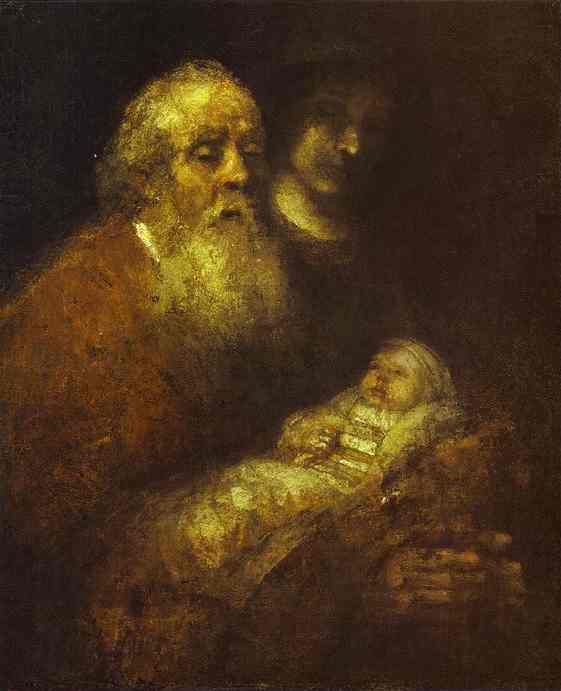
Rembrandt’s “Simeon in the Temple” (1669) is a work of quiet radiance and inward drama, painted at the very end of the artist’s life. In a dark, undefined interior, an old man with a flowing beard cradles an infant whose swaddled body carries the painting’s only concentrated brightness. Behind the elder’s shoulder a second adult emerges in penumbra, a witnessing presence that deepens the scene’s intimacy while guarding its mystery. Rather than staging a grand procession within the temple, Rembrandt compresses the biblical moment to a small island of light and breath: the aged Simeon recognizing the Christ child and releasing, at last, a lifetime’s hope. The painting is not theatrical; it is devotional in the best sense, a confession conducted through paint.
The Gospel Moment And Its Human Weight
The story comes from the Gospel of Luke: the aged Simeon, promised by the Holy Spirit that he would not die before seeing the Messiah, encounters the infant in the temple. Taking the child in his arms, he offers a prayer of release and blessing—“Now lettest thou thy servant depart in peace.” Rembrandt chooses the instant when prayer becomes recognition. Simeon’s mouth is parted as if the first words of gratitude are forming, and the child rests quiet in the old man’s arms, the fragile center around which the entire painting turns. By reducing the cast and circumventing architectural spectacle, Rembrandt makes the event legible as an interior revelation. The temple is less a building than a state of attention.
Late Style And The Courage Of Restraint
Painted in 1669, the canvas belongs to Rembrandt’s last, most distilled period. Ornament gives way to presence; color to temperature; line to touch. The surface is a weave of thin veils and fat, luminous passages that never flaunt virtuosity yet continually reward close looking. The unassertive background allows the figures to advance with a gravity that feels both ordinary and immense. This late language was forged through a lifetime of loss, success, and work; it is the maturity of a painter who trusts a few, necessary incidents of light more than any quantity of detail.
Composition And The Architecture Of Tenderness
The composition forms a gentle arc from Simeon’s illuminated forehead down through his beard to the diagonal cradle of the child. That motion creates a visual path from recognition to fulfillment. The background figure—likely Mary, though the identification remains purposefully soft—completes the triangle and stabilizes the scene without distracting from its core. The spatial depth is shallow, like a murmured conversation in a dim chapel; bodies float close to the picture plane, as if the viewer stood within arm’s reach. The canvas is organized to sustain stillness. Everything funnels toward the meeting of elder and infant, making the picture a chamber for blessing.
Light As Blessing And Witness
Light, in Rembrandt’s last decade, behaves as a moral presence. Here it arrives from the left and settles first on Simeon’s brow and beard, then descends to the child’s swaddling, which glows like a small hearth in the dusk. The witness behind them shares a modest share of illumination—just enough to be felt as companion, not judge. Darkness is not hostile; it is the medium that allows light to sound clearly. The painting’s luminosity therefore reads less like an optical effect than an act of recognition. The light blesses what Simeon blesses. It is both witness and answer to his prayer.
Palette, Temperature, And Tonal Music
The palette is narrow and perfectly tuned: deep browns and olive blacks for the room’s air; warm, resinous reds and russets for Simeon’s garment; a network of ochers and subdued whites for the flesh and cloth. Because chroma remains restrained, temperature does the expressive work. Warmth gathers around Simeon’s head and hands, and around the infant, while cooler grays whisper at the witness’s face and within the recesses of the room. These small shifts of temperature make breathing palpable. The hues never clang; they sing like a low choir around a single clear note of light.
Brushwork And The Intelligence Of Matter
One of the pleasures of the painting is how frankly it shows its making. Simeon’s beard and garment are laid with sticky, lifted paint that catches actual light; the child’s wrappings combine thin, translucent veils with creamy impastos that feel as soft as fabric. The witness’s face is suggested with fewer, softer touches, so that identity is more felt than described. The background is a field of scumbles and half-erased strokes, a living dusk that keeps the figures from becoming cutouts. Paint itself becomes a theology of incarnation: body and light disclosed through the physicality of pigment.
Simeon’s Face And The Poetry Of Age
Simeon’s face carries the story without speech. The eyes glisten but are heavy; the mouth opens as if prayer has turned into breath; the forehead holds a tender, luminous fatigue. There is no theatrical ecstasy; there is release. Rembrandt’s sympathy for age is always unsentimental and unsparing. Wrinkles form not as caricature but as paths along which light can travel. The old man’s features bear the history of hope and disappointment now gathered into fulfillment. If the child signifies promise, Simeon signifies experience transfigured—not erased—by grace.
The Christ Child And The Center Of Gravity
The infant dominates the image without moving. Rembrandt resists sweetening the face; it remains small and serious, aware without precocity. The swaddling bands, gently streaked with pale pigment, create the brightest plane in the painting, and the baby’s body forms the fulcrum around which Simeon’s hands curve. The effect is gravitational. The old man inclines toward the child; the witness inclines toward them both; even the field of light seems to bend inward. Theology here is embodied: salvation is held, not argued.
The Witness In Shadow
Behind Simeon, a shadowed adult gazes toward the scene. The features are softened by distance and darkness, allowing multiple readings—Mary, Anna the prophetess, or a pious bystander whose presence finishes the community needed for liturgy. Whoever it is, the figure’s role is to accompany rather than to draw attention. The profile catches just enough light to make solidarity visible. In doing so the painting avoids solipsism. Even in moments of intimate revelation, community is present.
Hands, Touch, And The Grammar Of Blessing
Rembrandt’s hands always speak. Simeon’s are broad and gentle, the fingers splayed to guard the child’s small weight. Their warm highlights and softened knuckles convey history—labor, longing, the steadiness of someone who has waited well. The child’s hands are barely visible, contained within the wrapping, a theological whisper that the power held here is not yet unfolded. The witness’s hands remain vague, perhaps clasped, a posture of reverent attention. Touch organizes meaning across the canvas: to hold is to bless; to witness is to consent.
Space, Setting, And The Poetics Of The Indeterminate
Viewers searching for architectural specificity will not find it. The temple is a zone of tonal atmosphere rather than marble. That choice universalizes the story and prevents antiquarian distraction. A few suggestions of structure—a ledge, a dark pillar, the press of shadow—create enough room for bodies while maintaining the painting’s devotional privacy. The indeterminacy is not neglect. It is a way of saying that this encounter can occur wherever there is attention and light.
Technique, Layers, And Time In The Surface
The painting’s stratigraphy reveals the sequence of decisions. A warm ground sets the tonality. Over it, Rembrandt places broad middle values to map garments and faces. Semi-opaque flesh tones arrive next, kept malleable so transitions remain humanly soft. Impastos lift the highest lights along beard, forehead, and bands of swaddling, while thin glazes cool the shadows behind the witness and under Simeon’s chin. Edges soften into pentimenti where the artist rethought contours—proof that the image was discovered rather than merely executed. The surface holds time like a memory: earlier touches remain under later ones, just as earlier hopes are carried into Simeon’s present joy.
Theological Themes Without Preaching
The painting communicates faith without emblematic clutter. There is no scrolling text, no ceremonial architecture, no chorus of angels. Instead, the canvas offers three themes through sight alone. Fulfillment appears in Simeon’s face and posture—the arrival of what was promised dissolving anxiety into gratitude. Incarnation appears in the weight of the child and the way light inhabits flesh and cloth. Community appears in the presence of the silent witness, whose attention models how viewers might stand before the mystery. Rembrandt trusts the viewer to feel these themes rather than to be instructed by them.
Resonances With Rembrandt’s Last Year
It is difficult to separate the painting from its date. 1669 was Rembrandt’s final year, a season of distilled calm after decades of turbulence. The subject of release—“now lettest thou thy servant depart in peace”—must have carried a personal echo. Yet the picture does not collapse into elegy. Its mood is not sorrow but completion. The gentleness of the light, the refusal of spectacle, and the tender steadiness of touch all suggest an artist who has arrived at clarity through experience and work.
How To Look At The Painting
The image rewards slow viewing. From across the room, the picture reads as a candlelit island in a sea of brown dusk. At conversational distance, faces open into soft halftones and the child’s wrappings begin to sparkle with tiny peaks of paint. Lean close to the beard and garment to see sticky impastos that physically catch the light; step back again to watch matter resolve into presence. Let your gaze move in an ellipse—Simeon’s face, the infant, the witness, back to Simeon—so that the painting’s pulse, which is the movement of attention around blessing, becomes palpable.
Legacy And Continuing Relevance
“Simeon in the Temple” remains compelling because it shows how a vast idea—hope fulfilled—can be carried by the smallest, most human gestures. Artists have learned from its restrained palette, its courage to leave darkness unfilled, and its reliance on touch to carry meaning. Viewers find in it a template for patience in an impatient age. It honors the quiet moment when understanding arrives not as argument but as recognition, when the world does not change but one’s way of being in it does.
Conclusion
In “Simeon in the Temple,” Rembrandt transforms a biblical episode into an intimate revelation rendered with almost nothing: a few faces, a pair of hands, a sleeping child, and light that behaves like grace. The temple is everywhere and nowhere; speech is about to begin but is not needed; the paint itself—thick where life blooms, thin where shadow gathers—enacts the theology it depicts. The elderly Simeon cradles the future and, in doing so, finds his own peace. The viewer, admitted to this quiet chamber, receives the same invitation: look steadily, consent to the light, and let the heart be released.