Image source: wikiart.org
Introduction
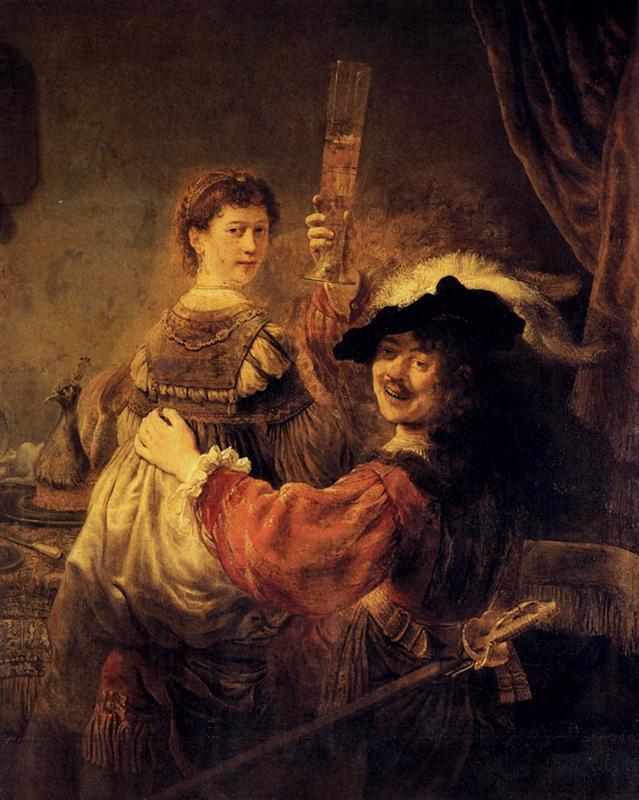
Rembrandt’s “Self-Portrait with Saskia in the Parable of the Prodigal Son” (1635) is a dazzling fusion of love picture, biblical meditation, and bravura self-advertisement. Painted early in the artist’s Amsterdam career, it shows Rembrandt and his young bride Saskia seated in a tavern interior, raising a tall Roemer glass amid rich fabrics, silverware, and a partially glimpsed feast. At first glance the work reads as an exuberant genre scene, a celebration of youth and prosperity. Yet the title anchors it to Luke’s parable of the prodigal son, who squandered his inheritance in “riotous living” before returning home repentant. Rembrandt folds himself and Saskia into that narrative, not as a literal confession but as a playful, consciously staged identification with the prodigal’s moment of worldly abandon. The result is a complex image where delight and self-awareness mingle, where painterly luxury carries moral resonance, and where the pleasures of marriage become the lens through which an old story is retold.
A Portrait Historié: Why the Parable Matters
Amsterdam’s elite loved “portraits historiés,” likenesses cast as figures from literature or scripture. The device allowed sitters to display culture while playing at theater. Rembrandt, recently married and flush with commissions, smartly adapts the device to a self-portrait. Rather than don a solemn biblical costume, he translates the prodigal’s “far country” into a Dutch tavern and refuses to disguise his own identity. His broad-brimmed hat with white feather, gleaming sword hilt, and ruby-toned slashed sleeve present an irresistibly worldly Rembrandt, a man who knows how to paint silk and laughter with equal conviction. Saskia, turned three-quarters toward the viewer while lifting the slender glass, plays the companion in joy—wife, muse, and co-actor. The narrative frame grants permission for the sumptuousness while forestalling moral panic: yes, this is pleasure, but it is pleasure observed and narrated, not unexamined folly.
Composition: A Spiral of Attention
The design is built on a spiral that begins at the lower right in Rembrandt’s hand resting on Saskia’s waist, rises through her torso to the lifted glass, loops back to his smiling face, and then descends across his red sleeve to the table of silver and pewter. This revolving pathway is energized by diagonals—the long rapier tilting forward, the curve of Saskia’s skirt, the arc of the feather—which pull us into the room and return us to the couple. The background remains soft, almost smoky, with a curtain at upper right acting like a theater drape. That curtain announces the scene’s self-conscious performance, while the dimness preserves intimacy. Rembrandt, master of pictorial traffic, makes sure every element points us back to eyes, glass, and gesture.
Chiaroscuro as Festive Drama
Light in the painting is celebratory rather than severe. A golden glow falls from the left, striking Saskia’s forehead, the glass stem, and the froth within the goblet, then splashing across Rembrandt’s cheek and sleeve before dissolving into warm shadow. This glow turns everyday surfaces into actors: the varnished wood of the table brightens, the silk puffs of Rembrandt’s sleeve take on topographical highlights, the ostrich feather smolders. Unlike the high-contrast tragedies of Rembrandt’s slightly later years, the chiaroscuro here has the temperature of lamp-lit conviviality. It clarifies rather than chastens, making the feast visible while hinting at the surrounding darkness of the unpictured world.
The Double Portrait: Intimacy and Display
As a likeness of two people who had only recently married, the painting speaks with affectionate humor. Rembrandt grips Saskia by the waist with a familiar, almost teasing hand; Saskia, balanced and elegant, accepts the embrace but claims her own agency through the lifted glass and direct, appraising look. Their gazes diverge: Saskia’s eyes meet ours as if to include us in the toast; Rembrandt looks outward past the picture edge, laughing, as though catching the eye of a companion or of his own reflection in a mirror. The double portrait thus oscillates between intimacy and display, private pleasure and public performance—a tension perfectly matched to the parable’s moral about seeing oneself truly after a season of spectacle.
Costume and Texture: The Orchestra of Material
The work is a tour de force of material description. Rembrandt’s glowing red sleeve is built with thick, elastic paint; satin catches highlights in cresting bands, then collapses into velvet shadow. The black felt hat eats light while the feather releases it in wisps. Saskia’s bodice and apron are described with softer, cooler tones, their textures read through the carefully placed lights on seams and laces. Metalware on the table—ewer, plate, the stem of the glass—gleams with a few high, hard strokes of lead white and pale yellow, demonstrating the painter’s control of specular highlights. In 1635 Rembrandt is at the height of his tactile imagination: he wants the viewer to feel polish, nap, stiffness, and liquid as if the eye had fingertips.
The Roemer Glass and the Theater of Wine
The tall, slender glass is a small column of narrative. It rises like a beacon at the painting’s center, its thin walls catching and bending light, its bubbled stem glinting. Dutch still-life painters treated such glassware as tests of skill; Rembrandt incorporates the challenge into a figure painting. The level of wine within the bowl is carefully pitched—neither full nor empty—symbolically poised between appetite and moderation. In the parable the prodigal spent his inheritance “with harlots”; here the stage props remain euphemistic. Wine stands in for loosened restraint, extravagant sleeve for excess, laughter for forgetfulness. Yet the glass is also a toast to marriage and to artistry. It refracts the painter’s light, just as Saskia refracts and completes his world.
Biblical Allegory without Preachiness
Rembrandt’s great strength as a storyteller is his refusal to reduce complex emotions into moral signage. He does not paint the prodigal’s repentance or the father’s embrace—those would come in other works or other artists’ hands. Instead he pauses at the carnival edge of the story, when desire feels like destiny. By casting himself and Saskia in this role, he invites a double reading. On one level, the picture is a wink: “We play at being prodigals, knowing the story’s end.” On another, it’s a sincere meditation on how easy it is to mistake good fortune for inexhaustibility. That duality keeps the painting from turning coy or didactic. It trusts viewers to carry the parable in their heads while enjoying the tangible present of paint.
The Self-Portrait as Announcement
This canvas also works as a public announcement of Rembrandt’s arrival in Amsterdam. The artist presents himself as exuberant, technically fearless, and socially plugged into fashions of masquerade and merry company. The sword and feather speak to swagger, the brilliant sleeve to painterly flourish, the laughter to charm. Yet within the showmanship lies self-knowledge. The very act of painting oneself as the prodigal already contains the seed of critique. Rembrandt is both subject and author, reveler and moral witness.
Psychological Nuance: The Two Faces of Joy
Look long at the faces and two registers of joy emerge. Rembrandt’s is overt—open-mouthed, dimples caught, eyes bright with amusement. Saskia’s is cooler, luminescent, composed. She does not mirror his grin; she steadies it. This balancing of temperaments complicates the reading of the couple as merely drinking companions. They are partners with complementary energies: his expansive gesture wraps around her; her measured, poised presence faces the world. The painting’s warmth depends on this duet rather than on any single expression.
The Table Still Life: Appetite and Order
At lower left Rembrandt arrays knives, pewter dishes, and a plump sack—perhaps a purse or food parcel—without fussy inventory. These objects extend the narrative of appetite while keeping a Dutch sense of order. The blades are sheathed or set down safely; the table is crowded but not chaotic. As in many Dutch interiors, abundance is acknowledged but contained. The prodigal’s “riotous” becomes Rembrandt’s “plentiful and well-lit,” more human treat than moral collapse.
The Curtain and the Art of Staging
The heavy drape at the right edge is a familiar baroque device, a reminder that pictures are stages. Here it tucks the pair into a cozy alcove and thickens the air with a sense of theater. Pull it aside, and we might see a larger hall or other revelers; drop it forward, and the scene becomes a private booth. The curtain also frames Rembrandt’s head with a halo-like ring of white feather, a painterly joke that doubles as a compositional emphasis. This is a picture that knows it is a picture, and the curtain is its wink.
Color: Honeyed Golds and Festive Reds
The palette is a consistent Rembrandtian harmony: honeyed golds, umbers, and burnt siennas set against cooler blacks and silvers, animated by the high keyed red of the sleeve. The golds create the tavern’s warm microclimate—the temperature of aged wood and candlelight—while the red sleeve supplies the shot of celebration. Saskia’s costume belongs to the golden register, which melds her with the room’s light; Rembrandt, in black and red, punctuates that amber field with accents of performance.
Touch, Impasto, and the Pleasure of Paint
Few seventeenth-century painters exploited the physicality of paint as sensually as Rembrandt. In this work you can sense the knife or loaded brush laying down peaks for the feather, the drier scumble that softens Saskia’s sleeve, the wet-into-wet blending around cheeks that makes skin feel supple. These varied applications are not mere display; they create a gallery experience that shifts as you move. The sparkles of impastoed highlight catch real light, making the feast look animated by your presence.
The Work within Rembrandt’s Marriage Imagery
Seen alongside “Saskia in Arcadian Costume,” “Saskia at the Window,” and the many etchings of her in domestic dress, this painting occupies the register of public joy. Where the drawings savor quiet intervals, here Rembrandt puts love on a stage of abundance. That range—private hush to merry clink—creates a composite portrait of partnership. It tells us that their early years contained both intimate routine and exuberant display, that marriage could be both a still room and a banquet.
The Viewer’s Invitation
By turning Saskia toward us with the glass raised, Rembrandt makes the viewer a literal guest. The cheers is for us as much as for him. The lower table edge, parallel to the picture plane, functions like a proffered surface on which we might set our own cup. This hospitality counters the parable’s cautionary edge: even as we recall the prodigal’s mistakes, we are welcomed into a convivial present tense. The painting proposes that moral reflection and pleasure are not enemies; they can pass the glass between them.
Time, Memory, and Afterglow
From the vantage of Rembrandt’s later hardships, the painting reads with added poignancy. The prosperity it celebrates would become precarious; the marriage would end with Saskia’s early death. None of that future is present in 1635, but the canvas nonetheless carries a temporal undertone. Foam in the glass will fall; laughter will fade; lamps burn down. Rembrandt’s genius is to let this knowledge hover without marring the glow. The moment remains complete in itself, a bright coin from youth that memory can turn over and over.
Reception and Legacy
For centuries the work has charmed viewers precisely because of its tightrope walk between allegory and life. It has been read as braggadocio, as confession, as celebration, and as advertisement. The variety of readings testifies to its flexibility. Contemporary audiences relish its unembarrassed pleasure while recognizing the self-irony folded into the biblical title. And painters continue to learn from its orchestration of textures: how a sleeve can anchor a composition, how a glass can be a plot, how a smile can carry light.
Why the Painting Still Feels Immediate
Despite its seventeenth-century costumes, the scene is legible today without gloss. A couple poses playfully with a drink; the room glows; the camera—here, the painter’s eye—catches the instant. The immediacy comes from honest bodily cues: the hand at the waist, the tilt of the glass, the sparkle on teeth, the loosened ribbon. Nothing is stiff; everything breathes. That vitality, amplified by Rembrandt’s handling of paint, keeps the canvas close to us.
Conclusion
“Self-Portrait with Saskia in the Parable of the Prodigal Son” distills the fizz of Rembrandt’s early Amsterdam years into a single, generous image. It is at once a conjugal toast, a virtuoso show of materials, a sly engagement with scripture, and a strategic self-presentation. The painting invites us to enjoy its banquet of light while remembering the story that shadows it. In that balance—joy conscious of its own edges—Rembrandt speaks across centuries with humane eloquence. He raises his glass, Saskia meets our eyes, and for a long moment the room is warm enough for everyone.