Image source: wikiart.org
Introduction
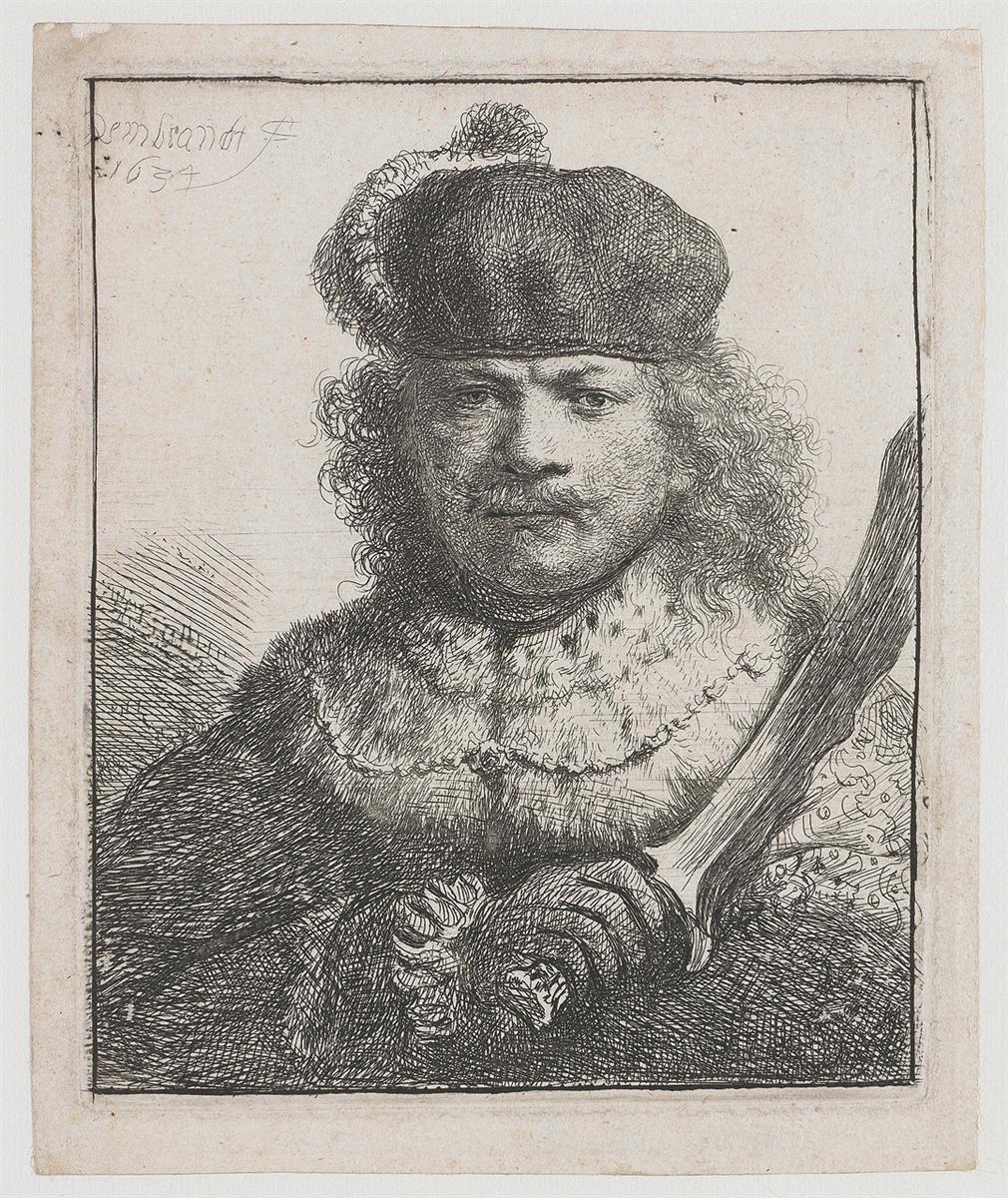
“Self-portrait with Raised Sabre” from 1634 is one of Rembrandt’s most theatrical etched self-images, a small copperplate that explodes with swagger. In it, the young artist thrusts himself forward in half-length, gripping an enormous curved blade that arcs up the right margin like a bolt of light. A furry cap rides the crown of his head, ringlets flare at the edges, and a rough, pelted collar pushes out toward the picture plane. The face meets us frontally, the eyes alert, the mustache firm, as if we have arrived at the instant just before a boast or a laugh. Although the print is intimate in scale, it projects across centuries with the stage presence of a poster. It is Rembrandt demonstrating how far etched line can carry drama, character, and play.
Historical Moment
The date 1634 places this print at a hinge in Rembrandt’s life. Having left Leiden for Amsterdam, he was newly married to Saskia van Uylenburgh and establishing himself among burgher patrons. He had already mastered narrative painting and portrait commissions; etching was his parallel arena, a medium that allowed fast, experimental statements to circulate widely. In these years he made a remarkable sequence of self-portraits—some deadpan, some comic, some introspective, some in flamboyant role-play. “Self-portrait with Raised Sabre” belongs to the flamboyant branch. Where other prints offer the artist in a soft cap or with inquisitive calm, here he tries on the persona of brash mercenary or stage cavalier. The series as a whole charts a young painter testing the elasticity of the self in public, using copper as a mirror that answers back.
Medium and Technique
The portrait is executed as an etching, the process in which a copper plate is coated with a resist, drawn into with a needle, and bitten by acid to incise the lines. Rembrandt’s line in this print is incisive and varied. He balances dense cross-hatching with long, curved sweeps; short, scumbled strokes with polished, unbroken contours. The sabre itself is defined by a clean, confident outline whose thickness swells and thins to suggest a blade catching light. The furry collar is built from compact, directional marks that simulate the bristling of pelt. The cap is mapped with tight, parallel hatching that reads as nap and shadow, and the hair around the temples springs into quick loops that dissolve into air. The face gathers all these strategies, using short, curved hatches to turn cheek and brow, tiny hooks to vitalize eyelids and nostrils, and a few bold sweeps to secure jaw and mouth. The overall effect is bravura without clutter: every patch of line has a purpose, and line density becomes tone, texture, and temperature.
Composition and Cropping
Rembrandt composes the figure as a compact wedge thrusting diagonally from lower left to upper right, culminating in the sword. The left half of the plate is weighted by the mass of cap and hair; the right half is opened and energized by the sabre’s arc. The hands cross near the center, the gloved knuckles modeled with deep, bitten shadow, gripping hilt and scabbard as if the print itself were a stage where force must be anchored. The head is placed high, the eyes slightly above the centerline, so that the gaze meets ours assertively. A narrow band of open paper at the top left holds the faint signature and date, a whisper amid the noise of lines. The tight, box-like border of the plate accentuates the sense that the figure is pressing out of its frame, eager to step into our space.
The Raised Sabre and the Theatre of Role
The most striking element is the sabre. It is not a practical accessory for a studio day; it is a prop, a piece of theatre. By grasping it, Rembrandt recruits a centuries-old language of valor and bravado, a code that Northern printmakers and painters had used to inflate an image with heroism. But he does not merely borrow the code; he tests how it behaves in a small, personal print. The raised blade divides the composition like a lightning stroke and introduces the only long, simple contour in a field of busy hatching. That simplicity turns the weapon into a conductor of light and a metronome for the eye’s travel. Its curve pulls us out of the hatching storm and back into the face, creating a duet between instrument and performer. The saber’s presence is less a threat than a flourish, like a dancer’s cane or a comedian’s prop—an emblem of role-playing that advertises the artist’s freedom to be many things on copper.
Costume, Texture, and Material Truth
The cap, collar, and glove are as crucial to the performance as the sword. The cap’s soft dome is studded with a tassel, its edges marked by broken lines that indicate seams and wear. The fur collar is a tour of tactile drawing: short strokes lie in the direction of the pelt, then switch orientation to catch the light, while scattered dots suggest guard hairs and irregularities. These marks are not a literal inventory; they are a behavior, line acting like fur. The glove is constructed with bold cross-hatching to assert thickness, and the compressed folds at the wrist imply a tight grip. In 1634 Rembrandt had already learned that when materials behave convincingly on the plate—steel glinting, fur bristling, leather creasing—the viewer accepts the fiction of role instantly.
Light Drawn with Silence
Etching carves darks; light is the paper left alone. Rembrandt exploits this fact ruthlessly. He leaves broad, open fields at the top and right so that the raised sabre and the white edge along the cheek blaze against emptiness. The highlight on the blade is truly nothing—just saved paper—yet it reads as gleam because all around it the line swarms. On the face, he builds halftones by widely spaced strokes, letting the bright ground carry the warmth of skin. Under the cap brim, tighter hatching deepens the eye sockets without losing moisture in the gaze. The orchestrated alternation of ink and uninked paper transforms the small sheet into a chamber of light, a classic Rembrandt maneuver made with the fewest means.
Expression and Psychological Temperature
The face does not roar. It regards us with steady, almost amused seriousness. The lips are closed, the mustache smoothed, the pupils clear. There is a glint of challenge in the symmetry of the gaze, but not aggression. The overriding mood is self-possession, the confidence of an artist who knows he can conjure a persona and dissolve it at will. This psychological poise keeps the flamboyant props from lapsing into parody. The picture thus balances two energies: the outward thrust of costume and weapon, and the inward calm of the person using them as instruments.
Gesture and Implied Motion
The crossed hands and forward hilt imply a movement that has just happened. The sabre is already raised, the wrist set; the hair lifts where the cap presses down, as if the head had turned briskly into position. That sense of immediacy is a hallmark of Rembrandt’s prints. He stages not a frozen pose but an instant caught in the arc of action, a theatrical beat that leaves a trace of breath on the paper. The viewer becomes a partner in the moment, finishing the motion with the eye.
Plate States and Printing Variability
Etchings live multiple lives as printers pull impressions across time. In some impressions of this portrait, a whisper of plate tone remains—a film of ink left deliberately on the plate—which veils the background and intensifies shadows beneath the cap. In others, the wiping is cleaner, making the lights sharper. That variability means the image can shift mood—from brooding to gleaming—without a single line being changed. Rembrandt understood this and often printed for effect, letting the same plate speak in different keys. The practice underscores the theme of role: even the printing stage participates in the portrait’s shape-shifting identity.
Relationship to Other Self-portraits
Across 1633–1635, Rembrandt produced a spectrum of self-portraits in print and paint. Some show him as a young gentleman in a gorget, others in a soft cap peering calmly, others grimacing for comic effect. “Self-portrait with Raised Sabre” stands near the apex of bravura. When set beside a quiet etched head in a soft cap from the same year, the sabre portrait reads like its extroverted sibling. The pair reveals his range: he can be candid and contemplative or boldly theatrical, often within weeks of each other. That range is not inconsistency; it is method. By rehearsing emotions and identities on copper, he sharpened the tools he would later use to illuminate the psychology of sitters and biblical figures.
The Market and the Message
Small etched self-portraits were portable calling cards. They circulated among collectors, dealers, and fellow artists, advertising skill and persona simultaneously. A print like this told the market that Rembrandt could deliver drama as readily as truth, and that he possessed a virtuoso command of line that few rivals could match. The flamboyance of the sabre is therefore not only personal play; it is marketing—an offering to a public that prized novelty, wit, and technical audacity in the intimate format of a print.
Edge, Frame, and Space
Rembrandt frequently let figures press against the plate’s edge to generate energy. Here the blade grazes the frame, the knuckles thicken near the border, and the cap’s tassel almost scrapes the top line. The rectangular border behaves like a theatrical proscenium that the actor is threatening to step through. Within that box he keeps space shallow—there is no detailed background, only faint radiating strokes at left that suggest atmosphere. The shallow space forces attention forward, keeping the drama at the surface where etched line can display its agility.
Symbolic Readings and Their Limits
It is tempting to load the sabre with symbolic freight—courage, ambition, conquest. Those readings are not wrong, but the print resists allegorical fixation. The blade is not brandished against an enemy; it is raised for the viewer, for the act of looking. The weapon’s true function here is pictorial: a brilliant, simple contour that organizes the field and declares a persona. Rembrandt’s real subject is performance—how images convince, how roles are made from materials, how line can pretend to be steel, fur, skin, and glint. The sabre symbolizes the power of art to cut into the world, but it does so by being drawn perfectly as a sabre.
The Ethics of Play
Even in his most theatrical self-portraits, Rembrandt avoids cruelty or mockery. The face remains human; the eyes carry light; the textures are lovingly observed. The young artist plays at bravado without deriding it. He takes pleasure in costume as a way of widening the self rather than inflating it. This ethical softness is part of the print’s charm. It invites viewers to enjoy the masquerade and to recognize themselves in the delight of pretending.
Influence and Legacy
The print became a model for later artists who used etching to project personality. Eighteenth- and nineteenth-century printmakers admired its fearless line and its ability to make small scale feel monumental. Painters as different as Goya and Manet absorbed the lesson that a single, assertive contour—here, the sabre—can electrify a composition. More broadly, the image contributes to Rembrandt’s lifelong project of narrating a life through self-portraiture, a project that still shapes how artists think about the public display of private selves.
Conclusion
“Self-portrait with Raised Sabre” is not merely a young man’s swagger. It is a compact thesis on what etching can do and what an artist’s image can be. In a few square inches of copper, Rembrandt marshals line, light, and texture to invent a stage and step onto it. The sabre’s arc, the bristling collar, the gloved fist, the bright cheek, and the steady eyes collaborate to create presence that feels both performed and true. The print’s bravado is joyful, its craft exact, and its self-knowledge clear: identity is elastic, and art is the sabre that cuts it into many convincing shapes.