Image source: wikiart.org
Introduction
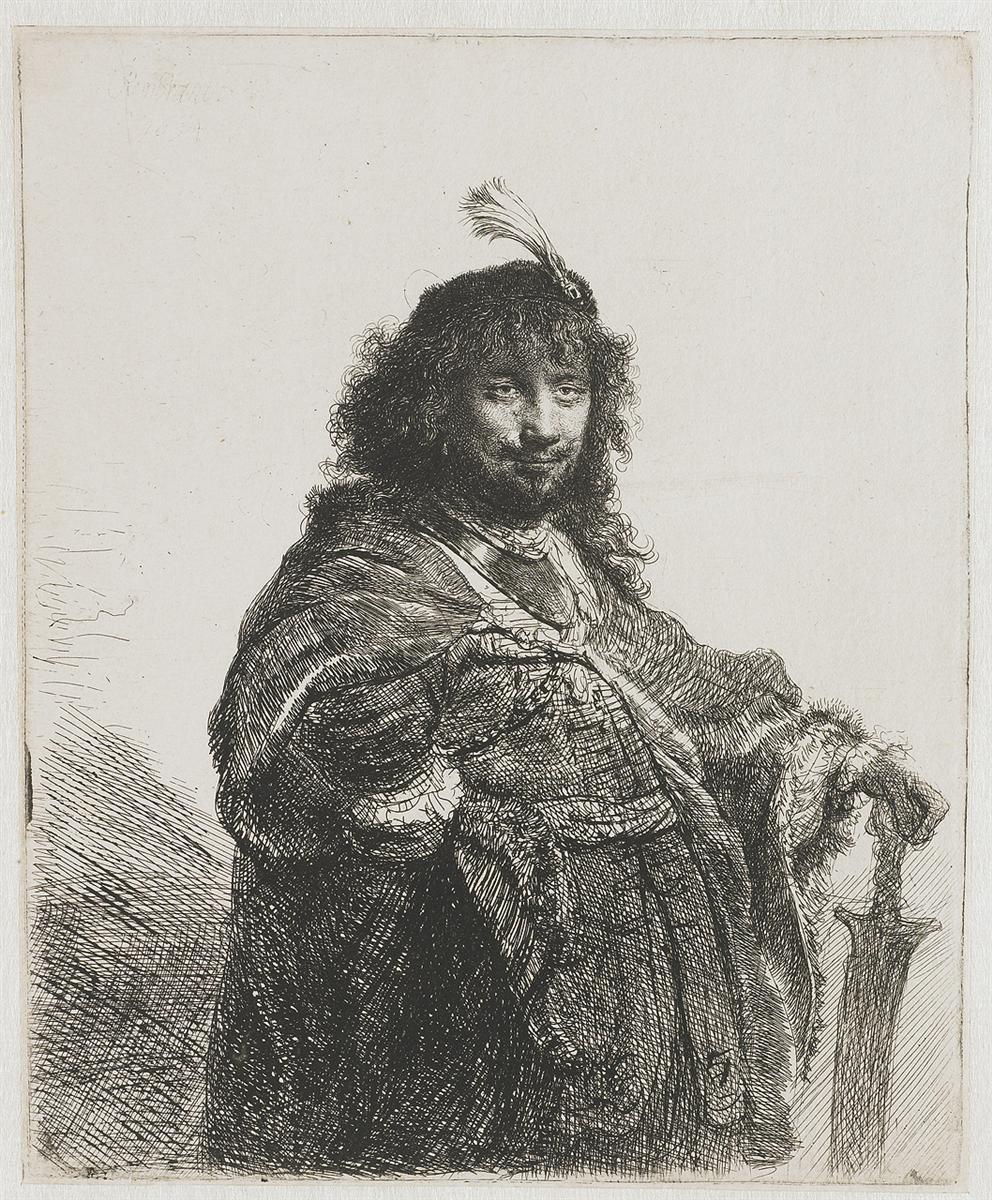
“Self-portrait with Plumed Cap and Lowered Sabre” (1634) is one of Rembrandt’s most beguiling exercises in role-playing on copper. In this etched image the twenty-something artist turns his body three-quarters to us, the left hand resting on a sword whose blade points toward the ground. A small plume erupts from his cap; a heavy cloak with a fur edge swallows his torso; patterned garments, belts, and straps cross in a dense weave of textures. The face glows with a mischievous half-smile, the eyes bright and measuring. Where companion prints from the same year brandish a raised weapon, this sheet shifts the drama from bravado to poise. The sabre is present but calmed, the posture confidently relaxed. Within a few square inches, Rembrandt orchestrates theatre, psychology, and virtuoso mark-making into a portrait that feels at once playful and authoritative.
Historical Moment
The year 1634 was a hinge between youthful experimentation and public acclaim. Rembrandt had recently relocated from Leiden to Amsterdam, married Saskia van Uylenburgh, and was serving an expanding clientele of merchants, ministers, and civic leaders. Parallel to his painted commissions, he pursued etching with the zeal of discovery. These prints circulated widely and quickly, building reputation far beyond any single canvas. During 1633–1635 he produced a remarkable sequence of self-portraits that test how costume and expression can reshape identity while keeping a recognizable core. This print sits near the center of that sequence. It captures the new Amsterdam confidence and the young artist’s delight in performance, yet reins in the swagger to present a persona of composed authority.
Composition and Posed Dialogue
Rembrandt composes the figure as a durable triangle whose apex is the helmet-like cap with a jaunty plume and whose base is the broad sweep of furred cloak. The left arm plants itself at the hip, the right arm descends to the pommel of the sword. Diagonals crisscross the torso—bandoliers, belts, and patterned fabrics—creating a lattice that both binds and energizes the form. The lowered sabre carves a second diagonal, a shadow-drenched slash that steadies the lower right corner. This geometry conducts the viewer’s eye in a loop: cap and plume to eyes, eyes to hand on hilt, hilt up the sleeve to the fur, fur back to the bright face. It is a self-contained conversation, a circuit in which gesture and expression echo one another.
Etching as Performance
Etching is drawing with acid, and this print flaunts the process with panache. In the cap, dense, parallel hatches compress to a velvety black; in the plume, wiry threads burst upward in quick, dry lines; the fur trim bristles with short, directional marks that change direction like wind in grass; the sword’s metal is declared with long, unbroken sweeps and a crisp highlight that is nothing more than saved paper. Across the torso Rembrandt switches speeds constantly—tight cross-hatching where shadow must thicken, open webs of line where halftone should breathe, scattered stipples to roughen a pelt or suggest worn cloth. The face is the most delicate register: short curved strokes wrap the cheek, tiny hooks vivify nostrils and lids, and the mouth is tied with a minimum of lines so that warmth remains in the paper. Every patch of the plate carries a different “handwriting,” but all are legible as one voice.
Light Drawn With Silence
In an etching, white is simply unmarked paper; Rembrandt turns that negative fact into the positive protagonist. The left side of the background is hatched to a soft gray that pushes the figure forward; the upper right is left luminous and bare, so the plume’s filaments and the cheek’s highlight blaze as if catching daylight. The face is modeled by omission: between the small strokes, paper glows through to become skin. Along the blade, a single flick of untouched ground reads as gleam. The alternation of inked density and saved brightness is so finely judged that the small sheet feels illuminated from within.
Costume, Plumed Cap, and the Language of Role
The cap with its jaunty feather places the performer somewhere between mercenary and courtly gallant. Rembrandt adopts this language knowingly, not to claim a literal station but to borrow its resonances—adventure, freedom, command. The fur collar deepens the cue, suggesting both warmth and expense, while layered fabrics and fastenings assert a body ready for action. Yet the role is held lightly. Nothing is stiff; folds fall naturally, and the feather tilts almost comically. The artist is trying on a costume rather than submitting to it. As in many of his self-portraits, the adopted dress becomes a tool for investigating how texture, edge, and light behave, and thereby how identities can be built from materials.
The Lowered Sabre and the Rhetoric of Restraint
By lowering the sabre, Rembrandt shifts the narrative. In related prints the blade rises like a lightning bolt and competes with the face for dominance. Here the sword descends to rest, a staff rather than a threat. The gesture speaks of readiness without provocation. It is a visual equivalent of a musician lowering the bow between phrases: the performance is ongoing, but the current moment is about listening. The lowered sabre also frees the face to lead the scene. Our eyes meet the artist’s, not his weapon’s, and the psychology of the portrait deepens accordingly.
Gesture, Hands, and Poise
Rembrandt choreographs the hands to broadcast character. The left hand on the hip opens outward, fingers curling slightly, announcing ease and ownership of the space. The right hand encloses the hilt with firm, rounded knuckles, a practical grasp rather than theatrical squeeze. Together they make a rhythm: outward openness balanced by inward control. They also ground the figure. Etched in dark, repeated cross-hatch, the hands become the heaviest visual masses after the cap; they pin the airy plume and nuanced face to the body’s gravity.
Background, Edge, and Breathing Space
The composition’s airiness depends on how Rembrandt treats the background. He resists the temptation to fill it with architecture or landscape. Instead, he leaves large reserves of paper blank and lets only a slanted field of hatching describe a space receding behind the left shoulder. This modest cue is enough; the figure breathes without losing presence. Along the silhouette, edges vary from sharp to dissolved. The fur at the shoulder frays into the white field; the sleeve at the wrist hardens against the void. This changing edge keeps the body alive in space, neither pasted on nor swallowed by the ground.
Comparison with the Raised Sabre Self-portrait
Seen beside “Self-portrait with Raised Sabre,” this print offers a revealing contrast. In the earlier plate the frontal head and upthrust weapon declare bravura; here the body turns, the arm relaxes, and the expression widens into a smile. The costume overlaps—the fur collar, patterned torso—but the mood cools from challenge to conversation. The two sheets together show Rembrandt’s range. He can court spectacle or cultivate poise, choose a single searing contour (the raised blade) or distribute interest across a field of textures (the lowered blade and layered garments). Both are compelling; the difference lies in the psychological temperature he tunes with light and line.
Expression and Psychological Nearness
The face is the print’s quiet climax. The smile is not broad; it is a curve that can be read as amusement, welcome, or a private joke. The lids hang a touch heavy, a habit of the artist’s visage that here registers as contentment rather than fatigue. Because the sabre has been lowered, the expression can afford subtlety. We are invited closer, into a zone where the sitter is playing a role and letting us see the play at the same time. That double awareness—mask and self, theatre and inwardness—is the signature of Rembrandt’s self-portraiture across decades.
Printing Variability and States
Etched plates yield impressions that can differ according to wiping and inking. Some impressions of this image retain a film of plate tone around the head, increasing the chiaroscuro and making the smile glow from shadow. Others are wiped cleaner, giving a brighter, more daylight effect. Minor changes between states—strengthened lines in the background, deepened bites in the fur—show the artist fine-tuning emphasis. This variability is not incidental; it is another tool of performance. The same plate can speak in multiple keys, mirroring the flexibility of persona enacted within the image.
Material Truth and the Conviction of Detail
Rembrandt’s credibility rests on tactile truth. The fur must feel bristly; the leather on the glove must crease and catch shadow; the sword’s guard must glint and recede; the plume must appear both fragile and springy. He achieves these contradictory sensations by letting the needle imitate the behavior of each material—scumbling for roughness, smooth sweeps for polish, dotted touches for sparkle. Because the materials convince, the role convinces. We accept the masquerade not because of its symbolism but because of its physicality.
Market, Audience, and the Image of the Artist
Small self-portraits in etching were strategic. They fit portfolios, traveled easily, and built recognition among collectors who might later commission paintings. A sheet like this advertises not merely skill but personality: a charming, adventurous, approachable maker who could supply drama or dignity as desired. At the same time, Rembrandt was shaping the broader cultural idea of the artist—not craftsman only, not courtier, but an imaginative persona who could invent and inhabit identities. The plumed cap and relaxed sword embody that idea in miniature.
The Signature and Self-Assertion
In the upper left, faint but legible, the signature and date hover like a whisper. Rembrandt often wove his name into the lightest parts of a plate rather than trumpeting it in a cartouche. The placement suits the portrait’s mood: self-assured enough to brand the work, modest enough to let the face carry the message. The date matters too; 1634 tallies with a burst of etched self-studies that together trace a young artist practicing how to be seen.
Influence and Afterlife
This print has echoed through centuries of portrait practice, particularly among artists who use costume to test identity. It anticipates the nineteenth-century fascination with the artist as a figure of romantic invention and the twentieth-century use of self-portraiture as a laboratory for persona. The specific tactics—lowered weapon as emblem of restrained power, plume as playful flourish, dense textures releasing into white paper—remain instructive to printmakers exploring how few lines can suggest a world.
Reading the Image Today
Modern viewers meet the print with an appetite for authenticity. What feels striking is how the image offers both authenticity and performance without contradiction. The smile seems true; the costume is acknowledged play. The lowered sabre avoids aggression; the gaze invites conversation. In an era saturated with self-imaging, the plate demonstrates a durable principle: personality on paper is most persuasive when materials behave honestly and role-play is worn lightly.
Conclusion
“Self-portrait with Plumed Cap and Lowered Sabre” is a compact drama of confidence at rest. The plume flickers, the fur bristles, the sword gleams and then quiets, and the face—open, amused, steady—holds the stage. Rembrandt uses the etcher’s grammar of line and the painter’s sense of light to make a portrait that is at once public and intimate, costume and character. Where other images from 1634 shout, this one speaks with a smile and a grounded stance. It is the self of a young master who knows that power does not always need to be raised; sometimes it is more persuasive lowered, held in reserve, and made visible through the precision of touch and the clarity of looking.