Image source: wikiart.org
Introduction
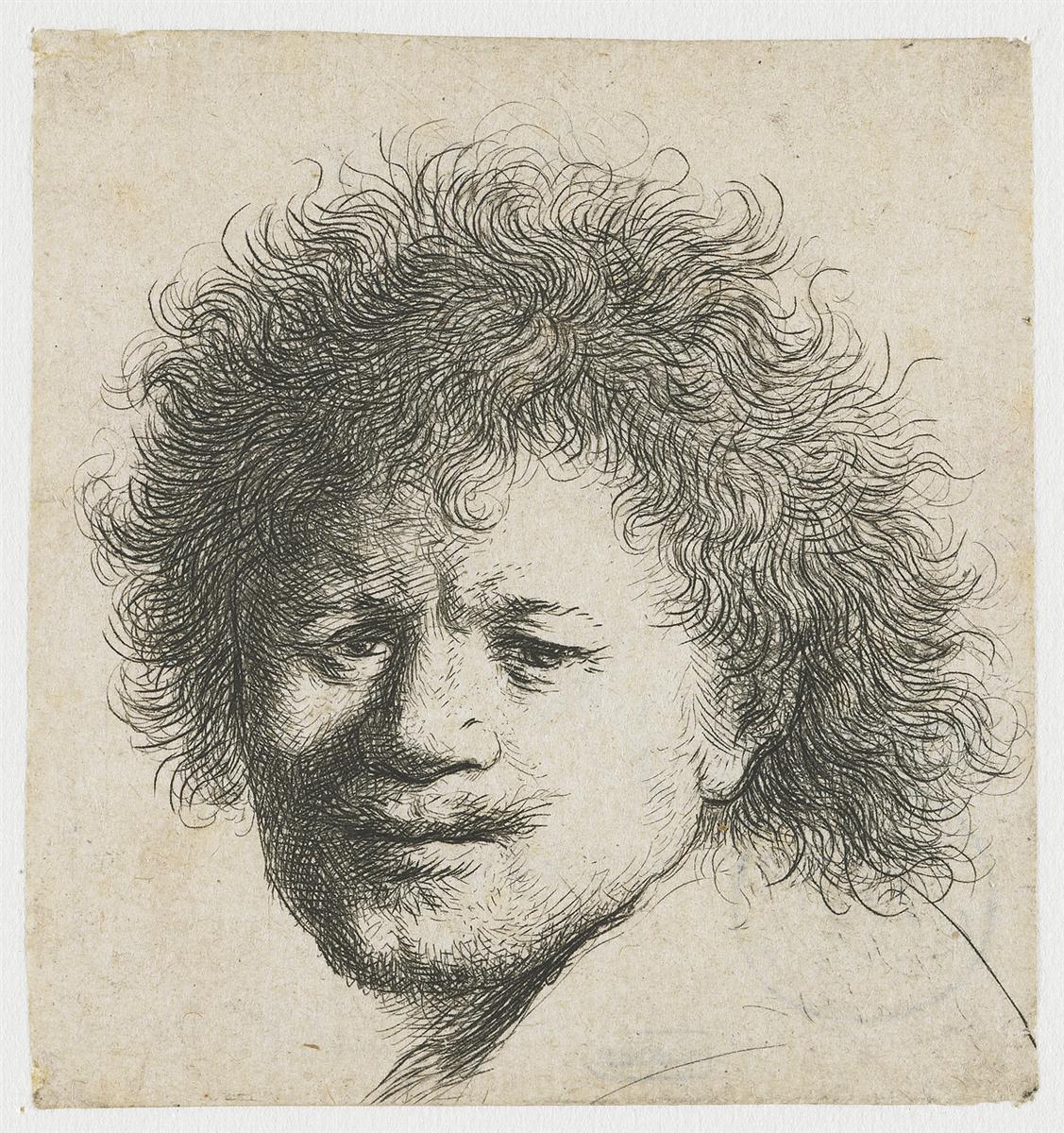
“Self-portrait with Long Bushy Hair” (1631) is among the most revealing of Rembrandt’s early etched self-studies, a compact sheet in which the artist tests how far line alone can carry expression, texture, and light. The head fills the plate, turned three-quarters to the viewer with the mouth caught in a wry half-smile and the brow knitting into thought. Around that face roils a storm of hair—loops, hooks, spirals—drawn with such nimble variety that the hair becomes both subject and atmosphere. The print does not rely on costume, emblem, or narrative. It proposes that a living face and a responsive line are enough to make presence.
The Moment In Rembrandt’s Formation
The date 1631 stands at a pivot in Rembrandt’s career. He was moving from Leiden to Amsterdam and showing recent collectors how his small plates could hold large drama. Self-portraits from these years functioned as laboratories and calling cards: laboratories because they let him practice extreme expressions, lighting schemes, and textures; calling cards because their distribution through the print trade advertised a distinct artistic intelligence. This sheet belongs to the cluster in which he studies his own head as a “tronie,” a character type, yet the specificity of the gaze and the individualized contours make it far more than an academic exercise.
The Composition And The Authority Of Cropping
The head is cropped aggressively: hair explodes against the upper edge, the lower right shoulder arcs out of frame, and only a breath of background remains. That tight framing accomplishes two things. It denies the comfort of distance, forcing intimate engagement, and it allows the hair’s frizzing silhouette to become a compositional engine. The viewer’s eye skims the halo of curls before falling into the denser modeling of cheek, nose, and lip. By eliminating the torso, hat, or studio props present in other self-portraits, Rembrandt concentrates attention on expression and mark.
Etched Line As Anatomy And Weather
Etching registers the speed and pressure of a moving hand. Rembrandt exploits that responsiveness to build a head whose surfaces feel tangible and whose air feels stirred. Across the hair he draws long, springing arcs that cross and rebound like gusts; near the temples the curls tighten into smaller loops; at the brow the lines break and interlock to model hushed shadow; and along the cheek he shortens and spaces strokes so the paper’s light can breathe through as living skin. The variety is radical yet disciplined: every change of direction follows an underlying plane, so that the head reads as solid while the hair reads as animated air.
Light, Shadow, And Psychological Temperature
Light falls from the left, catching the brow ridge, the bridge of the nose, and the cheekbone before dissolving into the shaded mouth and jaw. The strongest dark sits at the left side of the face where the hair meets skin, a hinge that turns the head convincingly in space. Because Rembrandt refuses theatrical contrasts, the transitions feel humane—neither cosmetic nor cruel. The light has the temperature of a studio morning, the kind that makes every pore honest. This controlled illumination supports the portrait’s emotional register: curious, alert, skeptical, but never hardened.
The Hair As Persona And Process
The portrait’s title announces the hair as protagonist. More than a likeness detail, the unruly mass signals a persona—the youthful virtuoso courting risk, refusing neatness, and trusting energy. At the same time it becomes a demonstration of process. We see how a single etched instrument can imitate the spring and collapse of curl by slight variations in spacing and pressure. The hair’s centrifugal rhythms push outward toward the plate edge, while the face’s centripetal modeling pulls attention inward. That push–pull makes the sheet vibrate with life.
The Mouth And The Drama Of Ambiguity
No feature is more decisive than the mouth. The corners lift asymmetrically; the lower lip presses lightly forward; a small shadow pools beneath it. The expression hovers between amusement and appraisal, as if the artist, mid-observation, had found the moment gently funny. The ambiguity is strategic. It invites the viewer to keep reading the rest of the face for clues—one more minute looking at the eye, one more pass across the brow—and in that extended looking the etched line does its work of persuasion.
Modeling The Eye And The Ethics Of Looking
The left eye, closer to the light, receives a minute highlight that anchors the gaze; the right sinks subtly into the socket, shaded by a delicate mesh of hatchings. The result is depth without melodrama and scrutiny without aggression. Rembrandt refuses the stare that dominates many baroque portraits; instead he offers the look of someone who is thinking while seeing, allowing the viewer to feel seen but not pinned. The ethics of looking here—frank, unflinching, unbullying—would become a signature of his mature portraiture.
Texture, Stubble, And The Truth Of Skin
Look close and the face isn’t polished; it bristles. Short, burr-like marks suggest stubble along the chin and upper lip, while scattered dots enliven the cheek. These decisions are small but consequential. They anchor the head in lived time—the self-portrait is not an emblem but a morning’s work—and they counterbalance the hair’s theatricality with a tactile realism. The skin feels slightly rough, the kind that catches the studio’s cool air, and that roughness enlists the senses beyond sight.
Negative Space And Breath
The background remains largely untouched, an airy field with the faintest traces of wiping or plate tone. That negative space performs essential labor. It isolates the unruly silhouette, gives the hair’s outermost wisps a place to evaporate, and surrounds the head with a subtle halo that reads as breath. If the background were hatched, the image would tighten and grow claustrophobic; by leaving it open, Rembrandt makes the portrait feel inhabited by air, which in turn keeps the expression supple.
Speed, Pressure, And The Music Of Line
The print is a small score for a single instrument performed at varied tempos. Fast, elastic arcs write the hair; medium, measured strokes articulate the brow and nose; slow, deliberate touches weight the nostril and lip. Pressure modulates like dynamics: forte in the hair where dark gathers, piano along the cheek where tone must be suggested rather than stated. The viewer experiences the face not only as a set of forms but as a sequence of gestures—decisions audible to the eye.
Comparison With Neighboring Self-Portraits
Around 1630–1631 Rembrandt makes several etched or painted self-portraits that test costumes and expressions: laughing, frowning, wide-eyed, or donning exotic caps. This sheet sits nearer the center of the spectrum. It lacks the overt role-play of the “fancy dress” self-portraits yet retains the experimental verve. The absence of costume and the dominance of hair push the image toward candor while preserving a trace of youthful bravura. In later decades he will pare everything back even further; already here the essentials—light, line, attention—carry the portrait.
The Plate As Mirror And Mask
Every self-portrait negotiates mirror and mask. The mirror shows an artist to himself; the mask shows an artist to the world. This print acknowledges both. The frank modeling of the face reads as mirror truth, while the explosive hair and played-with mouth acknowledge a staged persona. Rather than choosing one, Rembrandt fuses them, generating a likeness that feels both private and public—exactly what a small print exchanged among collectors needs to be.
The Role Of Printing And State
Impressions of the plate can differ depending on ink and wiping. A light plate tone softens the field and makes the hair’s outer wisps glow; a cleaner wipe yields a crisper silhouette and cooler atmosphere. Such variability suits a subject whose chief attribute is liveliness. Each impression seems to catch a different beat of breath, and collectors learn to read those micro-climates as part of the art.
The Education Of The Hand
Technically the etching is a lesson in how to turn form without resorting to blunt crosshatching. Notice how the cheek turns by a barely perceptible shift in stroke angle; how the nose’s bridge is defined not by outline but by value change; how the mouth’s depth arrives from the small shadow below the lower lip rather than from heavy contour. The sheet is therefore both image and pedagogy, a model for draftsmen in building convincing volume with economy.
Presence Without Emblems
The absence of props is deliberate. No painter’s palette, no book, no architectural backdrop distracts. The face and the hair suffice. That restraint places the portrait in a modern register long before modernism. It trusts the viewer to find meaning in the grain of looking rather than in iconography, and it trusts the medium—ink bitten into copper—to carry feeling without auxiliary narrative.
The Emotional Weather
The portrait’s weather is changeable but temperate. The hair’s storminess threatens drama, yet the face’s relaxed mouth and attentive eye calm it. The sheet avoids sonic extremes—no shout of laughter, no grimace. Instead it gives the equilibrium of a young artist who knows his power and is curious about its range. That poise is why the image continues to feel companionable rather than confrontational.
What To Look For Up Close
Begin at the pupil’s pinpoint highlight and notice how few marks define the eye’s wetness. Slide down the nose and find the narrow reserve that keeps the bridge luminous. Read the notch of shadow separating lower lip from chin—remove it mentally and the mouth collapses. Trace the hair’s outermost filaments as they dissolve into paper; each is a single confident stroke. Finally, locate the faint contour of the shoulder at lower right; its light arc is the necessary counterweight that keeps the head from floating.
Influence And Afterlife
This self-portrait helped codify a Rembrandtian approach to the etched head: explosive hair, candid light, and a drawing that feels improvised yet lands with inevitability. Later printmakers—from the eighteenth-century virtuosi to twentieth-century expressionists—learned from its economy and from its faith that line can think. Within Rembrandt’s own practice, the sheet forecasts his lifelong willingness to let the visible labor of making remain visible, not as mannerism but as evidence of attention.
Conclusion
“Self-portrait with Long Bushy Hair” compresses a great deal of Rembrandt’s early genius into a small square of paper. Composition by cropping, anatomy built from pressure-sensitive line, light that clarifies without glare, texture that tells the truth of hair and skin, and an expression pitched precisely between role-play and candor: together they produce a presence that feels immediate and humane. The print asks for nothing more than the viewer’s patience and returns the favor with a portrait that seems to breathe—etched proof that seeing, when done with curiosity and care, is a form of life.