Image source: wikiart.org
Introduction
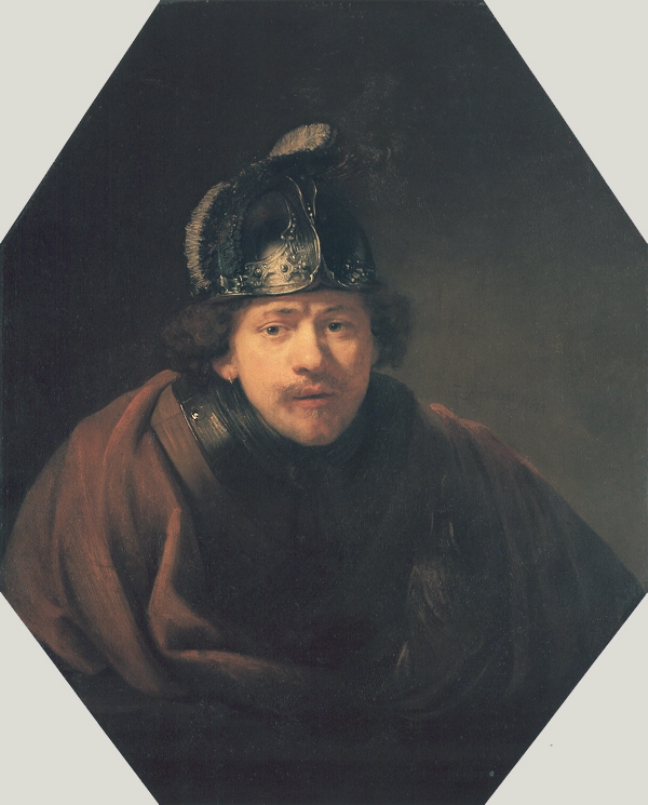
“Self-portrait with Helmet” (1634) captures Rembrandt at twenty-eight, early in his Amsterdam ascent and freshly married to Saskia van Uylenburgh. In this compact, half-length painting the artist appears wrapped in a heavy cloak and metal gorget, crowned by an ornate helmet whose feathery crest lifts into the dim studio light. The background is a deep brown chamber that swallows distractions; the face, softly illuminated, hovers between youthful alertness and reflective calm. Unlike the flamboyant self-images with raised swords or plumed caps etched in the same year, this canvas turns spectacle inward. Armor and helmet provide a frame, not a boast. The true performance is light—how it pours across steel, sinks into wool, and settles gently on skin—revealing a painter already fluent in turning props into meditations on presence.
Historical Context and the Fashion of Fancy Dress
Amsterdam in the mid-1630s was a city of wealth, civic order, and Protestant restraint, yet portraiture often allowed for “fancy dress,” an imaginative costume that evoked antique heroism or courtly distinction without claiming literal status. Rembrandt seized on the convention as a laboratory. In 1634 he painted pendant portraits for patrons in sober black-and-white, experimented with theatrical plumes and shining gorgets in his own likenesses, and issued a stream of etched self-studies that tested expressions and roles. The helmet here belongs to the studio’s prop closet—part Roman commander, part Northern mercenary. Its use situates the work within a pan-European tradition of artists adopting armor to borrow dignity and explore reflective surfaces. But Rembrandt’s choice is tempered. The helmet’s gleam is restrained; no weapon intrudes; the eyes look levelly outward. The costume becomes a means to study light and to suggest an inner gravity rather than an outward claim to valor.
Composition and the Geometry of Attention
The composition is unusually concentrated. Rembrandt places the head high in the frame so the gaze meets ours on level terms, then expands the lower field with a mass of cloak that rests on the picture’s ledge like a sculpted base. The triangular sweep of the fabric culminates in the broad arc of the shoulders; within this soft pyramid, the round gleam of the helmet and the oval of the face form a nested set of shapes. The gorget—a polished, crescent-like band around the neck—acts as a hinge between metal above and cloth below, a bright curve that bounces light onto the underside of the chin. The background is left unarticulated, save for a gentle lightening near the face that reads as air. The overall geometry enforces calm: diagonals in the drapery guide the eye upward to the face; the helmet’s crest mirrors that ascent before dissolving into shadow.
Light as the Narrative
Rembrandt’s light in 1634 is lucid rather than smoky. It falls from the left and slightly above, awakening specific surfaces in sequence. The crest of the helmet receives a clipped highlight that outlines its shape, then the light skims the embossed metal of the brow-guard, touches the rolled rim of the gorget, and finally settles, warm and even, across the cheeks and lips. The eyes are set back beneath the helm’s visor, where soft shade intensifies their wet glints without obscuring them. On the cloak, illumination lowers to a gentle murmur: a broader, slower modeling that evokes heavy, well-worn cloth. This choreography—bright metal, temperate flesh, breathing fabric—establishes a narrative of containment: power held close, warmth controlled by duty, a self gathered within its own attention.
The Helmet as Engine of Seeing
The helmet’s complexity is rendered with a painter’s economy. Rather than enumerating every chased motif, Rembrandt gives the metal its “behavior.” He floats thin, cool highlights along convex rims, drops darker, oilier notes into recesses, and introduces a feathery accent on the crest that catches just enough light to feel airy. The brow-guard’s embossed forms are suggested by crisp, directional strokes that turn abruptly where planes change—tiny edits that the eye assembles into ornament. The helmet thus becomes an instrument for focusing the gaze. Its shadow trims the forehead and draws us to the eyes; its crest points upward, echoing the lift of thought; its weight is belied by its luminous edges, which seem to hover rather than crush. In this way, the prop is recast as a device for looking as well as being looked at.
Flesh and the Discipline of Restraint
Rembrandt resists the temptation to polish the face into courtly brightness. He models skin with translucent layers, allowing cool undertones to temper the warmer blush along cheek and lip. The nose is built by halftones rather than outline; the chin projects with a modest, living roundness. The mustache and sparse beard are dropped in with economical touches, their color harmonized to the hair peeking from beneath the helmet’s rim. This disciplined handling preserves moisture and softness while preserving gravitas. The sitter is neither a caricature of virility nor a cipher of beauty; he is a thinking, breathing person whose features have not been argued into theatricality.
Color, Tonal Discipline, and Material Chorus
The palette is a concert of browns and blacks tuned by metallic grays and flesh warms. The cloak runs from auburn to umber, with cooler shadows that prevent monotony. The gorget lies in a key between slate and silver, its chill offset by the warmer skin tones it borders. The helmet’s highlights pick up faint greenish and blue notes that read as reflections of ambient air. Against this orchestra of low hues, the whites are few and decisive: the moist catch at each pupil, the small ridge along the lip, the clipped glint on metal. Tonally, the painting builds from a large, quiet base (the cloak), through a ring of mid-tone (face and gorget), to a crown of bright accent (helmet). The result is legibility without sacrifice of subtlety: from a distance, a noble bust; up close, a chamber of fine temperatures.
Surface, Brushwork, and the Truth of Materials
Rembrandt’s surface is a conversation among brushes. On the cloak, broader, slightly loaded strokes drag over a darker ground, leaving a nap that reads as dense wool. In the gorget, he pulls smoother strokes along the curve, then interrupts them with pin-head highlights to simulate reflected points of light. The helmet is knotted with short, precise touches near seams and edges, balancing with broader, softer sweeps across the dome. In the face, tiny, fused strokes change direction with the turning planes—down along the philtrum, laterally across the cheek—so that brushwork doubles as anatomy. This varied touch is never pyrotechnic; it’s a slow, exact clarifying of how things feel as much as how they appear. Tactile accuracy generates belief, and belief supports the picture’s quiet drama.
The Psychology of the Gaze
The expression is guarded but not opaque. The eyelids hang slightly heavy, an enduring feature of Rembrandt’s physiognomy that here reads as thoughtful restraint. The mouth is set with the faintest inward curl, a line that could become a smile or sink into seriousness depending on the viewer’s mood. The head inclines minimally forward, as if the armored sitter were leaning from shadow to meet our attention. Because the helmet dims the forehead and sharpens the eye sockets, the gaze gains intensity without a scowl. This psychological temperature—settled, attentive, ready—is the portrait’s lasting gift. It denies bravado in favor of presence.
Fancy Dress and the Ethics of Role
Armor and helmet have long attracted artists for their claim to grandeur and their optical opportunities. Yet they carry risks—of bombast, of empty theatrics. Rembrandt avoids these pitfalls by keeping the helmet subordinate to the head and the gorget subordinate to the throat, not the other way around. The costume does not swallow the person; it shelters him. What might be mere role-play becomes an ethical proposition: identity can be explored through borrowed signs without being replaced by them. The young painter does not pretend to be a soldier; he tests what courage, inwardly considered, might look like on a human face under thoughtful light.
Relationship to Companion Works
Compared with Rembrandt’s contemporary etched self-portraits—one with a raised sabre and another with a lowered sabre—this painting relaxes the rhetoric. There is no aggressive contour slicing the field, no plume declaring bravura. Instead the helmet absorbs brightness and feeds it back in measured glints, while the cloak’s mass domesticate the stage. Compared with “Self-portrait as a Young Man” with its polished gorget and gold chain, this work is richer in enveloping shadow and more introspective in mood. Together, the 1634 self-images map the artist’s range: the same face animates swagger, poise, and reflection as he calibrates the degree of theatre needed to explore the physics of light and the plurality of self.
Space and the Octagonal Field
Many versions of this image are set within an unusual, cropped octagonal field, with corner cuts that further compress the stage. The angled edges function like shutters, reducing peripheral noise and centering attention on the head and helm. The cut corners also echo the faceted planes of the helmet’s construction, turning the entire support into a faint analogue of armor. This subtle framing, whether original or the result of historical cropping, reinforces the portrait’s tone: concentrated, contained, intent.
The Face as Source of Light
Although light obviously falls from outside the picture, the painting is orchestrated so that the face reads as a source. Reflections ping outward from it: a warm lift along the gorget’s edge, a soft bloom on the cloak’s fold, a whisper on the helmet’s cheek piece. This visual rhetoric—face first, object second—grounds the work in humanism rather than spectacle. The world is illuminated by attention, the picture suggests; the materials shine because a person is present within them.
Time, Motion, and the Pause
Rembrandt often makes stillness feel recent. In “Self-portrait with Helmet,” the folds at the left shoulder look newly settled, the crest’s wisps seem to have just stopped vibrating, and the mouth carries a living moisture that implies breath. These cues persuade us that the sitter is not a mannequin staged for allegory but someone who has paused between movements. This is the electric instant the painter loves: a pause long enough to model with care, short enough to feel alive.
Reception and Legacy
This self-portrait has long appealed to viewers and painters alike for its combination of theater and truth. The helmet provides historical glamour; the face, humane modernity. Generations of artists have studied it for how it renders metal’s coolness without chalk, cloth’s weight without monotone, and flesh’s warmth without gloss. For historians, it anchors the 1634 cluster as the introspective node, demonstrating that Rembrandt’s fascination with costume served not only showmanship but also inner inquiry. For general audiences, the picture remains compelling because it invites a recognizable experience: the feeling of stepping into a role—job, uniform, responsibility—while keeping hold of oneself.
Conservation, Patina, and the Work of Time
Over nearly four centuries, the browns have mellowed and the darks have deepened, which only enhances the painting’s atmosphere. The helmet’s highlights retain their silver vitality, and the gorget’s curved glints still read decisively. Any delicate craquelure in the face now lends an additional granularity that echoes the picture’s original texture, like a new layer of translucency over old. The aging of the surface suits the theme: armor may shine, but time renders everything human.
Conclusion
“Self-portrait with Helmet” transforms a studio prop into a lens on character. Rembrandt stages an encounter where light negotiates among steel, wool, and skin and arrives at a steady, thoughtful gaze. The helmet does not inflate him; it concentrates him. The gorget curves like a luminous comma beneath a sentence still being spoken; the cloak gathers around the shoulders like gravity itself. In 1634, the young master demonstrates that grandeur need not shout and that the deepest drama can occur in a face quietly meeting light. The painting endures because it dignifies restraint, honors tactile truth, and suggests that the roles we wear are most persuasive when they shelter, rather than eclipse, who we are.