Image source: wikiart.org
First Encounter With Poise, Light, And A Flash Of Gold
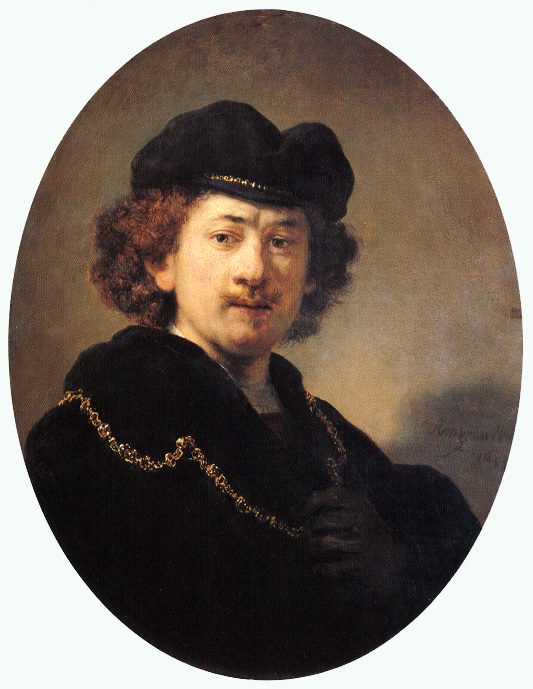
Rembrandt’s “Self-portrait with Hat and Gold Chain” presents a young master testing how splendor can dignify, not drown, a likeness. Within an oval, he turns toward us beneath a dark cap, curls flaring against a warm background, the lips set in a thoughtful half-smile. A gold chain arcs across his black garment, catching small fires of light that punctuate the deep tone. The right hand, sheathed in a dark glove, gathers the robe at the chest as if to steady breath. The painting’s first impression is composure: confidence that is neither boastful nor shy, framed by materials that honor craft and character alike.
The Oval As A Locket Of Attention
The oval format functions like a handheld locket, cutting away narrative clutter and focusing sight on the conversation between head, hand, and chain. Rembrandt sets the face high and slightly to the left so the surrounding dusk can breathe. The gently convex curve of the background guides the gaze in loops around the curls, down the chain’s rhythmic lights, and back to the eyes. The shape softens edges and makes intimacy the default—this is a private audience with a public artist.
Composition Built On Counterturns
The torso angles toward our right while the head returns to meet us, establishing a quiet torque that animates the pose. The cap’s brim sets a horizontal to steady the design; the chain draws a shallow diagonal that echoes the line of the shoulder; the glove forms a dark knot that anchors the lower register. These counterturns convert a static bust into an encounter. They also prepare the stage for the painting’s real subject: how a young painter greets the viewer with self-possession.
Light That Judges Kindly
Illumination arrives from the upper left and spreads with judicial calm. It clears the brow, rakes gently over cheek and nose, and settles into a measured sheen on the lips. The cap’s underside compresses values across the eyes just enough to avoid glare; the curls catch bright eddies along their outer ring; the chain’s links register as pinpoints and small bars that confirm the metal’s weight. Shadow is breathable, not punitive. The background holds a warm haze that admits depth without swallowing the figure.
The Hat As Canopy And Character
Rembrandt’s cap is more than studio attire. It is a canopy that contains thought and directs light. The soft crown rounds with subdued highlights; the brim curves in a firm silhouette against the atmospheric ground. By tempering the forehead’s brightness and cooling the upper face, the hat models modesty—a refusal of showy glare—that fits the painting’s ethic of authority through restraint.
The Gold Chain As Professional Emblem
Across the shoulder runs a bright, articulated chain—small medallions and links catching light in a disciplined rhythm. In the early 1630s, Rembrandt repeatedly included such a chain in self-portraits. It reads as a painter’s emblem, a declaration that the studio’s work deserves civic dignity. Here, the chain is scaled beautifully: decorative enough to spark the black garment, humble enough to defer to the face. Its diagonal also orchestrates the viewer’s route through the picture, leading from shoulder to glove and back to the head.
A Garment That Makes Room For Breath
The deep garment is a sea of moderated blacks—some tinged with blue, others with plum or olive—rather than a single flat tone. Long, confident strokes establish broad planes; soft scumbles and glazes knit transitions; the glove absorbs light into a velvety hush. Because the dark is alive with undertones, it behaves as air rather than void, allowing the chain’s bright syllables and the face’s warm values to speak clearly.
Eyes That Attend Rather Than Perform
The gaze is frank, unpressured, curious. Small pinpoints of highlight wet the pupils; the lower lids carry a gentle moisture that suggests breath and attention. This psychological middle register—neither swaggering nor shy—is Rembrandt’s favorite ground for truth. The mouth’s slight asymmetry and the neutral set of the brows imply a person thinking as he looks, not performing a mask for us. A portrait that refuses exaggeration feels contemporary by default.
Flesh As Living Climate
Skin is rendered with translucent veils that let light seem to rise from within. Warm notes collect at cheek and lips; cooler half-tones firm the jaw and temple; a soft reflection from the garment warms the underside of the chin. Nothing is cosmetically polished. The face retains the grain of life, the kind of surface that can gather and shed light as a living presence does in a room.
Color Tuned Like Chamber Music
The palette keeps to a persuasive narrow key: warm earths in the ground; black and blue-black in the garment; copper and straw tones in the hair; measured roses in the flesh; clean, bright gold for the chain. Because chroma is controlled, temperature changes do the expressive work. A cooler passage along the jaw prevents swelling; a warmer glaze at the cheek provides vitality; the chain’s metallic flickers add high notes that keep the composition lively without raising the volume.
Brushwork That Records Decisions
Surface reveals a spectrum of touch. Quick, lifted marks write curls; compact, bright dabs define chain links; thin glazes model the cheek’s slow turns; firmer strokes draw eyelids and nostrils; the glove is built from compressed, absorbent paint that drinks light. The brushwork never becomes spectacle for its own sake. Each passage answers a practical question—what kind of mark will make this material behave like itself under this light?
The Glove As Knot Of Agency
The dark glove clasped at the breast is a small essay in understated assertion. It anchors the lower register, sets a counterweight to the head, and reads as a gesture of self-possession: the artist gathers his cloak as he acknowledges the viewer. The seam, the softened knuckles, the way light barely survives on the leather—each detail is economical and convincing. The glove also amplifies the chain’s message: craft is a profession worthy of regalia, yet the person remains sovereign.
The Background As Protective Silence
There is no window, column, or drapery. The ground is a warm, granular dusk that holds the figure like respectful quiet around speech. This restraint is ethical. It refuses borrowed grandeur and allows the picture to build authority from seeing rather than from symbols. The slight haze behind the cap and curls keeps the image breathable; our attention returns reliably to the face.
Early Amsterdam Context And Self-Fashioning
The year is 1633. Rembrandt, not yet thirty, has moved from Leiden to Amsterdam and is commanding attention with portraits, history scenes, and prints. Self-portraits from these years are acts of self-fashioning—images aimed at patrons and peers that also function as a workshop for light, costume, and psychology. “Self-portrait with Hat and Gold Chain” belongs to the strand that leans toward public dignity without abandoning candor. The chain, glove, and cap provide the stage; the face keeps the plot honest.
Comparison With Companion Self-Portraits
Compared to the slightly sterner 1633 oval self-portrait without a hat, this canvas feels more open, even conversational. The cap softens glare and adds a note of studio informality; the gold chain tips the balance toward ceremony; the glove re-centers the image on controlled movement rather than stillness. Together, they present a fuller persona: a working artist who has earned a certain display, yet still values the plain light of the studio.
The Psychology Of Balance
Every element in the painting negotiates between two poles: private and public, craft and ornament, youth and authority. The hat protects privacy; the chain acknowledges rank; the glove contains motion; the eyes offer attention without revealing more than they mean to. This balancing act is the painting’s central achievement. Rembrandt proposes that dignity needs neither theatrical rhetoric nor false humility—only accurate light, disciplined color, and a face willing to be seen truthfully.
Edges That Keep Air Moving
Edges are meticulously tuned. The curls sometimes bite crisply into the background and elsewhere dissolve into feathered half-tones, suggesting space around the head. The chain sharpens where it crosses a fold and softens where it slips away. The glove’s outline is firm enough to carry weight but relaxed enough to avoid a cutout look. These modulations keep the portrait breathing, as though the studio’s air extends into our own.
Sound, Touch, And The Sensory Memory Of Paint
The image is rich in implied texture. One can almost hear the muffled flex of leather at the glove, the faint clink of the chain when the shoulder moves, the quiet rustle of a heavy cloak. The cap’s nap appears soft to the hand; the curls are springy; the skin is warm. Because Rembrandt observes materials with such tact, the painting touches senses beyond sight, and the sitter’s presence grows fuller.
The Chain As Line Of Poetry
Look again at the chain’s rhythm. Its brighter medallions land like accents within a sentence of dark; smaller links fill the meter between. The pattern subtly echoes the cadence of facial features—eye, nose, mouth—so that the chain reads not only as ornament but as a visual verse that rhymes with the head. Such correspondences give the painting its deep coherence: nothing added merely decorates; everything participates.
Time Held In A Single, Persuasive Hour
The portrait feels lodged in a real hour: morning or afternoon light, a quiet studio, a sitter who has paused just long enough to be seen and will move again. That credible hour resists both anecdote and abstraction. It adds the sensation that we are meeting someone rather than consulting an emblem. The picture is honest about the duration of attention it asks and rewards.
Why The Painting Still Feels Fresh
The image’s freshness springs from restraint. It does not rely on obvious drama or spectacular color. It trusts calibrated light, truthful textures, and an intelligent gaze. In an age of loud self-presentation, this measured self-portrait proposes another mode: show your tools and your face, keep your integrity, and let the work speak through the way you look back.
Closing Reflection On Presence, Craft, And Quiet Splendor
“Self-portrait with Hat and Gold Chain” is a young Rembrandt’s compact credo. The hat shelters thought; the gold chain dignifies labor; the glove steadies the body; the garment’s dusk grants gravity; the light tells the truth about planes; the eyes accept the viewer’s attention with equal measure. Splendor is allowed but governed; personality is present but not paraded. In the balance between show and soul, the painting chooses presence—an image as confident as it is humane.
