Image source: wikiart.org
Introduction
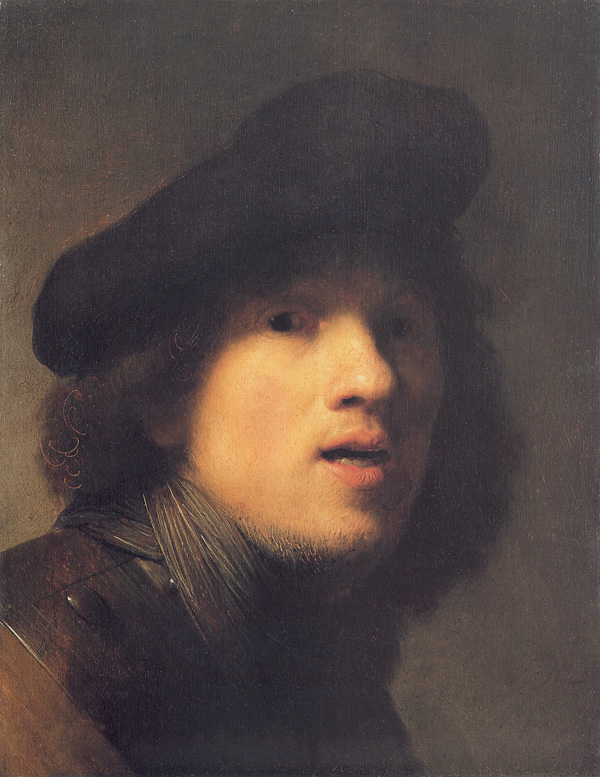
Rembrandt’s “Self-portrait with Gorget and Beret” from 1629 is a compact burst of ambition. The young artist presents himself in dramatic half-shadow, the mouth slightly parted as if caught mid-breath, a dark beret throwing a broad silhouette across his brow, and a gleam of metal from a gorget rising at the throat. The image is brisk in size yet vast in implication. It functions as a rehearsal of identity, a study in light and atmosphere, and a showcase for technical daring at the outset of his career. What makes this painting so compelling is the way it fuses theatrical costume with searching self-scrutiny: the armor suggests an actor’s part, but the face insists on presence, curiosity, and alertness. It is both a public calling card and a private experiment, the kind of work Rembrandt used to define what his art could do.
Historical Moment and Studio Context
The date 1629 places the work in Rembrandt’s Leiden period, when he was in his early twenties and already deep into experiments with expressive heads and strong chiaroscuro. He had returned from study with Pieter Lastman in Amsterdam and was working independently, sometimes in friendly rivalry with Jan Lievens. These years are marked by small panels and copper plates, intense manipulation of light, and a fascination with faces that double as characters and portraits. The artist turned often to the mirror, testing angles and expressions that could be harvested for etchings and paintings. The self-portraits from this time are not mere reportings of appearance. They are laboratories for drama and craft. This example in particular concentrates several questions in one frame: how far can light model a head, how does costume shape persona, and how might a glance activate space.
The First Encounter
Stand before the painting and the first sensation is the leap of flesh into light. A warm glow touches the left cheek, nose bridge, lower lip, and the small tuft of beard that catches just a spark at the chin. Everything else retreats. The beret is a dark continent, the hair dissolves into a cloud, the garment sinks into dusk except for the steel gorget that snags illumination along a bevelled edge. The head turns as if surprised to see us, not with fear but with interest. The parted lips communicate breath and time—this is a person mid-moment rather than a frozen mask. The effect is intimate and theatrical at once, a delicate balance that will become a signature of Rembrandt’s best portraits.
The Language of Costume
Rembrandt often used historical or exotic costume early in his career to create tronies—studies of head and expression in character. The gorget, a neck piece from a suit of armor, and the soft beret are not contemporary streetwear for Leiden in 1629; they are props that signal role-playing. The armor lends gravitas and situates the figure within a timeless realm of soldiers, heroes, or courtly types. The beret carries artistic associations, recalling the cap of Renaissance makers and thinkers. By combining them, the painter suggests two identities at once, martial and intellectual. Yet the face refuses to turn into a generic type. The specificity of the gaze and the mouth brings the costume back to earth. The props are vehicles, not destinations, and they establish a frame in which the artist asserts the primacy of seeing.
Chiaroscuro as Form and Meaning
The painting’s structure hinges on chiaroscuro. Illumination enters from the left, skimming surfaces and withholding itself just as quickly. This alternating rhythm of gift and refusal builds the head in relief. The light is not evenly descriptive; it is raking and strategic, emphasizing protrusions and turning planes. The cheekbone receives a creamy highlight, the nostril and philtrum deepen in shadow, and the half-occluded eye holds a dark well of thought. The depicted metal of the gorget reads with a distinctly different timbre from the flesh or fabric. Its reflectivity tightens the touch and sharpens the value shift, while the skin retains a soft, almost granular glow. Beyond description, the lighting confers mood. It stages the figure at a threshold, emerging from the background like a revelation and then slipping back into mystery. Identity here is a negotiation between what appears and what remains implied.
Brushwork and the Craft of Edges
Close viewing reveals how much the painting’s conviction rests on edges. Rembrandt manages transitions with exquisite control, moving from firm contour at the lit side of the nose to a melting contour at the jaw where shadow takes over. The beret’s boundary is crisp against the background light, while the hair releases into small curls that pick up glints without surrendering to fussiness. The gorget combines decisive strokes for the bright ridge with a quick modulation into shadow to suggest its rounded volume. Across the face tiny notes—one dab at the lower lip, a darker notch by the corner of the mouth, a brief glimmer along the eyelid—act like punctuation, guiding the eye’s reading without cluttering the page. The surface is tight in the passages that need authority and relaxed where suggestion will carry the form. This orchestration of edges is one of the young Rembrandt’s signature skills.
Color, Ground, and Atmosphere
The palette is modest: warm earths, a restrained red for the lip and cheek, smoky browns and blacks in the hat and background, and a cool note for the steel gorget. What enlivens these few hues is the way they interact with the warm ground. Rembrandt allows the ground tone to breathe through thin layers of paint in the shadows, producing an amber atmosphere that seems to radiate from within. The lighter flesh passages sit like bubbles of illumination atop that glow. The result is a sense of air density around the head. Lighting does not feel pasted on but suspended within an environment. This atmospheric cohesion grants the small panel remarkable breadth.
The Mouth as a Measure of Life
Few details in early Rembrandt are as eloquent as the slightly open mouth. The parted lips animate the face with breath and suggest the beginnings of speech or surprise. They complicate the expression so that it resists simple labels. The feature also carries a technical challenge. It requires the painter to differentiate the red of the lip from the flesh without spilling into caricature. Here the tone is carefully calibrated, the upper lip dark and soft, the lower lip brighter at the rim and tucked into shadow underneath. Together they create a pocket of space in which the teeth and tongue are only hinted at. The psychological effect is powerful: it is the moment before words, the interval in which attention pivots.
The Eye and the Keel of the Nose
Rembrandt tilts the head so the nearer eye sits close to the shadow edge. This decision gives the gaze unusual depth. The lit sclera gleams but the iris sinks back, making the eye a dark window rather than a reflective bead. The nose acts as a keel around which light breaks. The narrow highlight at the bridge is brighter than anything else on the face, anchoring the composition. The gaze, the nose, and the mouth thereby form a diagonal that organizes the whole, leading from the light source into the shaded interior and back out to the lip. This diagonal becomes the painting’s narrative path.
Youth, Experiment, and the Making of Persona
The self-portraits from Leiden are studies in becoming. The painter tries on roles—soldier, courtier, philosopher—not to disguise himself but to discover how gesture, light, and costume can construct an image of self that persuades. The gorget adds a note of daring and strength; the beret associates him with learned craft; the open mouth suggests spontaneity; the intense modeling of the flesh claims mastery of technique. These elements together announce a young artist staking his claim in a crowded market. He does not rely on sumptuous ornament or display of wealth. He relies on the performance of painting itself as a measure of worth.
Relationship to Tronies and the Print Workshop
This painting sits near a cluster of etched and painted heads in character that Rembrandt produced around the same time. Those tronies were not commissioned portraits but commodities intended for sale to a broad audience. They allowed the artist to display handling and expression without the social obligations of likeness. The self-portraits often double as tronies, and vice versa. In this work the line between the two dissolves. The result is a hybrid type: a private likeness presented with the theatrical clarity of a character study. The cross-fertilization with printmaking is also evident. Areas of sharp brightness against matte shadow anticipate the graphic logic of etching, while the rich halftones reveal painterly resources beyond the printmaker’s reach.
The Gorget as Symbol and Surface
As an object, the gorget is a treasure for a painter. Its hard curvature receives light in a narrow band and throws a crisp reflection. It offers a radically different surface from skin or cloth, and its geometry clarifies the direction and intensity of illumination. As a symbol, it carries echoes of valor and discipline. For a young artist, adopting the gorget advertises seriousness and strength without any boast. The object’s modest scale prevents grandiosity; it is a detail rather than a parade. Yet its presence rings clearly in the chord of the painting, reminding us that Rembrandt understands persona as a crafted interplay of material and meaning.
The Beret as Frame and Shadow Engine
The beret is both costume and device. Its wide brim frames the forehead and deepens shadow over the eyes, heightening the drama of the gaze. Its silhouette strengthens the composition by creating a large, simple shape against which the more delicate flesh can play. In some later self-portraits Rembrandt uses hats as light catchers, tracing their edges with highlights. Here he uses the hat primarily as a generator of shadow. It becomes an architectural element that shapes interiority. The darkness over the brow does not dehumanize the figure; it humanizes him by introducing privacy within the portrait.
The Background as Active Silence
The background is not purely blank. It is a softly modulated field that records brush movement and carries a gentle counter-glow near the lit side of the head. This halo is not decorative; it pushes the figure forward and clarifies the silhouette. The absence of objects or narrative furniture keeps all attention on the face and the subtle play of textures. In doing so, Rembrandt aligns the painting with the highest aspirations of portraiture: to grant the ordinary miracle of a person’s presence enough space to fill the frame.
The Touch of the Hand
One of the deepest pleasures of this work is how palpably it registers the painter’s hand. The skin is built from short, buttery strokes that sit close to the ground and hold light like fine grain. The hat and background are laid with broader, more absorbent sweeps, acquiescing to shadow. The metal of the gorget is sketched with sly precision, a bright ridge set against a swift falloff. These differences are not accidents; they are a coded vocabulary. The hand changes tempo according to surface, and the viewer learns to read that tempo as information. The result is a portrait that not only depicts touchable things but also feels touched into being.
Expression and the Ethics of Truthfulness
Rembrandt’s self-portraits rarely flatter. Even this youthful work avoids idealization. The budding beard is scruffy, the nostril shadow a little stubborn, the lower eyelid faintly puffy. Such details ground the image in observation rather than formula. The effect is not cruelty but respect. The painter grants his own face the same seriousness he would grant any sitter. The ethical stance embedded in this decision—truthfulness as a form of honor—will become central to his mature practice. It is already visible here in the way realism coexists with drama without either defeating the other.
Anticipations of the Later Rembrandt
Look closely and the seeds of later greatness are present. The interplay of warm ground and cool top notes anticipates the atmospheric breadth of the 1640s portraits. The willingness to leave deep shadow in control of large zones proposes the meditative darkness of the 1650s and 1660s self-portraits. The exploratory mouth foreshadows the psychological openness of the late works where speech, breath, and thought seem to vibrate in the paint. Even the modest format predicts how the artist will make intimacy a site of monumentality. The young Rembrandt is not yet the sage of the late self-portraits, but he already understands that presence is larger than scale.
Reception and Function
In the bustling Dutch market, a work like this served several functions. It could hang in the studio as proof of skill, impressing visitors and patrons with the artist’s mastery of light and flesh. It could feed the motifs and strategies of contemporary etchings, translating painterly solutions into graphic ones. It could also educate the painter himself, crystallizing lessons about edges, color temperature, and the psychology of the gaze. The work therefore exists at the junction of advertisement, experiment, and self-knowledge. That variety of function helps explain why the self-portrait became a recurring site of innovation across Rembrandt’s career.
Condition, Scale, and Intimacy
The painting’s small size invites close viewing. It asks the beholder to stand within the zone of conversation, to share the air that the open mouth suggests. Any wear on the surface, any craquelure or softening of glazes over time, tends to deepen the human warmth rather than diminish it, because the paint layers are organized in such a way that the essential forms remain legible. The scale suits the subject: a direct, unembarrassed look at a single face rather than a ceremonial display. It draws its power from concentration rather than spectacle.
What the Painting Teaches
This self-portrait teaches several lessons about Rembrandt’s art at the dawn of his career. Light can be both sculptor and storyteller, modeling forms while scripting mood. Costume can unlock persona without overwhelming individuality. The difference between surfaces—skin, cloth, and metal—can energize a composition and clarify the flow of attention. Above all, the face is not a static emblem but a living stage on which thought and breath appear and vanish. The genius of the painting lies not in proving these claims abstractly but in making them self-evident the moment one meets the gaze across the small field of paint.
Conclusion
“Self-portrait with Gorget and Beret” is a young artist’s manifesto in miniature. It fuses theatrical garb with unguarded presence, marries crisp light to soft atmosphere, and turns a narrow color range into a world. The work’s drama is concentrated in the mouth about to speak and the eye poised in shadow, while the armor and cap build a persona that is both historic and contemporary. The painting proves that confidence does not require flamboyance, that inwardness can command a room, and that the craft of edges and tones can carry as much emotion as any narrative. From this small panel radiates the path Rembrandt will follow for decades: a path where truth, light, and the complexity of the human face lead the way.
