Image source: wikiart.org
Introduction
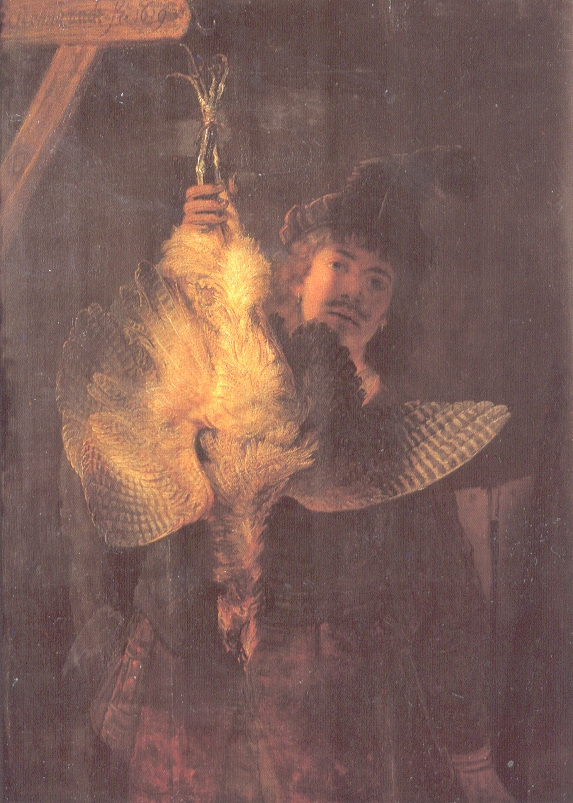
“Self-portrait with Bittern” (1639) is one of Rembrandt’s most surprising meditations on identity and matter. At first glance we see a young man emerging from shadow, his face and hat barely legible, while in front of him a great marsh bird explodes into light. The bittern, suspended upside down from a fist that disappears into plumage, becomes the picture’s blazing center, its soft belly and broad wings shimmering like a lantern. Rembrandt turns the usual hierarchy of portraiture on its head: instead of spotlighting the artist’s features, he allows an animal’s body—dead, heavy, and incandescent—to claim the stage. The result is a picture that hovers between self-portrait, trophy still life, and vanitas, and it shows the painter thinking aloud about how light, touch, and mortality shape the self.
An Unconventional Self-Portrait
Rembrandt made dozens of self-portraits across his career, many of them testing roles and guises—courtier, soldier, gentleman, biblical actor. In this canvas he takes up the role of hunter or game dealer, but with a twist. The human figure recedes into dusk; the quarry advances, a winged screen of light. This inversion is deliberate. It is as if the artist were saying that what defines him is not the face he presents to the world but the object he studies, handles, and renders. The self becomes a consequence of attention. By letting the bittern eclipse his own visage, Rembrandt proposes that the painter’s identity lives in his gaze and his hand—in the act of making—more than in his likeness.
Composition and the Stage of Light
The composition is governed by a radical vertical: the bird’s body hangs from the upper left and occupies the center like a golden pendulum. The downward thrust is countered by the horizontal spread of wings, whose scalloped feathers catch and measure the light. From the top left corner, a diagonal wooden support or rack pushes toward the suspended feet, creating a triangular armature that holds the image in tension. The artist’s head, just right of center, appears in a pocket of darkness, with a narrow halo of light grazing the cheek and mustache. The entire design pushes the viewer’s eye in a loop—down the hanging body, across the wing, back through the face, and up the vertical of the grasping arm—so that the picture breathes in long, slow circuits.
The Bittern as Protagonist
The bittern is a marsh bird prized for its rich plumage and rare, resonant call. In Dutch still life its feathers and subtle color made it a favorite subject for painters interested in texture and sheen. Rembrandt embraces the bird’s tactile abundance. The belly reads as a mass of down that diffuses light; the wing, rendered with minutely varied strokes, turns light into scales. Notice how each feather is not carefully outlined but suggested by a rhythm of brushmarks that quicken and relax as the wing curves. The amber core of the body gives way to cooler grays at the tips, a chromatic softening that lets the wing melt into shadow at the edges. He paints weight as well as glow: the neck twists into a knot; the body sags from the grip; the inverted head, mostly hidden, is felt as a gravitational pull near the bottom of the canvas.
Still Life, Hunt Piece, and Vanitas
Seventeenth-century Dutch art loved the “hunt piece,” a still life of game birds and hares presented on hooks or tabletops. Such images celebrated prosperity, taste, and skill. Yet they also carried vanitas overtones, reminding viewers that life is temporary and flesh perishable. Rembrandt knows this language and complicates it with his own presence. The dead bird occupies the place where a noble sitter’s torso would usually be; its bright body becomes an emblem of fleeting beauty. The artist’s sober face behind it adds a note of self-interrogation: to paint is to handle the perishable and turn it into lasting vision, but it is also to confront the end of life with open eyes. The painting thus reads as a manifesto of craft and a meditation on mortality.
The Human Figure in Shadow
Although the bird dazzles, the human figure is far from incidental. Rembrandt paints himself with a feathered cap, cloak, and belt of working gear. The right hand, gripping the bird’s tied legs, is almost entirely absorbed by down; the left hand descends toward the lower edge, its wrist marked by the soft glint of a bracelet or cuff. The face is built in warm half-tones that never quite reach the brilliant whites lavished on the plumage. Eyes peer from the shade with the curiosity and steadiness familiar from his other self-portraits. The mouth is slightly open, as if mid-breath. He offers not a dramatic actor’s mask but a workman’s concentration, a presence felt rather than announced.
Chiaroscuro as Revelation
The light that strikes the bird is not gentle; it is concentrated, almost theatrical. Rembrandt shapes it as a wedge that pierces the dark, turning down into glow and wing into mother-of-pearl. The surrounding space drinks the light rather than reflecting it, so that the effect is of a world that exists only where the painter’s attention falls. This is one of Rembrandt’s favored strategies: to make light behave like understanding. Here, understanding is given to feathers, down, and the complicated meeting of textures. The human face receives enough illumination to be legible but not enough to compete, signaling that revelation belongs to the object.
Color and the Alchemy of Warmth
While reproductions often register the picture as a field of browns and golds, the chromatic orchestration is subtle. The bittern’s belly ranges from honey and straw to pale peach; its wings shift through olive grays and smokier tones. These warm notes sit against a ground of deep umbers, bottle greens, and wine-colored shadows, creating a low, orchestral harmony rather than a bright chord. The small lights on the artist’s cheek and the band at his wrist are tuned to the bird’s palette, integrating human and avian into a single tonal world. The overall temperature is autumnal—a palette of ripeness and ending—which amplifies the picture’s elegiac mood.
Paint Handling and Tactile Knowledge
Close looking reveals how Rembrandt toggles between kinds of touch. The down of the bird’s belly is painted wet-into-wet, with soft, swirling strokes that let pigments mingle and bloom; the wing feathers take firmer, striated marks laid in repeating arcs; the knotted legs and tied cord are done with wiry, linear accents. The human face is layered in thin glazes that create a living transparency, while the hat’s feather dissolves into dry whispers against the dark. These shifts are not mere virtuosity. They reproduce the tactile facts a hand would learn: softness yielding under pressure, barbed feathers resisting, cord biting into scaly skin. The paint becomes a record of touch remembered and transposed into sight.
Gesture, Grip, and the Ethics of Handling
The grip matters. Rembrandt holds the bird high, as a seller would display goods or a hunter would show his prize. Yet despite the show, there is no cruelty in the gesture. The hand is firm but not punitive; the wrist relaxes; the fingers disappear into the fluff. In the context of a self-portrait, the grip becomes allegorical: the painter holds matter up to the light, not to dominate it but to reveal it. The body of the bird becomes the body of paint, and the act of holding becomes the act of making.
The Workshop and the Theater of Making
A diagonal beam at the upper left hints at a studio or market scaffold. The dark space behind reads less as a natural environment than as the unlit volume of a room. This theater-like staging was central to Rembrandt’s practice. He manipulated curtains, shutters, and screens to direct beams with precision, creating pools of radiance where surface could burst into presence. In “Self-portrait with Bittern” the studio becomes a crucible: light enters, matter blooms, and identity coalesces around the act of showing.
Dialogue with Rembrandt’s Other Self-Portraits
Seen alongside the laughing, costumed, or armored self-portraits of the late 1630s, this painting feels more sober, even introspective. Instead of displaying himself as a character, Rembrandt displays an object as a test. In later years he will turn to even blunter examinations of aging flesh and unadorned presence; this canvas anticipates that candor. The bird’s inverted body foreshadows the candlesticks, flayed ox, and carcasses in other works where the painter confronts the raw givens of life. Yet unlike the monumental “Slaughtered Ox,” here Rembrandt inserts himself directly, acknowledging that the artist is part of the chain that links life, death, and representation.
Symbolism and the Sound of Silence
The bittern was known for its deep, booming call—so distinctive that it entered Dutch proverbs. Hanging lifeless and silent, it becomes an emblem of voice stilled. Placed before a self-portrait, that silence shades into reflection: what does it mean for a painter—a maker of voices in pigment—to share space with a mute creature? Rembrandt’s expression is not triumphant but thoughtful, as if aware that mastery over an image is different from mastery over life. The painting leaves room for empathy without preaching it, a characteristic Rembrandt balance.
The Viewer’s Role and the Scale of Encounter
The picture asks us to stand close. From a distance we register a bright shape floating in darkness; near the surface we enter the world of feathers, cords, and pores of skin. The self-portrait element also shifts with distance. Across the room the artist nearly disappears; a step or two forward and his face emerges, framed by the fan of wings. This variable legibility is a gentle lesson in how attention changes meaning. The bird can be a dazzling still life or a shield that partly veils the self; the portrait can be a quiet cameo or a meditation on labor; the whole can shift with our approach, just as identity shifts with the things we hold.
Time, Mortality, and Transformation
The canvas speaks softly but persistently about time. The bird hangs at a point of transition, newly dead yet not yet plucked or dressed; its colors glow as if the last warmth of life were still within. The painter, full of youth but shadowed, studies it with the seriousness of someone for whom each painting is also a reckoning with the perishable. Rembrandt is often called a master of light, but he is equally a master of transformation. Here he translates a moment in the life of an animal into a lasting form without denying the cost. The work does not sentimentalize death; it absorbs it into the dignity of attention.
Why the Painting Feels Modern
The picture’s modernity lies in its refusal to fix a single genre. It is a self-portrait that cedes space to a still life, a trophy image that doubts bravado, a vanitas that whispers rather than lectures. Its light is curated but not theatrical; its paint is visible, its making transparent. Contemporary viewers can feel, almost physically, the artist’s choices—the pressure of a loaded brush, the quickening of small bristles over feather tips, the restraint at the edge of the cheek. That visibility of process connects us to the painter not through likeness but through labor.
Conclusion
“Self-portrait with Bittern” is a daring experiment in identity. Rembrandt lets a radiant mass of plumage eclipse his own features and, in doing so, articulates a vision of the self grounded in the act of seeing. The bird is at once trophy, model, and memento mori; the human hand that suspends it is both craftsman’s tool and emblem of care. Light enters, encounters matter, and builds meaning. Few paintings from the Dutch Golden Age bind still life and self-portrait so intimately or meditate with such quiet power on the link between what we hold and who we are. In this shadowed room in 1639, a young painter offered a credo that would echo through his later work: art is attention made visible, and attention confers dignity even on what has fallen silent.