Image source: wikiart.org
Introduction
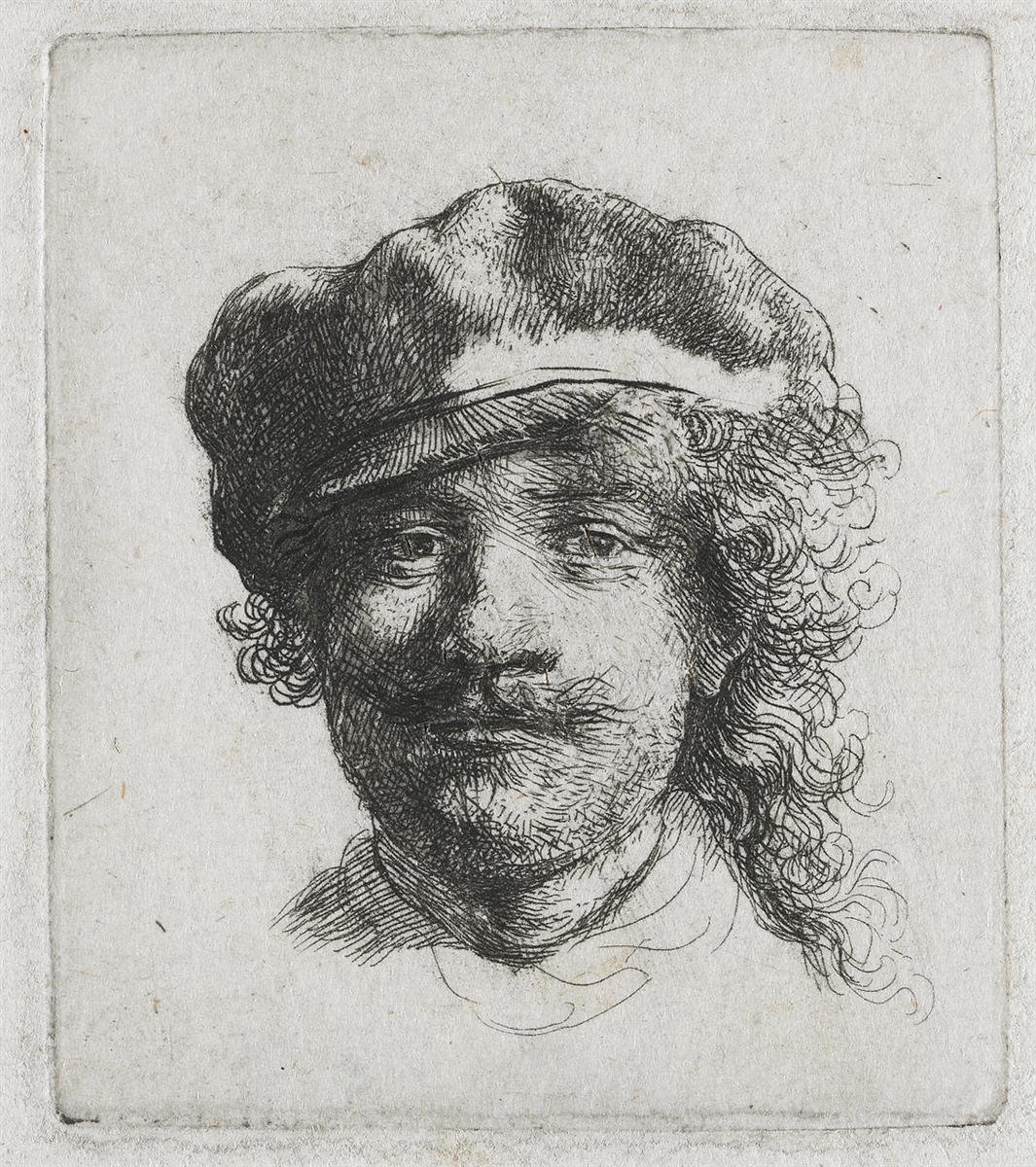
“Self-portrait Wearing a Soft Cap, Full Face, Head Only” is a compact tour de force from 1634, the year Rembrandt married Saskia van Uylenburgh and cemented his move from Leiden to Amsterdam. Barely larger than a hand, this etched head radiates immediacy: a close, frontal look from a young artist who is testing his image in copper and acid rather than in paint. The soft cap sits low over his brow, a casual badge of the studio; curls spill freely at the sides; a slight mustache creases with a suggestion of a smile. Minimal as it is—no costume display, no background stage—the print contains a world of technical bravura and psychological nuance. It shows Rembrandt discovering how a web of lines can capture not only semblance but presence.
Historical Moment
The date matters. In 1634 Rembrandt was twenty-eight, newly famous for portraits and religious scenes and newly embedded in Amsterdam’s commercial and artistic networks. He was also producing a flood of etchings that circulated quickly among collectors, dealers, and fellow artists. These small self-portraits are not mere vanity projects. They serve as calling cards, experiments, and micro-autobiographies rolled into one. This particular plate belongs to the early cluster of etched self-studies in which Rembrandt plays with identity—sometimes adopting theatrical expressions, sometimes slipping into a role—before settling here on frank, front-facing candor.
Medium and Technique
Etching trades brush for needle and acid. Rembrandt coated a copper plate with wax ground, drew with a steel point to expose the metal, then bathed the plate in acid so the lines would bite. In this print he keeps the burr of drypoint to a minimum and relies instead on bitten lines of varied density. The hat’s shadow, for instance, is knitted from tight cross-hatching; the cheeks and nose are built from more open, curving strokes that let the paper act as light. Around the chin he runs finer, parallel lines that shift direction as the form turns, and at the neck he leaves faint, exploratory scratches that suggest—but do not fully state—the collar. The result is a living surface in which line density, spacing, and direction behave like values and temperatures do in paint.
Composition at Intimate Range
Rembrandt crops the head boldly. The cap grazes the top of the plate, curls brush the side margins, and the truncated collar at bottom asserts that this is “head only”—no shoulders, no props. Such closeness matters: it eliminates transitional space and forces confrontation with the face. The slight asymmetry of the curls, the gentle lean of the cap brim, and the tiny irregularities of the outline combine to give the head sculptural presence. The composition reads instantly, even from a distance, because the masses are clear—dark cap, mid-tone face, darker ring of hair—and the eyes sit at the quiet center of the geometry.
The Soft Cap as Studio Emblem
The cap is practical and emblematic. Artists in northern Europe often wore soft berets or caps in the workshop; the headgear hints at the craft without the rhetoric of grand costume. Rembrandt renders it with luscious economy: broader hatchings shape the crown; a darker band registers the seam; two or three decisive strokes define the forward brim. Because the cap covers much of the forehead, it throws the eyes slightly into shade, intensifying their look and letting the face emerge from darkness—an etched analogue to the painter’s beloved chiaroscuro.
Light Drawn With Silence
Light in an etching is paper left untouched. Rembrandt engineers a simple illumination that glows from the front and slightly above. Notice how he leaves the bridge of the nose and upper cheek almost bare of line, then thickens the hatching as planes recede into shadow around the temples and under the mustache. Tiny white ellipses at the lower eyelids moisten the gaze; a single breather on the lower lip keeps the mouth from hardening. The print demonstrates a crucial rule of Rembrandt’s graphic art: where the viewer’s attention should settle, the marks loosen and the paper’s brightness speaks; where structure must be asserted, the marks condense.
Expression and Psychological Temperature
This is not one of the comic grimaces or wide-eyed role-plays found in other early self-portraits. The expression is settled and self-possessed. A faint upward pull at the corners of the mouth hints at amusement; the lids hang with youthful calm; the gaze meets us without challenge. The effect is paradoxical: intimacy without intrusion. We are invited to look closely at the face, but we are not pulled into a performance. That restraint may reflect the year’s transitions—marriage, new clientele, greater public scrutiny—and Rembrandt’s awareness that the self now needed to be presented as a reliable professional, not only a virtuoso of feeling.
The Grammar of Curls
Rembrandt’s curls are a playground of etched line. On the cap’s shaded side, they compress into dense, almost knotted hatching; on the light side they spring into arabesques that drift into the blank field. He is sparing with literal ringlets. Instead, he writes hair as energy—tight, elastic marks that relax as they meet light and air. This treatment does double duty: it expresses youthful vitality and creates a halo-like contrast that pops the face forward.
Youthful Physiognomy
Compared with later, sober self-portraits, this 1634 head records a smoother cheek, a slender mustache, and a jawline not yet buried beneath age or worry. The modeling refuses cosmetic polish, however. Look at the slight furrows between brow and cap brim, the faint pouches under the eyes, the unevenness at the nostrils created by asymmetric hatching. These are not defects; they are marks of lived presence. The young artist is already practicing the honesty that will define his mature work—truthfulness about the face as a terrain of time.
Comparison Within the Self-Portrait Series
Viewed against the expressive studies of about 1629–1631—open-mouthed astonishment, laughter, frowns—this plate is calmer. Viewed against later self-portraits in paint—brocaded costumes, shimmering chains, role-playing as an Eastern potentate—it is simpler. What it shares with the whole series is the inquiry: what can a face, under different lights and attitudes, reveal about the changing self? Here the answer is modest confidence. The etched method reinforces that note by austerity of means, as if to say, “I can be fully present with almost nothing.”
The Business of Etchings
These prints functioned in an emerging market. Their size and cost made them collectible, portable images of authorship. A self-portrait etched and printed in numbers could circulate widely, building recognition beyond the reach of a single painted commission. For Rembrandt, whose brand in 1634 depended on being both brilliant and dependable, this quietly charismatic head—unadorned, frank, technically exact—was ideal publicity. The soft cap, so plainly “workmanlike,” advertises craft over costume.
Plate States and Printing Variability
Etchings live multiple lives as printers pull impressions across time. Some impressions preserve a whisper of plate tone—a film of ink deliberately left on the plate—that veils the background and deepens shadows beneath the cap brim; others are wiped more cleanly, making the face brighter and slightly flatter. That variability means the portrait can appear to shift mood from impression to impression. In one, the look may feel luminescent and open; in another, more brooding and introspective. Rembrandt understood and exploited such variability, often revisiting plates to adjust lines or deepen bites, treating printing as another stage of artistry.
Drawing, Sculpture, and the Edge
A secret of the portrait’s vividness is the “breathing edge” around forms. Rembrandt avoids a hard contour around the head. Instead he lets adjacent hatchings suggest boundary by contrast. On the cap’s lit side he allows the paper to create a soft, fuzzy silhouette; on the shadow side he compresses the lines so that the border snaps into focus. The viewer reads these fluctuations as depth and turn, just as the eye reads the softened edges of painted flesh. The etched head thus feels modeled in the round, not pasted onto the page.
The Ethics of Looking at Oneself
Self-portraiture carries the temptation to flatter or to perform. This plate sidesteps both. The gaze is steady and undecorated; the artist allows the etched equivalent of pores and flyaway hairs. That ethical decision—to meet oneself without disguise—foreshadows the searing honesty of the late painted self-portraits. Even at twenty-eight, the artist is practicing a habit of scrutiny that is both technical and moral: to tell the truth about surfaces so that inner life can be inferred without theatrics.
Sound in a Silent Medium
What might be called the “acoustics” of the print are carefully tuned. Dense hatchings under the cap and at the left cheek behave like bass notes; the thin, quick curls at right sparkle like treble; the quiet, open planes of nose and cheek operate as rests. The composition’s rhythm—dark-light-dark-light across the width of the face—keeps the small sheet lively. This musicality is not fanciful; it is part of how Rembrandt ensures that the image remains animated even though no gesture or background activity is present.
Influence and Afterlife
Rembrandt’s innovations in self-portrait etching became benchmarks for later generations, from eighteenth-century printmakers who admired his bite and plate tone to nineteenth-century realists who prized his psychological candor. The immediacy of this particular head—its direct look, its technical clarity—made it especially popular as a study piece for students learning how to translate light with line. It also shaped the public’s image of Rembrandt as a figure of approachable genius: not a distant court painter, but a craftsman who looks you in the eye.
The Face as Trademark
Even as it speaks intimately, the print functions as an early trademark. Collectors who owned this and related self-portraits recognized Rembrandt’s features—the soft cap, mobile eyes, and unruly hair—as signatures almost as potent as his etched name. In a culture that valued authorship and originality, such recognizability mattered. The head tells viewers: here is the person behind the miracles of light and paint, a man whose identity is inseparable from his work.
The Experience of Scale
Encountered in person, the print’s smallness compels closeness. One leans in, narrows focus, and in doing so unconsciously mimics the artist’s concentrated labor at the plate. The act of looking becomes a mirror of the act of making. That intimacy is the opposite of grand portraiture on a wall; it is a conversation piece designed for the hand and the binder, for study by a window rather than applause in a hall.
Conclusion
“Self-portrait Wearing a Soft Cap, Full Face, Head Only” distills Rembrandt’s early brilliance into a handful of etched lines. It is technically exact yet alive with breath; modest in scale yet expansive in character. The soft cap signals the workshop; the curls register energy; the measured gaze declares a young master who already knows that truthfulness and economy can outshine finery. The print is not just an image of Rembrandt—it is a manifesto written in light and line: that art, at its most enduring, is a meeting of candor, craft, and attention.