Image source: wikiart.org
Introduction
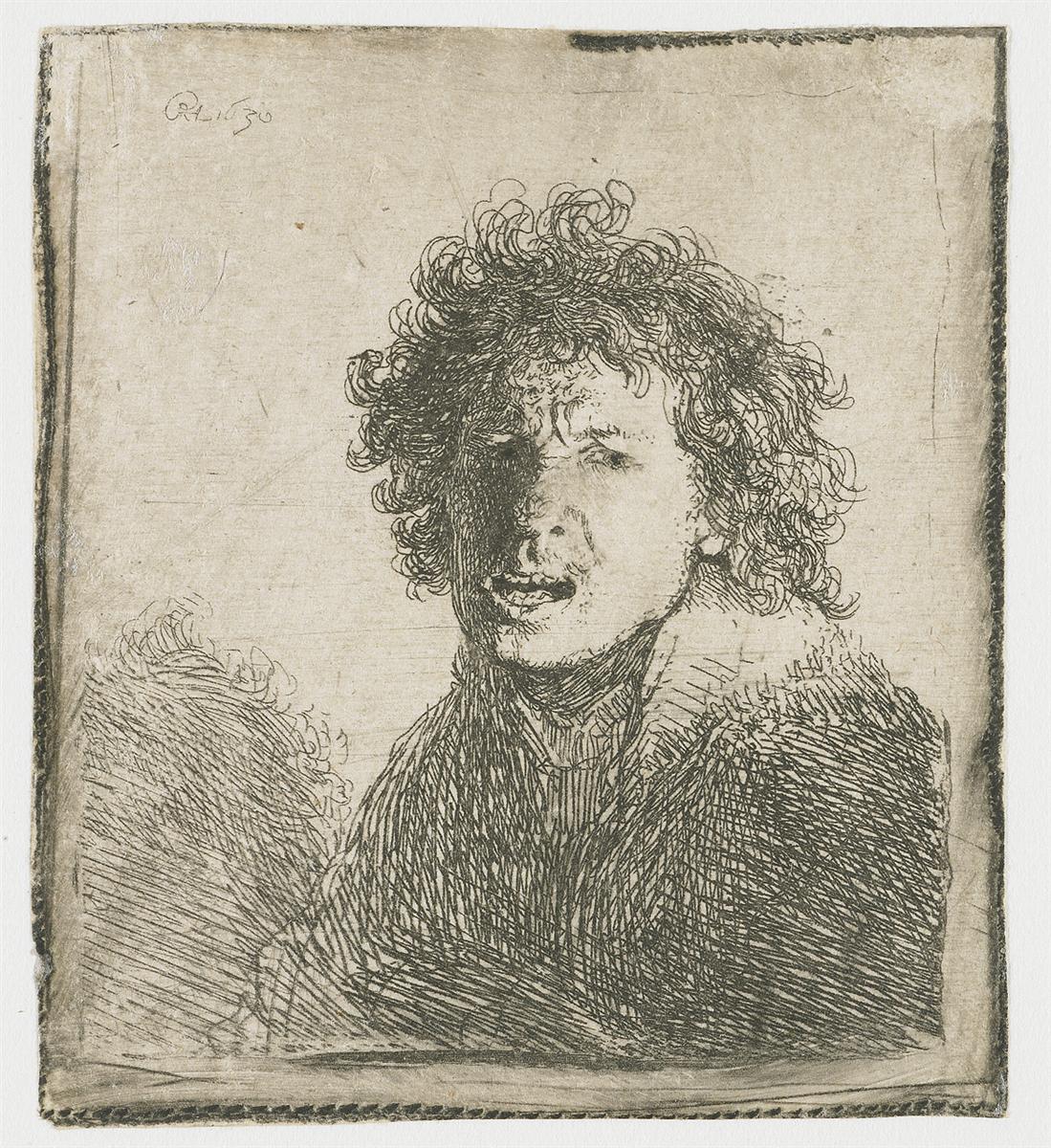
Rembrandt’s “Self-portrait Open Mouthed” (1630) is a small etching with the force of a shout. The young artist leans toward the viewer, hair in restless curls, lips parted as if caught in the instant before words become sound. One half of the face is steeped in shadow; the other, preserved as bright paper, is all nerves and breath. The sheet belongs to the artist’s famed cycle of early self-studies in Leiden, where he turned his own features into a laboratory for expression, light, and line. In this impression, he investigates the mechanics of speaking and the shock of being seen, transforming a quick studio experiment into a durable image of presence.
The Leiden Moment and Why This Image Matters
Around 1629–1631, Rembrandt repeatedly etched his head at the mirror, producing tronies—studies of character and mood rather than formal portraits. These intimate plates circulated among collectors who prized virtuoso draftsmanship and the new, psychological candor of Dutch art. “Self-portrait Open Mouthed” is one of the most kinetic of the group. Instead of a sober gaze, we are given a mouth in motion, brows flexing, eyes half-squinting into bright air. For a painter interested in biblical drama and everyday life alike, mastering such extremity was practical: prophets cry out, beggars call, merchants bargain, lovers exclaim. Here, the young artist tests how a handful of etched lines can persuade us that the head is making sound.
Composition That Feels Like an Exclamation
The head sits high and slightly left inside the printing border, with a broad, unoccupied field to the right. That asymmetry acts like a gulp of air before speech. A dense wedge of cross-hatching forms the torso and fur collar, thrusting diagonally across the lower quarter of the sheet and giving the figure weight. Above that base, a storm of curls surrounds the face like an aura of agitation. The mouth lies almost at the center, the true heart of the design, while the eyes tilt toward differing intensities of light—one narrowed in the penumbra, one exposed and alert. Even the plate’s internal framing line and faint drypoint scuffs feel like tremors around an utterance.
Etching as a Recorder of Breath and Pace
Etching captures velocity unmistakably: the needle’s speed and pressure remain legible in every stroke. Rembrandt uses that quality to embody breath. Long, confident lines knit the cloak; short, darting marks vibrate across the cheeks and around the mouth; quick spirals in the hair flicker like sparks. The cross-hatching at the throat tightens into a mesh, a graphic equivalent of the muscular constriction that shapes a syllable. He does not smooth these marks into anonymity. Their individuality is the message. We read them as the physical record of an action—an opening mouth and a body that braces to launch sound.
The Mouth as Anatomy and Meaning
Open mouths are notoriously hard to draw without slipping into caricature. Rembrandt solves the problem by binding expression to structure. A clear inner contour defines the dark of the oral cavity; the upper lip lifts, its edge broken by the philtrum; the lower lip rounds forward with a small highlight left as untouched paper. Subtle ticks at the corners keep the lips from dissolving into a perfect oval. The result is not a mask of astonishment but a believable, moving organ. It may be the start of a word, a groan of effort, a gust of laughter—the ambiguity is alive because the anatomy is exact.
Light and Shadow as the Music of Speech
The image’s chiaroscuro is decisive. The left half of the head, including one eye and much of the cheek, rests in shadow built from nested hatchings and drypoint burr; the right half is mostly preserved paper, the etching equivalent of a bright studio window. This half-lit division is not theatrical decoration; it is rhythm. The dark side holds back like a consonant—the pressure before release—while the bright side spills forward like a vowel. The distribution of light turns the face into audible form, with paper white functioning as the clear tone of a voice entering air.
Hair, Fur, and the Orchestration of Textures
Rembrandt assigns each material its own “dialect” of line. Hair is a quick language of loops and broken spirals that trap glints of white; the fur collar is a dense thicket of parallel strokes that read as warm heaviness; skin is a mosaic of tiny, direction-changing marks that allow value to shift without losing vibrancy. This orchestration is not incidental. Differences in texture keep the eye from sticking to expression alone; they build a believable head anchored in matter. Sound emerges from body, the plate insists—from curls that catch light, from clothes that hold heat, from the throat’s working darkness.
Negative Space and the Ethics of Reserve
Much of the sheet, especially at right, is left nearly untouched. That reserve is a principled choice. It prevents the figure from being buried in description and converts blankness into breathable space. The open field becomes the room into which the voice travels, the listener’s air, the silence that sharpens sound. Rembrandt’s refusal to fill every corner is an ethics of attention: he gives the figure what it needs—no more, no less—and trusts the viewer to complete the moment.
The Eyes as Evidence of Thought
Although the mouth commands attention, the eyes complicate the drama. The one cast in shadow is narrowed and almost wincing, skeptical of glare or effort; the bright-side eye opens to the light, scanning what—or who—caused this reaction. Their asymmetry rescues the face from theatrical cliché. This is not an emblem of surprise or terror; it is a mind in motion, processing an event even as sound escapes. The delicacy of the pupils—simple dark seeds within pale ovals—keeps the image from hardening into a cartoon.
The Border as Stage and Artifact
The plate includes a clear inner line that frames the image within a slightly larger, roughly inked margin. That drawn border behaves like a stage lip. The figure appears to lean over it, reducing the distance between etching and viewer to conversation range. At the same time, the border reveals process: this is a copperplate object printed under pressure, its edges catching ink and leaving a tactile memory of the press. Such physical candor fits the portrait’s theme of immediacy. Nothing about the sheet hides its making.
Relation to Other 1630 Self-Studies
Compared with the famous wide-eyed surprise etching from the same year, “Self-portrait Open Mouthed” investigates a different grammar of emotion. Where the earlier plate is about shock and intake, this one explores articulation and release. Placed beside the painted self-portraits of 1630—calmer, bathed in warm chiaroscuro—the etching reads as a rehearsal for moments of heightened narrative in later paintings. The consistency across media is striking: in every case, Rembrandt anchors drama in observed anatomy and truthful light rather than in symbolic props.
Printing Variants and Atmospheric Weather
As usual with Rembrandt, impressions can vary with inking and wiping. A plate tone left on the surface can veil the background in a gray that feels like studio dusk, deepening the left-side shadow and making the mouth glow. A cleaner wipe brightens the paper white, sharpening the contrast and cooling the mood. Heavier inking enriches the fur collar’s darkness; lighter inking lets the hair sparkle. These variants are not accidents but ways to tune the voice of the image—hoarse whisper, bright exclamation, or something in between—without altering a single line.
Technique as a Language of Empathy
Even at this early date, Rembrandt’s technique is inseparable from his humanism. He does not use his own face to mock himself or to parade virtuosity. He uses it to learn how people look when they are caught between impulse and thought. The exactness of the etched mouth and the honesty of the half-shadowed eye argue that attention is a form of respect. He will grant the same dignity to elders in armchairs, to beggars warming their hands, to prophets in crisis. The self is the first recipient of that care.
Lessons for Artists and Viewers
The print offers practical guidance. To depict speech, bind expression to structure—let the inner dark of the mouth, the lift of the upper lip, and the pull at the corners do the work. Assign textures distinct mark-languages so materials separate without outline: loops for hair, dense parallels for fur, small varied dashes for skin. Preserve paper as light rather than trying to “draw” brightness. Use asymmetry—of eyes, of light, of composition—to keep emotion dynamic. Most importantly, stop early. The open background is not a lack but the space where sound will live.
The Modernity of a Small Sheet
The image feels startlingly contemporary because it trusts essentials. No props, no emblem, no allegory: just a head, a moment, and the marks that carry it. Its honesty about process—the visible border, the unfilled corners, the lively burr of drypoint—aligns with modern taste for the seen hand. More profoundly, the subject is a universal human interval: the split-second in which breath takes shape as voice. The etching is as relatable at a smartphone’s scale as in a print room’s quiet.
Why This Voice Still Carries
What gives “Self-portrait Open Mouthed” its enduring pull is the way it turns a private studio experiment into a shared experience. Stand before it and you can feel the beginning of a word in your own throat. The image asks nothing but attention and offers, in return, the sensation of meeting another person exactly in the moment he becomes audible. That generosity—of presence, of craft, of unguarded emotion—has kept the small copperplate speaking for nearly four centuries.
Conclusion
In “Self-portrait Open Mouthed,” Rembrandt uses the most economical means—etched line, preserved paper, a handful of tonal fields—to hold a mind and body at the instant of utterance. Composition funnels energy toward the mouth; light divides the head into restraint and release; texture grounds sound in matter; negative space grants breath. The plate is both study and declaration: that expression emerges from truth, that technique can be humane, and that a sheet no bigger than a hand can contain the drama of speech itself.