Image source: wikiart.org
Introduction
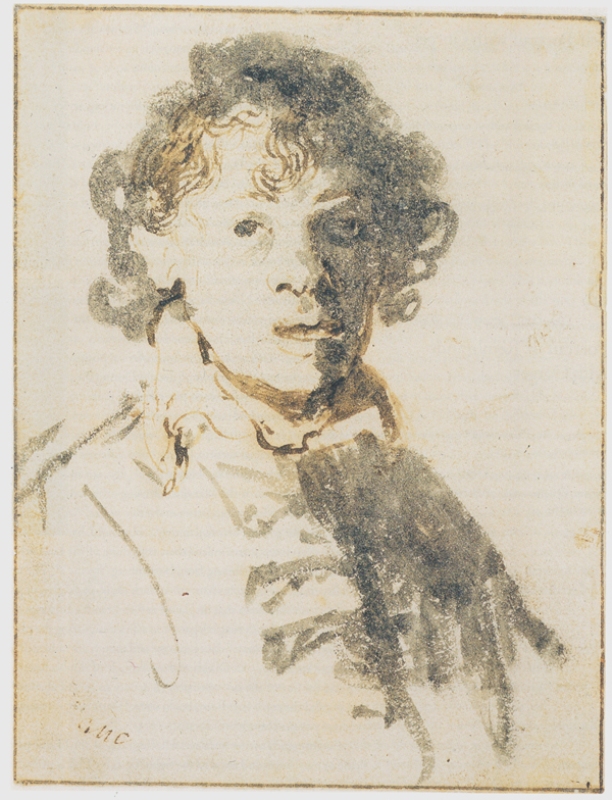
“Self-portrait, Open Mouthed” (1629) is among the most revealing experiments of Rembrandt’s Leiden years. Instead of the poised calm we associate with formal portraiture, the young artist gives us a face caught mid-breath—lips slightly parted, eyes alert, hair tumbling in soft curls. The drawing feels as immediate as a gasp. Sketched with a nimble combination of pen, brush, and wash, it compresses everything Rembrandt cared about at twenty-three: light as thought, line as touch, and the conviction that a fleeting expression can disclose more truth than a rehearsed pose. The sheet is small, but it opens a large window onto his method and his emerging philosophy of portraiture.
The Leiden Laboratory
The year 1629 places this study in a period when Rembrandt used his own face as a laboratory instrument. In Leiden he made a string of “tronies”—expressive head studies—often with the help of a mirror placed near the easel. These works weren’t commissioned; they were self-assignments where he could practice physiognomy, lighting, and the choreography of features without the etiquette of bourgeois portraiture. This sheet documents that process with unusual candor. The quick strokes, the half-resolved clothing, the absence of background architecture, and the frank asymmetries make visible a mind thinking through the face. As much as any oil from the same year, the drawing proves that Rembrandt’s search for character began in the mirror long before it moved onto the grand stage of history painting.
Composition That Points To Breath
The composition is startlingly simple—head and shoulders near the center, turned slightly to the right—but it is engineered to emphasize the channel of breath. The head sits high within the rectangle, so the open mouth falls on a visual axis that runs straight to the viewer’s eye. The upward swoop of the collar guides attention toward the lips, while the dark, brushed silhouette of the shoulder operates as a counterweight, stabilizing the composition so the face can flicker with life. The spare background leaves no distraction; the white of the paper becomes air around the head, a blank where breath can travel. In such economy, every mark matters, and the drawing rewards close looking with a sense of motion suspended.
The Open Mouth As A Device Of Life
The parted lips are not theatrical; they are anatomical. Rembrandt paints the instant when the jaw has relaxed but not yet formed a word, when inhalation or exhalation makes the lips glisten and separate. It is the same mute syllable that appears in several 1629 self-portraits in oil—an early signature. The effect is twofold. First, it convinces the viewer that the sitter is alive in time, not frozen in a museum pose. Second, it tilts the portrait toward psychology: the artist is thinking, surprised, or about to speak to himself. The mouth becomes an aperture through which interiority leaks into view.
Chiaroscuro Written In Ink And Wash
Even without oil’s depth, Rembrandt creates a sculptural play of light and shade. He builds the lit cheek with minimal line, letting the white paper act as flesh. For the shadowed side he switches to brushed wash: a diluted, smoky tone that feathered across the face, keeps the form round while whispering the presence of bone beneath skin. The shadow is not a block; it is transparent, as if light were passing through it. Small strokes along the nose and under the lower lip act like reflectors, bouncing brightness into the shadow so the face never collapses. This is chiaroscuro as a living pulse, achieved with materials that move as quickly as perception.
Line That Touches Rather Than Traces
One of the pleasures of the sheet is its line. Rembrandt’s pen does not merely outline; it palpates. Around the curls he spirals freely, letting some loops close and others unravel, so hair reads as air-caught vibration rather than a schematic helmet. Along the collar he varies pressure from crisp to ghosted, suggesting folds with a brevity that invites the viewer’s imagination. The contour of the cheek is not a single continuous fence; it is a series of suggestions that cohere into skin only when the eye collaborates. This “lost-and-found” approach to line is how Rembrandt generates intimacy: he gives us just enough and trusts us to complete the rest, like a conversation that leaves space for the listener.
Paper, Medium, And The Speed Of Seeing
The material facts matter. On a fine, light-toned paper the brown ink and sootier wash sit lightly, allowing the drawing to breathe. You can feel the speed of the hand: quick, confident spells around the eyes; slower, searching strokes at the mouth; broad, soft brushwork over the shoulder where he wanted tone without detail. The materials are not neutral. Pen encourages decisiveness; wash allows ambiguity. Together they enact the two halves of perception—certainty and hesitation—and the face seems to oscillate where those halves meet.
The Role Of The Mirror
A self-portrait in 1629 almost certainly involved a mirror set close enough to permit quick, alternating glances between subject and sheet. That setup explains the subtle skew in the features and the sidelong angle of the head. It also explains the feeling of privacy. We are looking at someone who is looking at himself, and that reflexive loop is intoxicating. The drawing becomes a record not just of a face but of the act of seeing that face. This is why the open mouth reads as an interior reaction: we witness a thought as it registers in muscle, and the artist, seeing that registration, records it on paper. The image is the echo of an echo.
Clothing As Sketch, Not Costume
The garment is indicated with just a handful of strokes and a pool of wash. It supplies weight and direction—a diagonal mass that pushes the composition forward—but it refuses to claim attention as fashion. Rembrandt does not need brocade or lace to show skill. He lets the shoulder’s darkness and the collar’s spur of light frame the face, then gets back to the main event. This restraint is strategic. It keeps us from reading the sheet as a role-play and anchors it as a study of being rather than of dress.
Eyes That Think In Two Keys
Rembrandt often paints one eye in clearer light than the other, a choice that animates the interior dialogue of a face. Here the left eye (on the viewer’s right) sits in shadow yet glitters with a small accent, while the other, in lighter territory, is more openly modeled. The difference makes the gaze feel kinetic, as if awareness moves across the features rather than emanating from a fixed point. When paired with the open mouth, the effect is of thinking-in-progress. The portrait doesn’t deliver a conclusion; it shows cognition.
The Ethics Of Imperfection
Some early self-portraits chase polish; this one favors truth. The nose is not symmetrically lit; the mouth is a little off-center; stray pen marks fringe the jaw. Rembrandt could have corrected them. He chose not to. The decision speaks to a core value: likeness grows from lived irregularities, not from ideal proportions. The visible working marks also preserve the drawing’s humanity. They remind us that a person made this quickly, with breath in his chest and ink on his fingers, and that the sitter and maker were the same young man.
Kinship With The Painted Studies Of 1629
Seen next to the 1629 oil self-portraits—especially the close-up heads with parted lips—this sheet reads like a preparatory heartbeat. The oils multiply the tonal range and add the poetry of color; the drawing crystallizes the essential problem those paintings solve: how to fix an instant of expression without strangling its life. That the solutions in both media feel consistent testifies to Rembrandt’s integrated eye. He was not translating a formula from drawing to paint; he was pursuing a single insight through different instruments.
Sound, Silence, And The Imagined Studio
Because the mouth is open and the modeling stays soft, viewers often find themselves “hearing” this drawing: a faint intake of breath, the tiny wet click of lips, the scratch of pen across paper. The sheet becomes a soundscape as well as an image. That auditory imagination situates us in the studio—north light, the mirror on a stand, the artist stepping forward to check his mouth’s shape, then stepping back to record it. The presence is so strong, one can almost feel the pause between glances, the tiny delays through which likeness is born.
Space Without Background
The absence of scenery does not mean a lack of space. Rembrandt invents depth through edge behavior and value alone. The dark shoulder thrusts forward; the shadowed cheek recedes; the curls create a halo of midtone that separates head from paper. Nothing casts a shadow on a wall and yet the figure floats in air. This subtle staging lets the drawing read both as a physical head and as a mental event—the kind of double identity that would become a hallmark of Rembrandt’s portraiture.
The Tronie Tradition And Its Transformation
Technically this is a tronie, an expressive head study not tied to a patron. But Rembrandt transforms the genre by folding in autobiography and psychology. Instead of an anonymous “character type,” we get a specific young man inhabiting an expression that seems to originate from thought rather than acting. That blend of type and self would later allow him to embody biblical figures with an intimacy that feels freshly observed, as if he had sat across from them and drawn from life.
What The Drawing Says About Ambition
A young painter depicting himself open-mouthed is making a wager. He is betting that viewers will value life over polish, immediacy over finish, honesty over flattery. He is also announcing a program: to pursue the human face as a site where painting, philosophy, and biology meet. The understated bravado of the sheet lies in its refusal to dress up for approval. Instead, it brings the viewer within arm’s length of the creative process and asks them to love the unguarded moment.
Lasting Influence And Contemporary Freshness
Centuries later, artists and viewers still respond to the drawing’s directness. Photographers seek similar “in-between” expressions; sketchers learn from its minimal means and maximal effect; museum-goers feel the pulse of breath across time. The sheet’s freshness comes from how it seems to renew itself each time we look. Because so much is suggestive, not dictated, our imagination reanimates it, and the open mouth opens again.
Conclusion
“Self-portrait, Open Mouthed” is a small miracle of observation from 1629, packed with the energy of a face discovering itself. Pen and wash collaborate to build a living chiaroscuro; line caresses rather than corrals; the composition steers us toward breath and thought. By daring to stop the clock on a fleeting expression, Rembrandt enlarges what portraiture can contain. The sheet stands as an early pledge that he will always favor the human over the ornamental, the present tense over the posed, and the truth of a single breath over the safety of an ideal mask. In its quick marks and luminous gaps, we meet a young artist and, through him, the enduring mystery of how a face begins to speak.