Image source: wikiart.org
A Young Artist Caught In The Act Of Listening
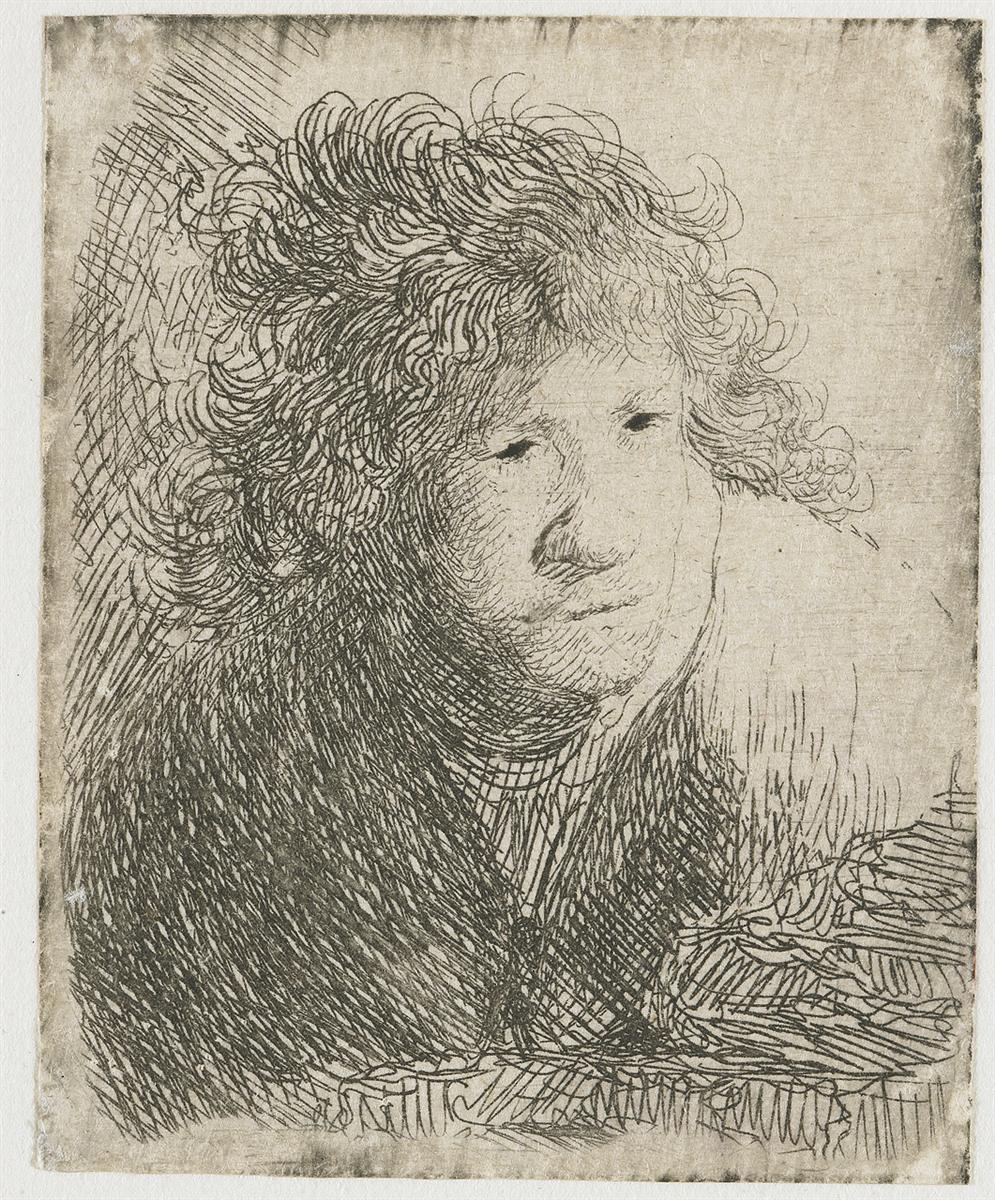
Rembrandt’s “Self-Portrait, Leaning Forward (Listening)” from 1628 is a small etching that feels wonderfully large in meaning. He places his own head and shoulders right at the picture plane, the curls of his hair swelling like weather, the eyes not quite focused on us but tuned to something offstage. The mouth rests in a thoughtful curve, the chin tipped slightly down, and the whole figure leans across an implied ledge as if to catch a fragment of speech. This is not the swaggering youth of a tronie in costume; it is a working artist portrayed in the most important stance he could adopt at the start of a career: attentive, curious, and alert to the world beyond himself.
Leiden, Etching, And The Urgency Of Experiment
In 1628 Rembrandt was in Leiden, refining an artistic language that already prized psychological specificity over spectacle. Etching, still a relatively nimble newcomer compared to engraving, matched the tempo of his mind. A wax-coated copper plate could be drawn into with a needle as quickly as one might sketch on paper; acid later bit those lines into the plate’s surface. The medium registers speed, pressure, and hesitation, turning the artist’s movements into a visible history. In this self-portrait Rembrandt exploits that responsiveness to show a pose too fleeting for a formal painting. The print has the frankness of a note from the studio, yet it achieves the intimacy of a face seen across a table.
A Composition Engineered For Contact
The head sits low and forward, thrusting into our space while leaving a pale, breathing field to the right. The shoulders compress into a dark wedge that anchors the body like ballast, and the curls expand above in a loose, airy crown. Hatching spreads beneath the jaw and across the chest in long, gently curving bands that echo the inclination of the torso. At the upper left, diagonal hatch builds a shallow corner that feels like the room’s whisper. The arrangement is simple and brilliantly effective: weight below, atmosphere above, a listening face between. We feel the pull of gravity and the counterpull of attention at the same time.
The Expressive Grammar Of Line
Rembrandt’s etched line behaves like speech. He scumbles and cross-hatches where forms need mass, skates lightly where air should remain. The curls are drawn as quick loops and hooks—never repetitive, always responsive—which keeps the hair alive as a boundary that breathes. The shadowed throat is woven from compact, parallel strokes that travel with the planes of anatomy, a dark scarf of marks that both models form and explains the lean. Across the face he restrains himself to a handful of decisive notches: a rehearsed pause of upper lids, a small dark at the inner corners of the eyes, the broken contour of nose and cheek, a soft shadow under the lower lip. The economy is astonishing. With almost nothing, he persuades us not only of likeness but of listening.
Listening As Psychology And Method
The subtitle “Listening” is not a later critic’s fancy; the figure’s attitude makes the act legible. The head tilts forward a few degrees more than a conversational pose. The mouth loosens, neither speaking nor sealed. The gaze slides away from the viewer’s direct line and settles at a point where meaning is arriving. This is a portrait of attention, and it doubles as a declaration about artmaking. Rembrandt represents himself as a receiver before he is a performer, the kind of painter who will let subjects tell him who they are. The self-portrait therefore offers more than a mood; it proposes a method.
Plate Tone And The Weather Of The Room
Many impressions of this little plate preserve a delicate film of ink—plate tone—that Rembrandt left intentionally when wiping the copper. That gray veil turns bare paper into atmosphere. He wipes more cleanly around the forehead and the higher curls to pop small highlights, while leaving tone thicker at the chest and left margin so the bust settles into space. The result is a room we can feel. The air near the listener is clearer; the air behind him is denser; the whole sheet acquires a kind of humidity appropriate to quiet concentration.
Edges That Let The Portrait Breathe
One reason the print seems alive is the way edges are negotiated. The cheek and jaw do not harden into cutout contour; they arrive and dissolve through sequences of short, responsive lines that allow the paper’s light to play as reflected glow. Around the curls, lines detach from one another, letting ground and hair mingle like strands floating in air. At the shoulder, heavier hatch binds mass to the page. These “lost and found” edges are not a trick; they are a philosophy of vision. The human head does not end where a cartoon line ends; it blends into air. Rembrandt draws that blending and so preserves the sitter’s breath.
The Hands We Do Not See
Although only head and chest are present, the print suggests hands by proxy. The slanted fields of hatch at the lower edge rise like an unseen forearm resting on a tabletop, and the forward tilt implies a hand’s weight bearing on that ledge. The absence becomes eloquent: the artist is both subject and observer, leaning as if to turn a page or shade an ear. This hinted agency keeps the portrait from becoming a passive mask; attention here is active, muscular, and chosen.
From Tronie To Self-Portrait, And Why The Distinction Matters
Dutch tronies often feature dramatic expressions or extravagant costumes that let artists display technical bravura. Rembrandt experimented with that mode—grimaces, fur caps, steel gorgets—in the same year. In “Leaning Forward (Listening)” he chooses the opposite strategy. He keeps nothing theatrical and lets the power derive from a face thinking. The hybrid status—self-portrait with a tronie’s freedom—lets him be both honest and experimental. He can stop when the image breathes, not when convention demands finish.
The Rhythm Of Values And The Music Of Silence
If you squint at the print, the head appears as a dark-to-mid value mass set against a pale field. Only a few pinpricks of near-white—forehead, cheek, a breath at the bridge of the nose—spark at the surface. Those small lights are enough to establish direction and mood. The rest is a restrained symphony of grays that produces the sensation of silence, the kind of silence in which listening happens. Value here is not just modeling; it is acoustics. We hear the room by how deeply the grays and blacks sit in the paper.
The Ethics Of Self-Scrutiny
This is no flattered likeness. The nose is short and blunt; the mouth carries the heaviness of youth; the hair is ungoverned. Yet nothing is cruel. The artist’s refusal to idealize himself is not a performance of humility; it is a commitment to candor. He accepts the face he has so that he may be free to study what faces do. That decision—visible across his whole career—is already present in this small plate. It is the foundation on which his later compassion for others will rest.
Listening As A Social Stance
Rembrandt’s forward lean accomplishes something else: it collapses the social distance between artist and viewer. We do not gaze upon a distant genius; we share a table with a young man who appears eager to catch the next sentence. This inclusion is part of the Dutch miracle of the seventeenth century, where artists and patrons met more as citizens than as courtiers. The picture practices the democracy it implies. It makes room for our voice.
What The Etching Teaches About Time
Though fixed, the portrait is temporally charged. The hair’s calligraphic energy feels like a recent motion; the softening around the mouth suggests breath just released; the tilted head implies the next moment when he will nod, answer, or turn. The lines preserve the pace of their making—quick here, deliberate there—so that time runs through the print at multiple scales: the second it captures, the minutes it took to draw, the years it prophesies in a career of looking. That temporal density is why the small sheet feels consequential.
Comparison With The Painted Self-Portraits Of 1628
In painted self-portraits from the same year, Rembrandt orchestrates glows across skin, scarf, and metal gorget, using oil’s capacity for depth. The etched “Listening” strips those cosmetics away. What remains is the bare relationship between intention and mark. Where the painted panels persuade by the drama of light, this print persuades by the persuasiveness of touch. Together they reveal a young artist building twin literacies—one in tone and color, one in line and pressure—that he will fuse in later masterworks.
The Viewer’s Path Through The Image
The print quietly choreographs our eye. We begin at the dark wedge of chest and climb the long parallel hatch toward the chin. There the linework tightens, so we slow. The nose’s broken edge tips us up to the small light at the forehead, and from there we drift through the curls, losing focus into the right-hand air. The diagonals at upper left tug us back down, and the cycle begins again. Each loop rehearses the act of listening: approach, attend, release, return. The composition is an embodied lesson.
Failure And Correction Left In Place
Look closely and you can find tiny exploratory marks where the artist searched for a contour, especially around nose and cheek. In a polished engraving such hesitations would be burnished out. Rembrandt keeps them. They operate like the faint penciled lines on a musician’s part—cues and breaths—evidence of a living process. Their presence extends empathy. We recognize not just a face but the making of a face, and in that recognition the portrait becomes more intimate.
The Human Proposal Inside The Technique
Under its virtuosity the etching argues for a way of being human. It suggests that listening is an active art, that attention requires posture, that curiosity is a form of respect. The portrait’s economy of means models the same ethic: say only what is necessary, but say it with all your focus. No ornament competes with the subject; no flourish distracts from meaning. Technique remains the servant of regard.
Seeds Of The Mature Rembrandt
This compact sheet forecasts several traits of Rembrandt’s mature printmaking. The “lost and found” edges will blossom into atmospheric borders in large biblical etchings; the dark anchor under the head will recur as a device for pulling figures into our space; the candid face will evolve into the late self-portraits’ deep self-knowledge. Above all, the commitment to psychological truth—faces as scenes where thought becomes visible—stands here at full strength.
How To Look Slowly
Set the print at reading distance and let the head come toward you. Trace the hatching at the chest with your eye until you feel the body’s weight. Pause at the small, damp darkness at the inner eye corner; let that dot organize the rest. Wander into the curls until they dissolve into atmosphere on the right, then return by the diagonal fields at the upper left, as if sound were calling you back. After several circuits the portrait stops being an image and becomes a presence, a person you could interrupt and to whom you might just as well listen.
Enduring Significance
“Self-Portrait, Leaning Forward (Listening)” endures because it converts a simple pose into a manifesto of attention. It shows the young Rembrandt not as a stagey prodigy but as a worker whose first tool is the will to hear. The etched lines carry the energy of that will—quick, searching, and exact. In a few square inches the print models a compact wisdom that still feels contemporary: that the most persuasive art begins in listening, and that the most persuasive likeness is the one that tells the truth about how a person attends to the world.