Image source: wikiart.org
Introduction
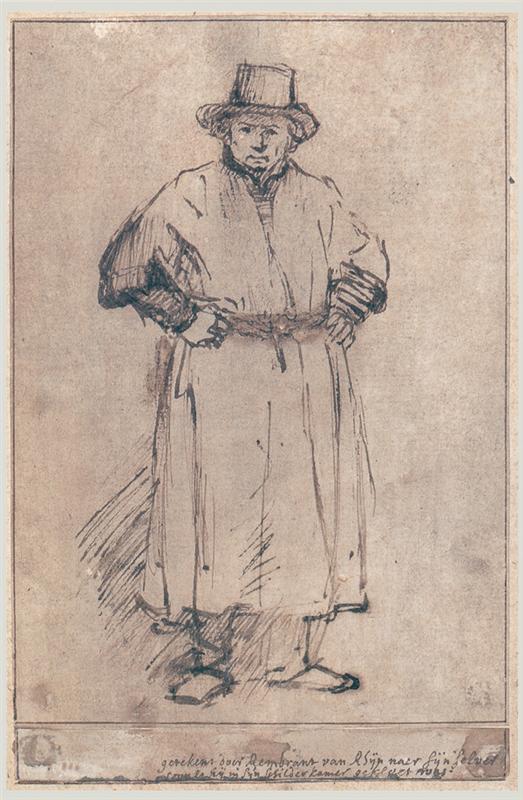
Rembrandt’s “Self-portrait in Studio Attire” from 1655 is a rare, candid study of the artist as worker rather than celebrity. Drawn with quick, economical strokes of pen and wash on toned paper, the figure stands frontally, hands planted at the hips, waist bound with a loose sash, and head topped with a practical cap. There is no theatrical backdrop, no regalia, no easel or palettes to announce vocation. What we see instead is a person paused in the middle of his day, clothed for labor, measuring us as coolly as he measures himself. The sheet has the immediacy of breath on a winter window—fleeting and precise at once—yet its spareness contains an entire philosophy of making.
The Studio As A State Of Mind
Because Rembrandt eliminates furniture and props, the “studio” arrives as attitude. The wide stance, the firm hands, and the centered mass of the robe define a zone of work around the body. The drawing reads like a portable workplace, as if the habits of looking, judging, and deciding have condensed into posture. A workshop cluttered with canvases and prints may surround him in reality, but the sheet proposes that the true studio is the artist’s attention and the discipline that supports it.
Materials That Favor Speed And Thinking
The portrait is executed in pen and ink, reinforced with swift touches of wash that anchor shadows at sleeves, hat brim, and hem. The paper’s mid-tone becomes the dominant atmosphere, allowing the artist to model volume with minimal darks and to reserve the brightest notes for untouched paper at the cheek and hat crown. Pen drawing was Rembrandt’s preferred language for testing ideas at full speed; here the medium becomes autobiography. The broken contours, the ruled runs of parallel strokes, and the sudden stillness where the line rests all feel inseparable from the artist’s thinking process.
Work Clothes As Aesthetic Program
The robe is not fashion; it is a studio habit. Its long, simple fall protects street clothes from pigment and chalk. The sash gathers the fabric at the waist so sleeves can be hitched up, freeing the hands. The cap keeps hair out of the eyes and filters overhead glare. Rembrandt records these features without fetish or fuss, letting the clothing speak to function. It is an anti-costume that paradoxically becomes a uniform—the insignia of a painter who treats labor as an honor.
The Architecture Of The Stance
The figure is built like a tripod: two feet angled outward, planted solidly; the third support implied by the vertical staff of the body rising from the belt. This geometry makes the self-portrait feel unbudgeable. The hands on the hips pull the robe laterally, setting up diagonals that counter the verticals of the front opening and the sash. Those crossing vectors lock the body into the page while also animating it, as if the artist has just stepped back from a canvas to judge a passage and will step forward again in an instant.
Hands That Announce Authority And Use
Rembrandt’s hands are not refined into anatomical showpieces; they are working parts, approximated with dense, knotty strokes that insist on grip and pressure. The right hand clutches the sash with an economy that reads as certainty, while the left pushes against the hip to create a firm fulcrum. Their placement gives the drawing its tone: the artist is not posing for admiration; he is bracing for judgment—his own of his work and ours of him.
A Face Made Of Measures, Not Flourishes
The head sits squarely atop the column of the robe, the face modeled with a few decisive notes: lids indicated by short arcs, a compact wedge for the nose, the mouth set in a line that refuses either smile or frown. Beneath the hat the hair spreads out in a scribble that feels exact. The expression is that of a craftsman caught in the interval between actions. He is not introspective in a romantic sense; he is calculating, balancing what he sees with what he intends to do next. In this sense the portrait becomes a diagram of judgment.
Light Without Spotlight
No theatrical illumination singles the figure out. Instead, a generalized studio light washes across the robe, creating faint highlights on the front fold and casting the sleeves into modest shadow. The face receives just enough value contrast to turn. By avoiding chiaroscuro heroics, Rembrandt keeps the image in the key of work. Light is there to reveal volume and temper, not to compose an epic.
The Discipline Of Leaving Things Out
One of the drawing’s pleasures is how much Rembrandt declines to describe. No background, no floor plane, no deep shadow under the feet. The robe’s lower half is suggested with a handful of descending lines, and the shoes are little more than abbreviated wedges. This withholding clarifies intention. The artist is after stance, attitude, and the compact theater of hands, belt, and headwear. Everything else is distraction.
Toned Paper As Time And Air
The warm paper does more than host ink; it supplies the atmosphere of the studio and the patina of time. Minor stains and foxing read like traces of use, as if the sheet has lived among charcoal, glue, and grindstones. That wear is fitting for a drawing about labor. It also deepens the tonal scale without added wash, allowing a modest economy of marks to feel full.
The Border Of Words And The Value Of Naming
Some impressions of this sheet carry a written note beneath the figure—part inscription, part label—that identifies the subject and sometimes alludes to the purpose of the study. Whether or not those words are present on the version you see, their idea hovers: this is Rembrandt as he goes to work. Naming the attire and role fixes the self-portrait in the social world of Amsterdam craftsmen, where identities were as practical as they were poetic.
The Year 1655 And The Courage Of Simplicity
The date is not incidental. In the mid-1650s Rembrandt was moving toward the bold, pared-down language that defines his late work. Within a year he would face bankruptcy proceedings, yet the drawings and etchings from these years radiate freedom. This self-portrait accepts the humbling realities of life and chooses to make from them a new aesthetic: fewer lines, truer rhythms, greater faith in gesture. The studio robe, not courtly silk, becomes the chosen icon.
Dialogue With Earlier And Later Self-Images
Compare this sheet to Rembrandt’s youthful, showy self-portraits with feathers, velvet, and theatrical light. Those earlier images stage ambition; this one stages responsibility. Compare it again to his very late painted self-portraits in which he appears with palette and brushes in monumental bust-length. There he is the elder master. Here he is the daily worker. The three phases—ambition, labor, mastery—are not contradictory; they are the arc of a life. This drawing occupies the honest middle.
Line As Character
Every segment of contour doubles as personality. The firm vertical slit of the robe declares directness; the rough, hatched sleeve declares energy; the errant tail of the sash declares improvisation. Even the wobbly brim of the hat feels right: it is a tool that has done its time. When viewers speak of Rembrandt’s line as “alive,” they mean what this sheet demonstrates—that the stroke records pressure, speed, and intention so transparently that you can reconstruct the gesture of the hand that made it.
The Ethics Of Self-Representation
This self-portrait is honest to the point of tenderness. There is no flattery, no self-pity, no apology. The mouth’s straight set and the heavy robe admit fatigue; the squared shoulders insist on resilience. The drawing refuses all myths of genius that separate talent from effort. It shows a person whose authority arises from showing up each day and doing the work with clarity.
The Viewer As Silent Collaborator
Because the drawing leaves so much open, the viewer’s eye completes folds, rounds the hat, fills the shadows. We become collaborators, supplying the very details the artist withholds. That participatory quality mirrors studio life, where models, assistants, and patrons were part of the daily conversation of making. In looking, we join the studio.
From Study To Emblem
While the sheet may have begun as a quick note toward a larger figure or as a mirror exercise, it reads now as an emblem: the artist in working clothes, standing his ground. Reproduced in books, on walls, and in minds, it has become shorthand for Rembrandt’s creed. The image answers a perennial question—what does an artist look like while being most himself?—with a single, unadorned figure holding his belt.
Tactility And The Memory Of Tools
Even without seeing brushes or pens, we can feel them in the drawing. The tight wrist that lays down the hat brim is the same wrist that steadies a mahlstick over wet paint. The forearm that fixes the sash is the one that would pull a burin across copper. The robe’s drape hints at shoulders used to carrying portfolios and canvases through narrow Dutch streets. The sheet stores the body’s history, and that history makes the likeness credible.
The Quiet Drama Of Scale
The figure nearly fills the vertical, leaving just enough air above the hat and below the shoes to keep the composition from choking. That slight squeeze adds charge, like a voice raised half a step. It also keeps the viewer within conversation distance. We are neither looking up to a monument nor down at a vignette; we are facing a person across the narrow hallway of a studio.
Why The Drawing Still Feels New
The image’s modernity lies in its candor. Contemporary viewers, accustomed to behind-the-scenes images of artists at work, recognize the authenticity of work clothes and the unposed stance. Yet the drawing goes beyond documentary. It distills the dignity of labor into a few lines and invites us to honor not only the finished masterpieces but also the countless standing pauses, belt-tightenings, and self-assessments that make them possible.
Conclusion
“Self-portrait in Studio Attire” is Rembrandt’s compact manifesto. It states that art is a profession of attention, that the body’s stance is the first tool, and that simplicity is the bravest style when truth is the aim. With pen, wash, and toned paper, he builds a figure sturdy enough to hold a lifetime’s habits. The robe is humble; the cap is ordinary; the hands are slightly rough. Count those as the portrait’s laurels. The artist looks back at us as if to say: this is how I work, this is how I stand, and this is how I will be remembered—not only by grand canvases and sonorous etchings but by the honest line that recorded a craftsman prepared to begin again.