Image source: wikiart.org
Introduction
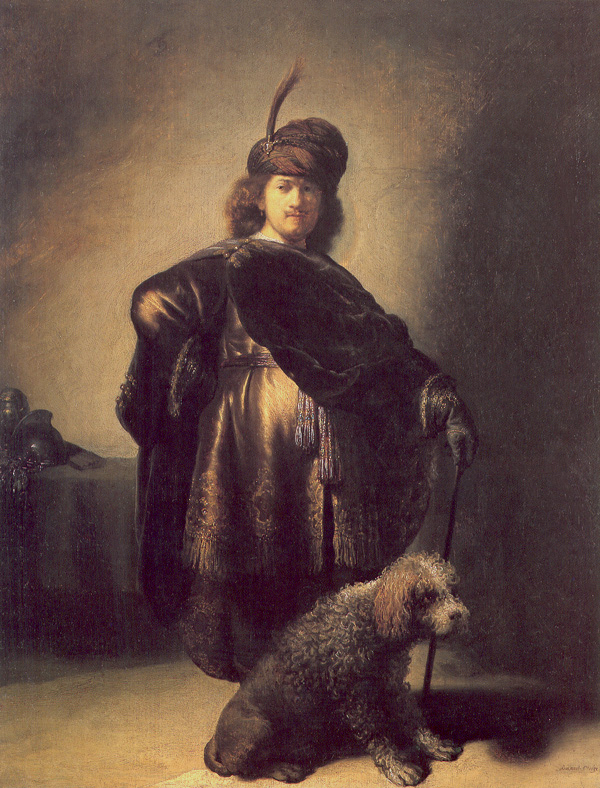
“Self-portrait in Oriental Attire with Poodle” (1631) shows the twenty-five-year-old Rembrandt performing with delightful audacity. Cloaked in sumptuous “Oriental” costume, crowned by a jeweled turban and a feather plume, he stands in a pool of light like an actor stepping into view. One hand rests on a walking staff; the other disappears beneath a velvet mantle elaborately trimmed with gold. At his feet, a curly poodle sits alert, its muzzle turned into the light. Armor glints on a table to the left. The scene is part masquerade, part manifesto: an artist announcing his command of light, texture, and persona at the very moment he was arriving in Amsterdam’s competitive market.
A Pivotal Year And A Shrewd Self-Fashioning
The date 1631 is crucial. Rembrandt had just shifted from Leiden to Amsterdam, bringing with him a portfolio of expressive heads and small history scenes. In the metropolis he encountered a clientele hungry for novelty and virtuosity. Self-portraits became laboratories for style and calling cards for patrons. This canvas advertises versatility—its theatrical costume evokes faraway courts, its staging rivals history painting, and its finish flaunts materials that wealthy sitters desired in their own portraits. By dressing as an “Oriental prince,” the young master tries on the authority of command and the allure of exoticism while displaying the painterly skills that could transfer prestige to any paying patron.
Oriental Attire And The Seventeenth-Century Imagination
The costume is not documentary ethnography; it is studio theater. Dutch collections teemed with imported textiles, turbans, belts, and scimitars from the Levant and Poland-Lithuania. Artists used these objects to fabricate “Eastern” personae that condensed luxury, power, and otherness. In Rembrandt’s hands the turban, plume, tasseled sash, and mantle function like instruments in an orchestra of texture. They also enabled a kind of role-play crucial to his early “tronies”: studies of character that explore expression and costume more than biography. Here he supports that play with a full-length format and a canine partner, transforming a private masquerade into a grand stage picture.
Composition And The Pyramid Of Presence
The composition organizes its theatrics with calm, classical order. The figure forms a broad pyramid: turban and plume at the apex, shoulders and mantle as the spreading base. The walking staff descends in a straight line to the poodle, whose compact body completes a second, lower pyramid. This two-tiered structure stabilizes the pageantry. A table with armor masses the left side, counterbalancing the actorly sweep of the cloak to the right. The floor is largely in shadow, pushing the illuminated forms forward and heightening the sense of a spotlighted stage.
Light As the Real Protagonist
Light pours from the upper left, strikes the turban and cheek, slides down the silk tunic, and lingers along the gold embroidery and tassels. Rembrandt orchestrates value the way a composer modulates volume. Highlights on the breastplate tassels and the small chain read as bright, brief notes; the mantle’s velvet absorbs light in deep, soft chords; the poodle’s curls glitter in a middle register that ties the luminous head to the shadowed ground. Crucially, the brightest values never blow out to raw white. Warmed by glazes, they keep the ensemble tonally unified and humane.
Textures: Velvet, Silk, Metal, Fur
Few early works demonstrate such tactile range. Velvet sleeves are built from broad, buttery strokes that vanish into darkness at the seam, perfectly capturing the way pile swallows light. The silk tunic is brushed in longer, sleeker bands that crest in high, satiny ridges; you can almost hear the fabric rustle. Metallic trim is sparingly impasted so a few beads of paint flash like actual thread. The turban’s woven folds are modelled with alternating warm and cool notes to suggest weight and twist. The poodle’s coat is a lacework of curled strokes that read as touchable wool rather than decorative scribble. This concert of textures is not mere bravura; it tells a story about material abundance and the senses that attend it.
The Dog As Counterpart And Anchor
The poodle does triple duty. Iconographically, dogs stand for fidelity and alertness, virtues transferable to their owners. Compositionally, the animal anchors the spotlight’s bottom edge, blocks a cavern of shadow, and keeps the staff from slicing the picture in two. Psychologically, the dog’s poised readiness—tail down, ears up, gaze turned—softens the sitter’s self-assurance and humanizes the masquerade. In Rembrandt’s art, animals often register the room’s felt temperature; here the poodle’s warm curls act like an acoustic absorber, deepening the scene’s hush.
Gesture, Gaze, And The Theater Of Command
Rembrandt’s stance is relaxed but declarative. The weight shifts to the back leg under the cloak; the forward leg, largely hidden, drives a subtle diagonal through the tunic’s highlights. The right hand on the staff is unforced, as if the stick were a symbolic scepter rather than a necessary support. The head tips slightly, and the mouth restrains a smile, creating a gaze that admits the jest while holding the stage. The result is a poised oscillation between actor and person, mask and mirror—precisely the tension that makes his self-portraits feel modern.
Armor On The Sideboard: A Quiet Storyline
The glinting armor on the table—half seen, half shadowed—adds a faint narrative tremor. It evokes martial identity without requiring a battlefield. For a seventeenth-century viewer, armor signaled valor, wealth, and history; as studio prop it also offered the painter a still life of reflected light. In this picture the armor’s subdued presence ensures that the primary gleam remains on Rembrandt’s costume and face, but its implication lingers: the young painter aligns himself with heroic tradition even as he inhabits the polite theater of Amsterdam’s interiors.
Space, Shadow, And The Sensation Of Air
Although the background is largely undifferentiated, it is not empty. Rembrandt modulates the brown-gray field with cool glazes near the table and warmer veils behind the figure, creating a breathable atmosphere rather than a flat backdrop. Shadows fall forward and to the right, enlarging the illuminated wedge around man and dog. The floor’s darkness safeguards the illusion of weight; the staff casts a muted shadow that convinces the eye of spatial credibility without dragging attention from the face.
Paint Handling And The Logic Of Edges
Edges govern mood. Along the turban and mantle, the painter softens contours so forms melt into air; this gives grandeur without hardness. Around the face he sharpens transitions, especially at the nostril and the lit cheekbone; those crisp notes spark presence. The poodle’s outline is broken by curls, a technical choice that keeps the animal from appearing cut out. Everywhere the brush marks align with material behavior: drag for velvet, glide for silk, flick for fur, bead for metal. The canvas reads like a manual of how light inhabits substances.
Color, Temperature, And Moral Atmosphere
The palette is a restrained harmony of auburns, umbers, olive browns, and golds, cooled by gray in the cap’s shadow and the distant wall. Warmth concentrates around the head and torso, while cooler notes settle into the cloak’s recesses and the table’s far side. This temperature map carries moral tone. Warmth accompanies the human presence and the refined textures of artifice; coolness keeps the theatrics from overheating into spectacle. The outcome is opulence under discipline.
Persona, Market, And the Amsterdam Audience
Why this costume, this format, this dog—now? Because they solved a market problem. Amsterdam patrons sought portraits that affirmed status yet spoke a cosmopolitan language. They also collected pictures that dramatized exotic goods flooding the city’s ports. By presenting himself as an “Oriental prince,” Rembrandt aligned the painter’s craft with luxury trade and global reach. At the same time the naturalistic modeling of face and dog reassured viewers that behind the glitter stood a serious observer of life. The painting thus pitches the artist as both virtuoso and witness, a valuable combination in a mercantile culture.
Relationship To Rembrandt’s Broader Self-Portrait Project
The 1631 costume self-portraits—beret and gold chain, oriental attire, and various cap-and-cloak variants—function like a suite of personae. Each tests a different register of light and social code: scholar, gentleman, courtly exotic. The present canvas is the most theatrical; its full-length scale and canine companion approach small history painting. But the underlying ethical stance—candor in the face, attention to lived texture—remains constant across the set. That consistency is what will deepen through the decades as Rembrandt strips away costume and doubles down on psychological light.
The Dog And The Viewer: Mediating Intimacy
The poodle’s placement between staff and edge leads the viewer’s eye back up to the master. Its gaze does not meet ours; it points us toward the hand and then to the face, like an usher in the theater of light. Because the animal does not show teeth or strain its posture, it introduces quiet companionship rather than threat, mediating the power of the costume with domestic warmth. The viewer is invited into the scene not as supplicant but as guest.
Reading The Light Path: A Guide For Close Looking
Start at the turban’s feather, where the light first kisses the plume’s tip. Follow the glow down into the forehead and cheek; note how the small highlight at the inner eye makes the glance alive. Travel across the silk tunic’s brighter ribs to the tassels, where stippled gold catches and releases the light. Drop to the dog’s back, where a thinner scumble makes curls shimmer without chalk. Finally, trace the shadow cast by the staff on the floor; its soft length gives the stage depth. This itinerary reveals how Rembrandt turns light into narrative momentum.
The Ethics Behind the Pageantry
For all its masquerade, the painting refuses cynicism. The face is studied with sober care; the dog is rendered with affectionate specificity; even the armor is treated as weighty metal rather than glittering toy. Rembrandt’s pageantry is a means to look harder at real things—the nest of curls on a poodle’s back, the nap of velvet, the grain of human skin. That ethic of attention rescues the picture from becoming merely exotic décor and aligns it with the deeper current of his art.
Why The Image Still Feels Modern
Viewers today, wary of costume spectacle and mindful of the histories of “Orientalism,” might expect distance. Yet the painting remains surprisingly fresh because its drama is rooted in light and touch more than in stereotype. You can set aside the borrowed garments and still be absorbed by how a face emerges from warm air, how a dog’s fur catches light, how a mantle swallows it. Rembrandt’s empathy—his curiosity about how things feel as much as how they look—keeps the image open to contemporary eyes.
Conclusion
“Self-portrait in Oriental Attire with Poodle” is a bravura early statement that fuses theater and truth. The costume proclaims role-play; the handling of light confers credibility; the dog anchors grandeur with domestic wit. In 1631, this was precisely the portrait Amsterdam needed to see: a young master who could clothe himself in global splendor, command every surface with intelligent brushwork, and still deliver a human presence you might recognize in the street. Behind the plume and tassels stands the lasting achievement—Rembrandt’s ability to make light itself feel like character.