Image source: wikiart.org
Introduction
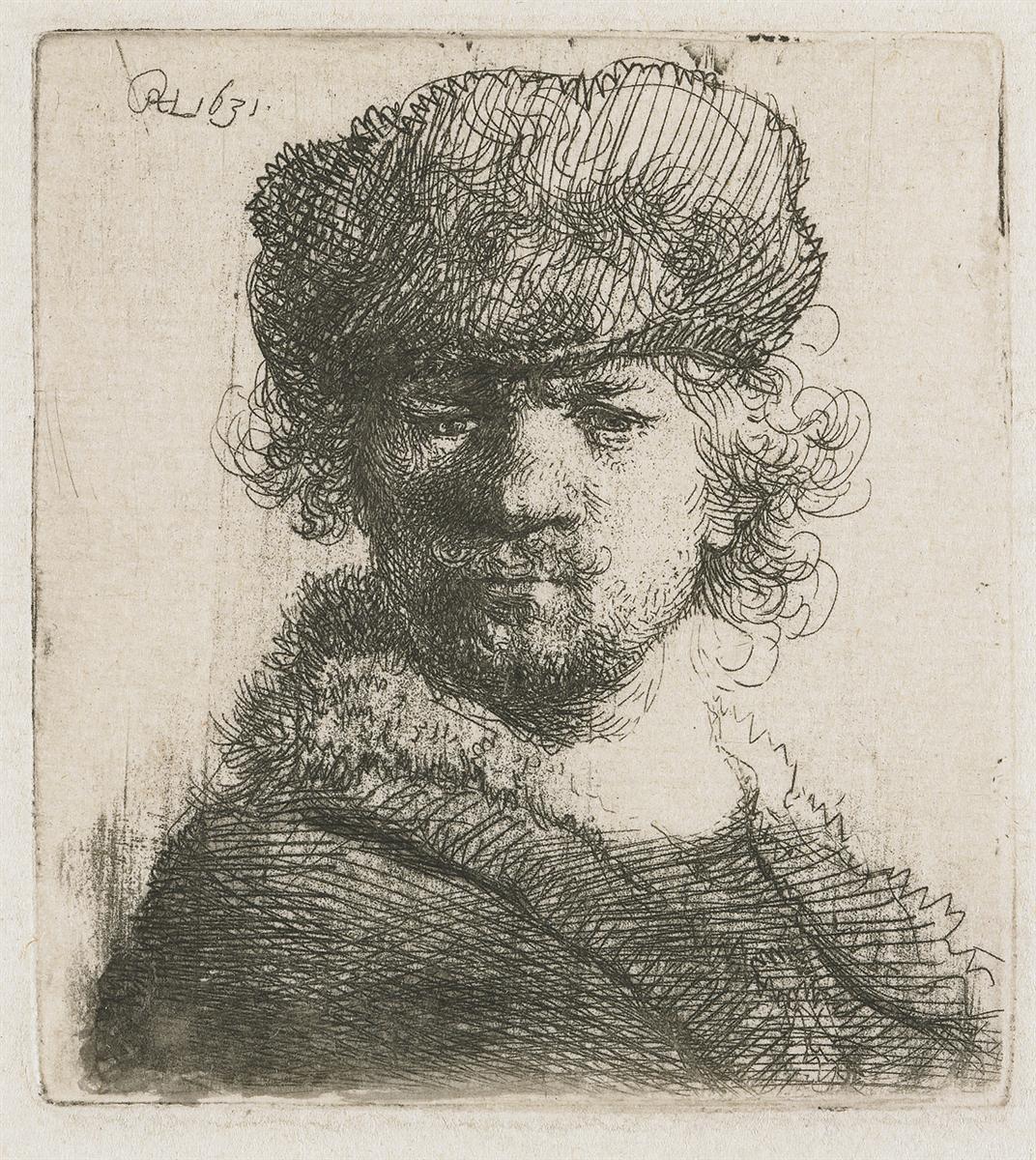
“Self-portrait in a Heavy Fur Cap, Bust” (1631) condenses Rembrandt’s restless self-scrutiny into a small, electrically alive etching. The artist fills the plate with his head and shoulders, turned three-quarters to the viewer and crowned by a voluminous cap whose weight is registered in long, confident strokes. Light grazes cheek, nose, and upper lip; shadows congregate beneath the brim and along the lower jaw. With a handful of lines, Rembrandt makes texture, temperature, and temperament visible. The image is both experiment and declaration—a young artist in Amsterdam testing what etched marks can do while announcing a persona equal parts craftsman, thinker, and actor.
A Young Master At A Turning Point
The date 1631 sits at a hinge in Rembrandt’s career. He was moving from Leiden to Amsterdam, from a university town to a booming mercantile capital, and from studio exercises to high-profile commissions. Self-portraits were tools for self-advertisement and laboratories for technical exploration. In this print he presents himself not as a courtly aristocrat but as a working artist wrapped in practical warmth. The heavy cap and fur-trimmed collar belong to the world of studios and streets, not to court pages or civic guards. By choosing this attire he aligns himself with Dutch frankness while still allowing the drama of light and shadow to elevate the encounter.
Etching As A Live Language
Etching allowed Rembrandt to draw with the speed of thought and the permanence of print. A copper plate, wax ground, and needle made mark-making as responsive as pen on paper; the acid then bit those lines, fixing the decisions. The liveliness of the etched stroke—its pressure changes, hesitations, and accelerations—survives every impression. In this self-portrait each region of the head receives a tailored syntax of marks. Curving cross-hatching under the eye creates a soft half-tone; short, prickling touches along the collar simulate fur; long, parallel grooves on the cap communicate the lie of nap under gravity. The medium’s agility lets Rembrandt move from whisper to shout within a thumbnail-sized field.
Composition And The Command Of Space
The face is set slightly off center, leaning into the plate’s right half. The brim of the cap sweeps diagonally across the forehead and casts a shaded visor that tightens the gaze. The bust fills the lower zone in a compact wedge that stabilizes the composition. Background is left largely untouched, a pale air that allows the head to emerge as if from fog. The monogram and date in the upper left act as a counterweight to the head’s mass, a small inscription that steadies the open field. This spare orchestration demonstrates Rembrandt’s instinct for giving the figure room to breathe without diluting presence.
The Fur Cap And The Theater Of Costume
Costume in Rembrandt’s self-portraits is never mere decoration; it is stagecraft. The heavy cap performs several roles at once. It frames the face with a dark crown, deepening values so the skin’s lights can flare without harshness. It thickens the silhouette, granting the head sculptural authority on a small plate. It also signals a persona: the cap suggests a craftsman’s winter gear as easily as an actor’s prop, letting Rembrandt slip between authenticity and performance. The collar’s fur echoes the cap’s texture and locks the composition with a second band of darkness, turning the face into a luminous island between two soft, absorbing shores.
The Face And The Psychology Of Looking
The portrait’s electricity flows from the eyes. The left eye, more exposed to light, glints with a small highlight that anchors our attention; the right recedes under the brim, insisting on asymmetry and depth. The mouth is closed yet not compressed, its corners softening into a hint of self-possession. Stubble pricks the cheeks and upper lip, and a few stray curls escape from the cap, establishing youth without prettiness. The overall expression resists easy labels—alert, appraising, slightly amused, entirely present. This studied ambiguity turns the image into a meeting rather than a display; the artist does not perform for us so much as measure us.
Line, Pressure, And The Modeling Of Form
Rembrandt models with line rather than with continuous tone. On the cap, long, evenly spaced hatchings create a coherent fabric; where the cap turns away from the light, he thickens and crowds those lines so value deepens naturally. On the face, he relaxes the spacing and breaks lines into shorter units, allowing the paper’s white to breathe through as living skin. Along the cheek near the nose, minuscule inflections change direction just enough to turn the plane convincingly. Nowhere do we sense formula; we sense a hand responding to light in real time. The plate preserves that responsiveness as a permanent record of looking.
Light And Shadow As Character
Light falls from the left, catching the ridge of the nose, the swell of the cheek, and the low relief of the moustache before dissolving toward the shaded jaw. This choreography of illumination produces not only volume but mood. The light is intimate, close, and untheatrical—the kind you feel beside a studio window on a cold morning. Shadow does not hide the person; it calibrates candor. Under the brim it compresses values just enough to intensify the gaze, and beneath the chin it gathers a soft darkness that grounds the head on the shoulders. The balance suggests a temperament that values clarity without exhibitionism.
Texture And The Tactile World
One of the print’s pleasures is its tactility. The cap looks thick enough to muffle sound; the fur collar reads as warm and slightly worn; the sleeve below glints with the suggestion of smooth, denser cloth. Even the stubble on the cheeks is legible, its sandpapery rasp evoked in clustered burrs of line. This tactile plenitude does not distract from the face; it enriches it. The portrait becomes a small climate in which air, fabric, hair, and skin share one continuous temperature.
The Signature And The Assertion Of Identity
Rembrandt places his monogram and the date plainly at the upper left. The inscription’s scale is modest, but its clarity matters. In self-portraits especially, to write one’s name on the same field as one’s face is to assert authorship doubly—by image and by word. The date 1631 locks the portrait to a specific moment in the artist’s formation. The print could travel across Europe; the monogram ensured that its authority traveled with it, making the sheet a calling card of craft and character.
Tronie, Self-Scrutiny, And Performance
Dutch artists used the term “tronie” for studies of heads that explore character types rather than named sitters. Many of Rembrandt’s self-portraits occupy a fertile borderland between tronie and likeness. This plate is unmistakably a self-image, yet it borrows the freedom of a tronie to exaggerate texture and mood. The heavy cap, the fur, the half-smile—all function as elements of a role he tries on. The result is not deception but experiment: by rehearsing different selves, he learns how faces mean.
Negative Space And The Breath Of The Plate
The untouched ground around the head is not an oversight; it is strategy. The pale field becomes air and silence, a contrast that lets the etched lines sing. It also strengthens the silhouette, making the brim’s broken edge and the curls’ irregular halo feel crisp. Because the background remains open, the smallest additions—faint vertical scrapes near the left margin, a soft plate tone if present in certain impressions—can shift the atmosphere dramatically. The image is both complete and breathable, finished and full of margin.
States, Impressions, And The Print’s Afterlife
Etchings often exist in multiple “states” as artists modify plates over time. While this self-portrait is prized for the immediacy of its early impressions, its power also depends on the printing. A lighter wipe accentuates the chill clarity of the paper’s white; a slightly retained plate tone warms the space and deepens the cap’s shadow. The variability is not a flaw but a feature of the medium: each impression becomes a fresh performance of the same score, and collectors learn to read the subtleties of ink as part of the artwork’s voice.
Comparison With Neighboring Self-Portraits
Rembrandt made numerous self-images around 1630–1631, in both paint and print. Some show him laughing, others frowning or adopting exotic costumes. This plate opts for equilibrium. Compared with the brash theatricality of certain painted self-portraits from the same period, the etched image is quieter yet more penetrating. It relies less on costume’s novelty and more on the pressure of seeing. The result feels modern in its candor and timeless in its economy.
The Ethics Of Attention
What finally distinguishes the print is an ethics of attention. The artist does not flatter his features; he records their topography with respect bordering on tenderness. The cap’s weight, the beard’s scatter, the skin’s unevenness—all are accepted and integrated into an image that values presence over polish. That ethic would deepen across Rembrandt’s career, but here we see it already: the conviction that truth of looking is a form of dignity.
What To Look For Up Close
A careful viewer will find small miracles. The tiny notch of light along the left nostril gives the entire nose breath. The faint reserve below the lower lip prevents the mouth from hardening and keeps speech latent. The cap’s hatchings change angle as they cross the crown, persuading the eye that nap follows form. The collar’s prickly edge is rendered by flicked, irregular strokes that feel almost audible. Even the shadow under the brim is gentle, a compressed mesh rather than a solid block, ensuring that the brow remains expressive rather than masked.
Why The Image Still Feels Modern
The portrait’s modernity lies in its trust in minimal means. In an age of digital images, its directness—ink bitten into copper, paper pressed, lines alive—retains shock value. It refuses polish yet arrives at elegance; it permits the viewer to see process without sacrificing presence. The gaze, unarmored by emblem or narrative, meets us on equal terms. Across centuries, the sheet models a way of presenting oneself that is neither narcissistic nor abject: curious, steady, and alert to light.
Legacy And Influence
This etching contributed to the European appetite for the artist’s face as a subject worth collecting. Later printmakers and painters learned from its economy and from its belief that personality can be carried by line alone. It also helped define the Rembrandt brand in Amsterdam’s competitive market. A small self-portrait passed from hand to hand could introduce the artist more effectively than any advertisement, because it demonstrated, in miniature, his ability to make flesh and fabric breathe.
Conclusion
“Self-portrait in a Heavy Fur Cap, Bust” is a compact manifesto. It declares that line can harbor warmth, that shadow can intensify candor, and that an artist’s face—without allegory or emblem—can hold the viewer in a durable exchange. The heavy cap, the textured collar, the frank gaze, and the sensitively modeled planes combine to deliver an image that is at once highly crafted and startlingly alive. It is not a grand statement but a focused act of looking, and that focus is precisely what allows the portrait to speak across time with undiminished authority.
