Image source: wikiart.org
Introduction
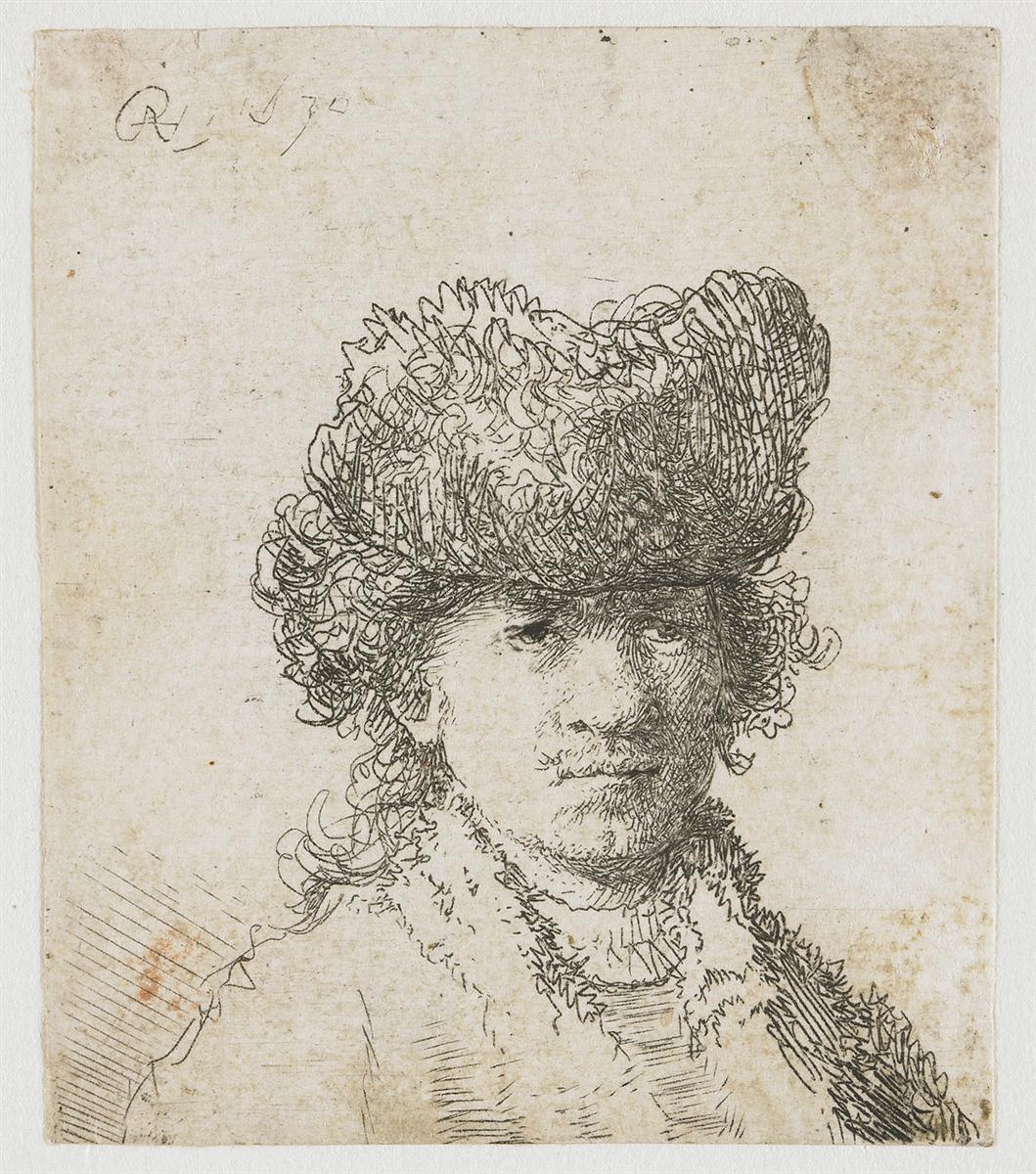
Rembrandt’s “Self-portrait in a Fur Cap, Bust” (1630) is a compact etching that radiates presence. The young artist, not yet twenty-five, leans slightly toward us, his face half in shadow beneath a voluminous fur cap, the collar of a rough pelt framing his neck like winter weather. The gaze is alert yet withheld, more evaluative than confrontational. Fine lines braid into curls at the ear; quick strokes knit the fur; untouched paper serves as air and light. In a few square inches, Rembrandt turns copper, acid, and ink into an encounter—quiet, steady, and indelible.
The Leiden Moment and the Role of Tronies
The year 1630 places this print at the end of Rembrandt’s Leiden period, when he used his own face as a laboratory for character and light. These early self-studies are tronies—images that examine expression and costume without the obligations of a commissioned portrait. In this plate he selects a fur cap and pelted collar, garments that evade fashionable specificity and give the head a timeless stage. The costume is not vanity but strategy: a dark, textured frame that sharpens the skin’s brightness and pushes attention to the eyes.
Composition and the Geometry of Attention
The bust-length figure is set high in the sheet, with generous space above and at the right. That spacing is deliberate; it slows the eye and turns the head into a visual anchor rather than a crowded object. The subtle rotation of shoulders against the head’s counter-turn creates a hinge of tension at the neck—enough motion to keep stillness alive. A faint wedge of parallel lines at the lower left acts like a stage lip, establishing a shallow foreground and preventing the bust from floating. Everything funnels toward the triangle formed by cap brim, brow ridge, and cheekbone, a zone where light, line, and psychology meet.
Etching as a Recorder of Touch
Etching translates the pressure and speed of the hand into legible marks. Rembrandt exploits that responsiveness by assigning each material its own dialect. The fur cap is rendered with densely looped strokes and short, hooked marks that mimic the spring of hair catching light. The pelt collar reads as a bristle of parallel lines with broken ends, darker and more directional than the cap, which grounds the bust in weight and warmth. Skin is handled with the lightest notation—tiny dashes around the mouth and chin, sparing hatchings beneath the eye and along the jaw—to keep the face luminous against its rough surround. The result is not merely descriptive; it is tactile. We feel the prickle of fur, the soft resistance of skin, the dry, crisp edge of paper white.
Paper White as Light and Air
Because an etching constructs darkness and leaves light as untouched paper, blankness is an active agent. Rembrandt allows the right side of the face, the top of the cheek, and the sliver of lower lip to remain largely unbitten, so the paper itself becomes the illumination. This is not theatrical spotlight but daylit clarity, the kind that reveals pores and fine hair without severity. Around the bust, broad reserves of white create breathable space, a silent room that amplifies the quiet authority of the head.
The Cap as Architecture
The fur cap is not decoration; it is structure. Its mass occupies the upper third of the image, providing a counterweight to the pelt collar below and enclosing the face the way an arch encloses an altar. The dense strokes along its lower edge cast a soft shadow into the eye sockets, lending the gaze a privacy that prevents the image from feeling performative. In place of a halo, we get a practical crown of warmth that serves both physiology and symbol: protection against weather, shelter for thought.
The Face Between Openness and Reserve
Rembrandt avoids a single, legible emotion. The mouth is relaxed, almost skeptical; one eye, set in deeper shadow, appears more introspective than the other; the brow tilts in a micro-frown that reads as attention rather than displeasure. This equilibrium between openness and reserve is the portrait’s psychological truth. The young artist presents himself not as a prodigy courting approval, but as a worker of sight—someone who studies as he is studied. Because the features are built from minimal means, they remain mobile: a change in viewing distance shifts the expression from cool to warm, from alert to contemplative.
Hair, Beard, and the Music of Line
The curls at the temples and ear are written in a lively counterpoint to the heavy textures of cap and collar. Loose spirals catch glints of paper, while a few stray locks break the silhouette and dissolve the boundary between figure and air. A faint mustache and scattered stubble on the chin are indicated with abbreviated strokes—enough to provide age and texture without stacking darkness over the mouth. The ensemble reads almost like music: bass tones in the collar, a rich middle register in the cap, and bright treble notes in the hair’s highlights.
The Ethics of Restraint
Much of the image’s power lies in what it withholds. There is no backdrop to decode, no attribute to proclaim status, no emblem to fix the interpretation. The refusal of anecdote is an ethical stance. It keeps the encounter honest and gives the viewer room for proximity. The artist trusts that a face lit by unembellished light, framed by useful garments, will suffice. That trust becomes part of the portrait’s character: sober, candid, humane.
The Inner Frame and the Objecthood of the Print
A fine incised border, visible just inside the sheet’s outer edge, functions as a second frame. It pushes the bust slightly forward and reminds us of the plate’s physicality—the copper edge that took ink and pressed into paper. The trace of making suits the image’s temperament. Nothing in the print is cosmetic; even the border declares process. We are not looking at an illusionistic window; we are holding an object impressed by deliberate handwork, a thing whose edges remember pressure.
Chiaroscuro Without Theater
Rembrandt’s distribution of darks and lights is strategic rather than spectacular. The cap and collar form the largest fields of shadow; the cheek and the right side of the chin provide the brightest whites; intermediate tones knit the face together. The transitions are abrupt where structure demands it—under the brim, at the jaw—and gentle where skin rounds toward light. This pattern of values models form convincingly while sustaining mood. The light does not seduce or dramatize; it clarifies.
Dialogue with Other Self-Studies of 1630
Compared with contemporaneous etchings—wide-eyed astonishment, open-mouthed utterance, skeptical frowning—this plate is quieter. It tests neither shock nor speech but bearing: how a head sits within garments, how light rests on skin, how a gaze occupies silence. Set against his painted self-portraits from the same year, it shares the commitment to truthful illumination while swapping oil’s glow for the graphic vitality of line. Together, these works chart a young artist establishing a vocabulary of presence that he will refine across decades.
Printing Variants and the Weather of Impressions
Rembrandt’s plates live many lives depending on inking and wiping. A plate tone left on the surface can haze the background with a soft gray, giving the cap extra mass and deepening the eye sockets; a cleaner wipe makes the paper blaze, sharpening the silhouette and cooling the mood. Heavier inking enriches the collar’s darkness, strengthening the bust’s base; lighter inking lets the curls sparkle with tiny lights. Such variants are interpretive, not accidental: different weathers for the same head—overcast introspection or bright clarity—without altering a single line.
The Self as Tool and Witness
Etching oneself is both practical and philosophical. The model is always available and always honest. In “Self-portrait in a Fur Cap, Bust,” Rembrandt treats himself as he will treat others: with attention before judgment. He calibrates each mark to a material reality—fur, hair, bone under skin—and lets recognition emerge from accuracy rather than from flourish. The self becomes the first beneficiary of a method that will dignify beggars, scholars, merchants, and prophets alike.
Texture, Temperature, and the Sense of Touch
One reason the image feels so near is that it persuades the fingertips. The collar’s dense strokes suggest rough warmth; the cap’s tighter, springy marks imply compact fur; the skin, largely spared heavy hatching, reads as soft, slightly cool by comparison. These tactile cues convert seeing into a multisensory experience. Even the blank background has a temperature—the neutral air of a studio winter—against which the fur’s warmth and the cheek’s light stand out.
Silence and Proximity
The scale of the print invites the viewer to lean in. At conversation distance the small notations around the eyes and mouth resolve into credible planes; step back and the whole head gathers into a calm presence. The silence of the background is not emptiness but a social distance held clear. The portrait knows exactly how close to come and how far to stay, a balance that makes the gaze feel courteous rather than intrusive.
Lessons for Draftsmen
The plate doubles as a manual of expressive economy. Assign distinct line languages to materials and keep them consistent; trust paper to be light; anchor the composition with a dense base and let the head emerge from it; draw only the shadows you need and let the rest remain breath. The print also teaches the discipline of stopping: the most persuasive areas are those where Rembrandt has done least—the glint on the cheek, the dim ridge of the brow, the spare line that defines the lower lip.
The Modernity of Restraint
Part of the etching’s freshness lies in its minimalist confidence. Contemporary eyes recognize the appeal of a limited palette of means used with precision. There is nothing to date the image except the style of fur; even that reads as texture rather than costume. The portrait could be a friend met this morning—reserved, observant, warmly dressed—because it builds character from universal components: light, posture, and the honesty of line.
Enduring Presence
Why does this small head endure? Because it affirms a truth both simple and rare: attention dignifies. Rembrandt offers no emblem to explain himself, no gesture to coerce feeling. He looks, records, and steps back. The viewer completes the circuit, meeting the gaze where light touches skin and fur absorbs shadow. In that exchange the centuries collapse. The etching becomes not just an image of a young artist but an ongoing conversation about how to see another human being.
Conclusion
“Self-portrait in a Fur Cap, Bust” turns modest means into lasting presence. A dense collar establishes ground; a fur cap shelters thought; paper white becomes light; spare hatching models skin without fuss. Between alertness and reserve, the young Rembrandt fashions a likeness that is also a creed: let materials speak, let light tell the truth, let silence carry weight. The print may be small, but its measure of human nearness is large—and it continues to feel newly made each time a viewer leans close and looks back.