Image source: wikiart.org
Introduction
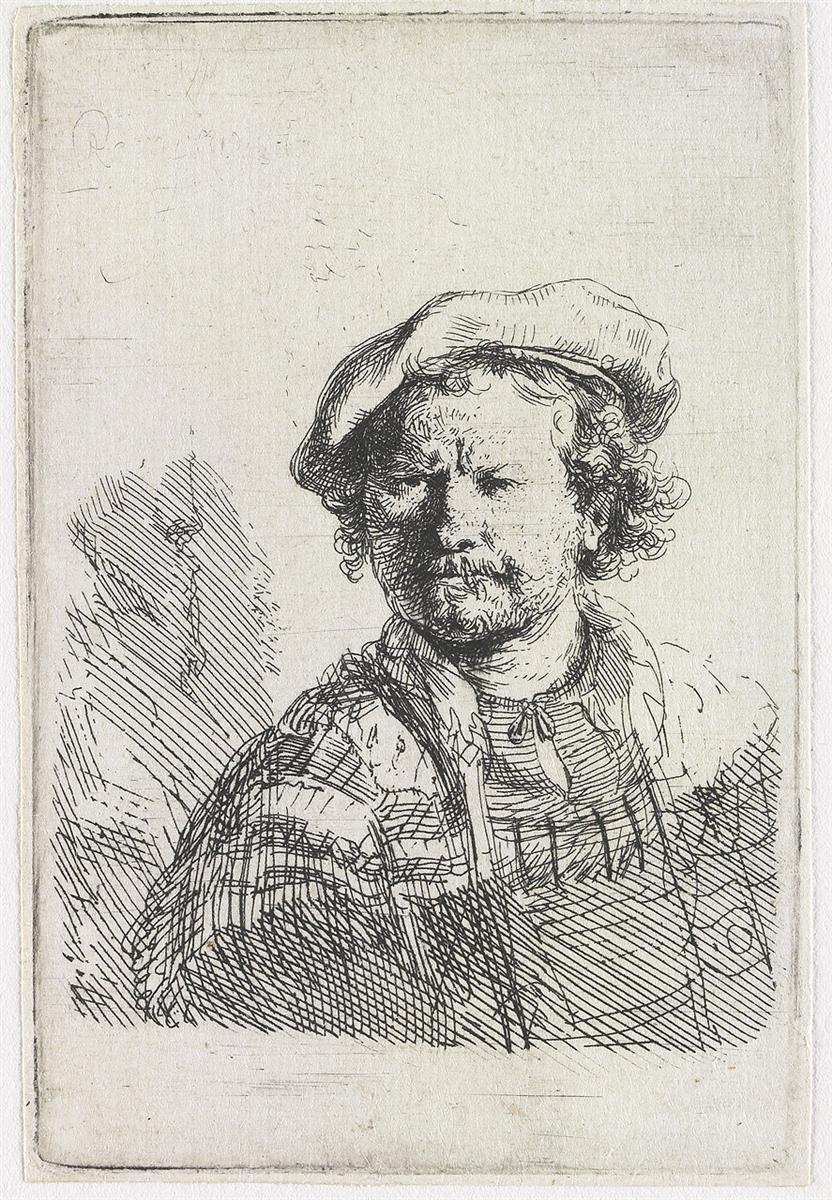
Rembrandt’s “Self-portrait in a Flat Cap and Embroidered Dress” from 1642 is a brisk, electrifying etching that captures the artist in mid-thought rather than mid-performance. The plate is small, the marks are few, and yet the presence feels large. Wearing a soft beret-like cap and a textured garment with ornamental stitching, he turns slightly to our left with a searching, almost skeptical look. The head tilts, the brow compresses, the mouth tightens into a mobile line. Behind him a wedge of background cross-hatching acts like a wind of shadow blowing past the shoulder. This is Rembrandt’s face not as a public emblem but as a workshop instrument—alert, unposed, reading light as he reads himself.
The Etching As A Studio Notebook
Rembrandt treated his etched self-portraits as a laboratory where the chemistry of expression could be tested quickly. Copper plates, unlike slow layers of oil paint, rewarded speed, experiment, and the appetite for risk. In this image, the needle has moved with a directness that borders on audacity. Lines sweep and stop; cross-hatching is laid in like shorthand; the face is built with a minimum of contours and a few decisive shadows. The result is a likeness that feels closer to a notebook page than to a salon piece, yet its spontaneity is inseparable from mastery. The plate reads like a memo to himself about posture, mood, and light on a particular day in 1642.
Context Within The 1642 Moment
The year is pivotal. Rembrandt had just finished the colossal militia painting now called “The Night Watch.” At nearly the same moment, his wife Saskia was dying; she passed away in 1642. The artist’s public triumph and private sorrow cross like the hatched lines behind his head. This etching, with its compact energy and refusal of theatrical costume, belongs to that hinge. The flat cap is not a sign of masquerade; it’s practical and present. The embroidered garment adds status and texture but doesn’t tilt the mood into display. The artist looks out as a professional who knows both the burden of work and the cost of attention.
Composition And The Architecture Of The Head
The composition concentrates the figure in the lower two-thirds of the plate, leaving a luminous field of open paper above. The head sits slightly right of center, turned three-quarters, which allows the nose to break a soft profile line and the left cheek to vanish into white. A triangular block of parallel hatch marks rises at the left like a counterform to the head, preventing the figure from floating. The shoulder mass expands low and wide, built from vigorous diagonal lines that cross like woven reeds. The hat spans the forehead as a dark, soft-edged brim, giving the features a theatrical frame without turning the print into theater. Everything is directed toward the face’s compact storm of feeling.
The Flat Cap And Embroidered Dress
Rembrandt’s clothing is specific but not fussy. The cap is a workman’s beret—crushed, pliant, a shape that painters wore for comfort and for managing studio light. The dress or jerkin carries ornamental bands and little picks of stitch-work, more like the memory of embroidery than a catalog of it. By using broad, slightly broken stripes and compact cross-hatching, Rembrandt evokes richness without pedantry. The choice has psychological bite: the garments acknowledge worldly success while the face rejects pomp. Status becomes texture, not subject.
The Language Of Line
The print is a masterclass in how different kinds of lines can strike different notes in a single face. The outer contour of the hat is slow and elastic; the cheek and jawline are quicker, more brittle. Short, choppy marks gather under the lower lid, around the nostril, and in the philtrum above the lip, anchoring the features with a granular intensity. Cross-hatching is not mechanically even: it opens to let light in, tightens to make a crease, and then abruptly changes direction to suggest planes turning in space. The beard and mustache appear through a handful of jagged strokes that hint at roughness rather than drawing every hair. Everywhere the needle seems to think aloud.
Light, Shadow, And Paper-White
Rembrandt builds light by leaving the paper bare and building darkness by hatching, never over-working the plate. The forehead and left cheek breathe with untouched paper; the bridge of the nose and a sliver of upper lip catch the brightest notes. Shadow under the hat brim carves the eyes into the skull, but he avoids theatrical black; we still feel the roundness of the eyeball and the moist weight of the lower lid. On the torso, he drops into dense diagonals that generate a tonal base for the pale face to lift from. The background wedge at left is more than a backdrop; it’s a tonal counterweight that keeps the light from dissolving the head.
Expression, Psychology, And The Momentary
The expression is famously difficult to name: irritation, skepticism, concentration, a touch of sardonic humor. The brows knit inward, compressing flesh between them; the mouth draws into an asymmetrical line that could be the beginning of a word or the end of a sigh. What matters is not a fixed emotion but a state of mind mid-change. Rembrandt catches himself between two impulses—the public face prepared for patrons and the private mind busy with evaluation. This doubleness is one reason his self-portraits remain modern; they refuse to pin the self to one label.
The Body As A Field Of Gesture
Though the plate is small, the figure carries a bodily presence. The shoulders square, suggesting firmness; the head tilts, creating a counter-rhythm of alertness. A small knot or tie at the throat is drawn with a couple of acute strokes, like a punctuation mark in the grammar of posture. Even the cap’s droop has the feeling of a gesture—a relaxed downward curve matching the tense upward press of the brow. The torso is not a generic bust; it breathes and supports the head’s quick thinking.
Background As Velocity
The left-hand hatching streaks across like wind, implying movement through a still image. It could be a curtain of shadow, a wall, or nothing specific at all; the effect is kinetic. By inclining those marks diagonally against the vertical of the head, Rembrandt animates the space with velocity. We sense that time is short, that the artist prints not to freeze himself but to register a passing mood before it evaporates.
States, Plate Tone, And The Variability Of Impressions
Like many of Rembrandt’s plates, this self-portrait exists in multiple impressions that can look strikingly different. A plate wiped perfectly clean yields a high, cool key with glittering whites; a plate left with a veil of ink—a plate tone—can add atmosphere, softening the sky-like upper field and warming the shadows. Plate wear over time softens the crispest hatchings; later pulls can seem more atmospheric, earlier ones more graphic. Rembrandt often printed on a variety of papers, from bright European sheets to toned oriental papers; each choice alters the emotional temperature. This variability is not accidental decoration; it is built into the medium’s expressive range and into the artist’s own curiosity about how a face changes with air.
Relation To Painted Self-Portraits Of 1642
Compare this etched presence with the more formal painted self-portrait of the same year. In oil, Rembrandt appears sober, composed, and professionally adorned, the light slow and warm. In the etching, everything tightens and quickens: the gaze narrows, the mouth compresses, the cap collapses into a lived-in shape. The two together offer a double image of identity—public steadiness and private vigilance—each true in its register. The painted version declares status managed; the etching confesses consciousness at work.
The Tronie Tradition And The Refusal Of Masquerade
Dutch artists often produced tronies—studies of heads in character, using costume as a spark. Rembrandt participated enthusiastically in the 1630s, trying on grimaces, feathers, and theatrical poses. By 1642 his self-portraits begin to strip away the game. The flat cap reads not as a stage prop but as a studio friend. The embroidered dress, though luxurious, is handled as pattern rather than performance. The refusal of masquerade sharpens the psychological pitch; the face is not acting, it is being.
The Ethics Of Self-Observation
One comes away from this plate with a sense of ethical intensity. Rembrandt is not flattering himself; he is not seeking pity; he is not selling brilliance with a wink. He is studying a soul responsible for an atelier, a household, and a reputation. The etched marks do not smooth the skin; they nick and crease it. The mouth does not pose; it works. The eyes do not beg; they assess. This ferocious honesty becomes a kind of hospitality toward the viewer: we are invited to look as truthfully at him as he looks at himself.
Craft Lessons For The Eye
The plate offers hard-won lessons for anyone who draws. Use the fewest lines necessary for a face, but vary their pressure, angle, and interval. Organize darks into large shapes to let the whites ring. Place a single wedge of background tone to anchor a head in space. Build expression from structure—brow, cheek, mouth—rather than from theatrical grimace. Let clothing carry rhythm so the face can carry meaning. Above all, allow the paper to do half the work.
Sound And Atmosphere
The print seems to generate sound by implication. One hears the scratch of the needle on copper, the soft pull of a cloth wiping plate tone across the surface, the faint creak of a stool in the studio, perhaps the murmur of assistants in a neighboring room. That sonic imagination enlarges the portrait’s world. We are not looking at a timeless mask; we are visiting a working space where tools and breath surround the face.
A Face That Thinks
What most distinguishes this self-portrait is the sensation that thinking is visible. The brow furrows not for effect but from effort; the mouth tightens as a sentence forms; the eyes try to measure both mirror and future. It is the face of a practitioner mid-judgment, deciding what to do next with line, life, and obligation. That quality—mind showing through matter—explains why the smallest Rembrandt prints can feel as consequential as large paintings.
Persistence, Mortality, And The Kindness Of Detail
Even as the etching is unflinching, it is kind. The small crescents within the eye sockets capture moisture; the tiny pauses at the ends of lines keep the skin from petrifying; the slight rounding of cheek and chin gives flesh its human spring. Mortality is present, but not as tragedy; it is simply the texture of living face. The detail that moves the viewer most may be the touch of light at the philtrum or the blunt ends of the mustache—minute recognitions that say, this is a person, not an emblem.
Legacy And Modernity
Artists and photographers have learned from this plate’s plain courage: the direct gaze, the minimal background, the authority of a flat cap, the refusal to prettify. The etched self-portrait reads as startlingly contemporary because it aligns making and meaning. It reminds a viewer in any century that the raw materials of identity—light, line, and time—are enough if the looking is exact.
Conclusion
“Self-portrait in a Flat Cap and Embroidered Dress” is not a small exercise tucked among grand works; it is a decisive statement about what an artist owes his own face. With a handful of marks, Rembrandt catches the flicker of thought and the weight of responsibility. The cap, the garment, the background wedge, and the restless mouth all conspire to present a self neither mythologized nor diminished, simply present and thinking. In an age that loved show, he chooses candor. In a medium that forgives nothing, he risks everything on the accuracy of his line. The plate succeeds because it tells us, with very little, almost everything that matters.