Image source: wikiart.org
First Encounter With A Shadowed Face
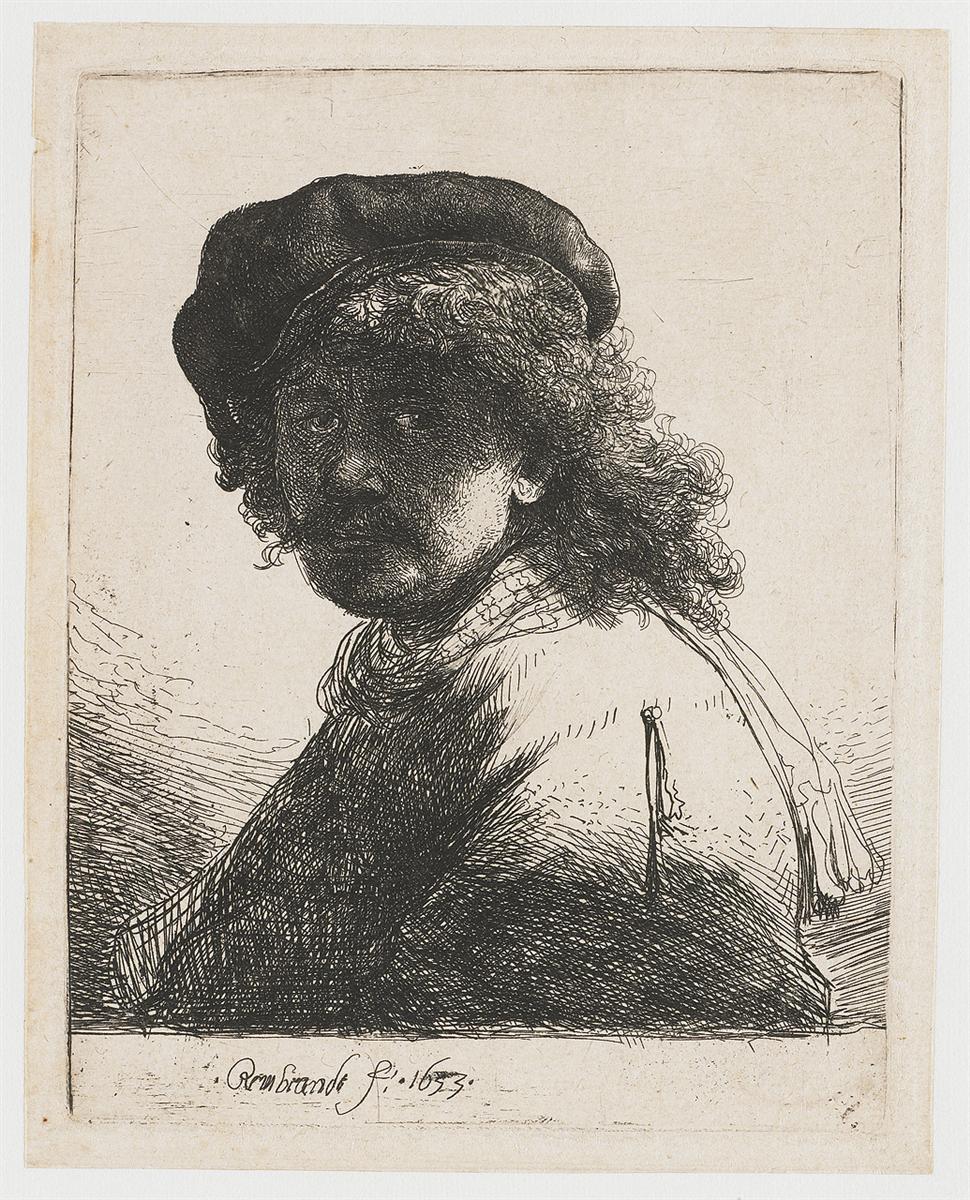
Rembrandt’s “Self-portrait in a Cap and Scarf, with the Face Dark, Bust” is a small etching with large ambitions. The artist turns his head toward us, the broad cap pressing a lid of shadow over his brow while a scarf circles the neck in a tight, bright loop. The face, half sunk in darkness, resists easy reading. We meet a presence that feels both candid and guarded, familiar and theatrical. The modest sheet becomes a stage on which Rembrandt experiments with light, line, persona, and the market for his own image.
A Self-Portrait Made With Needle And Acid
Unlike a painted likeness, this work begins with a copper plate, a ground of wax, and a fine etching needle. Rembrandt draws directly through the resist so that copper is exposed where the line will be; the plate is then bitten in acid, the exposed channels deepening into grooves that will carry ink. The technique encourages speed and improvisation. You can feel that quickness in the hair that bursts into tiny curls, the coat built with slanting hatches, and the background energized by long, sweeping strokes. The spontaneity is not carelessness. It is the energetic handwriting of a young master translating thought into line.
The Year 1633 And A Career Ascending
The etching dates to 1633, the year Rembrandt was twenty-seven and newly established in Amsterdam. He had left Leiden a few years earlier and was rapidly building a clientele for portraits, biblical histories, and prints. Self-portraits became part of his public identity—advertisements of skill, laboratories for expression, and collectible objects for a growing print market. This sheet belongs to an early cluster in which he tries on roles with costume, lighting, and attitude, testing how character can be invented without lying.
Composition That Turns On A Pivot
The portrait is a bust turned three-quarters to the viewer’s right, as if the artist has been called while working and has turned, not fully, but far enough to acknowledge us. The cap’s dark oval and the cascade of hair create a large, shadowy mass balanced by the small bright knot of scarf at the neck. The body angles one way; the eyes, pooled in shade, slip back toward the viewer. The entire design pivots around the collarbone, a hinge that makes the figure feel captured in motion, not posed.
A Cap And Scarf As Instruments Of Drama
Costume is minimal but strategic. The floppy cap collects darkness like a bowl, forcing the brow and eyes into a pooled shade. The scarf, by contrast, is a device for brightness; its compact loops catch light in concentrated highlights. Between these two objects, light compresses and then expands, teaching the viewer to read contrast as content. The “face dark” of the title is not an accident of settings; it is a choice that makes mood the subject.
Line As Voice And Weather
Rembrandt’s line speaks in different dialects across the sheet. Around the face, small flicks and loops suggest hair without pedantry. In the cap, broader, slower strokes lay down an inky weight that can receive plate tone. On the shoulder, brisk cross-hatching builds a heavy garment that seems to absorb light rather than reflect it. The background, worked with long, lateral sweeps, behaves like wind behind the figure, an abstract pressure that pushes the bust forward. All these marks are legible as decisions; you can reconstruct the order of operations by following the energy of the strokes.
Chiaroscuro Without Paint
The most striking feature is the darkness that keeps the eyes and much of the brow concealed. In oil painting, such shade would be a mass of mixed pigments; here, it is a dense constellation of hatchings and stipples, varied not only in closeness but in direction. Rembrandt knows that etched chiaroscuro cannot depend on smearing; it must be woven. The woven shade is alive, vibrating around the eyes, giving the impression of seeing and being seen at once. The light that escapes—across the cheek, at the rim of the nose, along the lip—feels earned.
Plate Tone And The Breath Of Paper
Many impressions of this etching preserve plate tone: a thin film of ink intentionally left on the plate surface and wiped unevenly before printing. Plate tone softens the white of the paper into atmospheric greys, wrapping the head in air. Close to the cap, the tone is heavier, deepening shadow; toward the far margins, it thins, letting the paper’s brightness open into space. The technique moves the print toward drawing and away from mechanical clarity, a signature Rembrandt effect.
The Psychology Of A Mask And A Glance
Why hide the eyes? Because concealment can reveal. In the darkened sockets, the whites only glimmer, which makes the gaze more searching. The mouth is slightly parted, undecided between concentration and speech. The combined effect is both wary and curious, the expression of someone interrupted at work—irritated, perhaps, but also alive to the interruption’s possibilities. The self-portrait refuses flattery. It offers a self that is working things out in real time.
A Young Man Trying On Selves
Rembrandt’s self-portraits of the early 1630s show him in velvet caps, plumed hats, fur collars, and theatrical attitudes. These roles are not disguises; they are experiments in self-fashioning. The cap and scarf here belong to that theater of becoming. He is not yet the bearded sage of the late self-portraits. He is a sharp, ambitious printmaker asking what kinds of faces the market will accept and which versions of himself can be true.
The Signature As Performance
At the bottom edge, “Rembrandt f. 1633” sits proudly in the plate. The flourish is calligraphic, a small performance that mirrors the bravura of the etch. Signing prints mattered not only for authorship but for commerce: the signature is a promise of quality and a brand. It also frames the image as a deliberate object, made to circulate, to be handled, swapped, and studied. The self-portrait becomes a currency of reputation.
Hair As Field Of Light
The wild halo of hair around the cap is a playground for the etcher’s needle. Tiny curls are registered by clustered loops, each trapping light. The hair at the crown collapses into the cap’s shadow; at the nape it thins and frays into the background’s hatching. The passage is technically pleasurable and symbolically potent: light appears wherever the hair escapes the cap’s control, as if invention glints most where form loosens.
The Scarf’s Calligraphy
Across the neck, the scarf’s lines are quick and assured. A few short, elastic strokes, and the viewer recognizes twist, weight, and sheen. That economy is the printmaker’s genius—how little is needed to make a thing behave like itself. The bright scarf is also a compositional fulcrum. It’s the brightest object on the sheet, anchoring the center and measuring all surrounding darks.
The Background As Pressure And Air
Empty space is never truly empty in Rembrandt’s prints. Here, the field is animated by directional hatchings that sweep from left to right behind the shoulder and then curl downward at the far right. The pattern gives the body a wind to lean into and keeps the bust from floating. The space breathes; it also pushes. This pressure dramatizes the turn of the head and makes the small sheet feel larger.
The Vocabulary Of Hatching
Three kinds of hatch dominate: long parallels that lay tone; cross-hatches that build density; and small, crabbed quavers that texture the face. Rembrandt changes hatching direction to model form—curving it around the cap, angling it down the shoulder, letting it flatten out in the background. The brass tacks of etching are on display, yet the method never becomes mechanical. You are always aware that a hand thought each mark into place.
Darkness As Self-Protection
The “face dark” is a deliberate strategy for privacy. This is not the confession of a soul; it is the presentation of a professional. By obscuring the eyes, Rembrandt keeps the portrait from becoming sentimental. He offers enough to be known as an artist and a type—a worker in cap and scarf—while maintaining the right to remain, in part, undeciphered. The darkness is an ethical stance as much as an aesthetic one.
The Market For The Artist’s Image
Prints were reproducible and portable; a self-portrait in print could circulate across Europe faster than any painting. Collectors prized images of artists, especially those who controlled their own matrices. Rembrandt understood this perfectly. By producing a suite of self-portraits in varied moods and costumes, he fed a market and wrote a serial autobiography in line. This etching, with its unusual emphasis on obscurity, adds a note of mystery to the series—a reminder that even a prolific self-portrayer can keep secrets.
The Relationship To Painted Self-Portraits
In paint, Rembrandt often builds faces with luminous flesh and deep optical space. On copper, he has line and the paper’s whiteness. The translation demands invention. Notice how the cheek’s highlight is not a dab of white but simply the uninked sheet; how the bridge of the nose is modeled by decreasing the pressure of hatch; how a boundary becomes a change in line direction rather than a drawn contour. The print shows a painter thinking like a draftsman—an art of subtraction rather than application.
Energy Of The Turn
The lively diagonal that runs from shoulder to head produces kinesis. You can reconstruct the moment preceding the pose: the artist bends over a plate, hears a footstep, and pivots. The etching holds the pivot. The body has not yet settled; the garment still reads as a mass in motion; hair seems to have been jostled. This is not a timeless mask; it is a time-bound glance.
The Face As Question
Because the eyes are dimmed, the mouth becomes expressive center. Slightly open, it suggests breath and the start of speech. Combined with the forward slant of the head, the mouth turns the portrait into a question. The image seems to ask: Who are you, viewer, and what will you make of me? That invitation to read becomes the reason the print still tensely fascinates.
The Ethics Of Economy
Etching rewards thrift. Every extra line risks mud. Rembrandt’s economy—how he stops once an area says what it needs to say—gives the print authority. The white paper around the cap’s upper edge is left almost blank, a risky openness that trusts the cap’s weight to anchor the figure. The restraint makes the dense passages—face, shoulder, scarf—more potent.
Touches Of Humor And Humanity
Even in shadow, a sly human warmth surfaces. The cap, slightly oversized, reads like studio attire—a practical hat worn for comfort rather than grandeur. The scarf tucked close to the throat implies cold mornings in the etching room. These small domestic notes save the sheet from swagger and tether the legendary name “Rembrandt” to the reality of a working life.
The Signature Of Youth And Future Depth
This 1633 self-portrait shows a young artist alert to his reflection and his profession. Compare it mentally with the late painted self-portraits: there, the eyes are fully illuminated; the light is meditative; the persona embraces vulnerability. Here, the energy is lateral and quick. Yet the seeds of the later profundity are present: the courage to show himself in unflattering light, the preference for truth over flattery, the fascination with how little illumination can carry feeling.
Why The Print Still Feels Modern
Contemporary viewers meet a familiar problem in this etching: the urge to present oneself and the desire to keep oneself. The cap and scarf are brand; the darkened face is privacy. In an age of proliferating self-images, Rembrandt’s solution feels wise. He chooses to be legible as a worker and ambiguous as a personality. The result is not evasive; it is respectful. It models a way to be seen without being spent.
Closing Reflection On Light, Line, And Self
“Self-portrait in a Cap and Scarf, with the Face Dark, Bust” is a compact thesis on what printmaking can do for the self. It turns inked grooves into air and light, costume into psychology, and a quick turn of the head into a durable encounter. The hat gathers shadow as a shelter for thought; the scarf concentrates light as a knot of presence; the face mediates between them with a look that both registers and withholds. In a few inches of paper, Rembrandt gives us labor, style, and self-scrutiny—an artist in the act of becoming.