Image source: wikiart.org
Introduction
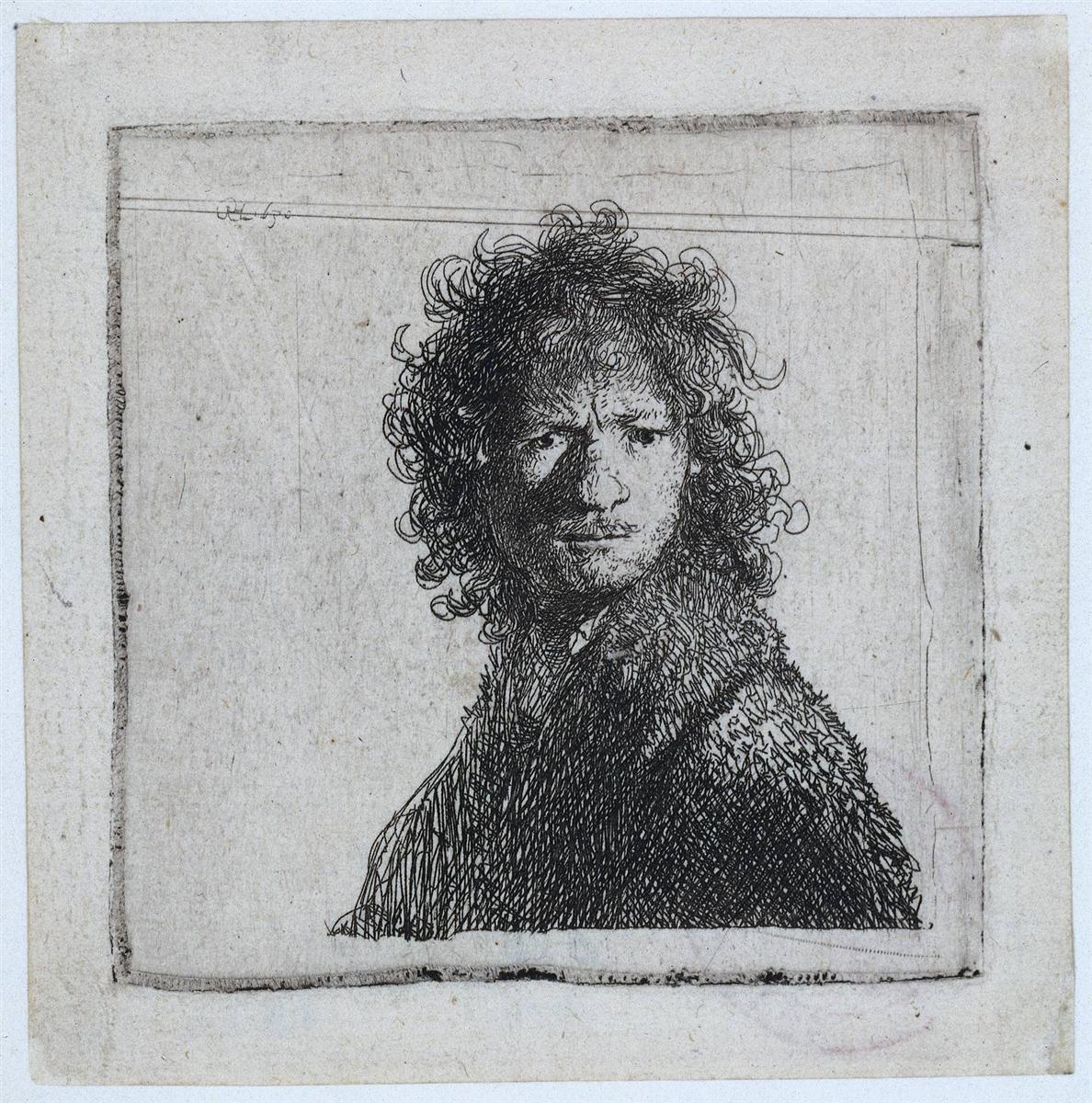
Rembrandt’s “Self-portrait, Frowning” (1630) distills a turbulent state of mind into a few square inches of copper and ink. The young artist appears three-quarters to the left, shoulders turned, head snapped back toward an unseen stimulus. His brow knots into a ridge of skepticism; the lips compress in a line that refuses to please; the eyes, set under tense lids, measure rather than welcome. A storm of wiry curls surrounds the face like a graphic atmosphere. The background remains almost empty, a stage of paper white that heightens the psychological voltage of the head and shoulders. This small etching—one of a cluster of self-studies Rembrandt produced in Leiden around 1630—reveals a painter already fluent in using line to make thought visible.
Context And Purpose
Between 1629 and 1631 Rembrandt turned to his own face as an endlessly available model. These works, often classed as tronies, were not vanity portraits; they were laboratories for expression, illumination, and the grammar of marks. Each sheet isolates a different verb of the human face—surprise, laughter, doubt, suspicion, fatigue. “Self-portrait, Frowning” belongs to the more severe end of the spectrum. Where a companion etching shows wide-eyed shock, this one studies the muscular architecture of disapproval and scrutiny. For a painter of narratives, such knowledge was practical: prophets rebuke, scholars puzzle, captains evaluate, fathers hesitate. By wrestling his own features into a frown, Rembrandt tested how little line could do maximal expressive work.
Composition That Compresses Tension
The image’s force begins with placement. The head sits high and left within the printed border, leaving a large, unoccupied field at right. That emptiness functions like silence in music—it loads the figure with pressure. The shoulders form a dense, dark wedge that thrusts diagonally from lower left toward center, a base of cross-hatching that anchors the portrait and contrasts with the pale surround. Above this mass, the face emerges as a knot of smaller marks whose direction turns the paper into moving air: strokes run downward along the cheek, upward through eyebrow, and spirally through the hair. A faint engraved rectangle inside the plate edge behaves like a secondary frame, pushing the head forward as if toward the lip of a stage.
The Frown As Anatomy And Idea
A frown is not a single feature but a conspiracy of parts. Rembrandt records it with economical precision. Two short, steep strokes knit the brows; the nasal root darkens into a contained triangle; the eyes narrow not by heavy shading but by bringing lids closer to the irises; tiny hooks at the corners of the mouth prevent the lips from softening. Nothing is exaggerated to the point of caricature. Instead, each mark honors how skin gathers over bone when the mind resists. Through this fidelity the expression becomes readable at human scale: less theatrical anger than concentrated misgiving, the face of someone assessing a claim and finding it wanting.
Etching As The Theater Of The Hand
Etching captures pace. Where drawing in chalk can be rubbed and revised, and oil paint can be blended into dusk, the etched line retains its path with uncompromising clarity. Rembrandt exploits this quality by assigning different velocities to different materials. Hair is written as quick loops and open coils; the cloak and fur collar are built from regimented, dark hatchings that slow the eye; the features at center switch to smaller, precise dashes that model planes without losing liveliness. These contrasts stage a visual drama: a stormy perimeter, a still core, and a set of lines that mimic the mind’s abrupt tightening when it frowns.
Light Carved From Paper
Because etched plates create darkness and leave light as untouched paper, white becomes the most active presence. Rembrandt preserves broad reserves around the head, using only a few guiding outlines to keep space coherent. Within the face, highlights on brow ridge, nose, and upper lip are simply left blank; they flare against nearby cross-hatching as if catching daylight from a studio window. This delicate distribution of white accomplishes two things. It situates the figure in believable illumination without a painted backdrop, and it grants the frown moral visibility—the light tells us that the scrutiny is not mean-spirited gloom but clear-seeing attention.
Hair And Collar As Expressive Counterweights
The portrait’s turbulence would be unbearable without stabilizers. The shaggy hair, drawn in vigorous curls, gives the tense face a cloudlike surround, softening severity with a hint of youthful unruliness. Below, the fur collar—rendered as a dense bed of short, parallel marks—forms a black raft that supports the head’s twist. This stacked structure—dark base, bright face, dark halo—creates a rhythm that keeps the eye circulating rather than locking into a grim stare. The clothing also locates the portrait within Rembrandt’s project of self-fashioning. He often appears in berets, gorgets, furred robes: not costumes for status but timeless frames that let physiognomy, not fashion, carry meaning.
The Gaze That Looks Past Us
Unlike many self-portraits that meet the viewer’s eyes, this one looks just off to our right. The deviation matters. It introduces narrative without props. We sense that the artist has turned from work or conversation toward an event we cannot see. The frown becomes the residue of encounter, not a static emblem. That off-axis gaze also increases realism: eyes almost never hold a perfectly frontal lock in life; they land and slide. Rembrandt captures that slipperiness with asymmetric lights within the irises and a micro-tilt of pupils—details that make the portrait feel like a moment rather than a pose.
The Border Within The Border
The plate shows a finely incised rectangular guide—perhaps the remains of an earlier trial or a deliberate device—which sits inside the physical plate edge. This inner border frames the head more intimately and leaves irregular margin around it. The device reads like a window, a drafted picture-within-picture that suits the subject of self-scrutiny. It reminds the viewer that we are looking at an image that knows it is an image: a young artist frowning into a mirror and into the medium at once.
Relationship To Other 1630 Self-Studies
Placed beside Rembrandt’s contemporaneous “Self-portrait” with wide-eyed surprise and his painted, softly lit busts, “Self-portrait, Frowning” maps a different emotional province. Where the shocked face opens, this one closes; where the painted head dissolves into warm chiaroscuro, this one sharpens into graphic insistence. Yet they share core commitments: light is truthful, not flattering; expression arises from anatomy, not from symbols; negative space is active; and the viewer stands at conversation distance. These constants would shape the artist’s later portraits, which often hold multiple emotions in suspension—doubt, patience, weariness, hope—all hinted rather than announced.
Printing Variants And Atmosphere
As with most Rembrandt plates, impressions can vary with inking and wiping. A plate tone left on the copper softens the background into a gray that feels like room air, enhancing the sculptural emergence of head and shoulder. A cleaner wipe yields brilliant whites that sharpen the scrutiny into almost clinical clarity. Heavy inking makes the fur collar sink toward black, creating a stronger base; light inking lets the hair glitter with tiny highlights. Collectors prize these differences not as accidents but as moods—a spectrum from wary warmth to cold appraisal—all viable readings of the same etched decisions.
The Ethics Of Refusal
The frown carries an ethical proposal: an artist may say no. Rembrandt’s sensible skepticism in his own image models the intellectual freedom he would grant to biblical protagonists, scholars, and common people. He draws figures not to flatter patrons or instruct the poor but to honor the truth of a moment. The refusal to smooth his features or sentimentalize the expression is part of this ethic. He offers neither a heroic mask nor a buffoon’s grimace—only a person thinking, and thinking is sometimes a frown.
Texture, Tempo, And The Sound Of The Image
Look long and the sheet gains aural dimension. The collar’s dense hatchings hum like a drone; the hair crackles in syncopated loops; the thin lines of the inner border hiss softly; the open field at right holds a pause. The face—composed of quick, small strokes—beats in a faster meter. Rembrandt’s control of tempo guides our attention from mass to detail and back, mirroring the mind’s oscillation during assessment. The print thus becomes not only a picture of a frown but an enactment of its timing.
Modernity Of Restraint
Part of the etching’s lasting freshness comes from what it withholds. No boasting costume, no emblematic objects, no explanatory inscription pins the image to a single story. The head occupies space that could be yesterday’s studio or today’s kitchen table. The openness invites viewers of any era to supply their own trigger for the frown: a puzzling argument, a bad idea, an off-key note, a misdrawn line just out of frame. The image’s ambition is modest and radical—to capture an honest second of human resistance and make it permanent.
Lessons For Image-Makers
The sheet functions as a terse guide for expressive draftsmanship. Assign a distinct mark-language to each material—coils for hair, nets for fur, tight dashes for flesh. Shape light by leaving paper, not by over-hatching. Use a dense base to set off a luminous head. Push the figure to one side of the frame and let the opposite side breathe. Bind the expression to anatomy; let small shifts at brow, lids, mouth, and nostril do the heavy lifting. Stop before the page is full; let emptiness hold tension.
The Self As Tool And Witness
Self-portraiture in Leiden offered Rembrandt two gifts: a readily available model and a trustworthy witness. The mirror can be ruthless, but it is also loyal. By turning his own face into a testing ground, he learned a language of empathy he would later apply to others. The frown he studies in this sheet equips him to understand the studied doubt of philosophers, the weary judgment of old soldiers, the disappointed tenderness of fathers. The self becomes both instrument and oath: what I grant my own features—clarity without cruelty—I will grant to every face.
Enduring Appeal
Why does “Self-portrait, Frowning” still compel? Because it recognizes something ordinary and rehabilitates it as worthy of art. We spend much of life evaluating—friends, work, news, ourselves. Rarely is that state depicted without caricature. Rembrandt captures it cleanly, neither mocking nor inflating it, and prints it small enough to be held in the hand like a mirror. The sheet makes an ally of skepticism and gives viewers permission to look hard at the world while remembering that such looking is itself a kind of care.
Conclusion
In this austere, charged etching the young Rembrandt proves that a handful of etched lines can hold a mind at work. The head leans into light, the brow knits, the mouth holds its counsel, and the blank field lets resistance vibrate. Composition, anatomy, and mark-making unite to produce an image that is as intimate as a breath and as durable as copper. “Self-portrait, Frowning” is not simply a record of how the artist looked in 1630; it is a compact manifesto for his art: attention over ornament, truth of light over flattering rhetoric, human inwardness over anecdote.