Image source: wikiart.org
A Face Made of Line and Light
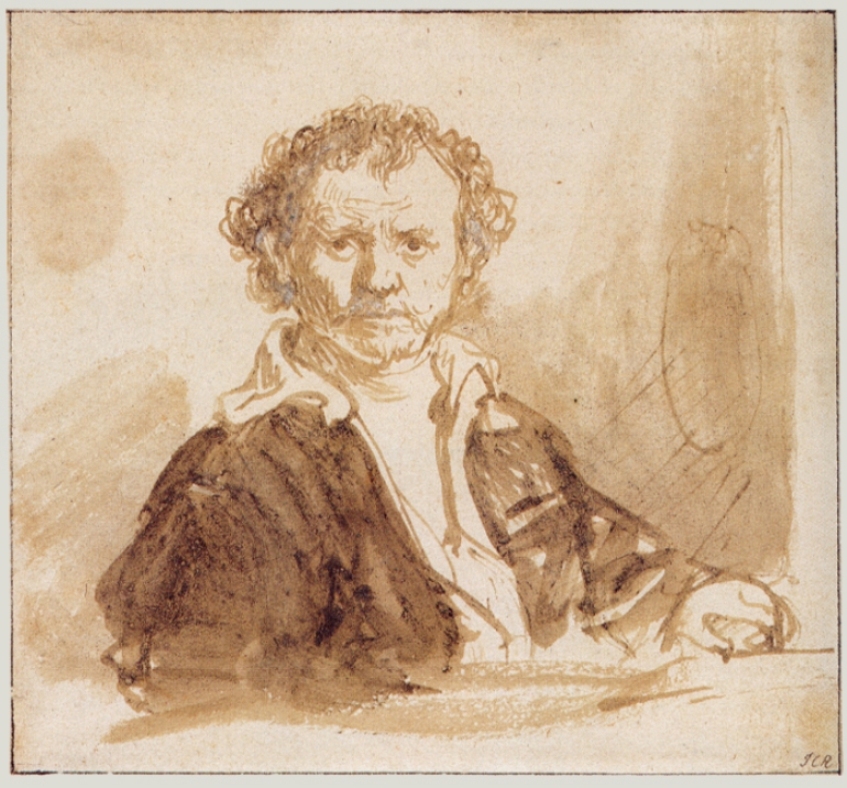
Rembrandt’s “Self-portrait” from 1637 is one of those small sheets that feel larger than the wall around them. The artist presents himself three-quarter length at a desk or ledge, torso angled, head turned frontally, eyes leveled to meet ours. The image is drawn in brown ink with wash and a few heightened touches, a vocabulary both spare and elastic. Nothing in it is theatrical. There is no spectacle of costume, no elaborate architecture, no symbolic clutter. And yet the page hums with presence: a thinking face, a body leaning into the moment, a room that seems to open and close around him like breath. What we witness is not the celebrity Rembrandt would later become but an artist in mid-stride, alert to his gifts and alert as well to the fugitive nature of the minute he is capturing.
Ink, Wash, and the Speed of Seeing
Technically, the sheet shows Rembrandt at his most agile with pen and brush. He outlines major forms with brisk ink strokes that thicken and taper according to pressure. Over those scaffolding lines, he lays transparent umber washes that float across cheek, sleeve, and background to create sudden weather—pockets of tone that drift and pool. At the junctions between line and wash, a distinctive energy emerges: contours are softened, then sharpened again where a pen stroke runs through a damp patch to leave a fuzzy feathering at the edge. This is the language of a draftsman who understands that drawing is not merely description but a way to trap time. The ink’s drying, the wash’s seep, the pressure of the hand—these become legible records of the seconds it took to make them.
Composing a Room Around a Head
The composition balances a compact head against a broad, simplified body and a field of tone that reads as studio wall. The shoulders flare outward like wings of a cloak, creating a dark base that makes the head blaze with attention. A diagonal sweep of wash at the right suggests either a window jamb or the shadowed face of a column; the same wash returns in weaker echoes along the left margin, where a pale oval—perhaps the ghost of a previous experiment with the brush—floats like a dropped note. These peripheral incidents keep the eye in play so that the frontal face never becomes static. The desk or ledge at the bottom is almost abstract, a slip of horizontal stroke that secures the figure in space while leaving the foreground open, as if we stand on the same floorboards.
The Head as an Engine of Expression
Rembrandt’s self-portraits are laboratories of facial construction, and this one is built with particular economy. The brow is massed with a few assertive strokes; the eyes are small, deep ovals surrounded by short flicks of line that indicate lids and bags without pettiness; the nose is two planes pivoting around a decisive bridge; the mouth, slightly compressed, is drawn with a handful of strokes that hint at skepticism and humor at once. The hair is a field of quick loops and ragged curls—a pen-scribble enlivened by wash—that frames the skull like a halo of unruly thought. What convinces is the constantly shifting degree of finish: the forehead and eyes are exacting; the cheeks, under the wash, are suggested; the jaw breaks into a sketch of beard. The head seems to find itself as we look, as if Tracing were still happening.
A Body That Speaks Without Posing
The torso, by contrast, is a theatre of gesture. Heavy sleeves fall into pyramidal folds that make the chest a platform for the head; the right forearm tilts toward us, but its exact position is left deliciously ambiguous, rendered as a mass of wash with a few decisive pen marks that imply elbow and cuff. That ambiguity is not negligence. It keeps attention on the face while allowing the body to suggest readiness—he could reach for a pen, turn a page, or push himself away from the desk. The coat’s open collar, drawn with a few zigzagging lines, stages a bright sliver of shirt that slices upward to the chin, a highlight that carries our gaze from torso to mouth in one breath.
Light That Climbs From Paper
There is no theatrically barred window or candle to declare the source of illumination, yet the sheet is full of light. Rembrandt achieves this by allowing the paper itself to do the work. He simply refuses to touch certain zones, letting them remain the white of the sheet, which reads as light falling across cheek, collar, and table edge. Around these reserved passages, the brown washes thicken, pushing the lit areas forward. The effect is not the staged chiaroscuro of the studio portrait but a daylit air, the diffuse glow of a working room that needs no explanation.
The Psychology of a Direct Stare
Many of Rembrandt’s self-studies from the 1630s explore expressive grimaces or dramatic three-quarter shadow. This one is quieter and more direct. The eyes meet ours head-on, and the expression settles somewhere between appraising and receptive. There is none of the contorted theater of practice faces; instead, this is the look of someone whose attention has been interrupted by the act of seeing himself. It is not vanity; it is curiosity anchored in responsibility. Because the gaze is level, the viewer becomes part of the studio—less spectator than interlocutor. The portrait’s intimacy grows from this reciprocity of attention.
Working Before a Mirror
Though the mirror is not depicted, its logic organizes everything. The left–right inversion typical of mirror drawing shows up in the way the garment falls and the direction of the turn. More importantly, the mirror sets the psychological terms: one person acting both as model and as observer, trying to outpace his own changing face. This doubling introduces a subtle tension between control and discovery. The wash that drifts and blooms across the right background can be read as the fog of the mirror itself, as if moisture and reflection share the paper with ink.
Costume, Status, and Studio Habit
The loosely draped coat and open shirt do not read as fancy dress or theatrical “Oriental” costume. They look like studio clothes—warm, accommodating, unshowy. This matters. In the mid-1630s Rembrandt prospered and excelled at portraits of burghers resplendent in lace and black satin; here he keeps his own image plain, refusing the visual rhetoric of status in favor of the rhetoric of work. Even the collar’s highlight does not parade as finery; it functions as composition. The message is not “behold the artist as gentleman,” but “behold the artist at work.”
The Right Side’s Quiet Mystery
The sheet’s right half holds one of its most intriguing features: a faint, ovalish form, with a few cross-lines within it, drifting behind the shoulder. It could be the ghost of a jug or a hanging, the blurred memory of a chair back, or simply a wash blot that the artist allowed to stand because it balanced the page. Whatever its precise identity, it functions like an abstract counterweight. Its vagueness keeps the background from collapsing into mere emptiness, adding a whiff of the room without competing with the figure. Rembrandt often permits such “accidents” to act as compositional agents; they signal trust in the vitality of the medium.
Line, Wash, and the Grammar of Drawing
The sheet is a compact lesson in Rembrandt’s graphic grammar. Pen line is the sentence: it states who, where, and what. Wash is the clause: it modifies, complicates, and slows the statement until it breathes. Where the two overlap, a small storm occurs—edges fuzz, values deepen, and the page feels less like a flat surface and more like a shallow space with air. In this self-portrait the balance tilts toward wash in the body and toward line in the head, a distribution that places intellect and attention in the crisp zone while letting the body relax into painterly breadth. The viewer senses mind and matter in active collaboration.
Mid-Career, Mid-Thought
Situating the sheet within Rembrandt’s career clarifies its temperature. In 1637 he was established in Amsterdam, newly married in the earlier part of the decade, enjoying commissions, perfecting etching, and flexing his powers in Old Testament narratives. He had not yet moved to the grand house he would purchase in 1639, nor faced the financial and personal storms of the 1650s. The self-portrait’s mood matches that moment: neither triumphant nor troubled, but keen and absorbed. It is the face of someone who knows he is good at what he does, who is listening for what he does not yet know.
A Conversation With Other Self-Portraits
Compare this sheet to Rembrandt’s etched self-portraits of the mid-1630s, where he tries out grimaces, haughty turns, and elaborate hats. Those prints are virtuosic studies in theater and social type. By contrast, this drawing sits closer to the painter’s self-portraits from later decades, where the drama retreats and presence deepens. In 1637 he has already begun to prefer the essential to the ornamental: the weight of the head, the line of the mouth, the angle of approach to the mirror. The sheet therefore occupies a transitional space, gathering the playfulness of earlier experiments into a calmer, more incisive gaze.
The Hand That Is and Isn’t There
One of the portrait’s pleasures is the implied hand. We do not see it in full; it is a blur of strokes near the lower right, a suggestion of fingers where the wash laps at the desk. And yet one cannot look at the face without feeling the hand’s presence—the hand that just made these lines, the hand about to make another. The omission is eloquent. It keeps the self-portrait from becoming an advertisement of skill and instead lets the drawing be a proof of it. We read the artist’s identity from the quality of attention, not from a displayed instrument.
The Ethics of Plainness
A self-portrait can be a boast. This one is a confession of craft. The plainness is ethical—a commitment to show just enough to be true and no more. The unmodeled patches of paper, the haze of wash allowed to float at the edge of form, the refusal to polish every contour into finish: these are not shortcuts but positions. They tell us that the artist believes the living parts of an image are often the ones left open for the viewer’s eye to complete. Such restraint is also a courtesy. It acknowledges that the viewer brings time and attention of their own.
Presence without Performance
What lingers after looking is the sensation of unforced presence. The artist is there: attentive, unsmiling, unsour. The face carries intelligence and a slight skepticism, as if measuring both himself and the act of showing himself. Because the studio is only implied, the context becomes the viewer’s space; because the dress is simple, the social message is not the point. The image belongs less to the market of identity than to the workshop of perception. We are not asked to admire the sitter; we are invited to join him in the game of making.
How to Look, Slowly
Begin at the eyes, then slide to the murky pool of wash at the right, where the room’s emptiness thickens like fog. Drift back along the collar’s white edge, up the beard’s quick strokes, and feel how the mouth is made with so little ink and yet carries so much decision. Let your gaze fall to the cuff, then along the table’s slim line, and notice how the lower border of the sheet suddenly feels like a ledge. Travel to the left shoulder, where a few heavy strokes turn cloth into weight, and finally return to the head. This circuit reveals a rhythm: crisp, soft, crisp again—a pulse that matches the portrait’s blend of alertness and ease.
Why It Still Feels New
Remove the date and the drawing could belong to any century that values frankness. Its modernity lies not in style but in temperament. The open background, the economy of means, the trust in the viewer, the preference for the incomplete truth over the complete falsehood—these make the sheet feel at home in today’s eyes. It is not an antique performance but a present-tense conversation with looking.
A Last Word on Self-Knowledge
Every self-portrait is a wager: can the act of looking at oneself reveal something that cannot be said otherwise? Rembrandt’s answer here is modest and profound. He offers no program, no emblem, no moral. He offers the feel of a human presence located by the simplest materials, as if to say that self-knowledge begins when attention steadies. The confidence is not loud. It is the confidence of a hand that knows where to stop.