Image source: wikiart.org
Introduction
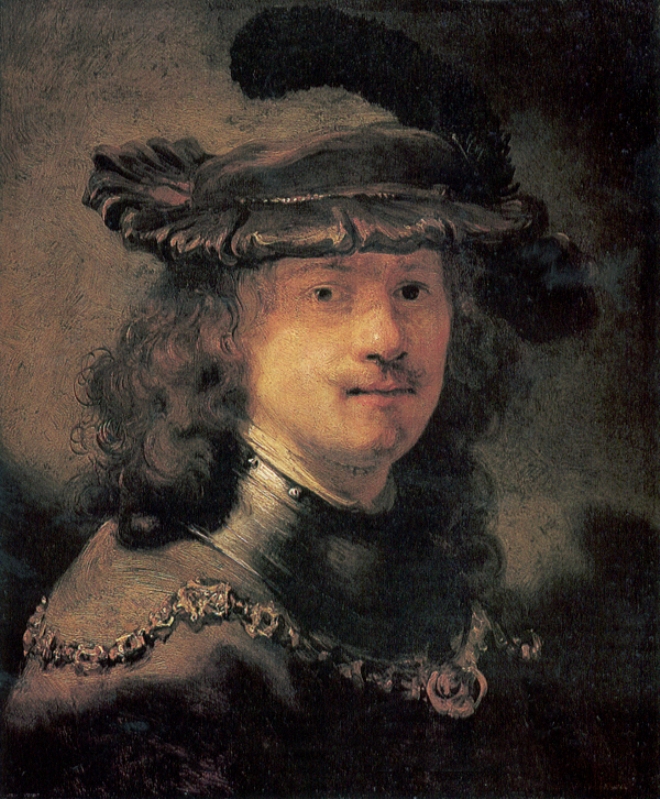
Rembrandt’s 1634 “Self-portrait” presents a young painter staging himself as a figure of rank and charisma. He appears in fanciful dress—a broad, beribboned cap with a plume, a polished metal gorget at the neck, and an ornate chain that glints across the chest—while his face, softly lit and alert, meets the viewer with a composed half-smile. The background is a thicket of warm darks through which his head and costume emerge in relief. The painting belongs to his first Amsterdam years, when he experimented relentlessly with persona and with paint, testing how far a self-portrait could travel beyond simple likeness into theater, marketing, and artistic manifesto. Every choice—costume, pose, lighting, brushwork—speaks to an artist announcing both talent and ambition.
Amsterdam in 1634 and the Young Master’s Strategy
In 1634 Rembrandt was twenty-eight, newly established in Amsterdam after formative years in Leiden, and recently married to Saskia van Uylenburgh. Amsterdam’s bustling market for portraits, history paintings, and prints rewarded visibility. Self-portraits functioned as studio signatures, demonstrations of skill, and advertisements for a painter’s range. This picture must be understood in that commercial and cultural context. By presenting himself in quasi-aristocratic dress rather than in a painter’s smock, Rembrandt appealed to the aspirations of patrons whose own likenesses would be shaped by his eye. He signaled that he knew how to make a person look important without sacrificing humanity, and that he could conjure the tactile pleasures of silk, metal, and feather alongside the subtleties of living skin.
Theatrical Costume and the Invention of Persona
The gorget, feathered cap, and chain are not documentary clothing for a day in the studio; they are props in a carefully crafted role. Northern artists had long practiced “tronies,” character studies in exotic dress used to explore expression, lighting, and texture. This self-portrait uses the tronie tradition but infuses it with autobiographical charge. The gorget evokes a soldier’s honor; the chain suggests noble orders; the cap—with its generous, ribboned brim and dark plume—adds flourish. Collectively, these elements stage Rembrandt as an actor-painter: not pretending to be a soldier or courtier, but adopting their visual language to declare the painter’s elevated calling. The persona is playful without being frivolous, which mirrors the complex claim of the picture itself: imagination is not escape; it is the means by which truth is made visible.
Composition and the Geometry of Presence
The head sits slightly off center, turned three-quarters to the viewer’s left, with the eyes meeting ours just below the upper third of the panel. The curve of the cap’s brim echoes the curve of the jaw and the shimmer of the gorget, establishing a rhythmic chain of arcs that keeps the eye moving. The metal collar acts like a reflective halo beneath the face, focusing attention upward while anchoring the bust within the darker field. The chain draws a gentle diagonal across the chest, adding forward momentum and a ceremonial note. Rembrandt encloses all this within a tight framing that excludes background distractions. The space feels intimate, as if the viewer had stepped into the studio and caught the painter turning from his easel.
Chiaroscuro as Character
Light is Rembrandt’s most persuasive rhetoric. Here it falls from the upper left, glancing first across the cheekbone and forehead, then catching the moist lower lip, the tip of the nose, and the subtle dome of the gorget. The far side of the face recedes into a half-shadow that preserves volume without flattening. This calibrated chiaroscuro scripts a psychology: confident yet private, warm yet measured. The gleam on metal and the subdued shine on satin sleeves are not merely technical demonstrations; they extend the portrait’s emotional range, contrasting the lively reflections of costume with the quieter, more absorbent planes of skin. Light behaves like a narrator, telling us who is before us and how to approach him.
The Face and Its Quiet Theatre
The success of the picture lies in the face’s poised naturalism. The mouth holds a small, closed smile—enough to signal alertness and self-possession, not enough to harden into manner. The eyes, enlivened by tiny catchlights, gaze straight out with a steadiness that stops short of challenge. Rembrandt models the flesh with translucent layers over a warm ground so that color seems to emanate from within rather than sit on top. The soft, downy moustache and the early fullness below the chin are rendered with an affectionate frankness. He allows the asymmetries of real anatomy—the unequal lift of eyelids, the individuality of nostrils—to persist, trusting that truth persuades better than polish. The young master is handsome, but in the way that presence, not cosmetics, makes a face beautiful.
Brushwork, Impasto, and the Pleasure of Painting
One can feel the hand at work everywhere. The feather is flicked in airy, lifted strokes, allowing actual bristle traces to mimic the softness of plumes. Along the rim of the cap, thicker, higher paint builds a ribboned relief that grabs light. The gorget contains oily, sliding highlights in which the brush seems to have skated deliberately, setting up a dialogue between smooth metal and textured paint. In the curls, Rembrandt alternates dry, dragged strokes with more syrupy coils, creating a living tangle. This variety of touch animates the surface and asserts paint as a material delight—an important part of the picture’s argument about the painter’s craft.
The Gorget and Chain as Emblems
The metal gorget functions both pictorially and symbolically. It gives a cool reflective plane just beneath the face, brightening the lower register and balancing the hat’s mass above. As symbol, it borrows the aura of the soldier—courage, honor, readiness—qualities a painter might claim in intellectual terms: courage to diverge from conventions, honor in representing truth, readiness to fight for artistic ideals. The chain adds a softer, gilded rhythm across the torso and ends near an ornamental device that behaves like a medal. Even if no literal order is implied, the suggestion of decoration says plainly that art is a discipline worthy of its own honors.
Hair, Cap, and the Play of Edges
The cap frames the head like an architectural cornice. Its soft, scalloped edge throws small shadows onto the forehead, while the plume dissolves into the background through airy strokes and darks that fade rather than cut. Around the hair, Rembrandt calibrates edges to control attention: certain curls crisp against the light field, others melt back into the shadowed ground. These optical games move the viewer in and out of the portrait’s space. Harder edges invite touch; softer ones breathe. The result is a head that seems to occupy real air rather than sit pasted on a flat backdrop.
Background as Atmospheric Field
The background is a swirl of warm browns and olive blacks, stirred by the movement of the brush into a subtle vortex behind the head. It functions as an acoustic panel for the portrait’s voice: absorbing noise, amplifying timbre. That restless yet subdued field draws the eye to the face and costume, while faint halations around hat and plume prevent a cut-out silhouette. The background’s painterly freedom also advertises versatility. Rembrandt can finish where finish matters and leave evident process where mood rather than detail carries meaning.
Dialogue with Precedents and Contemporaries
Self-portraits by northern masters of the previous century often show the artist with tools of trade or in sober dress. Italian prototypes favored classical elegance. Rembrandt’s image interpolates both traditions while asserting something new: the artist as man of imaginative station. Compared with Frans Hals’s lively, flickering touch, this portrait pursues a denser, more rounded modeling; compared with Anthony van Dyck’s aristocratic suavity, it stakes its charisma on forthright presence rather than entourage. The painting thus markets a distinctive brand—northern intimacy with baroque authority—and it would influence how later artists conceived the self-portrait as a site of self-fashioning.
The Business of Self-Portraiture
Self-portraits in the 1630s doubled as shop signs. Prospective patrons saw, in the artist’s own image, proof of how their portraits might feel: the sparkle on metal and fabric, the flattering yet credible light, the stable geometry within a dark, tasteful surround. By appearing in rising costume, Rembrandt reassured clients that he could confer dignity; by letting the face retain candid individuality, he promised truth. The work sold an approach: ornament enriches but never replaces character. It also circulated as a model for pupils in the studio, demonstrating how to coordinate costume, lighting, and expression into a persuasive whole.
Humanity within Role-Play
The risk of theatrical dress is hollow spectacle. Rembrandt avoids the trap by giving the costume plausible weight and by grounding the performance in an unforced expression. The skin is tender; the gaze is thinking; the mouth has a trace of humor. He lets us enjoy the pleasures of the plume and chain while never losing sight of the person who wears them. The picture insists that identity can be explored through masks that, paradoxically, reveal rather than conceal. In this way the self-portrait participates in a broader baroque fascination with role and selfhood while retaining a distinctly Dutch sobriety.
Material Layers and the Glow from Within
Technically, the painting is a lesson in layered construction. A warm ground sets the stage; mid-tone underpainting establishes volumes; glazes and scumbles build atmosphere; focused impasto clinches key highlights. Because the face is not heavily impasted, light seems to arise from subsurface color, lending the flesh an internal warmth. By contrast, the cap’s ribbons and the chain are built with thicker paint that catches external light. The oscillation between inner and outer radiance—glow from within, sparkle from without—enriches the drama and keeps the eye circulating.
Comparison to Other 1634 Self-Images
Rembrandt painted several self-portraits around this time, each testing a new register: genial young man with beret, more severe bust in armor, playful masquerader. The present image sits between swagger and introspection. It has more authority than the earlier Leiden examples and more warmth than later, more solemn self-portraits. In it we see the hinge of development: a painter confident enough to dress up, yet already committed to the truth of light on a living face.
Conservation, Surface, and Time’s Patina
The painting’s current surface reveals subtle craquelure in the darker fields and a slightly softened contour in areas where varnish has mellowed, effects that only deepen the perceived atmosphere. Rembrandt’s robust layering withstands time because he built harmonies from earth pigments and lead whites that age gracefully. The remaining vitality of the feather strokes and the gleam on the gorget attest to an artist who understood how to balance durability with immediacy.
The Psychology of the Gaze
Viewers repeatedly return to the eyes. They do not stare challengingly; they welcome. Because Rembrandt sets them within gently domed sockets and places small, bright highlights just off center, the gaze appears moist, alert, and perpetually in the act of seeing. A self-portrait is a reciprocal machine—the painter looks at himself as he looks at us—and these eyes capture that recursive loop. We are seen by someone who is looking and painting at once, and the portrait records that charged triangle of gazes: artist, mirror, viewer.
Meaning and Afterlife
As an artifact, the painting testifies to a culture that could reward a painter for projecting himself with noble associations while remaining recognizably human. As an image, it still works because it balances opposites: costume and candor, bravura and restraint, performance and truth. Many later self-portraits—Goya in a studio mirror, Courbet as a wounded man, photographers staging themselves in elaborate guises—owe a debt to Rembrandt’s willingness to use the self as laboratory. Here, in 1634, the experiment yields an identity we can trust precisely because it is constructed with intelligence and heart.
Conclusion
Rembrandt’s “Self-portrait” of 1634 is less a snapshot than a crafted statement. In a few square feet he argues for the dignity of painting, for the legitimacy of imaginative dress, and for the inexhaustible interest of the human face under thoughtful light. The feather, the gorget, the chain, the ribbons—these delights draw us in; the eyes and mouth hold us; the brushwork rewards prolonged looking with a hum of tactile pleasure. The young master looks out from his studio with calm confidence, presenting himself as both maker and model, as a man who understands that art is one of the surest ways to become fully present to the world.